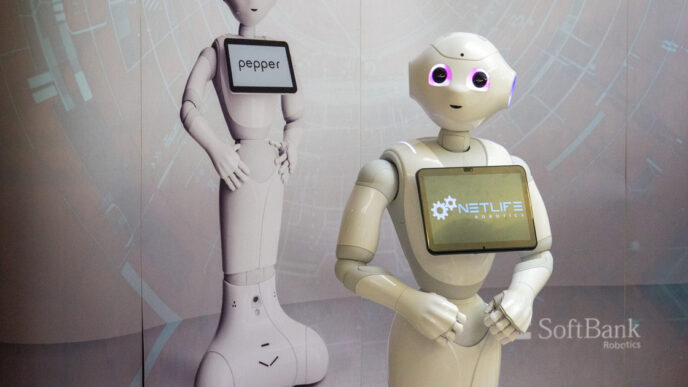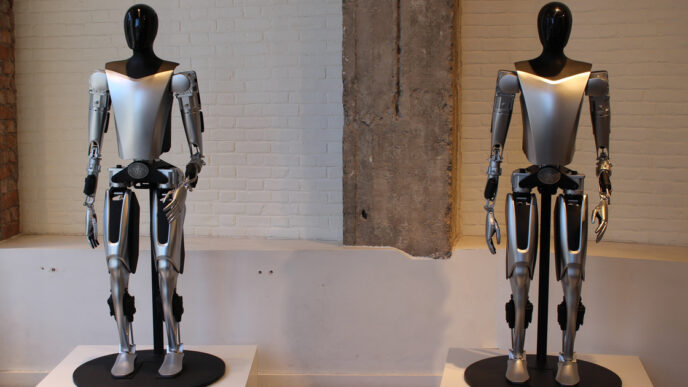
A humanoid robot is a machine built with a human-like body plan, typically a head, torso, two arms with hands, and either two legs or a wheeled base, so it can work in spaces and with tools designed for people. In 2026 humanoids are moving from research labs into factory and warehouse pilots, but only a handful are on sale, and most public demonstrations show far less independence than they appear to.
The short definition
- Humanoid: a robot with a human-like layout, usually two arms and a head-height sensor package, on legs or wheels.
- Not every humanoid walks. Some use a wheeled base to move faster and balance more easily. Apptronik’s Apollo 2, for example, was unveiled in bipedal and wheeled-base versions.
- Not every robot with arms is humanoid. Industrial arms, robot dogs, and delivery carts are not.
Why build robots shaped like people?
The argument made by companies is practical, not aesthetic. Buildings, shelves, stairs, and tools already fit the human body. A humanoid could, in principle, work in a facility without redesigning it. Boston Dynamics also notes that human-like hands let robots use tools made for people and learn from human demonstration data. These are company positions: critics point out that wheeled or specialized robots are often cheaper and more reliable for a single task, and the humanoid case depends on generality that has not yet been shown at scale.
How a humanoid robot works
| System | What it does | Learn more |
|---|---|---|
| Actuators and joints | Motors and gearboxes that move limbs; torque, speed, and weight set what the robot can lift | Humanoid locomotion systems |
| Sensors | Cameras, depth sensing, force and tactile sensing, balance sensors | Humanoid robot sensors |
| Hands | Grippers or multi-finger hands; the hardest part to make both strong and dexterous | Dexterous robot hands |
| Power | Batteries, charging or swapping; most humanoids run for hours, not days | Robot batteries and charging |
| Control software | Balance and whole-body control, often trained by reinforcement learning in simulation | AI models in humanoid robots |
| Task-level AI | Models that turn camera images and instructions into actions | See our explainer on vision-language-action models |
| Safety systems | Detecting people, stopping, limiting force | Humanoid robot safety systems |
Demo, pilot, or product? A four-level evidence ladder
Headlines often blur very different stages. We use four levels throughout this site:
- Demo: a video or live show. It may be scripted or teleoperated (a human is controlling the robot remotely).
- Internal use: the company uses its own robots for development and data collection.
- Pilot: a named customer tests the robot in a real workplace, usually in a limited role.
- Commercial: customers can order, and units are delivered under contract with published terms.
Always ask whether a task was done autonomously or with a remote operator. 1X, for example, says its NEO home robot has an “Expert Mode” in which 1X staff can remotely guide the robot through chores it does not know yet.
Examples in 2026 and where they sit
Figures below are company-reported unless stated. “Not publicly disclosed” means the company has not published the figure.
| Robot | Maker | Key published figures | Status (our reading) |
|---|---|---|---|
| Atlas (product version) | Boston Dynamics | 1.9 m, 90 kg, 56 degrees of freedom; payload 50 kg instant / 30 kg sustained | In training at Hyundai’s Georgia application center since Sept 2026; research partnership with Google DeepMind; price Not publicly disclosed |
| Digit 5 | Agility Robotics | 5’11”, 284 lb, 50 lb repeated lift, 90-min battery | Announced Sept 15, 2026; early access expected 1H 2027; price Not publicly disclosed |
| Figure 03 | Figure | 5’8″, 61 kg, 20 kg payload, 5-hour runtime | Figure reports 350+ built by April 2026, allocated to internal R&D, data collection, and commercial use-case development; Figure describes a BMW logistics deployment; price Not publicly disclosed |
| G1 | Unitree | 1.32 m, about 35 kg; US $13.5K base price excluding tax and shipping | On sale (orderable); research-oriented |
| NEO | 1X | 66 lb, $20,000 early access price | Preorders; US deliveries “in 2026” per 1X; we have not seen verified customer deliveries |
| Optimus | Tesla | Not publicly disclosed | Internal use; not for sale. See Tesla Optimus status |
For a ranked comparison, see our guide to the best humanoid robots in 2026.
What humanoids can and cannot do today
- Moving and lifting totes and parts: being piloted in logistics and automotive settings. See humanoid robots in logistics.
- Fine hand work: still hard. Google DeepMind says multi-finger dexterous manipulation “remains challenging.”
- Household chores: companies market this, but public evidence of reliable, unassisted home operation is limited. Read demos with the autonomy question in mind. See humanoid robots for home use.
- Working beside people safely: a design goal with new safety approaches emerging; standards are still developing.
Buying a humanoid: two caveats
Published prices run from about $4,900 (Unitree R1 Air) and $13,500 (Unitree G1 base) up to $20,000 (1X NEO early access); prices for industrial humanoids are generally not published. In the United States, the FCC added foreign-produced “advanced robotic devices”, including humanoids, to its Covered List in 2026. New models cannot receive FCC authorization for sale, while models already authorized may still be imported and sold. See the FCC FAQ before buying an imported robot.
Frequently asked questions
Are humanoid robots available to buy?
A few are. Unitree sells the G1 with a published base price, and 1X is taking orders for NEO. Most industrial humanoids are sold through pilots or enterprise agreements with unpublished pricing.
Do humanoid robots think for themselves?
They run AI models that map camera input and instructions to movement, and some tasks are done autonomously. Many demonstrations still involve teleoperation or tightly scripted conditions, so check how a demo was produced.
Why are most humanoids shown moving boxes?
Tote and part handling is a bounded task with known objects and layouts, so it is easier to make reliable than open-ended household work.
Related reading
Sources
- Boston Dynamics, “Enterprise Robotics, Redefined” (Atlas product version, Jan 5, 2026): bostondynamics.com; Atlas spec sheet: PDF
- Boston Dynamics, “Robot Hands for Modern AI and Real Work”: bostondynamics.com
- Agility Robotics, Digit 5 announcement (Sept 15, 2026): agilityrobotics.com
- Figure, Figure 03 specifications: figure.ai/figure; “Ramping Figure 03 Production” (Apr 29, 2026): figure.ai; “Figure 03 at BMW” (June 30, 2026): figure.ai
- Unitree G1 product pages: unitree.com/g1; R1: unitree.com/R1
- 1X, “NEO Home Robot” (Oct 28, 2025): 1x.tech; NEO factory update (Apr 30, 2026): 1x.tech
- Apptronik, “Welcome to Robot Park” (June 30, 2026): apptronik.com
- Google DeepMind, “Gemini Robotics 2”: deepmind.google
- FCC, Covered List FAQs (robots and inverters), updated Oct 2, 2026: fcc.gov
Last updated: October 4, 2026. To report an error, see our corrections page. Articles are drafted with AI assistance and reviewed and edited by an editor; see our editorial policy.