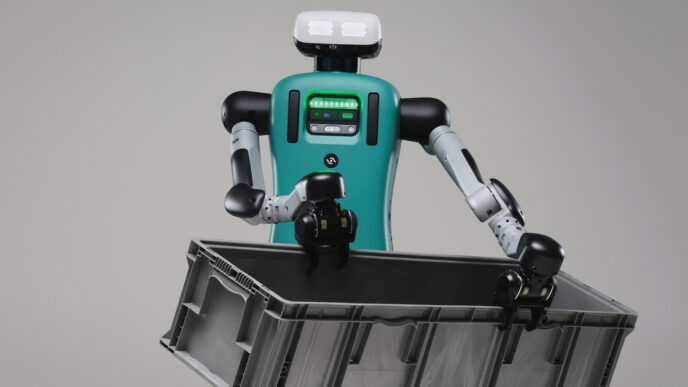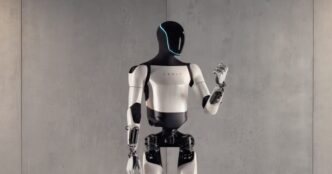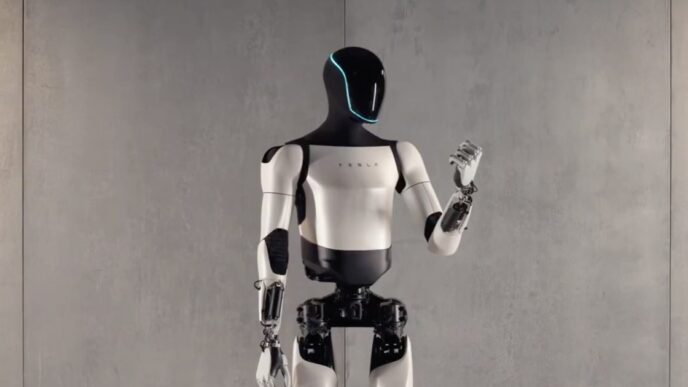
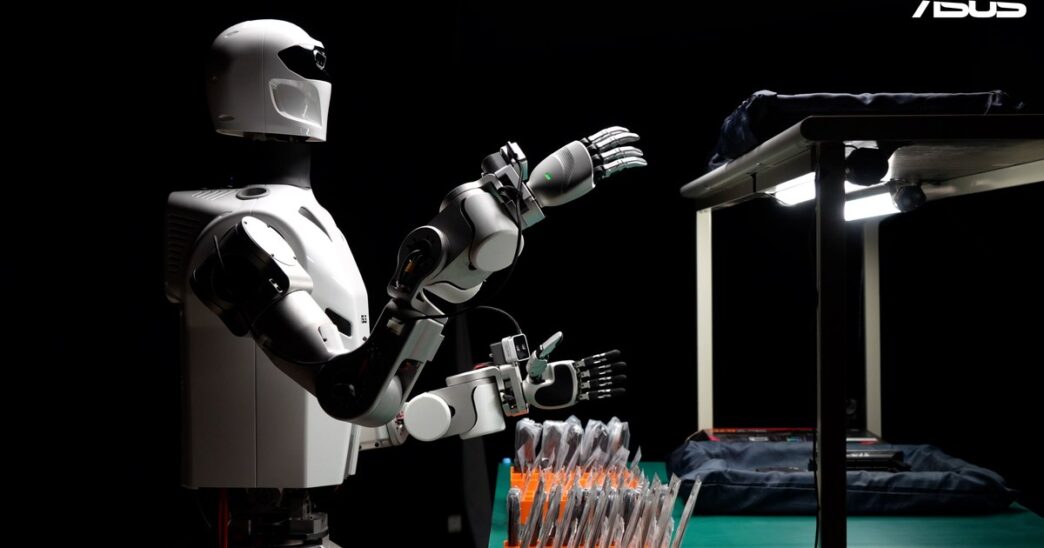
ASUS, the Taiwanese maker of PCs, motherboards and servers, has shown its first humanoid robot. ASUS Gallop is a two-armed robot on a fixed base that is learning to pack motherboard accessories at an electronics factory run by the ASUS group. Co-CEO S.Y. Hsu introduced it in a CNBC interview posted on November 12 (U.S. Eastern time), and ASUS followed with a longer explanation on its pressroom blog on November 13, written by Dr. Albert Chang.
The plan is unusually specific about the job and the bar. The packing station has 15 small parts, many sealed in thin, clear bags, and a board passes about every 20 seconds. ASUS says its target is 99.5% success within those 20 seconds, “the same standard we hold a person to.” It hasn’t published how close Gallop is to that target, or any specifications or a price. Customer pilots are planned for 2027, and market availability is targeted for the second half of 2028.
- What: ASUS’s first humanoid robot, a fixed-base, two-armed machine with an ASUS-designed body and hand, running on a single NVIDIA Jetson AGX Thor computer.
- Where it works: a motherboard accessory packing station at an ASUS group electronics manufacturing (EMS) plant. ASUS’s target is 99.5% success within a 20-second cycle.
- When: customer pilots in 2027, a wheeled version and a Computex 2027 showing, and market availability targeted for the second half of 2028.
- The catch: no measured success rate, no specs (height, weight, payload, degrees of freedom, battery) and no price. Training includes sessions in which an operator guides the robot over VR.
What ASUS Gallop does today
Gallop’s first job is the last step before a motherboard goes in its box: putting the accessories in with it. ASUS chose the station because it is hard. “Small, thin, and soft parts are exactly what a simple gripper can’t handle,” the blog says. Hsu made the same point on CNBC, saying many of the accessories “are very small and put in a plastic bag, so it needs some special training to handle those kinds of parts well,” as Humanoids Daily transcribed the interview.
ASUS also sets a second test for itself, and it’s a useful one for anyone judging a factory robot: the robot has to take on most of a job. “If a person still has to stand beside it the whole time, nobody gains anything,” the blog says. On progress, the company’s claim is that “the full loop now works: a person shows the task, the robot learns it, and we test it on the line.” That is a statement about a working process. It isn’t a success rate, a cycle time or an intervention count, and ASUS hasn’t published any of those yet.
Why a humanoid at all? ASUS’s argument is that factories are built around people, so a robot with two arms and dexterous hands can use the same stations, tools and trays without the line being rebuilt. On CNBC, Hsu tied this to low-volume, high-mix production, where lines change often and dedicated automation is hard to justify. ASUS adds a caveat of its own: “Not every task needs a humanoid, and we choose the ones that make sense.”
How Gallop learns, and where people stay in the loop
ASUS says it doesn’t build its own large AI model. Gallop starts from “leading open models,” which ASUS doesn’t name, and each task is then taught in four further steps, per the blog:
- Watching people. Experienced workers wear a small head camera, “with their consent,” so the robot can learn how the job is actually done.
- Simulation. Variations of each recorded example are generated so small changes on the line don’t surprise the robot.
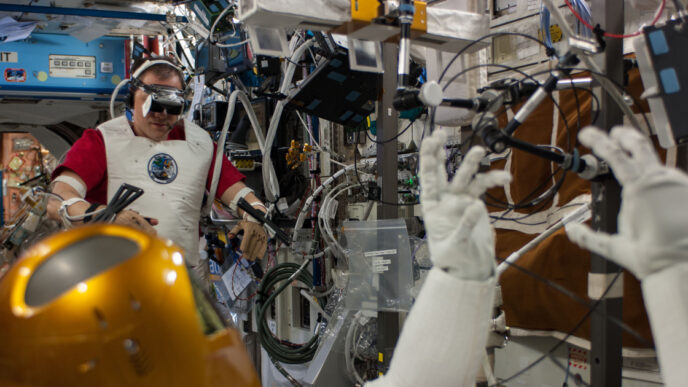
- Guided practice. An operator wearing a VR headset and gloves guides the robot through the task, with the same parts and cameras as the real station. This is teleoperation used to collect training data.
- On-the-job learning. Once deployed, what the robot records feeds back into training.
None of that is unusual, and using teleoperation for training data doesn’t mean the robot is remote-controlled at work. But it does mean footage of Gallop should be read with the questions in our guide to teleoperation versus autonomy in humanoid demos until ASUS reports how often a person steps in on the line.
The software is split into four layers. A “planner” looks at the scene and breaks the job into steps. A “supervisor,” a second AI, checks every step and re-plans when something goes wrong. A skills layer handles reaching, grasping and placing, and a control layer moves the arms and hands and “stops instantly if anything is wrong.” ASUS says the layers talk through fixed interfaces so a better model can be swapped in “without rebuilding the robot,” which it expects to happen every few months.
The hardware ASUS has described, and the specs it hasn’t
Everything runs on one NVIDIA Jetson AGX Thor computer inside the robot. NVIDIA rates the Jetson Thor family at up to 2,070 FP4 teraflops with 128 GB of memory, at 40 to 130 watts. When CNBC asked whether the NVIDIA partnership was intact, a day after Jensen Huang resigned as NVIDIA’s CEO, Hsu said ASUS is building Gallop with NVIDIA on Jetson Thor, according to Humanoids Daily’s account of the interview.
That puts Gallop in a growing group. Agile Robots’ compact Agile ONE SN research humanoid ships with a Jetson Thor, Agility says the general-availability Digit 5 standardizes on NVIDIA IGX Thor, and UK maker Humanoid replaced two onboard computers with one Jetson Thor in October, Humanoids Daily reports.
ASUS designs Gallop’s body and dexterous hand in-house and says the hand has a sense of touch. It calls the hand “the hardest part of any humanoid,” and “still scarce worldwide.” Motors and other standard parts come from suppliers it doesn’t name. Today Gallop works from a fixed base with two arms. A wheeled version comes next, and over the coming year ASUS plans to fit its own hand to the robot and show it to customers at Computex 2027.
What’s missing is the spec sheet. ASUS hasn’t published Gallop’s height, weight, degrees of freedom, payload, battery life or price, and the photo ASUS released shows a robot mounted on a pedestal. For buyers that matters more than it sounds: a fixed-base, two-armed robot at a station competes with collaborative robot arms, which have published prices and payloads.
How Gallop compares with other humanoids working in their makers’ own plants
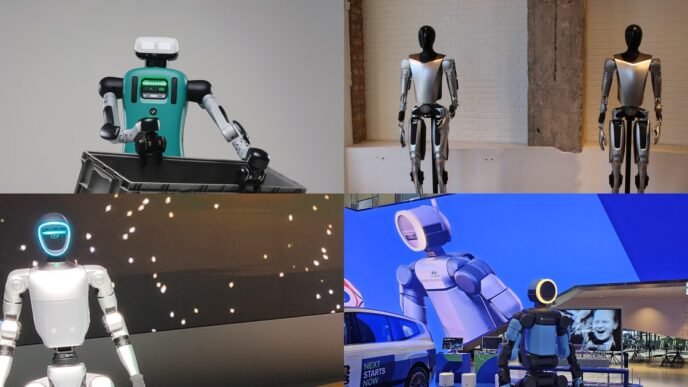
Testing in a factory you own is becoming the standard first step. We compared Gallop with four other programs using each company’s own disclosures and our humanoid readiness levels, where Level 3 means internal use and Level 4 means a pilot with a named outside customer.
| Maker and robot | Where it works | Published result | Outside customers | Our level |
|---|---|---|---|---|
| ASUS Gallop | Motherboard accessory packing at an ASUS group EMS plant | Target only: 99.5% within 20 seconds | Pilots planned for 2027 | 3, internal use |
| Xiaomi humanoid | Side-cover sorting in Xiaomi’s car factory | 8 hours 5 minutes of “stable operation” (Nov 3); no throughput or intervention figures | None announced | 3, internal use |
| Agile Robots (wheeled humanoids) | Supplying lines at its own Fürstenfeldbruck plant | About ten humanoid systems built per day in September (reported); deliveries undisclosed | Audi proof of concept | 3, with a lab proof of concept |
| Tesla Optimus | Tesla’s “Optimus Academy” for data collection | No task results published | None | 3, internal use |
| Boston Dynamics Atlas | Hyundai’s Robotics Metaplant Application Center, Georgia | No task results published | None outside Hyundai | 3, internal use |
Sources: ASUS’s blog; our coverage of Xiaomi’s eight-hour shift and Agile Robots’ Series F; Tesla and Boston Dynamics placements from our readiness-levels table (October 2026). Levels are our editorial placements, not industry ratings.
Our take: a credible first job, but a target is not a result
ASUS has picked the right way to introduce a factory humanoid. One hard station, a pass mark set against a human worker, and a factory it controls make for a claim that can be checked, which is more than most humanoid launches offer. Its own line about demos is the best summary: “A demo shows that a robot can do something once. A factory needs a robot that does the job every day.”
By that standard, Gallop hasn’t shown the result yet. Our placement is Level 3: internal use in the parent group’s plant, with no outside customer. The move to Level 4 would be a named pilot customer in 2027. The number we’d most like to see is the one ASUS has already defined: the measured success rate at 20 seconds, together with how often a person has to step in. If ASUS publishes those during the pilots, Gallop becomes one of the better-documented factory humanoids. If it doesn’t, the 99.5% figure stays a goal.
Two things work in ASUS’s favor. It builds the computers robots depend on and has its own EMS lines to test on, which most robot startups have to rent. And its swappable-model design is a reasonable bet while robot AI changes every few months. The risk is the timeline. Market availability in the second half of 2028 is about two years out, and by then a fixed-base, two-armed station robot will be judged against cheaper collaborative arms as much as against other humanoids. ASUS will need to show that its hand, and the humanoid form, earn their cost at the station.
Frequently asked questions
What is ASUS Gallop?
Gallop is ASUS’s first humanoid robot, built by the Humanoid Robotics business unit of its Physical AI Solutions Business Group. It is a two-armed robot on a fixed base with ASUS-designed hands, and it runs on one NVIDIA Jetson AGX Thor computer. A wheeled version is planned.
When will ASUS Gallop be available?
ASUS plans customer pilots in 2027 and is targeting market availability in the second half of 2028. Co-CEO S.Y. Hsu told CNBC that Gallop will be released to partners in the second half of 2027. ASUS also plans to show it at Computex 2027.
How much does ASUS Gallop cost?
ASUS hasn’t announced a price. It also hasn’t published Gallop’s height, weight, payload, degrees of freedom or battery life.
What does ASUS Gallop do?
Its first job is packing motherboard accessories at an ASUS group factory: 15 small parts, many in thin plastic bags, in a cycle of about 20 seconds per board. ASUS’s target is 99.5% success within 20 seconds. It hasn’t published a measured rate.
Is ASUS Gallop autonomous?
ASUS describes a robot that learns tasks and runs them with an AI planner and a supervising AI. Its training includes sessions in which an operator guides the robot over VR, which is a form of teleoperation. ASUS hasn’t said how often a person intervenes on the line.
Sources
- ASUS Pressroom: “Factory-Proven Physical AI: Why ASUS Is Building a Humanoid Robot,” by Dr. Albert Chang, November 13, 2026
- CNBC: “ASUS announces first humanoid robot: Gallop,” interview with S.Y. Hsu, November 12, 2026
- Humanoids Daily: “ASUS Unveils Gallop, Its First Humanoid Robot, Already Packing Parts on Its Own Production Line,” November 13, 2026
- NVIDIA: Jetson Thor product page
All sources accessed November 14, 2026.
Last updated: November 14, 2026. To report an error, see our corrections page. See our editorial policy.