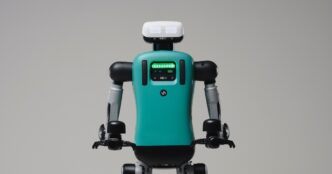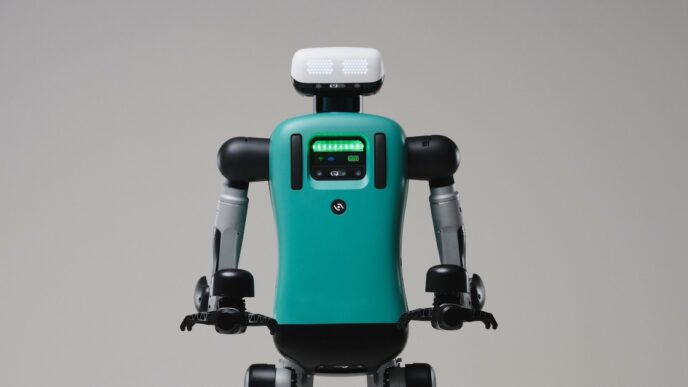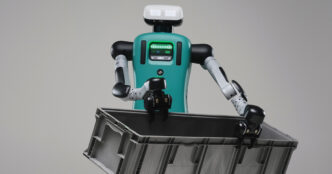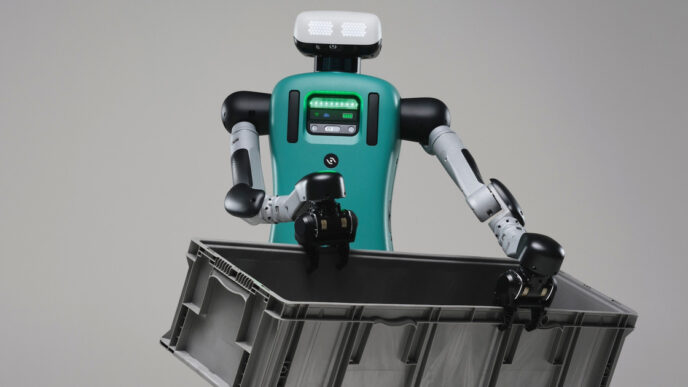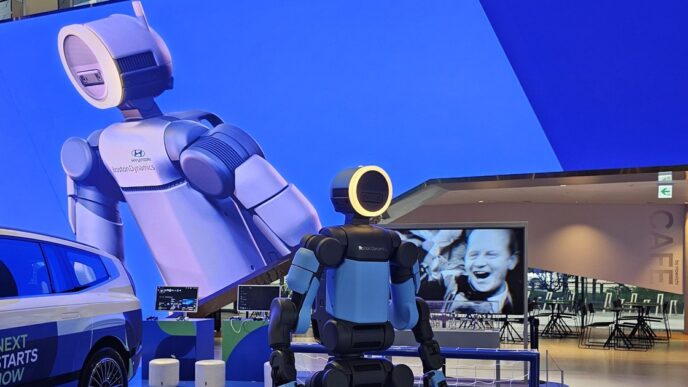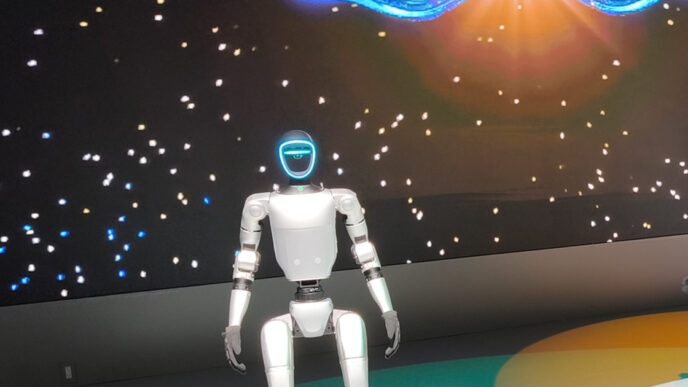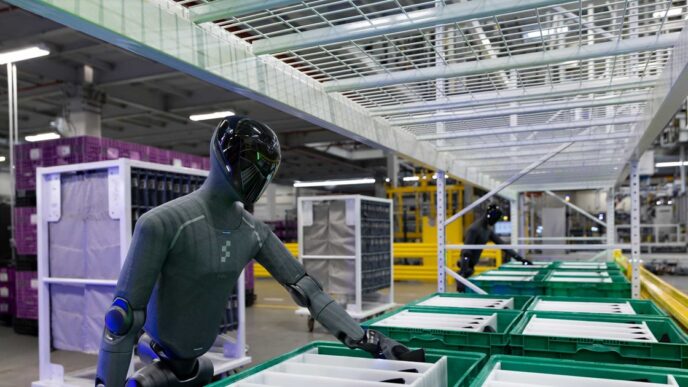
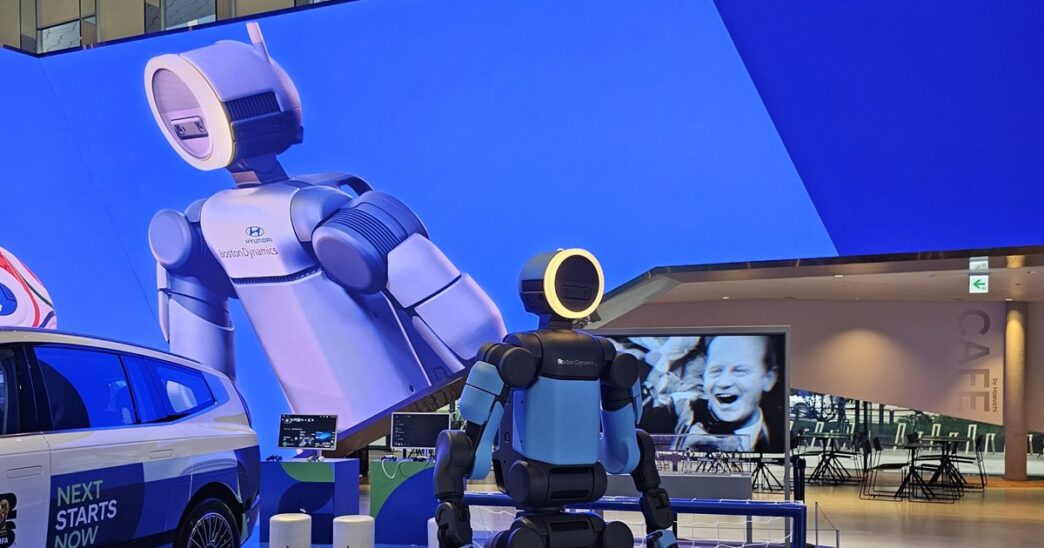
Hyundai Motor Group plans to put 25,000 Atlas humanoids to work in Hyundai and Kia plants “over the next few years,” according to Boston Dynamics. Today the robots are doing something much more modest: training. Since September 21, 2026, an undisclosed number of electric Atlas units have been learning to prepare and sequence auto parts at a new center inside Hyundai’s Georgia Metaplant, near Savannah.
That gap between the plan and the practice is the story of Atlas’s commercialization in 2026. It’s also the cleanest example of a problem across the humanoid industry, where big unit targets arrive years before anyone publishes deployment numbers. Boston Dynamics’ own boilerplate still calls Atlas its “electric humanoid platform currently in development.” That didn’t change when the company named a new CEO this week.
A training center, not a factory-floor win (yet)
The facility is called the Robotics Metaplant Application Center, or RMAC, and it sits inside Hyundai Motor Group Metaplant America (HMGMA). In its September 21 announcement, Boston Dynamics describes RMAC as a testbed and training center for fitting Atlas into Hyundai’s car manufacturing. Phase one is up and running. The first job is getting automotive parts staged and sequenced before they reach the assembly line.
Over time, the company says, Atlas will take on repetitive, strenuous work such as lifting heavy loads, and its applications will extend to component assembly by 2030.
A training center on the parent company’s campus is a real step. It shows Hyundai is serious about the program. It’s not proof that Atlas is doing paid production work, generating revenue, or available to outside customers. Boston Dynamics hasn’t claimed any of those things, and you shouldn’t read them into it. (We’ve written separately about how to tell a training demo from autonomous work.)
The roadmap runs to 2030, and every date is a plan
Here’s the timeline as Boston Dynamics and Hyundai have laid it out:
| When | What’s planned | Who says so |
|---|---|---|
| Now (Sept 2026) | RMAC phase 1 operational; Atlas in training on parts logistics and sequencing | Boston Dynamics release |
| 2027 | RMAC moves to an HMGMA building about 10 times larger; Boston Dynamics also plans to explore non-automotive uses and is talking with Spot and Stretch customers about data collection | Boston Dynamics release |
| 2028 | Parts-sequencing work at HMGMA | Hyundai Motor Group journal coverage of the program |
| 2030 | Component assembly | Boston Dynamics release |
None of these dates comes with acceptance criteria, unit counts or a customer sign-off. Treat them as management targets until Hyundai or Boston Dynamics confirms live production work with a scope and a start date.
The 25,000-robot number has no delivery schedule
The September release says the Group plans to expand Atlas deployment “beginning with” 25,000 units at Hyundai Motor and Kia plants worldwide over the next few years. It also plans a US factory capable of building 30,000 robots a year.
Those are the numbers that made headlines. Here’s the catch: both are internal plans by Boston Dynamics’ own parent company, not orders from an independent customer. Neither comes with a delivery schedule or a unit price, and there’s no start year for the factory. They sit in the same release that calls Atlas a platform in development. They’re a statement of intent from the buyer who owns the seller. That counts for something, but it isn’t booked revenue. For how other humanoid makers are raising money and reporting orders, see our robotics funding tracker.
A new CEO, but no new Atlas date
On October 6, Boston Dynamics announced that Rohit Prasad becomes CEO effective October 7, 2026. Prasad was previously Amazon’s senior vice president and head scientist for Alexa and AGI, and led the Amazon Nova model family. Subject to approval, he’s also expected to join the board. The release frames his job around commercializing “Physical AI,” and it quotes Jaehoon Chang, Hyundai Motor Group’s vice chair and chair of Boston Dynamics’ board.
What the release doesn’t include is just as telling. There’s no new Atlas availability date, no price and no change to the RMAC roadmap. Hiring an AI executive tells you where the company thinks the hard problem is. It doesn’t count as a deployment milestone.
What Atlas looks like on paper
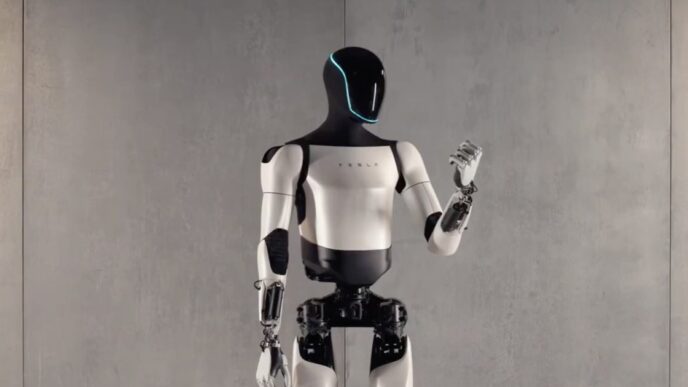
Boston Dynamics has published product-style specifications for the electric Atlas. It’s about 1.9 meters tall and weighs about 90 kg, with 56 degrees of freedom. The spec sheet lists payload figures, a roughly four-hour battery that can be swapped, an IP67 rating, and operating modes that include autonomous, VR teleoperation and tablet control. Those are company figures. They describe a capable machine, but they don’t tell you whether it’s ready for a factory shift, and they don’t come with a price. The newest piece of hardware, a four-finger hand with no pinky, was unveiled on October 1. It’s a hardware milestone too, not a deployment one.
What Boston Dynamics hasn’t said
The list of open questions is longer than the list of answers. Boston Dynamics hasn’t said:
- how many Atlas units are at RMAC
- whether they use the new hand
- how much of their training work is teleoperated rather than autonomous
- what safety certification they’d need for production use at HMGMA
- what Atlas costs to buy, lease or rent as a service
- when, or with what money, the 30,000-a-year factory gets built
Nor is there any independent data on Atlas’s productivity.
That puts Boston Dynamics in a different position from its rivals. Agility has SEC filings with order figures for Digit 5, 1X has a consumer price list, and Figure has published detailed Figure 03 specs and named customers. Boston Dynamics is betting on a parent manufacturer as its proving ground, backed by its existing commercial Spot and Stretch businesses. We compare all of them, plus Tesla Optimus, in our best humanoid robots of 2026.
What to watch
The next concrete marker is the 2027 move into the larger RMAC building. The more useful signal would come sooner: a robot count, a shift length, or footage of Atlas handling real parts on the Metaplant floor. Hyundai has given the industry a 25,000-unit headline. The question for Prasad’s first months is whether Boston Dynamics will start publishing the smaller numbers that would make that headline believable.
Frequently asked questions
Is Atlas commercially deployed at Hyundai?
Not as a confirmed production deployment. Boston Dynamics says Atlas is in training at RMAC, inside Hyundai’s Georgia Metaplant, and still calls Atlas a platform in development. Parts sequencing at the plant is framed as a 2028 plan.
What is RMAC?
It’s the Robotics Metaplant Application Center, Boston Dynamics’ testbed and training center at Hyundai Motor Group Metaplant America near Savannah, Georgia. The company said phase one was operational on September 21, 2026.
When will Atlas do production work?
Company and Hyundai plans point to parts sequencing from 2028 and component assembly from 2030. Those are targets, not confirmed production start dates.
How much does Atlas cost?
Boston Dynamics hasn’t published a price, lease rate or robots-as-a-service fee for Atlas.
Did the new CEO change the Atlas timeline?
No. The October 6, 2026 release naming Rohit Prasad as CEO didn’t include a new Atlas timeline, and it still describes Atlas as in development.
Sources
- Boston Dynamics, “Boston Dynamics Opens Robotics Metaplant Application Center to Train Humanoid Robots for Manufacturing Tasks,” Sept 21, 2026: company release
- Boston Dynamics, “Boston Dynamics Appoints Rohit Prasad as Chief Executive Officer,” Oct 6, 2026: company release
- Hyundai Motor Group journal coverage of the Atlas/RMAC roadmap (parts sequencing 2028; assembly 2030); dated targets treated as plans
- Boston Dynamics Atlas product materials (company specifications)
Last updated: October 7, 2026. To report an error, see our corrections page. Articles are drafted with AI assistance and reviewed and edited by an editor; see our editorial policy.