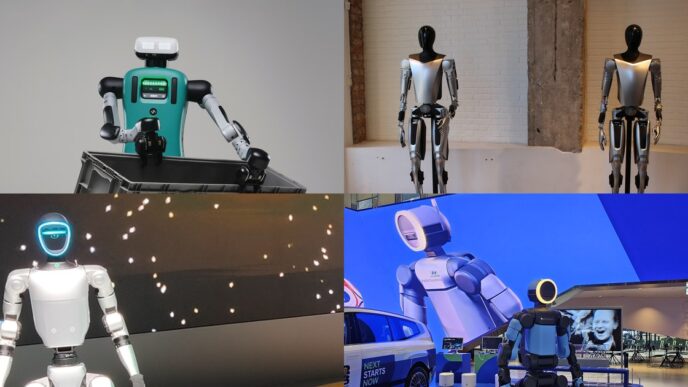
AgiBot says 20,000 of its robots have rolled off the production line. Unitree says it has produced about 18,000 bipedal humanoids. Neither number counts robots sold, and Unitree’s own IPO prospectus shows how wide that gap can get.
Humanoid robot production numbers are now used to rank the industry, price IPOs and justify purchases, usually without anyone checking which verb sits next to the figure. Here’s what each maker’s number actually counts, from the two five-figure claims to the sold-unit totals in filings and the “10,000s” that describe factories rather than output.
AgiBot’s 20,000 counts every model it makes
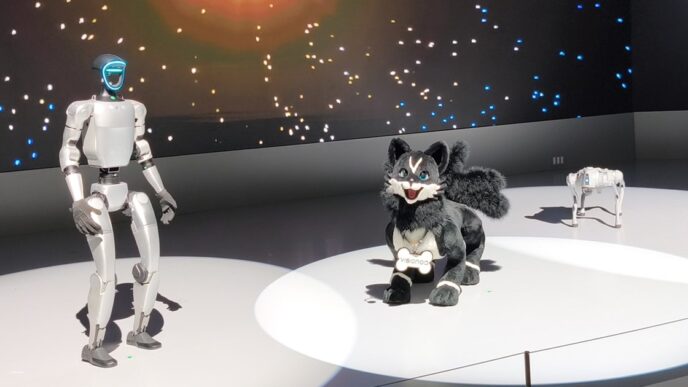
On September 24, AgiBot said the 20,000th robot to roll off its production line had been delivered to the theme-park operator Chimelong, as more than 300 AgiBot robots went to work at Chimelong Spaceship Park in Zhuhai. It had announced its 15,000th on June 28 (a G2, an industrial task robot) and its 10,000th on March 30, so by its own dates it added 10,000 robots in about six months. Its June release said the first 1,000 took roughly a year to turn into 5,000, and 5,000 to 10,000 took three months.
It’s a company claim. Neither release says how many of the robots were sold, delivered or kept in-house, and neither splits the total by model in its text. Humanoids Daily reports that AgiBot’s milestone graphic lists 5,638 A-series, 8,757 X-series and 5,605 G-series robots. SAG, a research firm, says AgiBot’s range spans full-size bipedal A-series, half-size bipedal X-series and wheeled G-series robots, so the total isn’t a count of one kind of machine. “Rolled off the line” is a factory verb. It doesn’t tell you a customer paid for each one. The only sales-style figure in the June release is a number it attributes to the research firm Omdia: 5,168 units shipped in 2025, a 39% global share.
Unitree’s 18,000 is bipeds only, and it’s a production count
The 18,000 comes via Humanoids Daily, which reports that Unitree said in a social post it had produced about 18,000 bipedal humanoids as of July 2026, excluding wheeled and other humanoid types. We haven’t seen the post itself, so treat it as a reported company claim.
The better-documented numbers sit in Unitree’s IPO prospectus, which we read in the original Chinese. Its humanoid unit table for 2025 shows 5,716 produced, 5,511 shipped and 5,215 sold. For 2024 the figures are 545 produced, 537 shipped and 412 sold, and for 2023 they are 9, 9 and 5. That adds up to the 5,632 sold across 2023 to 2025 that Xinhua reported in August. The prospectus explains that shipments ran ahead of sales because some robots had left the factory under customer contracts but hadn’t yet been signed for or accepted by the end of the year.
Put the two side by side and the gap is plain. The prospectus shows about 6,270 humanoids produced through 2025. An 18,000 total in July would mean roughly 11,000 to 12,000 more in seven months, if the two counts use the same scope. Unitree’s prospectus says it counts “pure humanoid” robots and excludes wheeled dual-arm ones, and the company hasn’t said whether the 18,000 matches. Analysts put Unitree’s first-half 2026 shipments far lower: about 5,900 according to the research firm Smart Analytics Global (SAG). Produced, shipped and sold are three different numbers, and Unitree is the one company here that has published all three for a year.
It’s also worth knowing who buys them. Humanoid Analytics, which has read Unitree’s replies to the Shanghai exchange, reports that 73.6% of the company’s humanoid revenue in the first nine months of 2025 came from research and education. Our robot price guide covers what that means for the G1.
UBTECH’s 10,000 is a target, and its filing says 921
UBTECH’s interim results for the first half of 2026, filed in Hong Kong on August 28, report sales of 921 full-size humanoid units, up roughly twentyfold from a year earlier, and revenue of RMB 590.3 million from those products and services. The same report says the company’s manufacturing work supports an “annual production target of 10,000 units.” That’s a goal for the year, and nowhere does the filing say it was reached.
The 921 has its own asterisk. UBTECH’s full-size humanoid line includes both bipedal Walker robots and wheeled models such as the Cruzr Y1, and the filing doesn’t split the 921 between them. In mid-September UBTECH said its Liuzhou factory, built with Siemens software, can finish a robot every 10 minutes and is designed for 10,000-unit capacity, according to Global Times. That’s what the plant is designed to do, not what it has done.
Agility and 1X are quoting what their factories could build
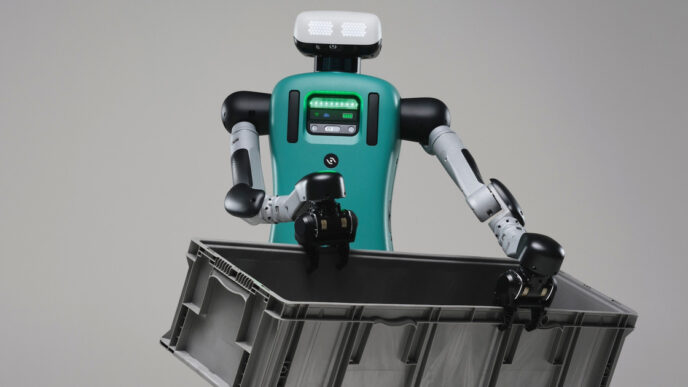
Agility’s RoboFab number appears in the S-4 it filed for its merger with Churchill Capital Corp XI, which we walked through here. The filing says RoboFab is designed to build 10,000 robots a year and that Digit v4 is deployed or committed for deployment across nine customer facilities. Capacity of 10,000 and nine sites are different orders of magnitude, and the filing doesn’t link them.
1X is in a similar spot. It says that with its Hayward NEO Factory online and a San Carlos facility coming online, it has capacity for up to 10,000 NEOs a year, and that it booked out a year of production (10,000 NEOs) in five days. Booked is not delivered: NEO’s order page still says US deliveries “start 2026,” and as of October 16 we haven’t seen confirmed deliveries, a gap we cover in our NEO status piece.
The US makers say less
Figure said on April 29 that it had delivered more than 350 third-generation robots from its BotQ plant and had demonstrated a cycle time of one robot per hour. It hasn’t said who received them or published an annual figure. Our Figure 03 explainer has the detail.
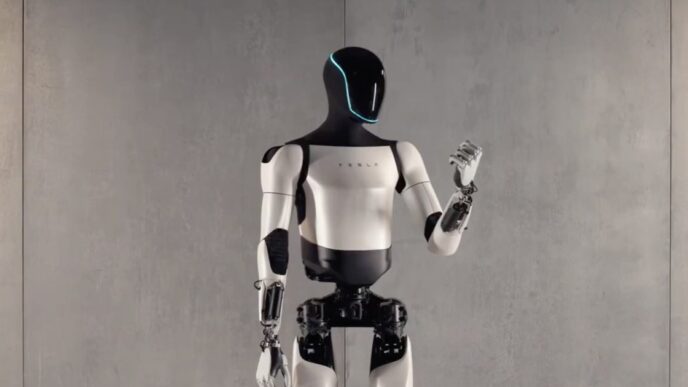
Tesla hasn’t given a number at all. The Information reported that it was building several hundred Optimus robots a week, mostly for internal training and testing, but Tesla hasn’t confirmed it. In January 2025 Musk said Tesla planned about 10,000 Optimus units that year, and Tesla has never reported how many it built. We lay out the paper trail in our Optimus status report.
Analysts count shipments, and they don’t agree
SAG’s August 10 report puts global humanoid shipments at about 19,100 in the first half of 2026, up 272% from 5,100 a year earlier. It credits AgiBot with about 8,400 (44% of the market) and Unitree with about 5,900 (31%), followed by Galbot at about 900, UBTECH at about 700 and Leju at about 600, and it forecasts nearly 60,000 shipments for the full year. Other firms count more. Counterpoint Research puts first-half shipments above 22,000, with AgiBot at 9,700 and Unitree above 7,000. IDC, in figures AgiBot published on September 30, puts them near 25,000, with AgiBot first at more than 8,600 (about 35%). Those are estimates, not company filings. Humanoid Analytics notes that Chinese industry groups have claimed far larger first-half totals for China alone, above 30,000 and above 40,000, without public methodologies. Different definitions of “humanoid” (wheeled or not, full-size or small) explain part of the spread, and nobody has reconciled the rest.
What XPENG’s factory photo does and doesn’t show
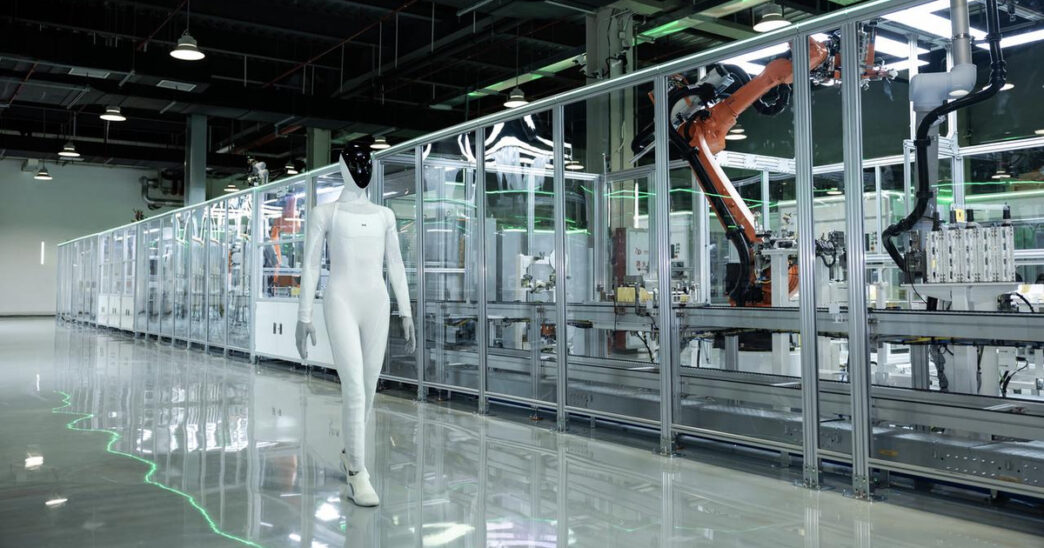
The robot in this article’s photo is XPENG’s IRON, walking past an automated line the company commissioned in September. XPENG says more than 80% of core processes are automated and that mass production is scheduled by the end of 2026, with market launch and deliveries planned for 2027, according to its release. It gave no unit count, capacity or cost. A commissioned line is a promise of volume, not volume.
A scorecard, and four questions to ask of every number
| Company | Number | What it counts |
|---|---|---|
| AgiBot | 20,000 | Robots rolled off the line, cumulative, all models, as of September 24 (company release) |
| Unitree | about 18,000; 5,215 | About 18,000 bipedal humanoids produced through July 2026 (company post, as reported); 5,215 humanoids sold in 2025 and 5,632 in 2023 to 2025 (prospectus) |
| UBTECH | 921; 10,000 | 921 full-size units sold in H1 2026 (filing); 10,000 is a yearly target and a plant design capacity |
| Figure | 350+ | Figure 03 robots “delivered” by April 29; recipients not named (company) |
| Agility | 10,000 | RoboFab design capacity per year (SEC filing); not output |
| 1X | about 10,000 | Yearly factory capacity, Hayward plus San Carlos (company); deliveries unconfirmed |
| Tesla | “several hundred a week” | Reported by The Information; Tesla hasn’t confirmed |
| XPENG | None | Line commissioned in September; mass production planned by end of 2026 |
| SAG, Counterpoint, IDC (analysts) | about 19,100; 22,000+; nearly 25,000 | Estimated global humanoid shipments, H1 2026 |
Before you repeat any figure from that table, ask what the verb is (built, shipped, sold, delivered or merely possible), which robots are included (bipedal, wheeled or both), who vouches for it (a prospectus, a filing, a research firm or a press release) and whether it covers one year or the company’s whole history. Answer those and most headline numbers shrink or sharpen at once.
The next numbers worth waiting for
Tesla’s third-quarter report on October 21 is the first chance for Tesla itself to put a unit count in writing. UBTECH’s full-year results will show whether 10,000 was a forecast or a milestone, and Unitree’s first reports as a listed company should show how its 18,000 reconciles with shipments and sales. The SEC declared Agility’s merger registration statement effective on October 13, and Churchill Capital Corp XI shareholders vote on the deal on November 2 (our vote explainer has the dates). The final prospectus repeats the 10,000-robot RoboFab capacity and the nine customer facilities, so Agility’s filings as a public company are where updated deployment counts would appear. XPENG’s year-end mass-production date is the other one to circle. If any of them publishes a delivered-and-paid figure, that will be the first like-for-like number in this race.
Frequently asked questions
Which company has built the most humanoid robots?
On the companies’ own claims, AgiBot, which said its 20,000th robot rolled off the line in September 2026, and Unitree, which reportedly said it had produced about 18,000 bipedal humanoids by July 2026. AgiBot’s total includes wheeled G-series robots; its bipedal A- and X-series come to about 14,400 in the breakdown Humanoids Daily reported. Both are cumulative production counts from the companies themselves, and neither is an independent tally of robots sold or working.
How many humanoid robots did Unitree sell in 2025?
5,215, according to the humanoid unit table in its IPO prospectus, which also shows 5,716 produced and 5,511 shipped that year. The 2023 to 2025 total sold is 5,632. The figures exclude wheeled dual-arm robots and count sales, not robots working at a customer.
Which company ships the most humanoid robots?
Smart Analytics Global estimates that AgiBot shipped about 8,400 humanoids in the first half of 2026, ahead of Unitree at about 5,900, out of roughly 19,100 worldwide. Counterpoint Research and IDC also rank AgiBot first, at 9,700 of more than 22,000 and more than 8,600 of nearly 25,000. These are analyst estimates, and the research groups use different definitions and reach different totals.
How many humanoid robots has Tesla built?
Tesla hasn’t said. The Information has reported several hundred a week, mostly for internal use, but Tesla hasn’t confirmed it, and the company has never reported how many Optimus robots it made in 2025.
Is production capacity the same as production?
No. Capacity is what a factory is designed to build in a year at full speed. Agility’s 10,000 RoboFab figure, UBTECH’s 10,000-unit Liuzhou design and 1X’s roughly 10,000 NEOs a year are capacity statements, and none of those companies has said it has reached that output.
Sources
Accessed October 9, 2026; re-checked and updated October 16, 2026.
- AgiBot, “AGIBOT and Chimelong Launch Large-Scale Embodied AI Theme Park with More Than 300 Robots” (20,000th robot; Sep 24, 2026): agibot.com
- AgiBot, “IDC Data Shows AGIBOT Led Global Humanoid Robot Shipments in H1 2026” (Sep 30, 2026): agibot.com
- Humanoids Daily, “AGIBOT Has Built 20,000 Robots—Twice Its March Total” (Sep 26, 2026): humanoidsdaily.com
- Counterpoint Research, “Global Humanoid Robot Shipments Soar Nearly 300% YoY in H1 2026” (Aug 2026): counterpointresearch.com
- AgiBot, “AGIBOT’s 15,000th Robot Rolls Off the Production Line” (Jun 28, 2026): agibot.com
- AgiBot, “AGIBOT Reaches 10,000 Units as Real-World Demand for Robots Accelerates,” PR Newswire (Mar 30, 2026): prnewswire.co.uk
- Unitree Robotics, IPO prospectus (招股意向书), humanoid production, shipment and sales table, via CNINFO: cninfo.com.cn (Chinese)
- Humanoids Daily, “Unitree Reclaims the Spotlight with 18,000 Cumulative Bipedal Humanoids Produced” (Aug 12, 2026): humanoidsdaily.com
- Xinhua via China Daily, “Unitree IPO draws spotlight to China’s fast-growing humanoid robot sector” (Aug 10, 2026): chinadaily.com.cn
- Smart Analytics Global, “Global Humanoid Robot Shipments Surged 272% YoY to 19.1K Units in 1H 2026” (Aug 10, 2026): smartanalyticsglobal.com
- Humanoid Analytics, “How Many Humanoid Robots Have Actually Been Sold in 2026?” (Aug 27, 2026, updated Sep 16): humanoidanalytics.com
- UBTECH Robotics, interim results announcement for the six months ended June 30, 2026 (HKEX, Aug 28, 2026): hkexnews.hk
- Global Times, “‘Robots building robots’: World’s 1st 10,000-unit-scale industrial humanoid robot smart factory starts production” (Sep 14, 2026): globaltimes.cn
- Figure AI, “Ramping Figure 03 production” (Apr 29, 2026): figure.ai
- Churchill Capital Corp XI / Agility Robotics, Form S-4/A (Sep 30, 2026) and final prospectus (424B3, Oct 13, 2026): sec.gov; SEC notice of effectiveness Oct 13, 2026; via our filing analysis; EDGAR filing list: sec.gov
- 1X, NEO Factory page and order page: 1x.tech/discover/neo-factory; 1x.tech/order
- Electrek, “Tesla ramps Optimus to hundreds a week, but the robots can’t generalize” (Sep 25, 2026): electrek.co; Tesla Form 8-K (Q3 results date, Oct 2, 2026) via our Optimus status article
- XPENG, “IRON, the World’s First Advanced General-Purpose Humanoid Robot, Walks off the Production Lines” (Sep 7, 2026): prnewswire.com
Related: Humanoid robot readiness levels · Robot companies directory · Humanoid robot prices 2026
Last updated: October 16, 2026. To report an error, see our corrections page. Articles are drafted with AI assistance and reviewed and edited by an editor; see our editorial policy.