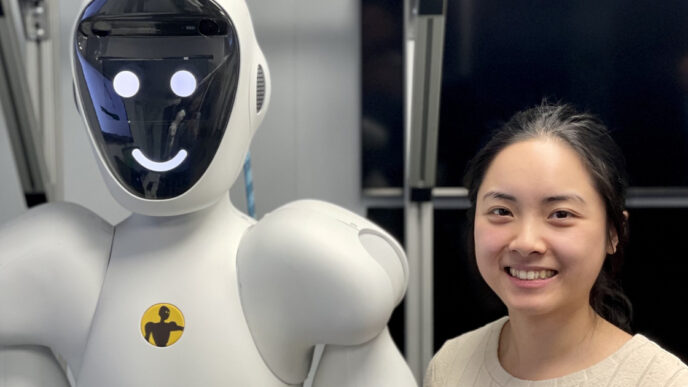
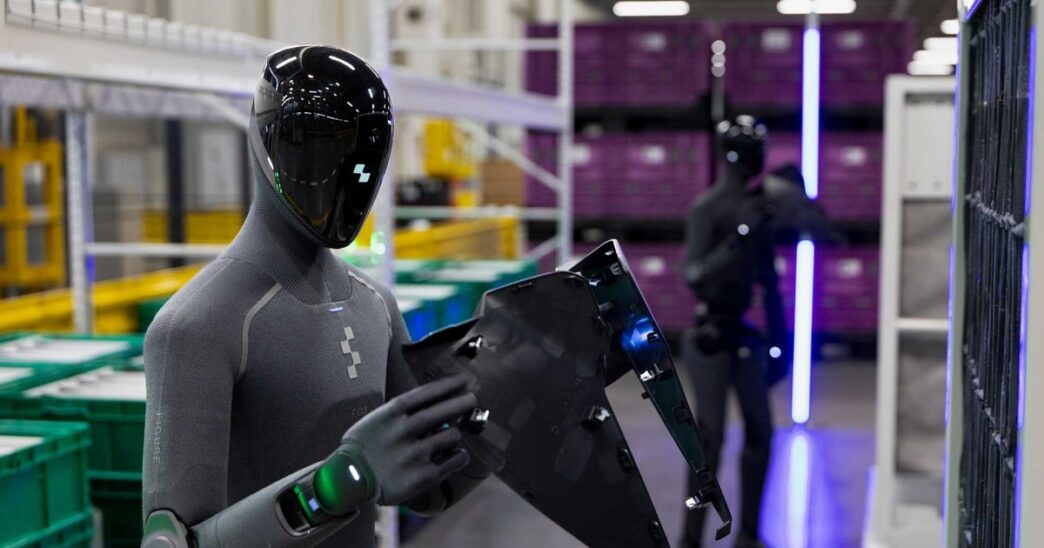
When Figure said a Figure 03 had arrived at BMW’s Spartanburg plant on June 30, 2026, and performed its “first demonstration” of a logistics workflow, the most important word in the sentence was “demonstration.” It meant a robot doing a real task in a real factory. It did not mean a fleet on contract, a published price or a robot anyone else could order. Humanoid announcements blur those stages all the time, which is why we use humanoid robot readiness levels to sort them.
The scale below has six steps, from a render to a robot you can buy with a delivery date. It borrows its spirit from NASA’s Technology Readiness Levels, which run from TRL 1 (basic principles observed) to TRL 9 (a system proven in actual operations), but it’s tuned to what robot companies actually announce. It’s our editorial framework, not an industry standard, and every placement below rests on what the company itself has published or told the press.
The six humanoid robot readiness levels
- Level 1, render or concept. Images, animations, spec sheets or a roadmap. No working robot has been shown doing the task.
- Level 2, demo. A working robot on video, on stage or at a trade show. It may be scripted, edited or teleoperated, meaning a person controls it remotely.
- Level 3, internal use. The company runs its own robots for development, data collection or work in its own (or its parent company’s) facilities.
- Level 4, pilot. A named outside customer tests the robot in a real workplace, usually in a narrow role for a limited time. Terms are rarely public.
- Level 5, commercial deployment. Robots do contracted work for paying customers, by purchase or robots-as-a-service, and the company says so in a filing or release that names customers.
- Level 6, open availability. A qualified buyer can order at a published price and the company is meeting delivery dates.
This expands the four-stage shorthand (demo, internal use, pilot, commercial) we use in our humanoid robot explainer. The extra steps matter because the jump from a render to a demo, and from a contract to open orders, is where a lot of marketing hides.
Readiness and autonomy are two different questions
A level describes where a robot is used and on what terms. It says nothing about who is in control. A Level 5 robot can still have remote operators on call, and a Level 2 demo can be fully autonomous. So for every claim, ask the second question separately: was the robot teleoperated, supervised by a person ready to step in, or acting on its own? Our guide to teleoperation versus autonomy covers the signs to look for in a video.
Some companies are open about it. 1X says its NEO home robot has an “Expert Mode” in which 1X staff can remotely guide it through chores it doesn’t know yet. Minerva Humanoids, which came out of stealth on October 6 with about $10 million in pre-seed funding, describes its robot for hazardous jobs as teleoperated, with some semi-autonomous functions. Neither is a flaw. It’s simply a different claim from “autonomous.”
Where major humanoids sit in October 2026
Placements reflect what each company has published as of October 2026. “Company says” means we haven’t independently verified the claim.
| Robot | Our level | Why | What would move it up |
|---|---|---|---|
| Tesla Optimus | 3, internal use | Tesla’s Q2 2026 update says the first builds go to its “Optimus Academy for training data collection and further functionality development.” No price, no customers. | A named outside customer, or sales |
| Boston Dynamics Atlas | 3, internal use | Training at Hyundai’s Robotics Metaplant Application Center in Georgia, inside the parent company. Plans call for component assembly by 2030. | Paid work outside Hyundai, or a public offer |
| Apptronik Apollo 2 | 3, internal use | Collects training data at Apptronik’s Robot Park in Austin; the company says the data supports Google DeepMind’s Gemini Robotics models. | Named customer deployments with counts |
| Figure 03 | 4, pilot | Figure says it delivered more than 350 Figure 03s from its BotQ plant by April 29 and demonstrated a logistics sequencing task at BMW’s Spartanburg plant on June 30. Fleet size and terms at BMW aren’t published. | Published contract terms or a customer-confirmed fleet |
| UBTECH Walker S series | 4, pilot | Inspection training with FAW-Volkswagen in Qingdao, extended on October 8 to factory logistics. No robot count or timeline disclosed. | Counts and contract status from the customer |
| Agility Digit (v4) | 5, commercial | Agility’s SEC filing says Digit v4 is “deployed or committed for deployment across nine customer facilities” with more than 65,000 hours of operation, naming Schaeffler, GXO, Toyota Motor Manufacturing Canada and Mercado Libre. Company says. | A public price or open ordering |
| Agility Digit 5 | 2, demo | Prototypes unveiled September 15, 2026. Agility expects early access in the first half of 2027 and general availability by the end of 2027. | Early-access units at customer sites |
| 1X NEO | 6 on paper, delivery unconfirmed | Public price of $20,000 or $499 a month with a $200 refundable deposit; the order page says “US Deliveries start 2026.” We haven’t seen confirmed customer deliveries. | Verified deliveries to paying households |
| Unitree G1 | 6, open availability | Listed at $13,500 on Unitree’s US store (backordered as of October 8). Sold mostly to universities, labs and developers. | Already at the top for availability; job readiness is a separate question |
| Minerva Roger | 2, demo (teleoperated) | The company says paid pilots start this fall. | A named pilot customer |
For the business details behind these rows, see our coverage of Atlas at Hyundai, Figure 03, Agility’s SPAC filings, 1X NEO and Apollo 2. Our robot companies directory tracks the same status for more firms.
A public price doesn’t mean a robot is ready for work
The table has an awkward result: the cheapest robot on it sits at the top. Unitree’s G1 is easier to buy than any humanoid from Tesla, Figure or Boston Dynamics, but it’s sold mostly to universities, labs and developers who program it for their own projects. Agility’s Digit has no public price at all, yet it’s the only humanoid here whose maker names several paying customers in a securities filing.
That’s why the scale measures commercial readiness, not capability. A robot can be on sale and still need a team of engineers to do anything useful, and a robot can do real factory work for one customer without ever being offered to the public. Our humanoid robot prices guide lists what each published price actually buys, and our robots-as-a-service explainer covers how most industrial deals are structured.
Words that usually signal each level
| Wording in a release | Usually means |
|---|---|
| “Unveils,” “introduces,” “concept,” “designed to” | Level 1 or 2 |
| “Demonstration,” “showcase,” “proof of concept” | Level 2, or Level 4 if a named customer site is involved |
| “Training,” “data collection,” “in our facility” | Level 3 |
| “Pilot,” “trial,” “strategic partnership,” “MOU” | Level 4 at most; a partnership or MOU can be lower |
| “Deployed,” “in production,” “under contract,” named customers in a filing | Level 5 |
| “Order now,” a price, “deliveries start” | Level 6 if deliveries are confirmed; otherwise a pre-order |
Five questions to ask about any humanoid claim
- Who was in control: the robot, a supervisor or a remote operator?
- Is the customer named, and has the customer said anything itself?
- How many robots, doing what, for how long?
- Who paid, and on what terms?
- Can a new buyer order one today, at what price, with what delivery date?
If a company can answer all five, it’s probably at Level 5 or higher. Most can’t yet, and the next tests are close. Tesla reports third-quarter results on October 21, Agility’s merger still needs its SEC registration to become effective, and 1X has under three months to show its first US deliveries if it is going to keep its 2026 promise.
Frequently asked questions
What are humanoid robot readiness levels?
They’re a six-step scale RoboticaGuide uses to describe how far a humanoid robot has progressed: render or concept, demo, internal use, pilot, commercial deployment and open availability. It’s inspired by NASA’s Technology Readiness Levels but focused on the commercial claims robot companies make.
Is a pilot the same as a commercial deployment?
No. A pilot is a limited test at a named customer’s workplace, usually with undisclosed terms. A commercial deployment means robots do contracted work for paying customers, and the company has said so in a release or filing that names them.
Which humanoid robots are commercially deployed?
Among the robots we track, Agility’s Digit has the strongest public evidence: its SEC filing says Digit v4 is deployed or committed across nine customer facilities and names Schaeffler, GXO, Toyota Motor Manufacturing Canada and Mercado Libre. Those are company statements we haven’t independently verified.
Does a public price mean a humanoid robot is ready for work?
Not necessarily. Unitree’s G1 has a published price and can be ordered, but it’s sold mostly to universities, labs and developers who program it for their own projects. Readiness for sale and readiness for a specific job are separate questions.
Sources
All accessed October 8, 2026.
- NASA Earth Science Technology Office, “Technology Readiness Levels”: esto.nasa.gov
- Figure AI, “F.03 at BMW”: figure.ai; “Ramping Figure 03 production” (Apr 29, 2026): figure.ai
- Tesla, Q2 2026 shareholder update (Jul 22, 2026): ir.tesla.com
- Boston Dynamics, RMAC release (Sep 21, 2026), via our Atlas coverage and the Boston Dynamics newsroom
- Apptronik, “Welcome to Robot Park”: apptronik.com
- Churchill Capital Corp XI / Agility Robotics, Form S-4/A (filed Sep 30, 2026), EDGAR filing list for CIK 2074973: sec.gov
- 1X, NEO order page: 1x.tech
- Unitree US store, G1 listing: shop.unitree.com
- Minerva Humanoids release (Oct 6, 2026): globenewswire.com
- Gasgoo, “UBTECH, FAW-Volkswagen partner on humanoid robots for logistics and smart manufacturing” (Oct 8, 2026): autonews.gasgoo.com
Related: Humanoid robot training data · Robotics funding tracker 2026 · Humanoid robots in warehouse logistics
Last updated: October 8, 2026. To report an error, see our corrections page. Articles are drafted with AI assistance and reviewed and edited by an editor; see our editorial policy.