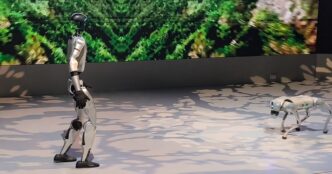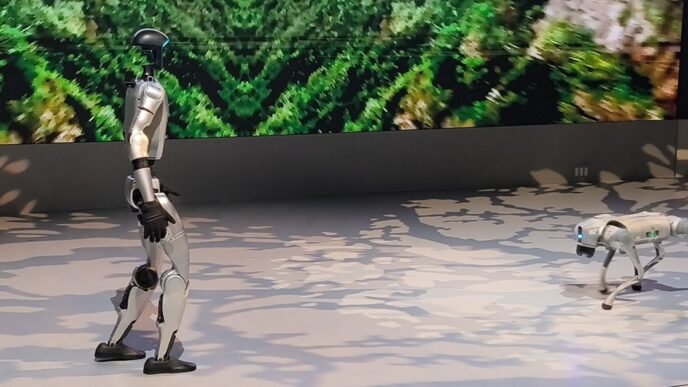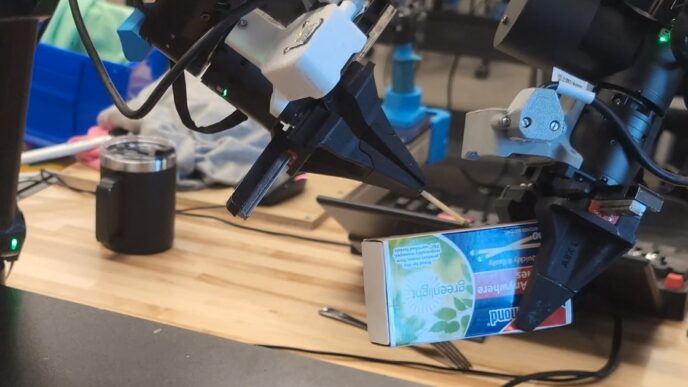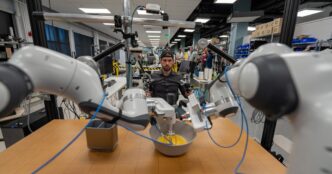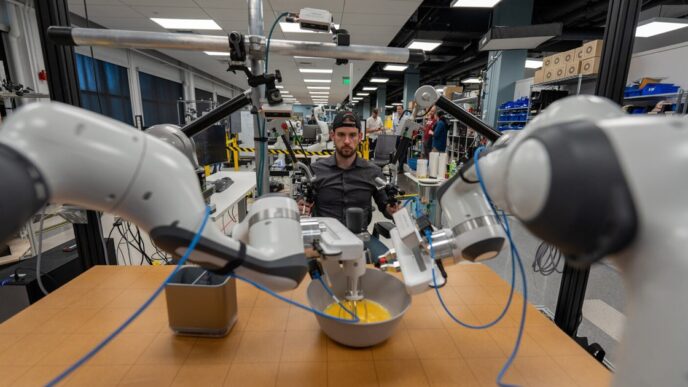
OpenAI no longer has a stand-alone robotics team. The company confirmed to Fortune on November 13 that the OpenAI robotics team’s researchers now sit inside its main research group under Chief Research Officer Mark Chen, while the applied robotics and hardware teams moved into the Applied organization under President Greg Brockman. OpenAI’s explanation is that its general-purpose models, GPT-6 Astra in particular, can now be applied to robots directly, and it says that is why robotics no longer sits in a unit of its own.
That claim has a public test behind it. In October, NVIDIA’s Seattle Robotics Lab published Astranomy, a study that ran GPT-6 Astra as a robot policy on 120 simulated manipulation tasks. We went through NVIDIA’s results, timing and cost tables. Astra beat every robot model on NVIDIA’s leaderboard. It also needed between 11 and 22 seconds to decide each move.
- What changed: OpenAI split up its stand-alone robotics team. Researchers moved under Mark Chen, applied robotics and hardware under Greg Brockman (OpenAI to Fortune, November 13, 2026). OpenAI says robotics work continues.
- Why, per OpenAI: its general models, including GPT-6 Astra, can be applied to robotics directly. OpenAI is still developing its own humanoid, with a first public demo targeted for 2027, Fortune reports.
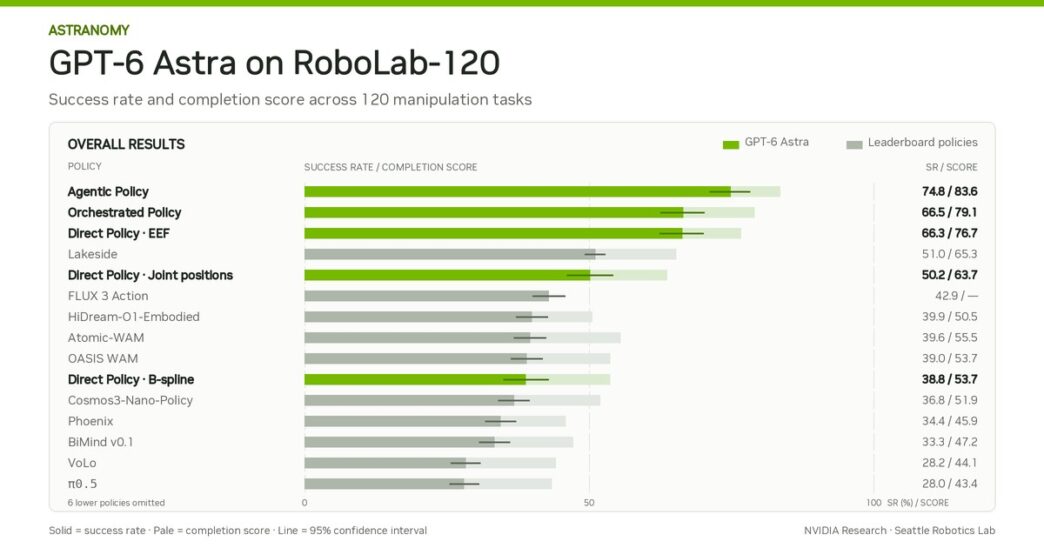
- The evidence: in NVIDIA’s simulated RoboLab-120 test, Astra reached 74.8% success against 51.0% for the best leaderboard entry and 28.0% for π0.5.
- The catch: each Astra decision took 11.5 to 21.7 seconds, the simulator was paused while it thought, and the best setup cost $36.40 per successful episode.
What OpenAI changed, and what it says it didn’t
Fortune broke the story on November 13 and reported that the change came so late that OpenAI’s booth at CoRL, the robot-learning conference in Austin, sat empty. Fortune’s headline says OpenAI disbanded the team. OpenAI’s version, given to The Decoder in a November 14 clarification, is that it reorganized the team to work more closely with research and product, and that robotics work continues. Both accounts agree on the facts that matter: there is no separate robotics unit any more, and robotics people now work inside the groups that build OpenAI’s general models and products.
The company’s reasoning, as Fortune reported it, is specific. At the start of 2026, OpenAI’s researchers assumed the best route to robotics ran through Sora, its video model. Since then, the spokesperson said, frontier models such as GPT-6 Astra have shown they can be applied to robots directly. OpenAI hasn’t published a statement or blog post of its own on the change. Everything above comes from what it told Fortune and The Decoder.
This is the third shape OpenAI’s robotics effort has taken. Here is the history as Fortune lays it out.
| When | What happened | Source |
|---|---|---|
| 2020 | OpenAI winds down its first robotics team. Co-founder Wojciech Zaremba later cited limited robot data and a faster path to AGI through other methods | Fortune |
| 2024 | OpenAI rebuilds a stand-alone robotics team and announces a partnership with Figure to develop AI models for humanoids | Fortune |
| February 2025 | The Figure partnership ends when Figure says it will build its own robot AI | Fortune |
| Ongoing | OpenAI says it is developing its own humanoid robot; Sam Altman targets a first public demonstration in 2027 | Fortune |
| November 13, 2026 | Stand-alone team split between Research (Mark Chen) and Applied (Greg Brockman); OpenAI says robotics continues | Fortune; The Decoder |
Fortune also notes the money backdrop: OpenAI’s operating losses reportedly reached $10.9 billion in its most recent quarter, and it has already dropped side projects, including Sora, to free up computing power.
What NVIDIA’s GPT-6 Astra robot test actually measured
NVIDIA’s Astranomy study, by Jenai Xuning Yang, Ashna Khetan and Shun Zhang, is dated October 14 and listed as a CoRL 2026 late-breaking result. It put Astra in charge of a simulated DROID robot arm on RoboLab-120, NVIDIA’s benchmark of 120 pick-and-place tasks, with five episodes per task and no extra robot training. Astra saw three camera views and output arm positions in three set-ups: Direct, where it answers each observation with actions; Agentic, where it works inside a persistent Codex session; and Orchestrated, where NVIDIA’s Cosmos3-Nano-Policy drives the arm and Astra steps in when it expects a mistake.
The success rates and Astra’s timings and costs come from NVIDIA’s tables. The latency figures for π0.5, FLUX 3 Action and Cosmos3-Nano-Policy are numbers NVIDIA cites from Black Forest Labs’ FLUX 3 Action model report, measured on an H200, not from NVIDIA’s own runs.
| Policy (RoboLab-120) | Success rate | Time per decision | Cost per successful episode |
|---|---|---|---|
| GPT-6 Astra, Agentic (Codex session) | 74.8% | 13.37 s | $36.40 (30.9M tokens) |
| GPT-6 Astra, Orchestrated (with Cosmos3-Nano-Policy) | 66.5% | 11.50 s for Astra + 2.74 s for Cosmos | $17.72 (11.0M tokens) |
| GPT-6 Astra, Direct (end-effector poses) | 66.3% | 18.56 s | $1.96 (160k tokens) |
| Lakeside (best leaderboard entry) | 51.0% | Not reported | Not applicable |
| GPT-6 Astra, Direct (joint positions) | 50.2% | 20.19 s | Not broken out |
| FLUX 3 Action (Black Forest Labs) | 42.9% | 397.74 ms | None listed (no API tokens) |
| Cosmos3-Nano-Policy (NVIDIA) | 36.8% | 713.76 ms | None listed (no API tokens) |
| π0.5 (Physical Intelligence) | 28.0% | 46.96 ms | None listed (no API tokens) |
The leaderboard part of this is consistent with what we found ourselves. When we checked RoboLab-120 for our world action models explainer on October 11, Lakeside led at 51.0% and FLUX 3 Action sat at 42.9%. Astra’s Agentic set-up beats that leader by 23.8 points.
We also checked NVIDIA’s cost math. Its Direct-mode token table charges about $10 per million uncached input tokens and $50 per million output tokens, which matches the GPT-6 Astra list price we reported when OpenAI’s models came to Google Cloud. NVIDIA says its estimates use prices published on October 1, 2026, and count successful episodes only.
The speed problem, in numbers
The timing table is where the study gets blunt. Across Astra’s set-ups, waiting for the model took 94.9% to 97.8% of each episode’s estimated duration. By our arithmetic, Direct mode’s 18.56 seconds per call is about 395 times slower than π0.5’s 46.96 milliseconds. Even the Orchestrated set-up, where Astra’s own calls are quickest at 11.50 seconds, is roughly 245 times slower.
NVIDIA shows what that means with one task: put a small red yogurt in a red bowl. The arm moved for 5.2 seconds. Astra thought for 232.6 seconds across 12 calls, about 19 seconds a call. The whole job would have taken an estimated 3 minutes 57 seconds in real time, so the robot was moving for about 2% of it. In the simulation that didn’t matter, because NVIDIA paused the world while Astra thought. A real kitchen doesn’t pause.
Compare that with how robot makers split the job today. Figure’s Helix, as described in our Figure 03 explainer, pairs a slow 7-billion-parameter “System 2” running at 7 to 9 Hz with a fast “System 1” at 200 Hz, according to Figure. Astra in Direct mode decides about once every 18 seconds, so even next to Helix’s slow layer it is more than 100 times slower.
Where Astra failed, and what the test left out
NVIDIA’s own write-up is careful about the limits, and they are worth repeating.
- Grasping is the weak spot. In the Orchestrated set-up, Astra stepped in on 14.5% of simulation steps, and 64.4% of those interventions were about grasping problems. Wrong targets or plans made up another 20.2%. The failure clips show the gripper adjusting around an object without ever securing it.
- Only pick-and-place. The study didn’t cover contact-rich work like insertion or assembly, long mobile tasks, or anything that needs fast reactions.
- Simulation only. Every number above comes from a simulated arm. NVIDIA tested no physical robot.
- Small samples. Five episodes per task, and NVIDIA says it hasn’t established statistical significance for the smaller gaps between set-ups.
- Unknown training data. NVIDIA tested Astra through OpenAI’s interface and can’t say what robot or 3D data went into it.
Safety is a separate question that this test doesn’t touch. In Robocurve’s RoboSpoof study, which we covered on November 11, GPT-6 Astra was one of five frontier models that attempted unsafe tasks far more often once its camera feed was blurred or doctored.
Our take: OpenAI is betting on the planner, not the reflexes
Reading the reorganization as OpenAI quitting robotics gets it wrong. It is a bet that the hard part of a robot brain is general understanding: knowing which object is the yogurt, what “put it in the bowl” means, and what went wrong after a failed grasp. NVIDIA’s numbers back that up in a narrow way. A model with no extra robot training beat every policy on NVIDIA’s board at deciding what to do.
The same numbers show what the bet leaves out. A robot that thinks for 19 seconds between moves can’t work next to people, and at $17 to $36 per successful pick-and-place in the stronger set-ups, it can’t work cheaply either. Someone still has to build the fast layer that runs on the robot at hundreds of decisions a second. That is the part Physical Intelligence, Figure and NVIDIA’s own GR00T team are building, and it is why CMU’s Guanya Shi told Fortune he still sees a role for smaller models that run on the robot without a network connection. Unitree’s Wang Xingxing said in October that GPT-6 did well on his robots. Astranomy puts numbers on how well, and how slowly, at least in simulation.
For robot makers, our view is that the split now looks settled: a general model on top for planning and recovery, and a fast vision-language-action model underneath for motion. The open question is who owns each layer. OpenAI has just reorganized so its general models get better at the top layer. Whether it also builds the bottom one will show in the humanoid it says it plans to demonstrate in 2027.
Frequently asked questions
Did OpenAI shut down its robotics team?
Not entirely. OpenAI confirmed to Fortune on November 13, 2026 that it disbanded its stand-alone robotics team: researchers moved to the main research group under Mark Chen, and applied robotics and hardware staff moved to the Applied organization under Greg Brockman. OpenAI says robotics work continues.
Why did OpenAI reorganize its robotics team?
OpenAI told Fortune that its general-purpose models, including GPT-6 Astra, have shown they can be applied to robotics directly, and that this is why it moved its robotics researchers onto teams working on general models. OpenAI describes the change as a way to speed up robotics, not a retreat. Fortune also points to cost pressure, with reported operating losses of $10.9 billion in the most recent quarter.
Is OpenAI still building a humanoid robot?
Yes, according to Fortune. OpenAI has said it is developing its own humanoid robot, and CEO Sam Altman is targeting a first public demonstration in 2027. OpenAI hasn’t published specifications or a timeline beyond that.
Can GPT-6 Astra control a robot?
In simulation, yes, slowly. In NVIDIA’s Astranomy study, Astra completed 74.8% of 120 simulated pick-and-place tasks in its best set-up, ahead of every model on NVIDIA’s leaderboard. But each decision took 11.5 to 21.7 seconds, the simulator was paused while it thought, and NVIDIA tested no physical robot.
Sources
- Fortune: “Exclusive: OpenAI disbands its stand-alone robotics team as its general models start running robots,” November 13, 2026
- The Decoder: “OpenAI reassigns robotics researchers to other teams,” updated November 14, 2026
- NVIDIA Research, Seattle Robotics Lab: “Astranomy: An empirical study of GPT-6 Astra as a native robot policy,” October 14, 2026 (results, timing and token tables)
- NVIDIA: RoboLab benchmark repository
All sources accessed November 16, 2026.
Last updated: November 16, 2026. To report an error, see our corrections page. See our editorial policy.