Humanoid robot spec sheets borrow vocabulary from industrial automation, electric vehicles and AI research, often in the same table. This humanoid robot glossary explains the terms you will meet most often, from degrees of freedom (DoF) and payload to runtime, IP ratings and vision-language-action models, and shows how each one appears in real, published specifications.
The examples come from the makers’ own product pages for Boston Dynamics’ Atlas, Agility Robotics’ Digit 5 and Unitree’s G1, rechecked for this guide. They are company figures, not independent test results, and the same word can mean different things from one company to the next. Where that happens, we say so.
- DoF: the number of independent joints. Atlas lists 56; Unitree’s G1 lists 23, or 23 to 43 for the EDU version.
- Payload: how much the robot can carry. Check whether it is instant or sustained: Atlas lists 50 kg instant and 30 kg sustained.
- Runtime: time per charge. Published figures run from about 2 hours (G1) to 4 hours (Atlas), and they rarely state the workload.
- IP rating: protection against dust and water. Atlas lists IP67.
- VLA: a vision-language-action model, the kind of AI that turns camera input and instructions into movement.
Humanoid robot glossary: body and movement
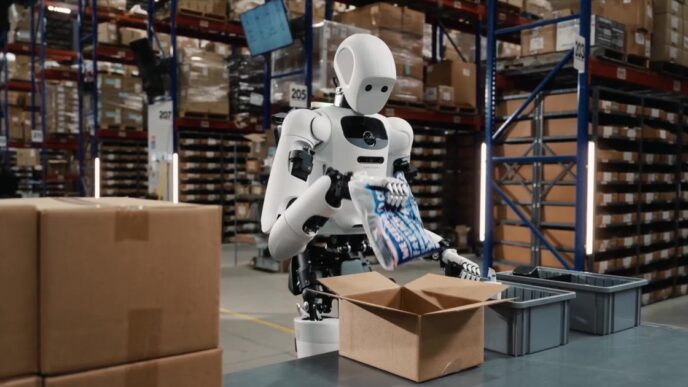
Humanoid robot. A robot with a roughly human body plan: a torso, two arms and a head, usually on two legs, though some models use a wheeled base. The point is to work in spaces and with tools designed for people. Our guide to what a humanoid robot is covers the types.
Degrees of freedom (DoF). The number of independent ways a robot can move, which in practice means the number of actuated joints. Unitree breaks the base G1’s 23 DoF down as 6 per leg, 1 at the waist and 5 per arm. Boston Dynamics lists 56 DoF for Atlas. Counts are not always comparable, because some companies include hand joints and others do not. A higher number means more ways to move, not necessarily a more useful robot. See our DoF explainer for a full comparison.
Actuator. The motor-and-gearbox unit that moves a joint. Most new humanoids use electric actuators; the original Atlas was hydraulic. Unitree lists permanent magnet synchronous motors for the G1’s joints. Our actuator guide explains the main designs.
Joint torque. The rotational force a joint can produce, usually given in newton-meters (N·m). Torque decides how much a leg or arm can push or lift. Unitree lists maximum knee torque of 90 N·m for the G1 and 120 N·m for the G1 EDU, and notes this is the largest joint motor, so other joints are weaker.
Range of motion. How far each joint can rotate, given in degrees. Unitree lists the G1’s knee at 0 to 165 degrees and its waist at plus or minus 155 degrees. Boston Dynamics lists Atlas’s range of motion simply as “continuous,” which suggests some joints can keep rotating rather than stopping at a hard limit; it does not give per-joint figures.
Reach. How far the robot can extend its hands, often measured as the highest point it can reach. Boston Dynamics lists 2.3 m (7.5 ft) for Atlas; Agility lists 2.2 m (7.2 ft) for Digit 5.
End effector, gripper and dexterous hand. The end effector is whatever is at the end of the arm. A gripper is a simple tool, often with two or three fingers. A dexterous hand has multiple jointed fingers. Unitree’s optional Dex3-1 hand has 7 active DoF: 3 in the thumb and 2 each in the index and middle fingers. Agility says Digit 5 uses a swappable gripper design.
Bipedal vs wheeled. Bipedal robots walk on two legs and can handle stairs and steps; wheeled humanoids put a torso on a mobile base for stability and efficiency on flat floors. Our comparison of bipedal and wheeled humanoids covers the trade-offs.
Strength and endurance
Payload. The weight a robot can carry or lift. This is where spec sheets differ most. Boston Dynamics gives two numbers for Atlas: 50 kg (110 lb) “instant” and 30 kg (66 lb) “sustained.” Agility lists Digit 5’s payload as 23 kg (50 lb), and its launch release described that as a repeated lift. Always ask whether a figure is a peak, a sustained load or a repeated lift, and at what arm position.
Arm load. A narrower figure for what one arm can hold. Unitree lists about 2 kg for the G1 and about 3 kg for the G1 EDU, and warns that the maximum “varies greatly” with arm posture. That is far below the whole-body payloads above, which is why the two numbers should never be compared directly.
Runtime or battery life. How long the robot works on one charge. Boston Dynamics lists 4 hours for Atlas, Unitree about 2 hours for the G1, and Agility 90 minutes for Digit 5 in its launch materials. Few companies say what task the figure assumes, and lifting heavy boxes drains a battery faster than standing. Our runtime guide compares them.
Run-to-charge ratio. Working time divided by charging time. Agility lists a 10:1 ratio for Digit 5, based on 90 minutes of work and a claimed 9-minute charge, and says that adds up to 20 working hours in a 24-hour day. Digit 5 is not shipping yet; Agility plans early access in the first half of 2027.
Battery swap. Replacing a depleted battery instead of recharging it in place. Unitree’s G1 uses a quick-release 9,000 mAh smart battery changed by hand. Boston Dynamics says Atlas navigates to a station and swaps its own battery.
Durability and safety
IP rating. An Ingress Protection code defined by the International Electrotechnical Commission in IEC 60529. The first digit rates protection against solids such as dust, up to 6 (dust-tight). The second rates protection against water; 7 means protection against temporary immersion under the standard’s test conditions. Boston Dynamics lists IP67 for Atlas. An IP rating does not mean a robot can work in rain or a washdown area for hours, so ask the vendor.
Operating temperature. The ambient range in which the robot is designed to work. Boston Dynamics lists -20 to 40 °C (-4 to 104 °F) for Atlas, which matters for unheated warehouses and loading docks.
Functional safety. Engineering that makes a machine detect faults and move to a safe state, typically certified against standards. For a balancing humanoid this is hard, because simply cutting power can make it fall. Our safety systems guide explains why, and our ISO standards guide covers which standards apply.
Cooperative safety. Agility’s term for a robot designed to work near people without fences. Agility says Digit 5’s human-detection software and safety behaviors are designed to make external barriers unnecessary. Treat it as a design goal until certification is published.
Sensing and computing
Depth camera and LiDAR. Depth cameras measure distance for each pixel; LiDAR scans with laser pulses to build a 3D map. Unitree lists a depth camera and a 3D LiDAR on the G1. Boston Dynamics lists a 360-degree camera view for Atlas.
Tactile sensing. Touch sensors, usually in the hands, that detect contact and pressure. Boston Dynamics lists tactile sensing for Atlas, and Unitree offers tactile sensor arrays as an option on its Dex3-1 hand.
Onboard compute. The computers inside the robot. Unitree lists an 8-core CPU on the G1, with higher-power modules such as NVIDIA Orin as options on the EDU.
OTA updates and fleet software. Over-the-air updates install new software remotely, and Unitree lists OTA for the G1. Fleet software manages many robots and connects them to warehouse systems; Boston Dynamics says Atlas will connect to its Orbit fleet platform, and Agility says Digit 5 ships with fleet management software.
AI and control
Policy. The software, often a neural network, that maps what the robot senses to motor commands. Policies for walking are often trained with reinforcement learning in simulation, then transferred to the robot.
VLA (vision-language-action model). An AI model that takes camera images and a text instruction and outputs robot actions. See our VLA guide.
Robot foundation model. A large model trained on broad robot and internet data and adapted to many tasks and robot bodies. VLAs are one type. Our foundation model explainer lists examples.
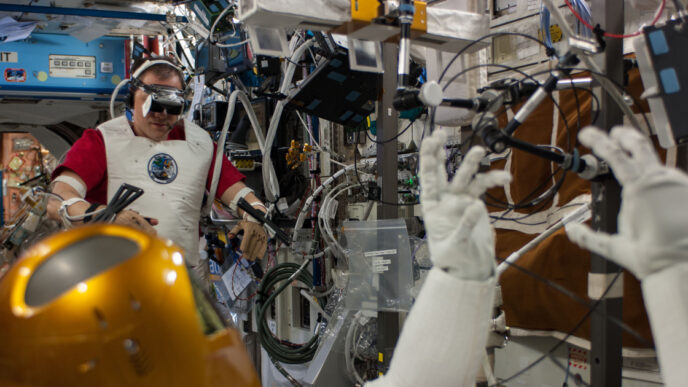
Teleoperation vs autonomy. Teleoperation means a human controls the robot remotely, for example through a VR headset; autonomy means the robot decides its own actions. Many demos mix the two. Our guide to reading robot demos explains how to tell.
Buying and deployment
EDU or developer version. A version sold to researchers with programming access and extra options. Unitree’s G1 EDU adds secondary development, more DoF options and an 18-month warranty instead of 8, and is priced through sales rather than at the base G1’s US $13,500.
RaaS (robots as a service). Renting robots for a recurring fee instead of buying them. See our RaaS vs buying guide.
Pilot vs commercial deployment. A pilot is a limited, often paid trial at a customer site; commercial deployment means robots doing ongoing paid work. Early access means a limited release before general availability.
How to read a humanoid spec sheet
- Check the conditions. Payload and runtime mean little without the arm position, task and duty cycle.
- Compare like with like. Instant vs sustained payload, whole-body vs single-arm load, and DoF with or without hands.
- Separate shipping from planned. A spec for a robot in early access, like Digit 5, is a target until customers confirm it.
- Read the footnotes. Unitree’s say its parameters “may vary in different scenarios and configurations.”
Frequently asked questions
What does DoF mean on a humanoid robot?
DoF stands for degrees of freedom, the number of independent joints a robot can move. Boston Dynamics lists 56 for Atlas, and Unitree lists 23 for the base G1 and 23 to 43 for the G1 EDU. Counts vary in whether they include hand joints, so compare carefully.
What is the difference between instant and sustained payload?
Instant payload is the most a robot can lift briefly; sustained payload is what it can carry continuously. Boston Dynamics lists Atlas at 50 kg instant and 30 kg sustained. Many companies publish only one figure, so ask which kind it is.
How long do humanoid robot batteries last?
Published figures range from about 90 minutes for Agility’s Digit 5 to about 2 hours for Unitree’s G1 and 4 hours for Atlas. Companies rarely state the workload behind the number, and fast charging or battery swapping changes how much of a shift a robot can work.
What does IP67 mean for a robot?
IP67 is an Ingress Protection rating under IEC 60529. The 6 means dust-tight and the 7 means protected against temporary immersion in water under test conditions. Boston Dynamics lists IP67 for Atlas. It does not guarantee long-term operation in wet environments.
What is a run-to-charge ratio?
It compares how long a robot works with how long it charges. Agility lists 10:1 for Digit 5, based on 90 minutes of work and a claimed 9-minute charge, adding up to 20 working hours a day. Digit 5 is planned for early access in the first half of 2027.
Sources
- Boston Dynamics, Atlas product page and specifications: bostondynamics.com
- Agility Robotics, Digit 5 product page: agilityrobotics.com
- Agility Robotics, “Agility Unveils Digit 5 Humanoid Robot Built for Cooperatively Safe Work at Scale” (launch release, 2026): agilityrobotics.com
- Unitree, G1 product page and parameter table: unitree.com
- Agility Robotics, “Introducing Digit 5” (YouTube, September 15, 2026): youtube.com
- International Electrotechnical Commission, IP ratings (IEC 60529): iec.ch
All sources accessed November 2, 2026.
Last updated: November 2, 2026. To report an error, see our corrections page. Articles are drafted with AI assistance and reviewed and edited by an editor; see our editorial policy.