Genesis AI has raised a $500 million Series A at a $3.5 billion post-money valuation, the Paris and San Carlos, California, robotics company announced on November 17, 2026. Premji Invest, Khosla Ventures and Eclipse co-led the round. NVIDIA, AMD Ventures, Samsung Next, Ericsson, Zoom, Bpifrance and accounts advised by T. Rowe Price joined, along with former Google CEO Eric Schmidt and former Tesla CFO Zach Kirkhorn.
That is the same check size Agile Robots got for its Series F a week earlier, for a company founded in 2024 whose wheeled robot, Eno, was unveiled only in June. We lined up what Genesis promised in June against what it said this week, checked the one piece of its stack anyone can download, and compared the round with this year’s other large robotics raises. The money is real. Most of what Eno can do in a customer’s building is still unproven.
- The round: $500 million Series A at a $3.5 billion post-money valuation, announced November 17, 2026, co-led by Premji Invest, Khosla Ventures and Eclipse. With the $105 million seed, Genesis has disclosed about $605 million in funding.
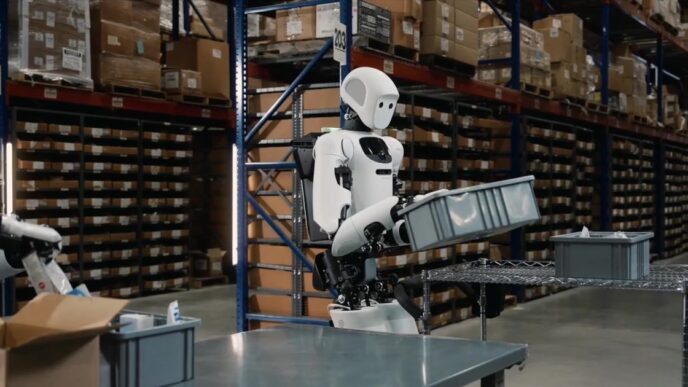
- The robot: Eno, a wheeled two-armed robot with human-sized dexterous hands, run by Genesis’s own GENE model. Genesis told TechCrunch it has built 30 to 40 units.
- Status: pilots with a handful of customers Genesis won’t name. A contract manufacturer is set to start mass production in the U.S. next year, according to TechCrunch.
- The catch: no price, no named paying customer and no deployment count. Genesis told TechCrunch its hands last only a few weeks of regular work before they need replacing.
Who invested in Genesis AI, and what the money is for
The release lists three co-leads: Premji Invest, Khosla Ventures and Eclipse. Eclipse and Khosla were already backers before this round, as were Bpifrance and HSG, according to Genesis’s June release. New names include Durable Capital Partners, T. Rowe Price, NVIDIA, AMD Ventures, Zoom, Samsung Next and Ericsson. Individual investors include Schmidt, Zoom CEO Eric Yuan, former Yahoo CEO Jerry Yang, French entrepreneur Xavier Niel and Kirkhorn.
Genesis says the money goes to four things: more data collection and larger training runs, “human-level physical manipulation,” deploying Eno “at scale with customers,” and hiring. It didn’t say how the $500 million splits across them, how many robots it plans to build or when it expects revenue. Eno goes first to manufacturing, logistics and laboratories, then to hospitality and healthcare, and later to homes and outdoor work, the company says.
Chief executive Zhou Xian and president Théophile Gervet met as graduate students in a Carnegie Mellon University lab and founded the company in 2024, TechCrunch reports. The $105 million seed round was announced in July 2025. The copyright line on its website names Genesis AI SAS.
What Genesis is building: GENE, a data glove, Genesis World and Eno
Genesis’s pitch is that it builds every layer itself. The November release names four pieces, and each was announced separately this year.
- GENE, the robot model. Genesis introduced GENE-26.5 on May 6, 2026, with YouTube clips labelled “Autonomous 1x speed”: a 20-step meal, lab pipetting, wire harnessing, solving a Rubik’s cube and playing piano. Those clips are company demos. Genesis described the model in a blog post, but we found no public weights and no outside test of GENE.
- A data glove matched to the robot hand. Genesis says its robot hand matches a human hand and its sensor glove, a “1:1:1 mapping” that lets the robot learn from people who wear the glove while doing their normal jobs. TechCrunch reports more than 100 workers around the world wear the gloves and head cameras. It’s the same bet behind Japan’s AIRoA-0, which trained on 16,151 hours of handheld-gripper data, and Robbyant’s LingBot-Touch, built from tactile-glove recordings. Unlike those two, Genesis hasn’t released its glove data or a downloadable model.
- Genesis World, the simulator. This is the only part anyone can inspect. Genesis announced Genesis World 1.0 on May 27 and released it as open source. We checked the GitHub repository on November 18: Apache 2.0 license, about 30,250 stars, and a new release, v1.4.7, published November 17, the day of the funding news. The repository was created in October 2023, before the company was founded in 2024.
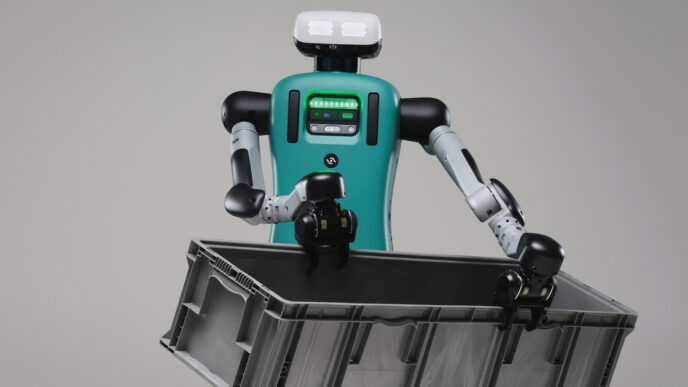
- Eno, the robot. Unveiled June 16, Eno has a wheeled base and a tower of jointed panels that raises or lowers its arms and folds down for storage. Its hands are Genesis’s own design, shaped like human hands. An optional screen can show what the robot is “thinking.” Genesis calls Eno general-purpose but not a humanoid in looks: “human in capability, not in form.”
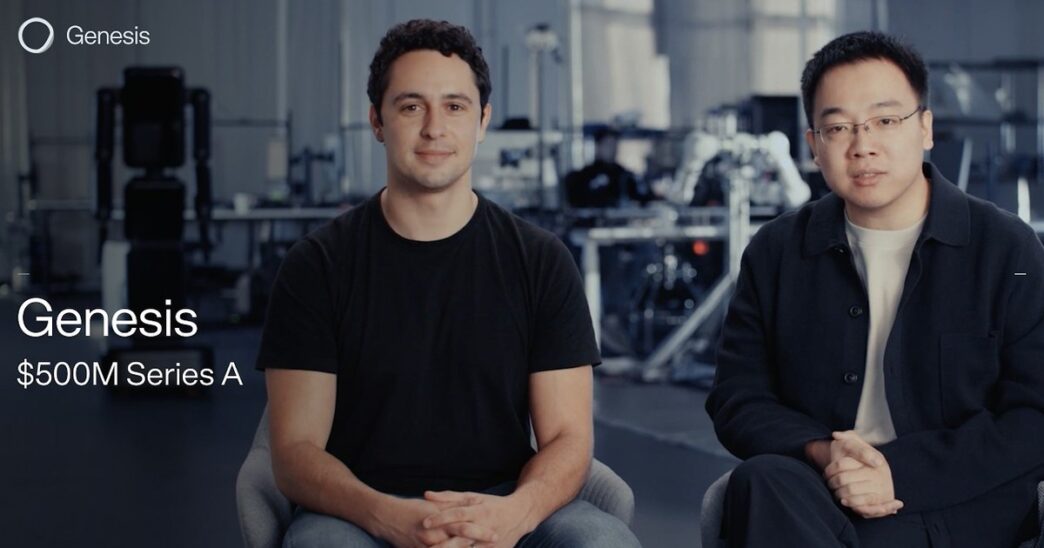
Genesis’s own film for the round, published on its YouTube channel the morning of the announcement, shows the founders in the lab with robots behind them.
Promised in June, shown in November
Genesis’s June 16 Eno release set out a plan. Here is how each piece stands five months later.
| June 2026 plan | November 2026 status | Source |
|---|---|---|
| “[B]egin Eno’s production and targeted customer deployments by the end of 2026” | Genesis is “currently ramping up production.” 30 to 40 Enos built. A contract manufacturer starts U.S. mass production next year. Genesis’s website still says customer deployments are planned “by the end of 2026.” | Genesis release; TechCrunch; genesis.ai |
| Industrial customers first: manufacturing, logistics, labs | Same order. Pilots with “a handful” of customers Genesis won’t name. | Genesis release; TechCrunch |
| LG CNS partnership: evaluate Eno at LG operations in the U.S., then a pilot, then a rollout | Not mentioned in the November release. No pilot results published. | Genesis and LG CNS release (June 16) |
| Hands that “exactly match the form and function of human hands” | The hands last “a few weeks of regular work” before they need replacing, per TechCrunch’s interview with Zhou. | TechCrunch |
| GENE runs Eno on long, multi-step tasks | TechCrunch’s in-person demo ran on off-the-shelf arms, not Eno. Eno “wasn’t ready to demonstrate its abilities.” On a second run the arms fumbled a box and struggled to peel a label. | TechCrunch |
None of this means Genesis is behind its plan. It still has six weeks to start the “targeted” deployments it promised for 2026. But a few dozen hand-built robots and a hand that wears out in weeks are the real starting point, and a $3.5 billion price tag sets a high bar.
How it compares with 2026’s other big robotics rounds
Genesis’s round is large for a Series A. The table below sets it against rounds we’ve covered this year, using the figures the companies disclosed.
| Company | Round, date | Amount | Valuation | What it has shown in the field |
|---|---|---|---|---|
| Genesis AI | Series A, Nov 17, 2026 | $500 million | $3.5 billion post-money | 30 to 40 Enos built; pilots with unnamed customers (TechCrunch) |
| Agile Robots | Series F, Nov 12, 2026 | $500 million | $8.5 billion | Plant rated for up to 10,000 humanoids a year; no humanoid delivery count |
| Bedrock Robotics | Series C, Oct 26, 2026 | $600 million | $4.1 billion post-money | Paid, fully autonomous excavator work since mid-August; fleet size not disclosed |
| Path Robotics | Series E, Nov 10, 2026 | $300 million | $2.45 billion post-money | “Dozens” of welding cells deployed, per lead investor Georgian |
| Foundry Robotics | Series A, Oct 28, 2026 | $100 million | Not disclosed | Says it ships to paying customers; none named |
| Skild AI (tracker) | January 2026 | Close to $1.4 billion | More than $14 billion | Says it has passed $100 million in annual recurring revenue |
Three things stand out. Genesis’s Series A is as big as Agile Robots’ Series F, at about 41% of Agile’s valuation, and Agile already runs a humanoid plant. It’s priced close to Bedrock, which has machines doing paid autonomous work. And Genesis is the only company in the table without a commercial deployment it can point to. NVIDIA invested in both Genesis and Agile Robots this month. For a broader view of where robot money went this year, see our robotics funding tracker.
Our take: investors are paying for the data engine, and the hands are the test
The valuation rests on a theory more than on robots in service. Zhou told TechCrunch the model design accounts for “maybe 10%” of the result and that “we have all the recipes. It’s just about execution.” If that’s right, the edge goes to whoever collects the most useful human data, and Genesis’s glove, matched one-to-one with its robot hand, is a cleaner way to collect it than teleoperating robots one at a time. The open simulator gives it credibility with researchers, too. That’s the case its investors are buying.
The weak point is hardware, and Zhou says so himself. A hand that lasts a few weeks is fine in a lab. In a plant running every day, it means hand swaps every few weeks for every robot, and that cost lands on the customer or on Genesis. Hand life, uptime and a price are the numbers that would turn Eno from a demo into a product. None has been published. Genesis also chose wheels over legs, which is the sensible choice for factories, labs and warehouses, the same places GXO plans to test up to 1,000 Apptronik Apollo humanoids.
We’d judge Genesis on three things over the next year. First, whether a customer goes on record about a paid deployment. Second, whether the U.S. contract manufacturer produces Enos in the hundreds. Third, whether GENE is ever tested by someone outside the company. Until then, the $3.5 billion is a bet on the team and the data approach, not proof that Eno works in a customer’s building.
Demo, pilot or deployment: where each claim stands
- Confirmed by the company: the $500 million Series A, the $3.5 billion post-money valuation, the investor list, the use of funds and the planned order of industries (Genesis release, November 17).
- Company demos: GENE clips labelled “autonomous” at 1x speed (May 2026), the Eno launch film and the funding film. Not independently tested.
- Pilots: Eno with “a handful” of unnamed customers (TechCrunch). The LG CNS evaluation announced in June, with no results published.
- Reported, from TechCrunch’s interview: 30 to 40 Enos built, a U.S. contract manufacturer starting next year, a finalized mass-production design, and hand life of a few weeks.
- Not disclosed: Eno’s price, revenue, a named paying customer, deployment numbers, production targets and any independent GENE test.
Frequently asked questions
How much has Genesis AI raised?
Genesis AI announced a $500 million Series A at a $3.5 billion post-money valuation on November 17, 2026. It had announced a $105 million seed round in July 2025, so its disclosed funding totals about $605 million.
Who invested in Genesis AI?
Premji Invest, Khosla Ventures and Eclipse co-led the Series A. Durable Capital Partners, accounts advised by T. Rowe Price, Bpifrance, HSG, NVIDIA, AMD Ventures, Zoom, Samsung Next and Ericsson took part, along with Eric Schmidt, Eric Yuan, Jerry Yang, Xavier Niel and Zach Kirkhorn.
What is the Genesis AI Eno robot?
Eno is Genesis AI’s first robot, unveiled June 16, 2026. It has a wheeled base, an adjustable tower that folds for storage, and two arms with human-sized dexterous hands, and it runs on Genesis’s GENE model. Genesis targets manufacturing, logistics and labs first. It hasn’t published a price.
Can you buy Eno?
Not yet. Genesis runs a waitlist on its website and says it plans targeted customer deployments by the end of 2026. It told TechCrunch it is piloting Eno with a handful of undisclosed customers and that a contract manufacturer will start U.S. mass production next year.
Sources
- Genesis AI: “Genesis AI Raises $500M Series A at $3.5B Valuation…,” November 17, 2026 (PR Newswire)
- Genesis AI: “Introducing Eno: Genesis AI’s First General-Purpose Robot…,” June 16, 2026 (PR Newswire)
- Genesis AI and LG CNS: strategic partnership release, June 16, 2026 (PR Newswire)
- Genesis AI: “Genesis AI Unveils GENE-26.5…,” May 6, 2026 (PR Newswire)
- TechCrunch: “Genesis AI raises $500M to deploy glove-wearing robots,” November 17, 2026
- Genesis AI (YouTube): “Genesis – $500M Series A,” November 17, 2026
- Genesis AI (YouTube): “Meet Eno,” June 16, 2026
- Genesis AI (YouTube): “GENE at work | Autonomous 1x speed,” May 6, 2026
- Genesis AI (YouTube): “Announcing Genesis World 1.0,” May 27, 2026
- Genesis-Embodied-AI/genesis-world on GitHub (license, stars and release v1.4.7, checked November 18, 2026)
- Genesis AI website (Eno waitlist and deployment timing)
All sources accessed November 18, 2026.
Last updated: November 18, 2026. To report an error, see our corrections page. See our editorial policy.