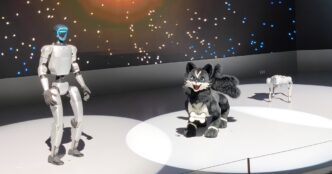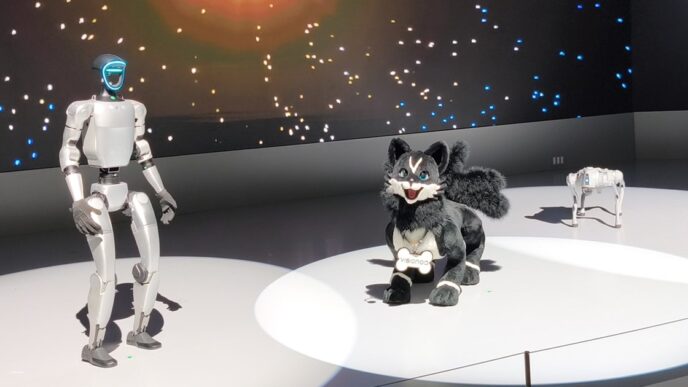
Faraday Future, best known for its electric cars, is now selling a humanoid robot for $2,490. The FF Nova launched on October 15 alongside a sister company, FF EAI Robotics Ecosystem (Nasdaq: FFR), and the two are calling it the first embodied-AI humanoid sold in the US for under $2,500. Read the spec sheet and the price makes more sense: Nova stands 49.7 centimeters tall, weighs 2.8 kilograms and walks at 0.1 meters per second.
That doesn’t make it a gimmick. FF Nova is a real bipedal robot with LiDAR, a depth sensor, on-board compute and an open SDK, aimed at developers and schools that want to train walking and manipulation policies without spending five figures. It just isn’t the kind of humanoid that carries boxes or folds laundry, and the price comparison FF is drawing deserves a closer look before anyone applies for one.
What $2,490 buys
Here’s what FF lists on the FF Nova product page, checked October 16:
| Spec | FF Nova |
|---|---|
| Price | $2,490 (Developer Skills Package $390 extra) |
| Height / weight | 49.7 cm (19.6 in) / 2.8 kg (6.2 lb) |
| Degrees of freedom | 20 (head 2, arms 6, legs 12) |
| Walking speed | 0.1 m/s on two legs; 0.8 m/s on the detachable wheeled base |
| Maximum obstacle height | 2 cm |
| Compute | 10 TOPS, 8 GB RAM, 32 GB storage |
| Sensors | 2D LiDAR, wide-angle camera (about 4 MP), 3D time-of-flight sensor, three-microphone array |
| Software | Open SDK, ROS 2, over-the-air updates; reinforcement-learning program on NVIDIA Isaac |
Two numbers stand out. A walking speed of 0.1 m/s is about a fifth of a mile per hour, and a 2 cm obstacle limit means Nova needs flat floors. FF clearly knows this: the wheeled base is the mode it pairs with autonomous navigation, while walking is pitched as the way Nova interacts with people. Battery life isn’t listed on the product page.
What a developer does get is the workflow. FF says users can train policies in simulation, preview them, and then validate them on a physical robot, the same sim-to-real loop larger humanoid makers use. The company also connects Nova to a large voice AI model and cloud-based AI agents, and promises a Skills Store where developers’ work could be shared and, in FF’s words, “potentially monetized in the future.”
FF’s price chart compares Nova with a much bigger robot
FF’s “first under $2,500” claim rests on a three-column chart on its product page. On one side is an unnamed “entry-level toy” at about $2,000, 37 cm and 17 degrees of freedom. On the other is an unnamed “embodied AI humanoid” at $13,000 or more, 127 cm tall and 35 kg. That second column lines up with Unitree’s G1, which Unitree’s own product page lists from $13.5K, standing 132 cm and weighing about 35 kg.
The chart is honest about the sizes, but the framing does a lot of work. Nova is less than half the G1’s height and about a twelfth of its weight. It belongs with small research and education humanoids, not with the full-size machines in our humanoid robot price guide. “First under $2,500” is FF’s claim; we haven’t seen an independent tally that confirms it.
Only 100 FF Novas, by invitation
Nova is rolling out in three phases, according to the companies’ joint release. Phase One is 100 units for invited developers and educational institutions, with applications through developer.ff.com during a seven-day window and the first 20 units ready to deliver immediately. Phase Two opens sales to all developers and schools, and Phase Three is a full consumer launch. Neither later phase has a date.
The $299 FF Nova Mini is on sale now, according to FF. It’s a sub-1 kg bipedal robot for kids aged eight and up, with block-based programming and an optional $499 curriculum of 16 live small-group classes over two months.
The fine print is in the risk factors
The most useful buyer information in the release isn’t in the product section. In its forward-looking statements, Faraday Future says it relies on Chinese OEMs for all of its robotics products, and on a single OEM for most of them. It also lists the possibility of a federal ban on imports of Chinese robotics products and tariff uncertainty as risks. Anyone budgeting for a fleet of Novas should read that next to our guide to the FCC Covered List and foreign-made robots. FF hasn’t said which manufacturer builds Nova.
The corporate picture is also in motion. FFR, which was called AIxCrypto Holdings until September 30, signed definitive agreements on October 12 to buy Faraday Future’s robotics business in an all-stock deal that values it at about $200 million, after which FF would own about 65.7% of FFR. Both companies’ statements include going-concern warnings. For a robot whose value depends on SDK updates and a developer community, who supports it in two years is a fair question.
The next checkpoint is the invitation results, which FF says it will announce after the application window closes. The bigger one is whether Phase Two gets a date and a published battery spec. Until then, FF Nova is a cheap way into humanoid robot development for 100 invited buyers, not a $2,490 version of the robots on factory floors.
Frequently asked questions
How much does the FF Nova humanoid robot cost?
FF lists the FF Nova at $2,490, with an optional Developer Skills Package for $390. The smaller FF Nova Mini for children costs $299, and its 16-class curriculum is $499.
How big is FF Nova?
According to Faraday Future, Nova is 49.7 cm (19.6 inches) tall and weighs 2.8 kg (6.2 pounds), with 20 degrees of freedom. It walks at 0.1 m/s and can ride a detachable wheeled base at 0.8 m/s.
Can anyone buy FF Nova right now?
Not yet. The first phase is limited to 100 units for invited developers and educational institutions, who apply through developer.ff.com. Wider developer sales and a consumer launch are planned, but FF hasn’t given dates for either.
Who manufactures FF Nova?
FF and FFR sell it, but Faraday Future says in its risk disclosures that it relies on Chinese OEMs for all of its robotics products. The company hasn’t named the manufacturer of Nova.
Is FF Nova comparable to Unitree G1 or Tesla Optimus?
No. Nova is a small developer and education robot about half a meter tall. Unitree’s G1 stands 132 cm, weighs about 35 kg and starts at $13.5K, and Tesla’s Optimus is a full-size humanoid Tesla hasn’t put on sale.
Sources
- FF EAI Robotics Ecosystem Inc. and Faraday Future, “FF EAI Robotics (FFR) and FF Jointly Launch FF Nova, First Embodied AI Humanoid Robot Priced Below $2,500 in U.S. …,” PR Newswire, October 15, 2026: prnewswire.com
- Faraday Future, FF Nova product page (specs and comparison chart): robotics.ff.com/us/nova
- Faraday Future, FF Nova and FF Nova Mini launch page: ff.com/us/1014launch
- Unitree, G1 product page (price and size): unitree.com/g1
All sources accessed October 16, 2026. Prices checked October 16, 2026.
Related: Humanoid robot prices in 2026 · Unitree G1, R1 and H2 prices · More Robot Companies coverage
Last updated: October 16, 2026. To report an error, see our corrections page. Articles are drafted with AI assistance and reviewed and edited by an editor; see our editorial policy.