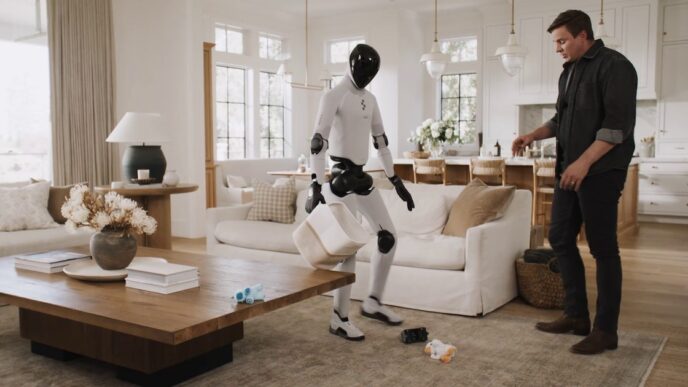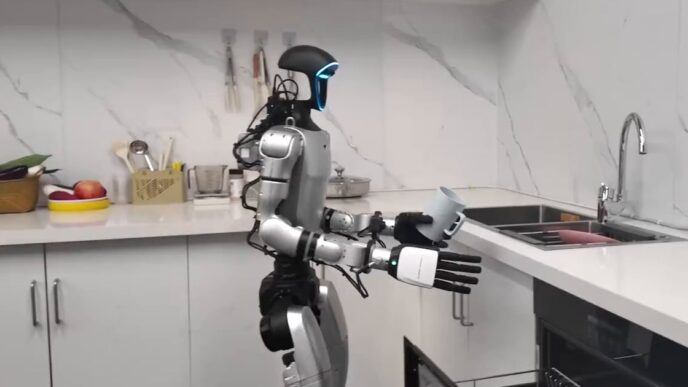
Almost every walking humanoid you have seen in a 2026 demo learned to walk somewhere other than the real world. Figure, Boston Dynamics and university labs train their robots’ control policies in physics simulators first, running thousands of virtual robots in parallel, then copy the result onto real hardware. The method is called sim-to-real, or sim2real, and the problem it tries to solve is the “reality gap”: the difference between how a robot behaves in software and how it behaves on a real floor.
This guide explains how sim-to-real training works, what techniques such as domain randomization actually do, what the companies using it have published, and where the method still falls short. It uses the companies’ own technical posts and the original research papers, and it keeps company claims separate from measured results.
- What it is: training a robot’s control policy in a physics simulator, usually with reinforcement learning, then running that policy on the physical robot.
- Why it works: GPUs can simulate thousands of robots at once, so a policy can gather years of practice in hours without breaking hardware.
- The main trick: domain randomization. Friction, mass, motor strength, delays and sensor noise are varied in training so the real world looks like one more variation.
- Who says they use it: Figure (Figure 02 walking), Boston Dynamics (Atlas and Spot) and many research labs, through tools such as NVIDIA Isaac Lab and MuJoCo.
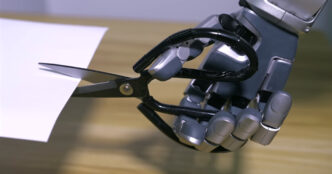
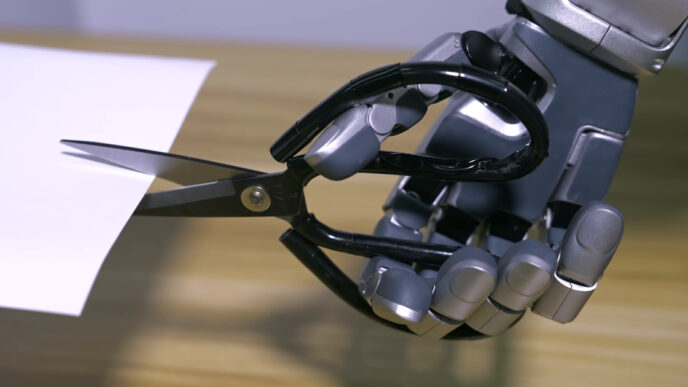
- Limits: it is strongest for locomotion and balance. Contact-rich hand work, deformable objects and long tasks still lean on real-world data.
What sim-to-real means
A robot’s controller, or policy, is the software that turns what the robot senses into motor commands, many times per second. Writing that controller by hand is slow, and training it by trial and error on a real humanoid is slower still: every fall risks damage, every attempt takes real time, and a real robot can only practice one attempt at a time.
Sim-to-real moves that trial and error into software. A physics engine models the robot’s links, joints, motors and contacts with the ground. A learning algorithm, most often reinforcement learning (RL), tries millions of actions, keeps what earns reward and drops what does not. When the policy is good enough in simulation, engineers load the same neural network onto the robot. If it works without further training on the hardware, researchers call that zero-shot transfer.
The catch is that no simulator is exact. Real motors have delays and heat up, real floors have uneven friction, and real cameras and joint sensors are noisy. A 2017 paper by Josh Tobin and colleagues at OpenAI and UC Berkeley described the challenge as bridging the “reality gap” between simulated robotics and experiments on hardware. Most of the techniques below exist to close or tolerate that gap.
How a sim-to-real training run works
The companies that have described their pipelines follow a similar pattern:
- Model the robot. Build a simulated copy with the robot’s geometry, mass, joint limits and actuator behavior.
- Define the task and reward. For walking, rewards typically cover following a commanded speed, staying upright and using little power. Many teams also add a reference motion, such as recorded human walking or an animation, that the robot is rewarded for imitating.
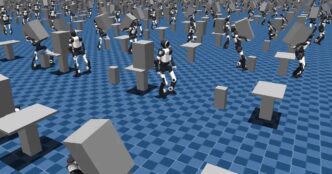
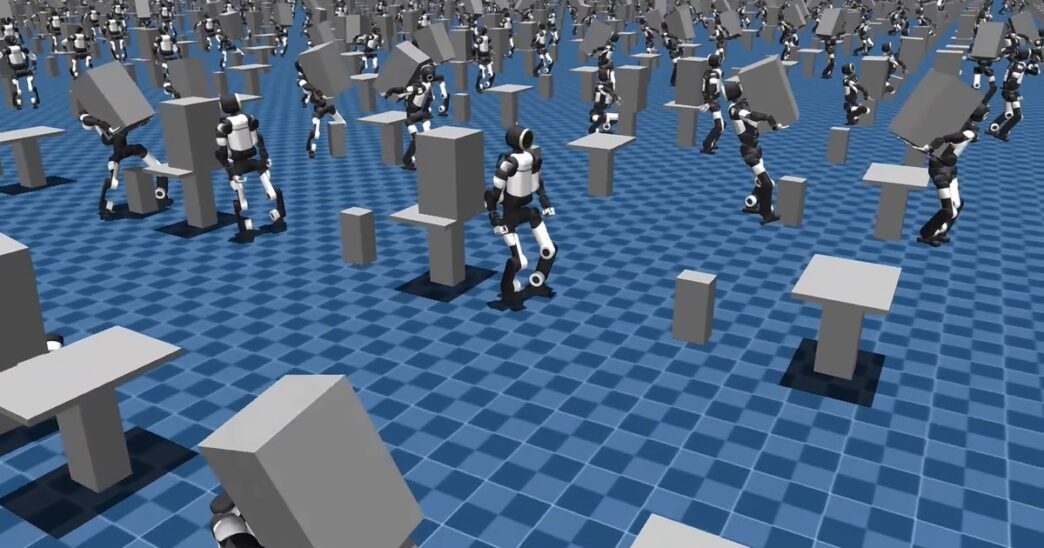
- Train in parallel. Run thousands of simulated robots at once on GPUs, each in a slightly different world.
- Randomize and disturb. Vary physics settings and push, trip or overload the virtual robots so the policy learns to recover.
- Transfer and test. Run the policy on hardware, find failures, recreate them in simulation and train again.
Figure described this process for Figure 02 in a March 2025 post on reinforcement-learning walking. It trained an end-to-end RL policy in a GPU-accelerated, high-fidelity simulator and said it could generate “years of data in only a few hours.” Its training ran thousands of virtual humanoids in parallel, each with unique physical parameters, across varied terrain, actuator dynamics and trips, slips and shoves. Figure said the reward combined imitation of human walking trajectories with velocity tracking, power use and robustness.
Domain randomization: the core trick
Domain randomization is the idea that if a policy has seen enough different simulated worlds, the real world will look like one more of them. Tobin’s 2017 paper applied it to vision: an object detector trained only on simulated images with deliberately non-realistic random textures located real objects to within 1.5 cm and was used for grasping in clutter. A second paper the same year, by Xue Bin Peng with OpenAI colleagues, randomized the dynamics of the simulator instead of its appearance, and a robot arm trained only in simulation pushed an object to a target on real hardware.
The most famous example is OpenAI’s 2019 Rubik’s Cube project. Its automatic domain randomization (ADR) widened the range of randomized environments as the policy improved, creating ever-harder training worlds. A five-fingered robot hand trained only in simulation manipulated a real cube. The paper reports that the best policy completed cubes needing 15 face rotations 60% of the time and full 26-rotation scrambles 20% of the time, and it used an existing solver algorithm to choose the sequence of moves. The learned part was the hand control and state estimation, not the puzzle solving.
Companies building humanoids say they rely on the same idea. Figure said domain randomization, combined with high-frequency torque feedback on the robot, let its walking policy transfer zero-shot to real Figure 02 robots without additional tuning, and that the same network ran on 10 robots. Boston Dynamics’ 2026 post on training Atlas to lift a mini-fridge describes randomizing the fridge’s weight, the floor’s friction and the robot’s motor strength.
Modeling the hardware: actuators, latency and noise
Randomization only goes so far if the simulated robot is badly wrong to begin with. A 2019 Science Robotics paper led by Jemin Hwangbo at ETH Zurich trained a neural network on data from the quadruped ANYmal’s real actuators, an “actuator net,” and plugged it into the simulator so the virtual motors behaved like the real ones. Policies trained this way let ANYmal follow speed commands precisely, run faster than before and recover from falls in complex positions.
Hardware design matters too. In its Atlas post, Boston Dynamics says it built the electric Atlas with only two actuator types, all rotary, partly because they are easier to represent well in simulation, and that its legs and arms are identical. The company defines the sim-to-real gap in practical terms such as friction, latency and sensor noise, and says that for Atlas the gap is small enough that a behavior trained one day can be tested on the robot the next.
What Boston Dynamics says about Atlas and Spot
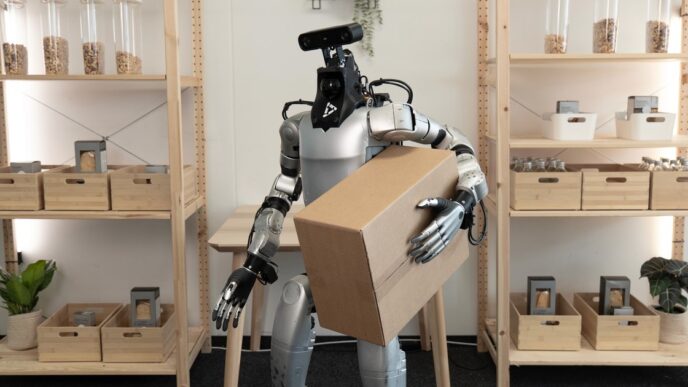
The Atlas fridge work is a useful case study because Boston Dynamics published both the method and a limit test. According to the company, engineers gave the policy a reference animation, rewards for keeping the load secure and random disturbances, and trained it over millions of hours of simulated experience in parallel on GPUs. The policy was trained on loads of roughly 50 to 70 lb, yet Atlas, a 90 kg robot, carried a loaded fridge weighing more than 100 lb. That is a company demonstration, not an independent benchmark, but it shows randomized training generalizing beyond its training range. Boston Dynamics says its goal is to train and deploy new behaviors “in as little as a day.”
Spot shows the same approach in a shipping product. In a 2024 post, Boston Dynamics said Spot’s locomotion historically relied on model predictive control, and that it moved to a hybrid with an RL policy trained over more than a million simulations with randomized stairs, terrain roughness and friction. It said a robustness test fleet runs more than 2,000 hours a week, that falls seen in testing are recreated in simulation, and that the RL controller shipped in Spot release 4.0. The company also launched a Spot RL Researcher Kit with NVIDIA and the AI Institute, built on Isaac Lab.
The tools: Isaac Lab, MuJoCo and parallel training
Speed is what made sim-to-real practical for legged robots. A 2021 ETH Zurich and NVIDIA paper, “Learning to Walk in Minutes,” trained thousands of simulated ANYmal robots on a single workstation GPU, producing a flat-ground walking policy in under four minutes and a rough-terrain policy in about twenty, then transferred it to the real robot. That work ran on NVIDIA’s Isaac Gym.
Its successor, Isaac Lab, is an open-source framework that NVIDIA’s authors describe as combining GPU-parallel physics, photorealistic graphics, actuator models, sensor simulation and domain randomization tools for reinforcement and imitation learning. Google DeepMind’s MuJoCo physics engine is the other common choice; its MuJoCo Playground framework, released in 2025, claims policies can be trained in minutes on a single GPU and transferred zero-shot to quadrupeds, humanoids, hands and arms. NVIDIA also packages simulation into its GR00T humanoid tools, and Berkeley’s SuperMimic project recently claimed large cuts in the GPU time needed to train humanoid motion tracking.
Where sim-to-real still struggles
Most published zero-shot successes involve the robot’s own body: walking, balancing, getting up and carrying loads. The physics there is well understood, and the robot mostly needs its joint sensors and an estimate of its own state. Tasks with rich contact, such as folding cloth, handling cables or inserting parts, are harder to simulate accurately, and vision adds another gap between rendered and real images.
That is why most companies mix methods. Teleoperated demonstrations and real-world datasets such as FineART feed vision-language-action models for manipulation, while simulation handles locomotion and whole-body control. Virtual twins, like the DELMIA model Audi is using to plan humanoid parts picking, play a different role: they check reach, timing and layout before deployment rather than training the policy itself.
When you read a claim that a robot was “trained in simulation,” three questions help:
- Which part was trained in simulation? Walking, a single skill or the whole task?
- Was transfer zero-shot? Or did the policy need fine-tuning with real data?
- What was measured on hardware? Success rates, number of robots and conditions, not just one video.
What to watch next
The open question is whether simulation can do for manipulation what it has done for walking. Watch for hardware success rates on hand tasks trained mostly in simulation, for Boston Dynamics to show more Atlas behaviors trained within a day as it says it intends, and for open tools such as Isaac Lab and MuJoCo Playground to publish humanoid sim-to-real results that outside labs can reproduce. Watch also how teams combine simulated practice with the growing pool of real robot datasets, since that mix will decide how quickly new skills reach factory floors.
Frequently asked questions
What does sim-to-real mean in robotics?
Sim-to-real means training a robot’s control policy in a physics simulator and then running it on a physical robot. It usually uses reinforcement learning across thousands of simulated robots in parallel. When the policy works on hardware without extra real-world training, researchers call it zero-shot transfer.
What is the reality gap?
The reality gap is the difference between how a robot behaves in simulation and how it behaves in the real world. It comes from imperfect models of friction, motors, delays, sensor noise and contact. Domain randomization, better actuator models and real-world testing are the main ways to close it.
What is domain randomization?
Domain randomization varies the simulator’s settings during training, such as friction, object weight, motor strength, lighting or textures, so a policy learns to handle many conditions. If the training range is wide enough, the real world looks like one more variation. OpenAI’s automatic version, ADR, widened the ranges as the policy improved.
Do Figure and Boston Dynamics train robots in simulation?
Both say they do. Figure said in March 2025 that Figure 02’s walking policy was trained with reinforcement learning in simulation and transferred zero-shot. Boston Dynamics says Atlas behaviors such as lifting a mini-fridge, and Spot’s locomotion controller since release 4.0, use policies trained in simulation.
What software is used for sim-to-real training?
Common tools include NVIDIA Isaac Lab, the successor to Isaac Gym, and Google DeepMind’s MuJoCo with its MuJoCo Playground framework. Both run many robot simulations in parallel on GPUs and include domain randomization features. Companies also use their own in-house simulators.
Sources
- Figure, “Natural Humanoid Walk Using Reinforcement Learning” (March 25, 2025): figure.ai
- Boston Dynamics, “Training a Humanoid Robot for Hard Work” (2026): bostondynamics.com
- Boston Dynamics, “Starting on the Right Foot with Reinforcement Learning” (2024): bostondynamics.com
- Boston Dynamics, “How does Atlas learn? | Inside the Lab” (YouTube, May 18, 2026): youtube.com
- Tobin et al., “Domain Randomization for Transferring Deep Neural Networks from Simulation to the Real World” (arXiv 1703.06907, 2017): arxiv.org
- Peng et al., “Sim-to-Real Transfer of Robotic Control with Dynamics Randomization” (arXiv 1710.06537, 2017): arxiv.org
- OpenAI et al., “Solving Rubik’s Cube with a Robot Hand” (arXiv 1910.07113, 2019): arxiv.org
- Hwangbo et al., “Learning agile and dynamic motor skills for legged robots” (Science Robotics, 2019; arXiv 1901.08652): arxiv.org
- Rudin et al., “Learning to Walk in Minutes Using Massively Parallel Deep Reinforcement Learning” (arXiv 2109.11978, 2021): arxiv.org
- NVIDIA et al., “Isaac Lab: A GPU-Accelerated Simulation Framework for Multi-Modal Robot Learning” (arXiv 2511.04831, 2025): arxiv.org
- Zakka et al., “MuJoCo Playground” (arXiv 2502.08844, 2025): arxiv.org
All sources accessed November 2, 2026.
Last updated: November 2, 2026. To report an error, see our corrections page. Articles are drafted with AI assistance and reviewed and edited by an editor; see our editorial policy.