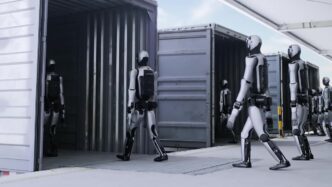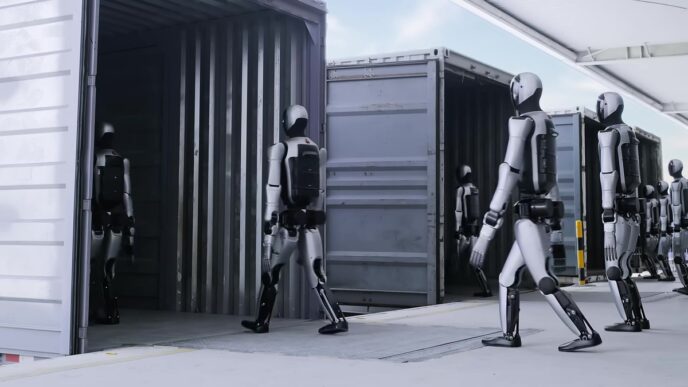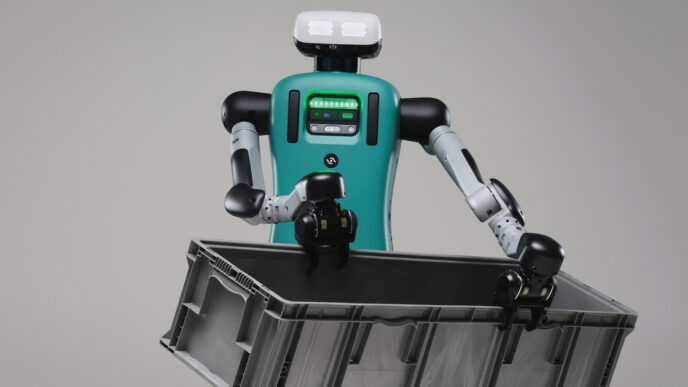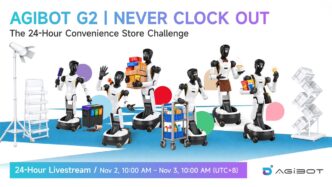
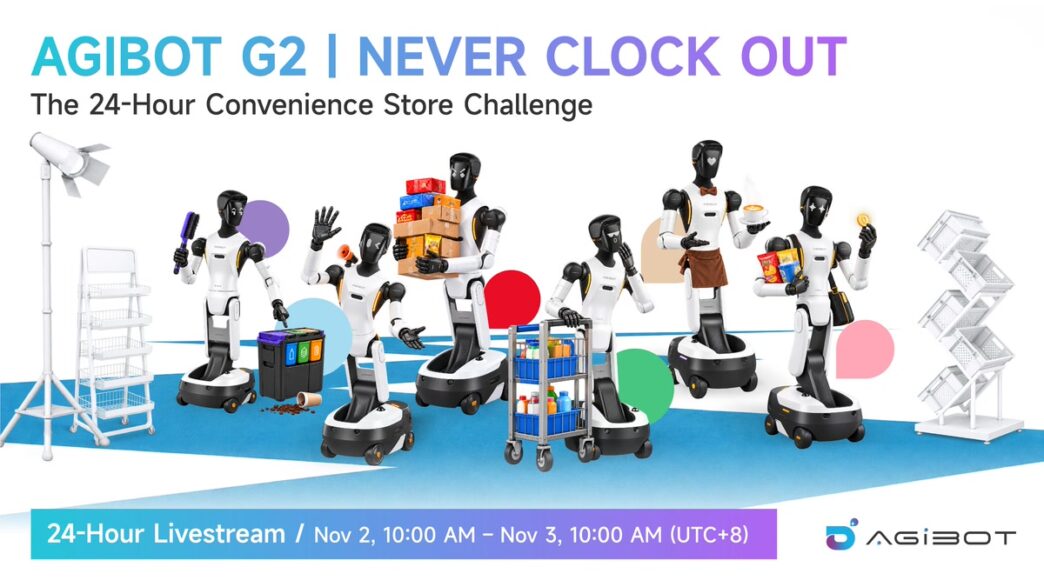
AgiBot put six of its wheeled G2 humanoid robots to work in a real Shanghai convenience store for a full day, and on Sunday, November 8, 2026, it published the scorecard. In a release on its own site and on GlobeNewswire, the company says the six robots completed 1,730 tasks between 10 a.m. on November 2 and 10 a.m. on November 3, from making coffee to restocking shelves, while a livestream drew more than two million viewers. Four of the six passed AgiBot’s final assessment. Two did not.
That last line is the most useful thing in the release. An AgiBot G2 convenience store shift is a harder, messier test than a stage demo, and the company is publishing a partial failure alongside the headline count. It is also still a company-run trial with company-defined tasks, and it leaves out the number that matters most for anyone thinking about deploying robots in a shop: how often a person had to step in.
- What: six AgiBot G2 wheeled humanoids worked a 24-hour trial in an operating convenience store in Shanghai’s Xuhui District, November 2-3, 2026.
- Result AgiBot reports: 1,730 tasks, including 683 customer interactions, 147 coffee orders and 277 shelf checks or restocks. Four of six robots passed the final assessment.
- Status: a public trial, not a commercial deployment. No store operator is named as a customer, and there is no price or rollout date.
- The catch: no intervention, teleoperation, charging or error figures; AgiBot set the tasks and the pass criteria; and the robots’ own Worken productivity metric can’t be calculated from what was published.
What AgiBot says the G2 robots did
The release describes six G2 robots, each assigned one job: customer assistance, shelf inspection, restocking, coffee preparation, checkout and hot food, and cleaning. AgiBot’s task tally for the 24 hours breaks down like this:
| Task type (AgiBot’s labels) | Count | Share of 1,730 |
|---|---|---|
| Customer-service interactions | 683 | 39% |
| Product pickups and deliveries | 369 | 21% |
| Shelf inspections and restocking | 277 | 16% |
| Coffee orders | 147 | 8% |
| Table-cleaning tasks | 128 | 7% |
| Breakfast servings | 126 | 7% |
The six categories add up exactly to 1,730, which is a small but real check on the release. Spread over 24 hours, that is about 72 tasks an hour for the whole store, or roughly 12 an hour per robot on average. Those are our calculations from AgiBot’s figures, and they treat a greeting and a coffee as equal “tasks,” which they obviously aren’t. Customer interactions, the easiest category to rack up, make up almost two in five.
The trial ran across four periods, the lunch rush, the evening peak, overnight and the next morning’s breakfast rush. AgiBot says the robots were scored on time on duty, task completion, customer feedback, response time and handling of unexpected situations. Two evaluators also ran spot tests: ordering regular and sugar-free Coca-Cola to see whether a robot could tell the cans apart, scrambling packs of chewing gum on a shelf, and blocking an aisle with a person and a box. AgiBot doesn’t say how the robots did on those tests, which roles the two failing robots held, or which criteria they missed.
The company credits Genie Master, its embodied-AI agent framework, with coordinating the six machines. Through what AgiBot calls the Embodied Execution Protocol (EEP), Genie Master assigns tasks, the robots carry them out with their own action policies, and results flow back for analysis. AgiBot says successful and failed attempts are stored as long-term memory and turned into training data, and that it used quieter overnight hours for extra practice on precise manipulation. Those are descriptions of the system’s design, not measured results.
What the 1,730 number doesn’t tell you
When AgiBot first announced the challenge on November 2, outlets including Humanoids Daily and Interesting Engineering pointed out that a 24-hour livestream describes the length of the event, not uninterrupted autonomous work by every robot. The results release doesn’t close that gap. It has no figures for:
- Human interventions. How many times staff or engineers helped a robot, reset it or finished a task for it.
- Teleoperation. Whether any task, or any robot for any period, was remotely operated. Our guide to reading humanoid demos explains why that line matters more than the run time.
- Charging and downtime. Whether robots were swapped, docked or paused during the 24 hours.
- Failures. How many attempted tasks went wrong, beyond the bare fact that two robots didn’t pass.
There is also no customer here in the commercial sense. The release doesn’t name the store’s operator or say whether it is paying for robots. On our readiness scale, this is a public pilot in a real environment, a step up from a scripted demo, but not a paid deployment.
AgiBot’s own yardstick can’t score this trial
Four days before the store opened, AgiBot asked the industry to stop counting robots and start counting work. Its Worken metric, unveiled at its Innovation Day on October 29, multiplies the number of active robots by their autonomous working hours and by an output efficiency ratio measured against a reference benchmark, such as what a human worker would do. AgiBot says the store trial closed out its AI WAVE technology showcase, a run of releases that began on October 22.
Yet the store release publishes only one of Worken’s three inputs. We know there were six active robots. We don’t know their autonomous hours, which is exactly the number interventions and teleoperation would reduce, and we don’t have an output ratio, such as how 147 coffees compare with a barista’s output over the same day. AgiBot’s Worken slide at Innovation Day included a retail shopping-guidance deployment, so the company clearly can produce these figures for retail. Applying its own metric to its most public test would have made the result far easier to judge.
How it compares with Xiaomi’s eight-hour factory shift
The timing invites a comparison. On November 3, the day AgiBot’s store shift ended in Shanghai, Xiaomi posted footage of its humanoids working an eight-hour shift in its car factory. Xiaomi’s run logged 8 hours and 5 minutes at a single sorting station, with two charging breaks, and the company published no throughput or intervention numbers.
AgiBot’s trial is longer, uses more robots, covers six different jobs and is customer-facing, which is a less predictable setting than a factory station. It also publishes a task count, which Xiaomi didn’t. Neither company reports how often a human stepped in. So the two tests move the same conversation forward from opposite directions: Xiaomi shows a robot holding one industrial station for a shift, and AgiBot shows a small fleet juggling varied, lower-stakes service tasks around the clock. Neither yet shows what a buyer would pay or save.
Scale is the other context. AgiBot says its 20,000th robot rolled off its production line in September 2026, as it noted again in this release and as we track in our production numbers tracker. A six-robot store trial is a tiny slice of that fleet. Its value is as a stress test, not as evidence of how many of those 20,000 machines are doing paid work.
Who this matters to
For retailers, the G2 trial is a preview of the jobs humanoid makers will pitch first: restocking, simple food service and answering questions, overnight when staffing is hardest. The useful questions to ask AgiBot are the ones the release skips: the intervention rate, the cost per robot, and what happens when a robot fails mid-task with a customer waiting. For investors and rivals, it’s a signal that Chinese humanoid makers are now competing on endurance and variety in public, after a year of dance records and stage demos such as AgiBot’s own 110-robot Guinness performance.
What to watch next
AgiBot says it will keep testing robots in more roles and real-world settings and will check which capabilities carry over between tasks. Three disclosures would make the next trial much more meaningful: an intervention and teleoperation log, a Worken score with its autonomous hours, and a named retail customer paying for robots beyond a showcase. Until then, 1,730 tasks is a credible sign of endurance and a company scoreboard, in that order.
Frequently asked questions
What did AgiBot’s G2 robots do in the convenience store?
Six G2 wheeled humanoids each took one role (customer assistance, shelf inspection, restocking, coffee, checkout and hot food, and cleaning) in a working store in Shanghai’s Xuhui District from 10 a.m. November 2 to 10 a.m. November 3, 2026. AgiBot says they completed 1,730 tasks.
Did all six AgiBot robots pass the trial?
No. AgiBot says four of the six passed its final assessment, which looked at time on duty, task completion, customer feedback, response time and handling of unexpected situations. It hasn’t said which robots failed or why.
Were the AgiBot G2 robots fully autonomous?
AgiBot hasn’t published intervention, teleoperation or charging figures for the trial, so full autonomy can’t be confirmed. The 24 hours describes the length of the event, not proof that every robot worked unaided the whole time.
Is AgiBot selling G2 robots to convenience stores?
The release doesn’t name a retail customer, a price or a rollout plan. It describes the store shift as a trial and says AgiBot will keep testing robots in more roles and settings.
How does this compare with Xiaomi’s 8-hour robot shift?
Xiaomi’s November 3 run was 8 hours and 5 minutes at one factory station, with two charging breaks. AgiBot’s trial ran 24 hours with six robots in six customer-facing roles and reported a task count. Neither company published how often humans intervened.
Sources
- AgiBot: “Six AGIBOT G2 Robots Complete 1,730 Tasks in 24-Hour Shanghai Convenience Store Trial” (company release; task counts, dates, assessment, Genie Master / EEP)
- GlobeNewswire: the same AgiBot release, November 8, 2026, 11:00 ET
- AgiBot on X: “Robots Never Clock Out” challenge announcement and schedule (November 1, 2026)
- Humanoids Daily: AgiBot livestreams six G2 robots in a 24-hour convenience store challenge, November 2, 2026
- Interesting Engineering: AgiBot puts six humanoid robots through a 24-hour convenience store shift, November 3, 2026
All sources accessed November 9, 2026.
Last updated: November 9, 2026. To report an error, see our corrections page. Articles are drafted with AI assistance and reviewed and edited by an editor; see our editorial policy.