South Korea has cleared 20 humanoid robots to work in the same space as factory and warehouse staff, without the safety fences its rules normally demand for industrial robots. The Ministry of Trade, Industry and Resources approved the special case on Tuesday, October 13, at the sixth meeting this year of its industrial-convergence regulatory sandbox committee, held at the Korea Chamber of Commerce and Industry in Seoul.
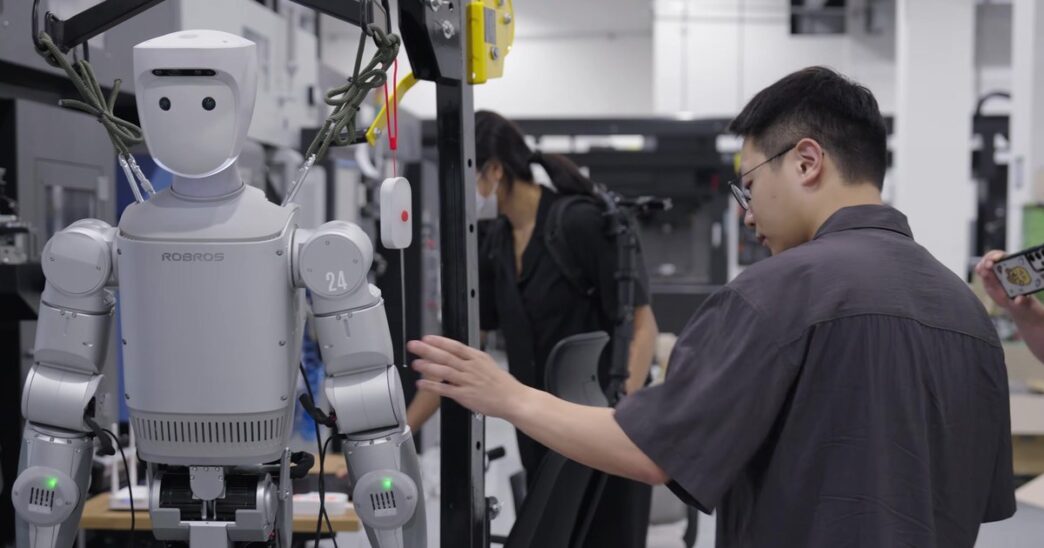
All 20 robots are IGRIS-C, a two-legged humanoid made by Seoul startup Robros. They’ll go to four sites: a chip-packaging plant, an auto-parts maker, a shipyard and a cold-chain logistics company. It’s a supervised trial, not a commercial rollout. The government says it will use the data to rewrite its safety standards for robots that move around people.
Why the fence rule matters
Korea’s Occupational Safety and Health Standards Rules (Article 223) require a fence at least 1.8 meters high around an industrial robot, or sensor-based protective devices where a fence isn’t practical. The main exception is for robots the labor minister recognizes as meeting Korean or international standards, which in practice means fixed collaborative arms. A humanoid that walks between workstations fits none of those boxes. As Etoday and Global Economic put it, the rule assumes a robot that stays in one place.
The special case doesn’t scrap the rule. According to Global Economic’s report, the trial is conditional on a risk assessment and risk-reduction measures under the Ministry of Employment and Labor. “The pilot will proceed on the premise that the companies take safety measures to reduce risk,” Choi Soo-yeon, director of the ministry’s industrial regulation innovation division, told the Hankyoreh.
The four sites
| Host company | Industry | Task in the trial |
|---|---|---|
| Nepes | Semiconductor back-end packaging | Cleaning packaging parts |
| Sungwoo Hitech | Auto parts | Seating car-body parts |
| HD Hyundai Samho | Shipbuilding | Stacking scaffold-fastening pieces |
| Delivery Lab | Logistics | Stacking refrigerated packaging |
The ministry framed the significance as breadth: the trial goes beyond simple transport into chips, cars and ships, and into fiddlier jobs like precision cleaning and cold-storage work. Seoul Economic Daily reported that humanoids had so far been allowed only as company-by-company sandbox exceptions, and that the government now wants to turn trial data into general rules. So this isn’t Korea’s first humanoid on a factory floor. What’s new is the plan to write the standard.
What IGRIS-C is
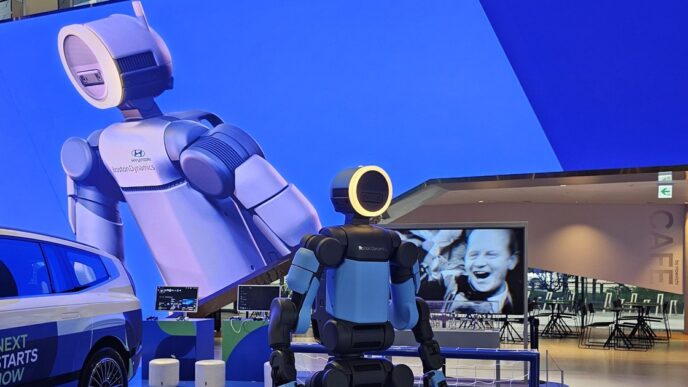
Robros lists IGRIS-C at 154 cm tall and 56 kg, with a 48 V, 17,000 mAh battery and a 2.5-hour charge time. Its spec page gives 6 degrees of freedom per hand, 7 per arm, 6 per leg, 3 at the waist and 2 at the neck (43 in total, by our count). Listed safety features are force limiting, collision detection, an emergency stop and a collaborative mode; our guide to ISO safety standards for humanoid robots explains what those cover.
The robot also ships with a “Master Arm” teleoperation rig and a data platform, which tells you how Robros trains it: people operate the robot remotely to collect demonstrations. That matters for reading the trial. Robros CEO Noh Seung-jun told the Hankyoreh that IGRIS-C slows down when it senses people nearby and stops if they come closer, and that if a person shuts it down after a fault, it sits down where it stands. The Hankyoreh reported that during the trial the robot does the work on its own while a person watches. That’s the company’s description; nobody outside has published data on how often a human steps in. (Our explainer on teleoperation versus autonomy covers why that number matters.)
Robros told Seoul Economic Daily it has sold 18 IGRIS-C units and aims to pass 50 built by the end of the year. It also said a logistics pilot with Lotte Global Logistics, running since early 2026, has reached “minimal human intervention.” Neither figure has been independently verified.
Context: Korea already automates more than anyone
South Korea had the world’s highest robot density in 2024, at 1,220 industrial robots per 10,000 manufacturing workers, according to the International Federation of Robotics. Nearly all of those are fixed machines behind guarding. Humanoids are pitched as robots that share an aisle with people, which is what current rules weren’t written for. In China, Shanghai on Monday set a reported target of 8,000 humanoids in its factories by 2028.
Minister Kim Jung-kwan, who chaired the meeting, said “the key is not to remove regulation unconditionally” but to change it so new technology can reach sites when it’s needed while protecting public safety, according to the Hankyoreh. The same meeting approved a trial of four-legged patrol robots on public footpaths in Cheonan, run by Maum AI, which the ministry called a first, plus an AI security platform for a Bundang hospital.
What we don’t know yet
- Timing. None of the releases or reports we read give a start date or how long the trial runs.
- Intervention rates. How often a person has to stop, correct or teleoperate a robot is the number that would show whether this is working.
- What the new standard will say. The government says the data will feed safety rules; it hasn’t said when, or whether they’ll follow ISO work on mobile and humanoid robots.
- Cost. Robros hasn’t published a current price. Edaily reported a preorder price of about 150 million won in July 2025, for an earlier, smaller version of the robot.
Frequently asked questions
What did South Korea approve for humanoid robots?
On October 13, 2026, the Ministry of Trade, Industry and Resources granted a regulatory sandbox special case that lets Robros put 20 IGRIS-C humanoids to work next to people at four company sites, without the 1.8-meter safety fence Korean rules normally require for industrial robots.
Which companies will use the robots?
Nepes (semiconductor packaging), Sungwoo Hitech (auto parts), HD Hyundai Samho (shipbuilding) and Delivery Lab (refrigerated logistics). Tasks include cleaning packaging parts, seating car-body parts and stacking materials.
Is this the first time humanoids have worked in Korean factories?
No. Seoul Economic Daily reported that humanoids had been allowed before as individual sandbox exceptions. What’s new is the scale across core industries and the government’s stated plan to turn the trial data into general safety standards.
Do the robots work on their own?
Robros says the robots do the tasks themselves while a person monitors them, and that they slow down or stop when people get close. IGRIS-C also ships with a teleoperation rig for collecting training data. No independent data on intervention rates has been published.
How big is the IGRIS-C humanoid?
Robros lists it at 154 cm tall and 56 kg, with a 48 V battery that charges in 2.5 hours and roughly 43 degrees of freedom across its hands, arms, legs, waist and neck.
Sources
- Ministry of Trade, Industry and Resources, “4족 보행 로봇이 우리 동네 안전을 지킵니다” (sandbox committee results), October 13, 2026: motir.go.kr
- Hankyoreh, Kim Nam-il, “안전 펜스 밖으로 나온 로봇…규제 풀어 사람과 같은 공간서 일한다,” October 13, 2026: hani.co.kr
- Seoul Economic Daily, October 13, 2026: sedaily.com
- Global Economic, Lee Da-hyun, October 13, 2026: g-enews.com
- Etoday, October 13, 2026: etoday.co.kr
- Financial News, Park Ji-young, October 13, 2026: fnnews.com
- Robros, IGRIS-C product and specification page (accessed October 13, 2026): robros.co.kr
- Korea Occupational Safety and Health Standards Rules, Article 223 (industrial robot fencing), via the National Law Information Center: law.go.kr
- International Federation of Robotics, “Robot Density Surges in Europe, Asia, and Americas,” April 8, 2026: ifr.org
- Robros, “From One to Many: Deployed in the Real World” (official video; source of the featured image), August 28, 2026: youtube.com
Related: Humanoid robots in warehouse logistics · Where humanoid robot training data comes from · More policy and safety coverage
Last updated: October 13, 2026. To report an error, see our corrections page. Articles are drafted with AI assistance and reviewed and edited by an editor; see our editorial policy.