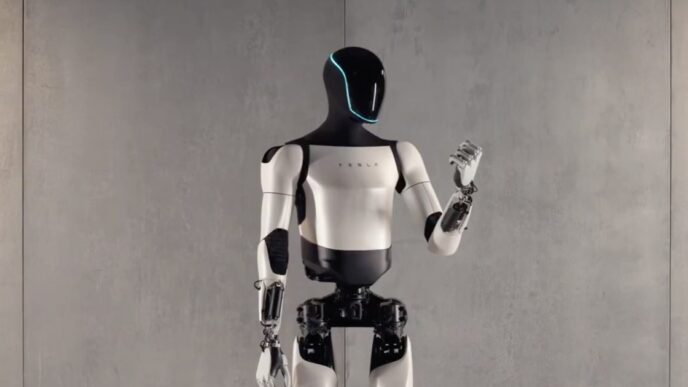
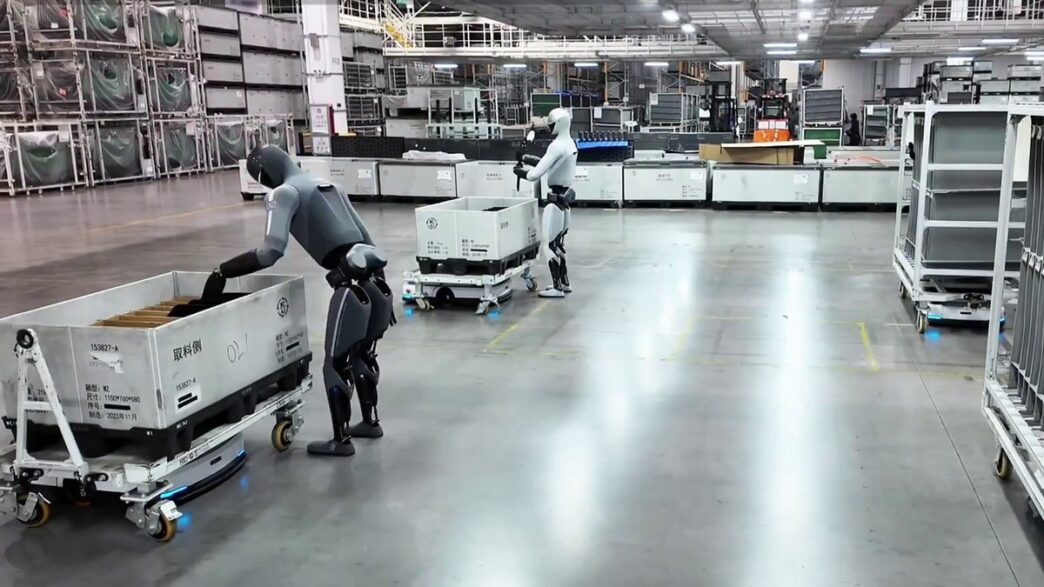
Xiaomi says its humanoid robot has worked a full eight-hour shift at a station in its electric-car factory. On Tuesday, November 3, 2026, the company’s official Xiaomi Tech account posted sped-up footage of the run: two-legged robots lifting dashboard side covers out of parts bins and sorting them into racks, with an on-screen clock that ends at 8 hours and 5 minutes. Founder Lei Jun shared the video too. Xiaomi calls the result a “preliminary validation” that the Xiaomi humanoid robot can do production-line work.
It’s a real step for a robot line Xiaomi first showed on stage in August 2022, when the original CyberOne walked out at a launch event. It is also a company video with a company scoreboard. Xiaomi hasn’t said how many parts the robots sorted, how often a person stepped in, or when, if ever, humanoids will work in its plants for real.
- What: Xiaomi’s full-size humanoid ran a first eight-hour trial at the center-console side-cover sorting station in the final-assembly hall of its car factory.
- Result Xiaomi reports: 8 hours 5 minutes of “stable operation,” with two charging breaks, at 3 hours 2 minutes and 6 hours 3 minutes of cumulative work.
- Earlier steps: 3 hours at a nut-installing station in March 2026 (90.2% success, 76-second cycle), then 98% at that station by July.
- The catch: no throughput, error or intervention figures, no unit count, no price and no deployment date. It is a factory pilot, shown in Xiaomi’s own footage.
What the Xiaomi humanoid robot did on the line
The job is called center-console side-cover sequencing. In the final-assembly hall of a car plant, parts are often delivered to the line in the exact order the cars will arrive, a system the industry calls SPS (set parts supply). At this station, The Paper explained, the robot has to take a large, flexible, irregularly shaped interior trim panel out of a supply bin, turn it to the right orientation, and slot it into the right compartment of a rack, matched to the sequence of car models coming down the line and to the line’s pace.
That is harder than it sounds. The panels bend, and they sit in the bin at random angles, so the robot can’t grab the same spot every time. It’s the kind of variable task that fixed industrial arms struggle with, which is why humanoid makers like to pick it for demos.
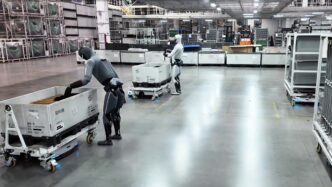
In Xiaomi’s footage, a black humanoid and a white one work beside autonomous mobile robots (AMRs), wheeled carts that bring the bins in and take filled racks away. The Paper reported that the robots adjusted their routes and steps to meet the incoming AMRs. Xiaomi says the robot “can autonomously detect and correct anomalies while coordinating with the production line system,” which is its claim; the video doesn’t show what counted as an anomaly. The Paper also noticed that in the second half of the run one robot dropped a part on the floor and a wheeled robot came over to pick it up.
8 hours on the production line. 🤖
Xiaomi’s full-size humanoid robot takes on an 8-hour task at the Center Console Side-Cover Sorting Workstation at Xiaomi Auto Factory.
Beyond sustained operation, it can autonomously detect and correct anomalies while coordinating with the… pic.twitter.com/brpO3S5bCn
— Xiaomi Tech (@XiaomiTech_) November 3, 2026
Video: Xiaomi. “8 hours on the production line” from the official Xiaomi Tech account on X, November 3, 2026 (watch on X). It’s company footage played at up to 100x speed; the “Autonomous” label on screen is Xiaomi’s, not an outside check.
Two charging breaks in eight hours
The on-screen clock in Xiaomi’s video tells the most useful part of the story. The robot is shown charging twice: once at 3 hours 2 minutes of cumulative operating time, and again at 6 hours 3 minutes. The final card reads “Completed 8 Hours and 5 Minutes of Stable Operation.” Xiaomi didn’t say how long each charge took, so the run covered a shift’s worth of working time, not necessarily eight straight hours of wall-clock time.
That puts the battery life at roughly three hours of this work per charge. Xiaomi’s statement to Beijing Daily says the run “met the station’s full-day production demand.” It doesn’t say whether one robot did all eight hours or whether the black and white robots took turns. Xiaomi’s post describes “Xiaomi’s full-size humanoid robot” in the singular. The Paper identified the robot in the video as the CyberOne 02, a name Xiaomi’s own posts didn’t use.
Three hours between charges isn’t unusual. Battery life is one of the most quoted and least comparable humanoid specs, as we found when Unitree’s eight-hour claim for its H2-X turned out to be for standing, not working. Xiaomi’s number at least comes from a working station.
From three hours to a full shift
Xiaomi has been running this “internship,” as it calls it, since the spring. In its statement carried by Beijing Daily, the company laid out three stages.
| When | Station | What Xiaomi reported |
|---|---|---|
| March 2026 | Self-tapping nut installation | First time in the car factory; 3 hours of continuous autonomous work; 90.2% success installing on both sides; kept up with the 76-second line cycle |
| July 2026 | Nut installation, plus side-cover sorting and bin folding | Success rate at the nut station up to 98%; two more complex stations added; first long runs with flexible parts |
| November 3, 2026 | Center-console side-cover sorting | First 8-hour challenge; 8 hours 5 minutes of stable operation; anomaly correction and coordination with line systems (Xiaomi’s claim) |
The trend is clear: longer runs, harder parts, more stations. What’s missing is the same kind of number for the new station. Xiaomi gave success rates for the nut task in March and July, but it hasn’t published a success rate, a parts-per-hour count or a cycle time for the side-cover job.
Lei Jun answered one obvious question himself. When people online asked why a factory needs a humanoid at all, he replied, in The Paper’s account: “This is a general-purpose humanoid robot. The hardware doesn’t need to be changed, and it can adapt to more different jobs and scenarios” (our translation). That’s the whole pitch for humanoids over custom automation, and it’s still a pitch. Xiaomi has shown the robot at two kinds of station in one plant.
What Xiaomi hasn’t published
Using our readiness scale, this is a pilot inside the company’s own factory: more than a staged demo, well short of a commercial deployment. Here’s what would move it up:
- Throughput. How many covers per hour, against the human or automated rate at the same station.
- Interventions. How often a person had to step in, reset a part or take over. The video shows a dropped part being recovered by another robot, but Xiaomi hasn’t said how many errors there were in total.
- Remote help. Whether any part of the run was teleoperated or remotely supervised. Our guide to teleoperation versus autonomy explains why an “autonomous” label on a company video isn’t the same as an audit.
- Scale and timing. How many robots Xiaomi has built, the specs of the new model, and whether it plans to put humanoids on its lines permanently.
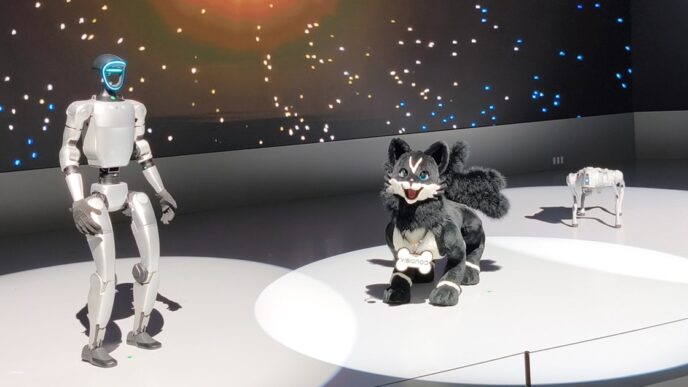
The Paper noted that Xiaomi’s website still lists the original CyberOne, which Xiaomi says coordinates 21 joints in its whole-body control. The company hasn’t published a spec sheet for the robot in this video.
The same AI model is also tidying apartments
Xiaomi announced a second trial the same day. Its robot foundation model, Xiaomi-Robotics-1, released on July 16 according to The Paper, now runs an agent system in a trial at the Xiaomi Youth Apartments, staff housing run by the company. Xiaomi says the system completed more than 50 tasks over a continuous run of more than 30 minutes across three rooms, including preparing tools, tidying a sofa and tables, clearing trash, sorting items and inspecting the rooms. Xiaomi also said the model’s core technology won a “Leading Science and Technology” award at the World Internet Conference in Wuzhen, which runs November 2 to 5.
Running the factory robot and the home robot on one family of models is the strategy most humanoid makers describe. If you want the background on what such a model is, our explainer on robot foundation models covers it.
How it compares with Figure and AgiBot
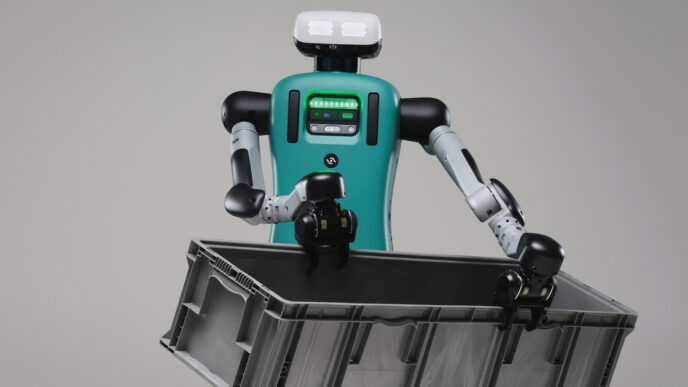
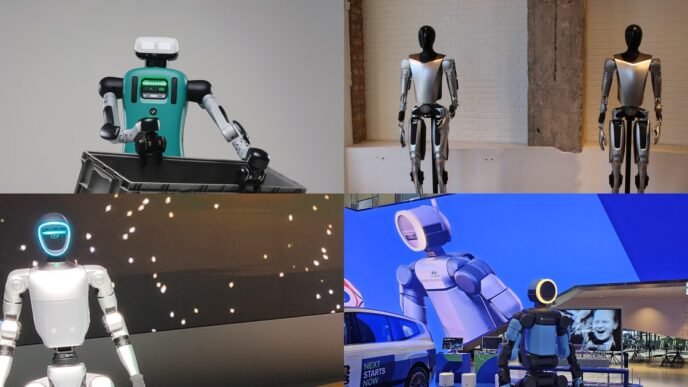
Xiaomi isn’t the first to run a humanoid through factory work, and The Paper put it alongside two others. Figure says a Figure 03 performed its first logistics workflow demonstration at BMW’s Spartanburg plant in June 2026, which we covered in our Figure 03 explainer. The Paper reported that AgiBot’s G2 humanoid works the factory’s 8 a.m. to 7 p.m. schedule testing tablets at a Longcheer plant in Nanchang. AgiBot has also tried to put a number on robot work with its Worken metric, though it sets the benchmarks itself.
All three share the same gap: the companies report the duration and the task, and rarely the output. Xiaomi has one advantage the others don’t. It owns the factory, so it doesn’t need an outside customer to sign off before it expands a trial. Another carmaker, XPENG, is in a similar position with its IRON humanoid.
What to watch next
The next useful signal would be numbers from the side-cover station: parts per hour, error rate and human interventions. After that, watch for a spec sheet or a public name for the new robot, a second Xiaomi plant or station, and any word on how many units the company is building. Until then, this is best read as a well-documented pilot from a company with deep pockets and its own production lines to practice on.
Frequently asked questions
What did Xiaomi’s humanoid robot do in the car factory?
It sorted center-console side covers, large flexible trim panels, from supply bins into racks in vehicle order at a station in the final-assembly hall of Xiaomi’s car factory. Xiaomi says it completed 8 hours and 5 minutes of stable operation, shown in a sped-up video posted November 3, 2026.
Did the robot work eight hours without stopping?
No. Xiaomi’s video shows two charging breaks, at 3 hours 2 minutes and 6 hours 3 minutes of cumulative operating time. Xiaomi didn’t say how long the charges took, and it didn’t say whether one robot or two robots shared the work.
Was the Xiaomi robot autonomous?
Xiaomi labels the footage “Autonomous” and says the robot can detect and correct anomalies on its own. That is Xiaomi’s claim in its own video. The company hasn’t published intervention counts or said whether anyone supervised the run remotely.
Which robot model is it?
Xiaomi’s posts call it a full-size humanoid robot without naming it. The Paper identified it as the CyberOne 02. Xiaomi’s website still lists only the earlier CyberOne, and no spec sheet for the new robot has been published.
When will Xiaomi sell or deploy humanoid robots?
Xiaomi hasn’t announced a price, a sale date or a plan to put humanoids into regular production. It describes the eight-hour run as a preliminary validation of production-line capability, after earlier trials in March and July 2026.
Sources
- Xiaomi Tech (official X account): “8 hours on the production line,” video post, November 3, 2026
- Xiaomi Tech (official X account): Xiaomi-Robotics-1 Youth Apartment trial post, November 3, 2026
- Beijing Daily, via the National Center for Science and Technology Innovation site: Xiaomi robot progress report (Chinese), November 4, 2026
- The Paper, Song Ziqiao: “Xiaomi robot works 8 hours at the car factory” (Chinese), November 4, 2026
- Xiaomi: CyberOne product page
All sources accessed November 4, 2026. Chinese-language quotes are our translation unless noted.
Last updated: November 4, 2026. To report an error, see our corrections page. Articles are drafted with AI assistance and reviewed and edited by an editor; see our editorial policy.