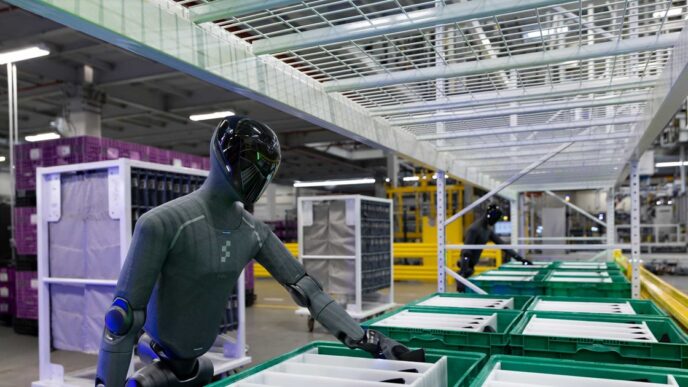
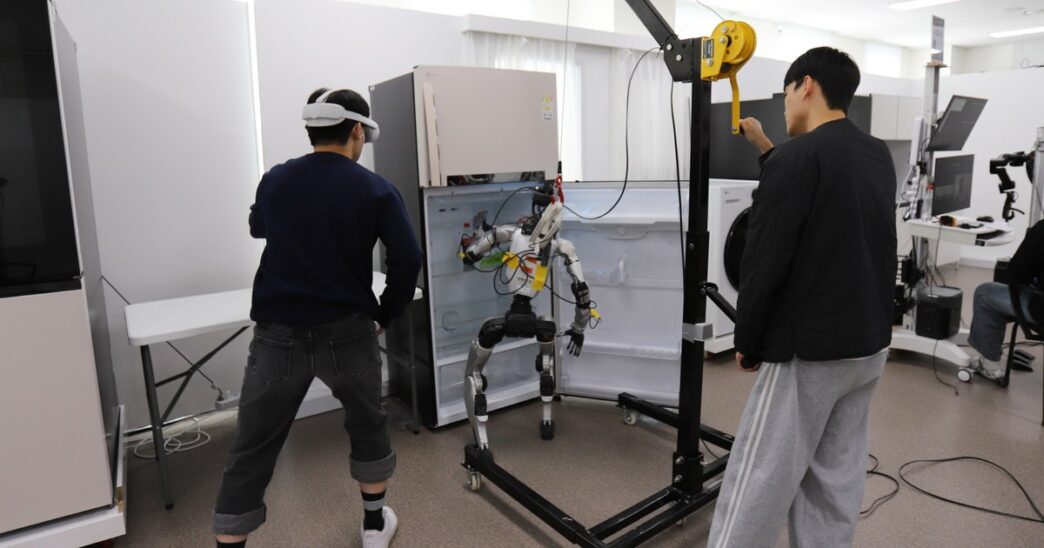
South Korea opened its first humanoid data factory on Tuesday, November 3, 2026: a room full of two-legged robots that people steer by remote control so the robots’ movements can be recorded and turned into training data. The state-funded Korea Institute of Machinery and Materials (KIMM) built the AI Humanoid Data Factory with the Electronics and Telecommunications Research Institute (ETRI) at KIMM’s headquarters in Daejeon. It runs 12 humanoids today.
The government calls it the country’s first data production facility dedicated to bipedal humanoids. The idea is simple. Robot AI models need large amounts of real robot data, almost nobody has enough of it, and Korea doesn’t want to rely on foreign datasets and foreign models to get it. Whether a 12-robot room can make a dent in that shortage is a fair question, and the answer depends on numbers the institute hasn’t published yet.
- What: KIMM and ETRI’s AI Humanoid Data Factory, a facility where operators teleoperate humanoids to record motion and task data for training AI models.
- Date and size: opened November 3, 2026, in Daejeon, with 12 humanoids in about 1,000 square meters; KIMM’s research lead says it should reach 25 robots by 2030.
- Access: government-funded; KIMM plans to open it to companies, universities and institutes in stages from late 2027. No pricing or access terms yet.
- The catch: no data volumes, hours recorded or release plans have been published, and the demos shown were teleoperated, not autonomous.
What happens inside the humanoid data factory
A data factory, in the ministry’s description, is a place where people remotely operate robots to perform tasks while the robots’ movements and task data are collected. The KIMM facility is set up to capture everything from arm and leg motions to tasks that use the whole body. KIMM’s photos show staged home settings with a kitchen, a refrigerator, a washing machine and a microwave with model food.
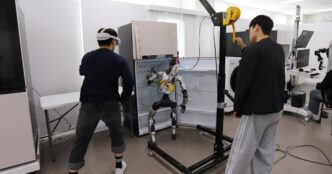
At the opening ceremony, operators ran several humanoids through everyday chores: taking items out of a refrigerator, handling laundry and tidying a sofa. They also worked buttons and levers inside a car interior, an industrial task. In KIMM’s photos, the operators wear VR headsets and hold hand controllers, and the robots are tethered to wheeled overhead hoists, a standard guard against falls during testing. The ceremony also showed data collected by having robots imitate human movement, not only by direct remote control.
The recordings train vision-language-action (VLA) models, the kind of AI that turns what a robot sees and is told into motor commands. Our plain-English guide to VLA models explains how they work. According to KIMM, trained models then go back onto the real robots for testing, and the data from those test runs is fed back into training. That loop of collect, train, test and collect again is the point of having the robots in one place.
Twelve robots now, a mix of makers
ZDNet Korea reported that the 12 robots include Chinese-made humanoids, Korean-made ones and KIMM’s own KAIROS. The institute didn’t list the models. That mix matters. Data recorded on one robot’s body doesn’t transfer perfectly to another with different joints, hands and proportions, so a facility that records several kinds of humanoid could produce more broadly useful data. It could also produce smaller piles of data for each robot type.
The site covers about 1,000 square meters, according to ZDNet Korea and Aju Press. Park Chan-hoon, who leads the KIMM research group behind it, told ZDNet Korea that by 2030 KAIROS would be finished and the factory would be collecting data from 25 robots. He said a data factory should gather data from a variety of robots, not just one.
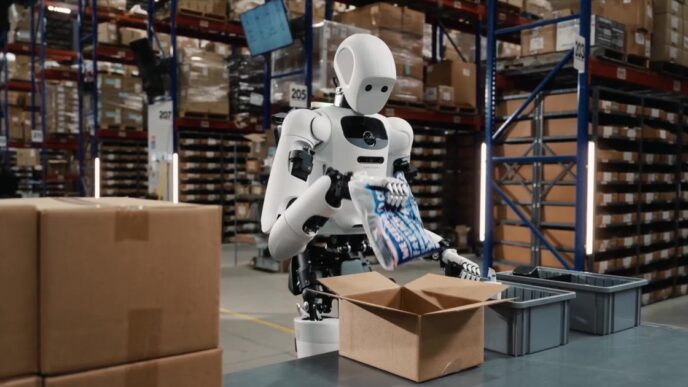
For scale, Tutor Intelligence, a US robotics company, said in April 2026 that its first data factory runs 100 of its own two-armed Sonny robots, remotely supervised by operators in VR. Apptronik runs a similar collection site, Robot Park, for its Apollo humanoids. KIMM’s 12 humanoids are a modest start by comparison, though Tutor’s robots roll on wheeled bases, while KIMM’s facility is built for two-legged machines.
Why Korea wants its own robot training data
The shortage is the reason this facility exists. There is no internet-sized library of robots doing chores, and the largest public collections are small next to the text that trained language models. The Open X-Embodiment dataset, for example, pooled more than a million robot trajectories from 22 robot types, mostly robot arms. Real-robot data usually needs a person, a robot and hours of operation for every example, which is why companies are paying for it. Our explainer on humanoid robot training data covers the main ways firms are trying to close the gap.
The ministry says the factory will produce and store large amounts of real-world robot task data inside Korea, cutting reliance on overseas data and helping the country build its own humanoid AI. “Securing high-quality robot task data on a large scale is the core of national technological competitiveness,” KIMM president Ryu Seog-hyeon said, in Aju Press’s translation. He added that KIMM would speed up development of KAIROS through cooperation with industry and academia and open the data factory in stages from the end of 2027.
Kim Seong-su, who heads research and development policy at the Ministry of Science and ICT, said building public data infrastructure to back industry and academic research was important for competitiveness in AI humanoids, according to the ministry’s release (our translation).
KAIROS, the robot the data is meant to serve
KAIROS is the humanoid KIMM has been building for little more than a year, according to Aju Press. At Tuesday’s ceremony the institute showed it handling objects precisely and imitating whole-body human motion. Aju Press reported that two months ago, four of six KAIROS units on a Seoul stage swung their arms to calisthenics music with their feet barely leaving the floor, and that version 1 is due in April 2027. That’s months before outside users are due to get access to the factory.
The facility belongs to a national research program. KIMM is the lead institution of what it calls the Autonomous-growth AI Humanoid Global TOP Strategic Research Group, a project that runs from May 2025 to April 2030, according to AI Times. The ministry backs it under K-Moonshot, a program that applies AI to 12 national missions, one of them humanoids. Aju Press reported that the ministry wants a world-class national humanoid platform within three years, and that a Next-X Humanoid Challenge will make its final selection from 2027. KIMM describes the goal as a “K-humanoid” standard platform.
The money behind Korea’s humanoid push
The factory is one piece of a larger state effort. On August 27, Korea’s Ministry of Planning and Budget earmarked 2.3 trillion won (about $1.7 billion) through 2030 for the humanoid industry, Aju Press reported. The plan includes buying 1,080 Korean-made humanoids and raising the domestic share of core parts to 80%, from about 45%. Korea has also been loosening rules so humanoids can work in factories: in October it let 20 Robros humanoids work beside people without safety fences in a supervised trial.
The government hasn’t said how much of that money goes to the data factory itself, how many operators work there or what it costs to run.
What KIMM hasn’t said yet
Several things would show whether the humanoid data factory works as advertised:
- Volume. No hours of data, episode counts or collection targets have been published.
- Access terms. Opening “in stages” from late 2027 could mean shared datasets, booked time on the robots or both. Prices and licensing haven’t been announced.
- Open data. KIMM hasn’t said whether any data will be released publicly, the way Open X-Embodiment was.
- Results. There are no published success rates for models trained on the data. The chores shown at the opening were remote-controlled demonstrations, which is how the data gets made, not proof of autonomy. Our guide to teleoperation versus autonomy explains the difference.
What to watch next
The next milestone is April 2027, when KAIROS version 1 is due, followed by the staged opening of the factory from late 2027. Before then, the useful signals are a first data release or paper from the KIMM-ETRI group, the Next-X Humanoid Challenge selection, and whether the robot count climbs toward the 25 Park has described. If the factory starts publishing how much data it produces and how models trained on it perform, it will be easier to judge whether a national data facility can keep pace with companies running fleets of their own.
Frequently asked questions
What is the AI Humanoid Data Factory?
It is a facility at the Korea Institute of Machinery and Materials in Daejeon where people remotely operate humanoid robots through tasks so that the robots’ motion and task data can be recorded and used to train AI models. KIMM built it with ETRI, and it opened on November 3, 2026.
How many robots does the humanoid data factory have?
It runs 12 humanoids, including Chinese-made robots, Korean-made robots and KIMM’s own KAIROS, according to ZDNet Korea. KIMM’s research lead Park Chan-hoon said the plan is to collect data from 25 robots by 2030.
Can companies use the data factory?
Not yet. KIMM says it will open the facility to companies, universities and research institutes in stages from late 2027. It hasn’t announced pricing, access rules or whether any data will be released publicly.
What tasks are the robots trained on?
At the opening, operators guided humanoids through household chores, such as taking items from a refrigerator, handling laundry and tidying a sofa, and industrial tasks, such as working buttons and levers inside a car. The facility collects data on arm, leg and whole-body movements.
What is KAIROS?
KAIROS is a humanoid robot under development at KIMM. At the opening, KIMM showed it handling objects precisely and imitating whole-body human motion. Aju Press reported that version 1 is due in April 2027.
Sources
- Korea Institute of Machinery and Materials: AI Humanoid Data Factory opening press release and photos (Korean), November 3, 2026
- Korea.kr (Ministry of Science and ICT): “First data production base where humanoids learn how to work opens in Korea” (Korean), November 3, 2026
- Aju Press, Kim Dong-young: “Korea opens first data factory to train humanoids,” November 3, 2026
- ZDNet Korea, Park Hee-beom: report on the KIMM AI Humanoid Data Factory opening (Korean), November 3, 2026
- AI Times: report on the KIMM data factory and research group (Korean), November 3, 2026
- Yonhap News Agency: report on the data factory opening (Korean), November 3, 2026
- KIMM official YouTube channel: KAIROS Short, October 15, 2026
- Tutor Intelligence: “Building a 100-Robot Data Factory Toward Factory-Ready AI,” April 30, 2026
All sources accessed November 3, 2026. Korean-language quotes are our translation unless noted.
Last updated: November 3, 2026. To report an error, see our corrections page. Articles are drafted with AI assistance and reviewed and edited by an editor; see our editorial policy.