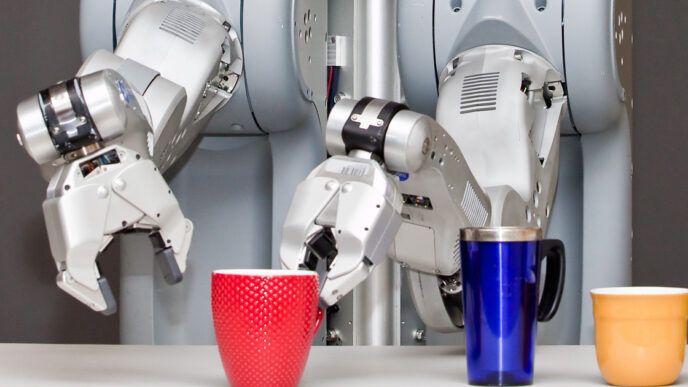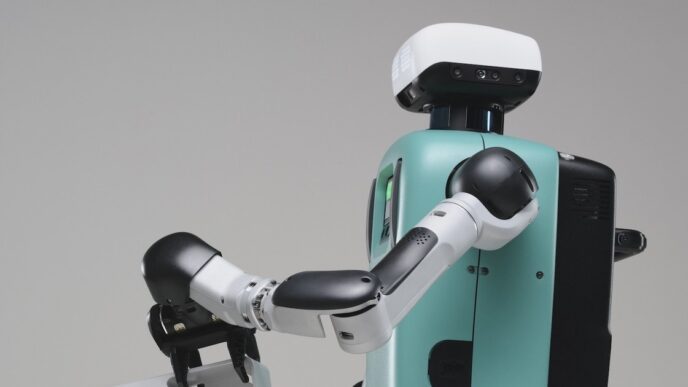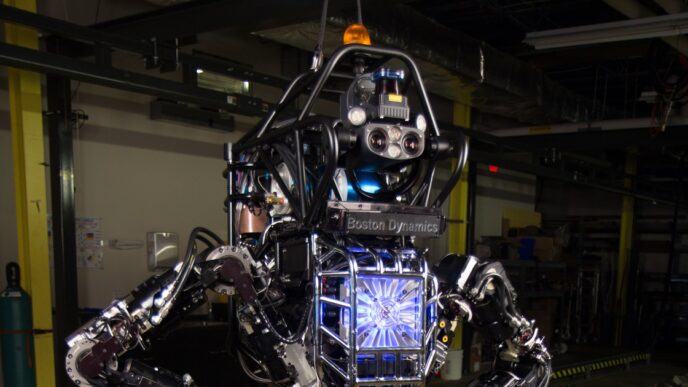
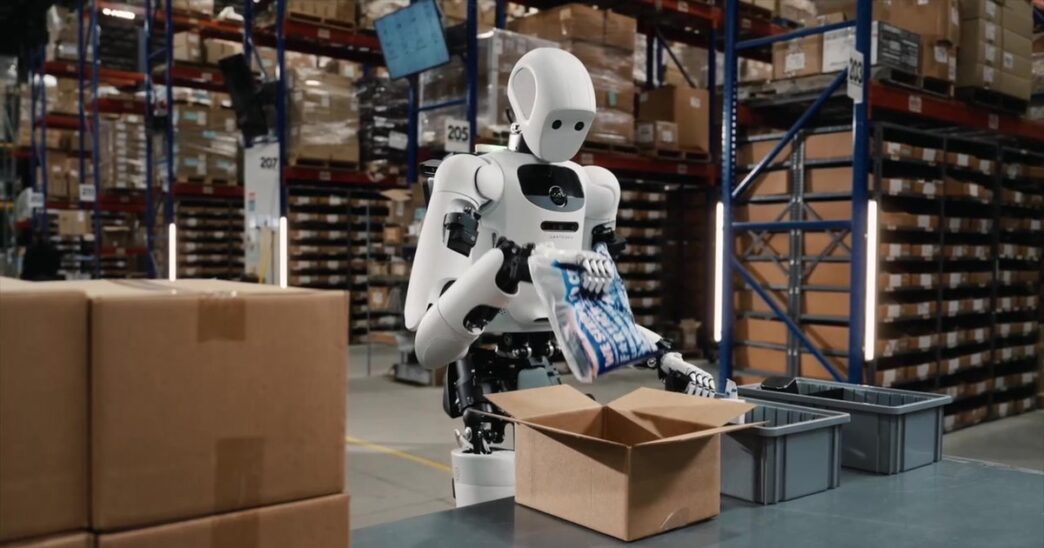
Boston Dynamics’ most practical box-moving robot isn’t Atlas. It’s Stretch, a commercial machine that looks nothing like a person. That’s worth keeping in mind as humanoid makers pitch warehouse operators on robots with two arms and two legs.
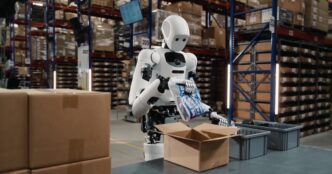
Warehouses already run on autonomous mobile robots (AMRs), conveyors and fixed arms. Humanoid robots in warehouse logistics are being pitched for the work that’s left over: picking totes from mixed shelves, sequencing parts before assembly, and staffing packing stations designed for humans. Some of that pitch is credible in 2026. Most of it hasn’t been proven at a customer site in public yet. Here’s where each program stands and how to run a pilot that tells you the truth.
The jobs humanoids are going after
The claims cluster around four kinds of work. The first is handling totes and cases at human-height shelving. The second is goods-to-person and person-to-goods assistance. The third is moving goods from a trailer or the floor onto pallets, though that job is often better suited to Stretch-class robots or AMRs. The fourth is sequencing automotive parts before they reach the assembly line, which is the job Boston Dynamics has Atlas training for at Hyundai.
The common thread is that these spaces were built around people. Shelving, carts and workstations are already the right height for two arms, which is the core of the humanoid argument.
Where each program actually stands
| Program | Published logistics evidence | What that evidence amounts to |
|---|---|---|
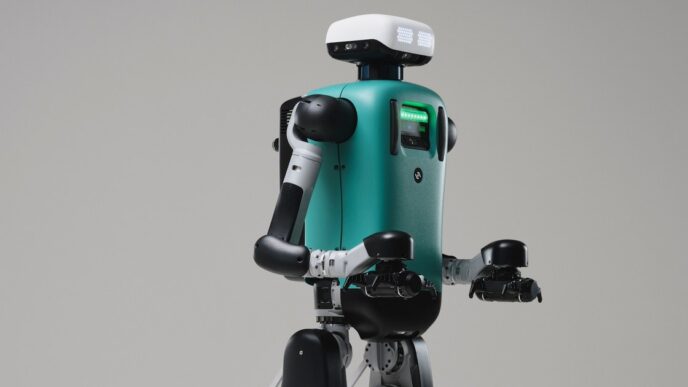
| Agility Digit | Commercial logistics positioning; Digit 5 safety and specs; order claims in SEC filings | Company and SEC claims; verify any site pilot |
| Apptronik Apollo | Warehouse imagery; Robot Park data collection; partner logos including GXO | Company material; ask for robot counts |
| Boston Dynamics Atlas | Training on parts logistics and sequencing at Hyundai’s Georgia Metaplant (RMAC) | Training confirmed; production work not confirmed |
| Figure 03 | Figure’s claims about a logistics workflow at BMW’s plant | Company demo; scope undisclosed |
| Boston Dynamics Stretch (not a humanoid) | Commercial box-moving robot | Often the pragmatic logistics choice today |
Read down the right-hand column and a pattern jumps out. Every humanoid entry is a company claim, a training program or a demo. Only the robot that doesn’t look human is described as a commercial product. We go deeper on each in our reports on Digit 5, Apollo 2, Atlas at Hyundai and Figure 03.
When a humanoid is the wrong answer
If your bottleneck is moving goods long distances across flat floors, start with AMRs. If your picks are highly structured and happen in one cell, a fixed arm with vision will probably be cheaper and more reliable. If you can’t staff the integration work and the safety risk assessment, no robot will save you. And if the vendor’s demo is teleoperated and there’s no published plan for autonomy, you’re buying a remote-controlled robot. Our teleoperation guide explains how to tell.
Humanoids make the most sense where the work is varied, the space is built for people, and rebuilding the facility around automation isn’t an option.
How to run a pilot that tells you the truth
- Pick one product family and one aisle layout. Don’t let the vendor choose the easiest corner of the building.
- Define the scorecard before day one: picks per hour, damage rate and human interventions per hour.
- Log the share of time the robot is teleoperated.
- Include shift changes and unexpected obstacles in the test, not just steady-state runs.
- Require a safety case mapped to standards. Our ISO safety checklist covers the ones to ask about.
The milestone that would change this picture is simple: a named warehouse operator publishing a humanoid’s interventions-per-hour figure from a real shift. When that happens, the comparison with Stretch and AMRs can finally be made on data instead of video.
Frequently asked questions
Are humanoid robots used in warehouses today?
Vendors report pilots and training deployments, but treat each site as a claim until you see robot counts, duration and performance figures. Stretch-class robots and AMRs remain the mature baseline for logistics.
Is Agility’s Digit a warehouse robot?
Agility positions Digit for logistics work in spaces built for people. We cover Digit 5 and the SPAC economics in separate articles; note that photos of earlier Digit generations are often used in coverage of Digit 5.
Will Atlas stock shelves?
Not according to anything Boston Dynamics has published. Its near-term work at RMAC is training on automotive parts logistics and sequencing, not general e-commerce shelving.
Sources
- Company releases and product pages for Digit, Apollo, Atlas/RMAC, Figure and Stretch
- Agility SEC materials for order and economics claims
Last updated: October 7, 2026. To report an error, see our corrections page. Articles are drafted with AI assistance and reviewed and edited by an editor; see our editorial policy.