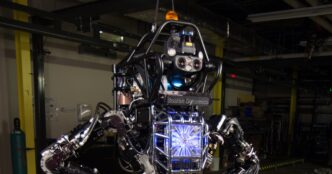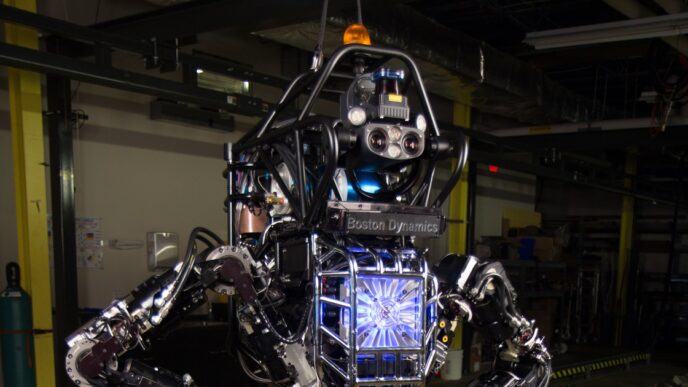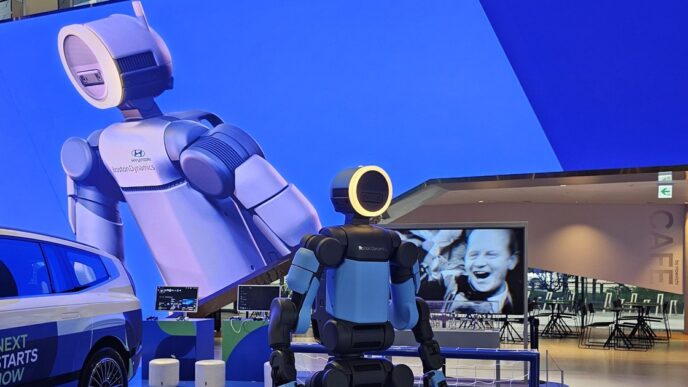
Boston Dynamics says the electric Atlas has 56 degrees of freedom. On October 1, it unveiled a new Atlas hand with 13 degrees of freedom of its own. So does the robot now have 69? Nobody outside Boston Dynamics knows, because the company hasn’t said whether the 56 includes the hands.
That small mystery is a good introduction to the most slippery number on a humanoid spec sheet. Degrees of freedom (DoF) count how many independent joint motions a robot can control. Vendors love a big DoF figure, but they count differently. Some include the hands, some stop at the wrist, and some mix powered joints with passive ones. Here’s what the number really measures, how the published 2026 figures compare, and how to keep it from misleading you.
One joint axis, one degree of freedom
In robotics, one degree of freedom is usually one independently controllable joint axis: hip pitch, say, or knee flexion or wrist yaw. A human arm is often modeled as about seven DoF from shoulder to wrist, before you get to the hand, and a five-fingered hand can add more than a dozen more. That’s why whole-body humanoid totals commonly land anywhere from about 20 to 60-plus. It mostly depends on whether the hands, neck and waist are counted.
DoF isn’t the same as the number of motors. One joint can use more than one actuator, and several joints can share a tendon drive. It doesn’t tell you payload or speed either; more joints don’t automatically make a robot stronger or faster. And it isn’t dexterity. Control software, sensing and reliability matter at least as much as joint count, which is why we cover actuators and teleoperation vs autonomy separately.
Active, passive and “it depends what you count”
Active DoF are the joint axes the robot drives with actuators, and they’re usually what matters for real work. Passive DoF are unpowered joints such as springs, free pivots or compliant elements. They help absorb shocks but aren’t controllable motion. Whole-body figures add up legs, waist and arms, plus or minus the neck and hands, so compare them only when both vendors include the same body parts. Hand DoF are often published separately and can make up a big chunk of the total. And some makers sell optional wrist, waist or hand kits and list a range rather than a number. Unitree’s G1 EDU, for example, is listed at 23 to 43.
The single most useful question is the Atlas question: does this number include the hands? (Our Atlas four-finger hand report has the details on that one.)
Humanoid robot degrees of freedom, as published
Here’s what makers have published as of October 2026:
| Robot | Published DoF | What the figure covers | Source |
|---|---|---|---|
| Boston Dynamics Atlas (electric) | 56 whole-body; new hand 13 (four fingers) | Product sheet plus Oct 2026 hand blog; unclear whether 56 includes the hand | Company |
| Unitree G1 | 23 (6 per leg, 1 waist, 5 per arm) | Base configuration without optional hand kits | Company spec |
| Unitree G1 EDU | 23 to 43 | Optional waist, wrist and hand joints | Company spec |
| Unitree R1 | 20 or 26, depending on version | Arms have 4 or 5 each; waist and head joints vary | Company spec |
| Unitree H2 Plus | About 75 including hands | Store and marketing materials; confirm the configuration before buying | Company store |
| Figure (Helix control stack) | 35 DoF controlled | Figure’s description of Helix controlling a humanoid upper body, not a full-robot spec sheet | Company |
| Apptronik Apollo 2 with SharpaWave hands | Hands described as 22 DoF | Cited in Gemini Robotics materials; whole-body Apollo DoF isn’t tabulated the same way | Partner / company |
| Tesla Optimus | No stable public whole-body DoF figure in 2026 | 2022 AI Day discussed actuator counts; treat current DoF claims as unconfirmed | Sparse |
Look at that list and the headline numbers stop meaning much on their own. The H2 Plus’s roughly 75 includes hands, the G1’s 23 doesn’t, and Figure’s 35 is a control-stack figure for the upper body. Full Unitree configurations and prices are in our Unitree G1, R1 and H2 guide, and wider price context is in humanoid robot prices 2026.
Why more joints can make a worse robot
Every extra axis needs sensing, calibration and a control policy that can actually use it. High-DoF hands are hard to teleoperate and harder still to run autonomously. Joints far from the body, like wrists and fingers, add weight exactly where it hurts balance and battery life; see battery and runtime limits. More actuators also mean more failure points and a bigger spare-parts kit.
Boston Dynamics made that argument itself with the new Atlas hand, choosing a simpler, more repairable design over a higher finger count. The right DoF depends on the job. Tote handling and cart pushing need strong legs and a reliable gripper far more than a 20-DoF hand. Fine assembly might need the opposite.
How to read a DoF number on a datasheet
- Ask for a joint-by-joint breakdown: legs, waist, arms, neck, hands.
- Check whether the figure counts active joints only, and whether optional kits are in the headline number.
- Separate hand DoF from arm DoF. A “40-DoF robot” may be a 23-DoF body with dexterous hands bolted on.
- Ask for continuous torque and thermal limits at the key joints. A DoF figure without torque is half a spec (our actuators guide explains why).
- In demos, check whether the extra joints are moving under autonomy or only under teleoperation.
The thing to watch is Boston Dynamics’ next spec-sheet update. If it says whether the 56 includes the 13-DoF hand, it’ll answer the Atlas question. It’ll also show whether the industry’s most-watched robot is willing to count its joints the way buyers need.
Frequently asked questions
What does DoF mean for a humanoid robot?
Degrees of freedom count independently controllable joint axes. A whole-body number usually covers the legs, torso and arms, and may or may not include the hands, so always check what the vendor counted.
How many degrees of freedom does Atlas have?
Boston Dynamics lists the electric Atlas at 56 degrees of freedom. Separately, it describes a new four-finger hand with 13 DoF. It hasn’t said whether the 56 already includes that hand.
How many DoF does the Unitree G1 have?
Unitree lists the base G1 at 23 DoF: 6 per leg, 1 at the waist and 5 per arm. The G1 EDU is listed as configurable from 23 to 43 DoF with optional waist, wrist and hand joints.
Is a humanoid with more DoF always more capable?
No. Extra joints add cost, mass, heat and control difficulty. Capability depends as much on torque, sensing, software and reliability as on joint count, so buy for the task, not the biggest number on the sheet.
Sources
- Boston Dynamics Atlas product specifications (56 DoF, payload, battery) [company]
- Boston Dynamics, Atlas hand blog (Oct 1, 2026): four fingers, 13 DoF [company]
- Unitree G1 / G1 EDU / R1 / H2 product and store pages: DoF tables [company]
- Figure, Helix system description (35 DoF upper-body control context) [company]
- DeepMind Gemini Robotics materials referencing SharpaWave / Apollo hand DoF [partner]
Related: What is a humanoid robot? · Atlas four-finger hand · Actuators: electric vs hydraulic · Bipedal vs wheeled
Last updated: October 7, 2026. To report an error, see our corrections page. Articles are drafted with AI assistance and reviewed and edited by an editor; see our editorial policy.