Walmart has agreed to buy about $6 billion more in warehouse automation from Symbotic, the Massachusetts company whose robots already run inside Walmart’s regional distribution centers. The two companies announced the expanded Walmart Symbotic agreement on Thursday, October 29, 2026, and Symbotic filed the contract terms with the US Securities and Exchange Commission the same day.
The money is new spending on top of Walmart’s existing Symbotic contracts, and the filing says it can’t be cut without both sides agreeing. It’s also spread over “a number of years,” and neither company has said when the first new systems will go in, which sites get them or what the next-generation racking will look like.
- What happened: on October 29, 2026, Walmart and Symbotic signed an Enterprise Master Automation Agreement with an initial commitment of about $6 billion in additional spend over several years.
- What it covers: Symbotic’s automated storage and retrieval systems for ambient (non-refrigerated) areas of Walmart distribution and fulfillment centers in the US and select Americas markets, plus $125 million for next-generation racking. The press release names 25 US regional distribution centers.
- Why it matters: Symbotic says the deal could add up to $6.92 billion to its backlog, which already stood at about $22.5 billion in June.
- The catch: one customer, which Symbotic doesn’t name in its revenue table, was already 90.5% of its revenue last quarter, and Symbotic lists dependency on Walmart as a risk. There’s also no installation timeline yet.
What the Walmart Symbotic agreement says
The new contract is called an Enterprise Master Automation Agreement. According to the Form 8-K, it sets up a framework for the automation systems and technology Symbotic provides to Walmart and its affiliates “on a global basis.” Under it, Walmart made a new commitment to buy Symbotic systems and fund development programs worth “approximately $6,000,000,000” over a number of years across multiple locations.
That commitment is made up of two kinds of add-on documents signed the same day:
- Market program addenda (MPAs). These cover Walmart’s purchase of Symbotic’s automated material handling systems “for ambient areas of distribution or fulfillment centers in the United States and select international markets in the Americas.” Ambient means the dry-goods parts of a warehouse, not the chilled or frozen areas.
- A development program addendum (DPA). Walmart committed $125 million to fund research and development of “next-generation racking technology and related picking, process flow and inventory management capabilities.”
On top of the system prices, Walmart will pay Symbotic separate fees for software licenses and system support, operation and maintenance, extra support services, spare parts and related expenses. So $6 billion is the committed starting point, not the full value of the relationship.
The filing adds some details the press release leaves out:
- The commitment is locked in. It “may not be reduced without the mutual written consent” of both companies, subject to each side’s termination rights. If Walmart buys fewer systems than it committed to, the contract sets out a calculation for what it owes Symbotic.
- It adds to the old deals. The 2022 master agreement and the January 2025 agreement stay in force, and the new spend is in addition to those purchase commitments.
- Walmart gets more say. While it owns more than 5% of Symbotic’s fully diluted equity, Walmart can recommend one independent director candidate. In any year in which Walmart makes up more than 50% of Symbotic’s revenue over four quarters, it can name two non-voting board observers.
- There’s a competitor clause. The agreement restricts Symbotic from selling or licensing its products to “a specified company” and that company’s affiliates. The filing doesn’t name it.
- Either side can walk away after insolvency or an uncured material breach, and Walmart can end the contract if Symbotic goes through certain change-of-control deals.
Where the 25 distribution centers fit
The press release says the expanded agreement brings “further automation capabilities to 25 U.S. regional distribution centers,” while supporting opportunities across Walmart’s global network. Walmart says the work will support e-commerce upstream inventory management, increase storage capacity and improve how products move through its supply chain.
That number needs context. Symbotic’s quarterly report already describes a Walmart contract “to implement Systems in all of Walmart’s 42 regional distribution centers,” and Symbotic said in January 2025 that it was deploying across all 42. So the 25 sites are not necessarily new buildings. Neither company has said which 25 centers are involved, whether they already have Symbotic systems, or what will be added there. We’ll update this when either company says more.
The 8-K wording also reaches further than the release. The systems can go into distribution or fulfillment centers in the US and “select international markets in the Americas.” Symbotic already lists a separate commercial agreement with Nueva Wal Mart de México in its filings, but the new filing doesn’t name any country.
How Symbotic’s warehouse robots work
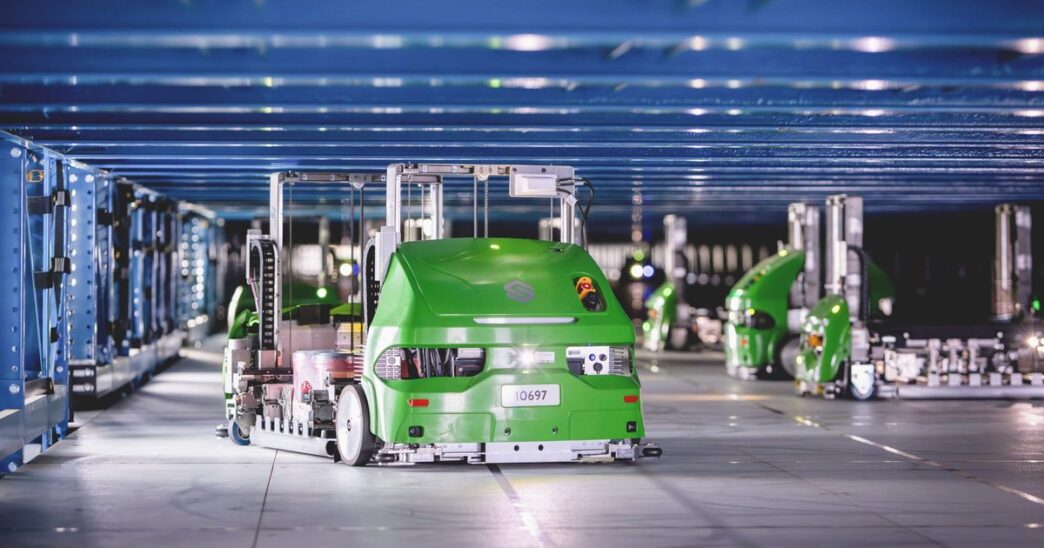
Symbotic builds full warehouse systems, not single robots. Its filings describe robotic automation, with hardware and software, that moves, stores and sorts cases and individual items, called eaches, inside warehouses. The best-known part is the SymBot, a small autonomous vehicle that drives through dense, multi-level storage racks to fetch and store cases. Symbotic says its AI-based software orchestrates “millions of cases, every day” across its customers.
The press release also mentions a BreakPack each-picking system and SymMicro, a micro-fulfillment system for e-commerce. SymMicro comes from Walmart’s Advanced Systems and Robotics business, which Symbotic bought in January 2025 for $200 million in cash plus up to $350 million in contingent payments. As part of that deal, Walmart agreed to pay Symbotic $520 million for a development program and, if performance criteria were met, to buy systems for 400 Accelerated Pickup and Delivery centers at its stores.
These systems are already in commercial use, not pilots. Symbotic’s quarterly report says its systems are operational at some of the world’s largest retailers, including Walmart, and at wholesale distributors such as C&S Wholesale Grocers. In August, its finance chief said the company had “77 systems in deployment,” and the quarterly report compares that with 46 systems in deployment a year earlier. What’s new here is the size and length of Walmart’s commitment, not the technology itself.
What the deal means for Symbotic
Symbotic expects the new commitment could increase its future backlog by up to $6.92 billion. For scale, it reported about $22.5 billion of remaining performance obligations at the end of June 2026, most of it tied to the Walmart 42-center contract and to Exol, Symbotic’s warehouse-as-a-service joint venture. It expected to recognize about 15% of that as revenue in the next 12 months and about 62% over the following 13 to 60 months.
The business is growing. For the quarter ended June 27, 2026, Symbotic reported revenue of $721 million, up 22% from a year earlier, and net income of $55 million, compared with a $21 million loss. It guided to revenue of $760 million to $780 million for the quarter that ended in late September. Those fourth-quarter results haven’t been released yet.
The risk is concentration. A single customer, labeled “Customer A” in the quarterly report, accounted for 90.5% of Symbotic’s revenue in that June quarter, up from 83.8% a year earlier, and 82.8% of its accounts receivable. Symbotic doesn’t name that customer in the table, but it lists “dependency on Walmart” among its risk factors, and the new agreement gives Walmart board observers only in years when it makes up more than half of Symbotic’s revenue. A bigger Walmart contract makes that kind of concentration more likely to grow than shrink.
Walmart is also an investor. The 8-K says the director recommendation right lasts “for so long as Walmart continues to own greater than 5%” of Symbotic’s fully diluted equity, so Walmart is customer, funder of development work and shareholder at the same time.
What it means for Walmart and warehouse automation
For Walmart, the pitch is capacity and speed. Rob Montgomery, executive vice president for Walmart U.S. supply chain operations, said the work with Symbotic “helps us improve service, grow capacity, simplify work for our associates and lower costs.” Symbotic chief executive Rick Cohen said the partnership “started with a single product over a decade ago” and now covers “a full end-to-end solution.”
For the wider robotics market, it’s a reminder of where the large, multi-year robot spending is today. Humanoid deals still tend to be counted in single robots or pilot sites. Fixed, purpose-built warehouse systems like Symbotic’s are being bought in billions of dollars, under long contracts, by one of the world’s largest retailers. Our guide to demo, pilot and commercial readiness explains why that difference matters when you compare robot announcements.
What we still don’t know
- Timing. The filing says “a number of years.” There’s no schedule for the first installations under the new contract.
- Which sites. The 25 regional distribution centers aren’t named, and nor are the international markets in the Americas.
- The new racking. The $125 million development program is for next-generation racking and picking, but no design, prototype or test date has been published.
- The specified company. The competitor Symbotic can’t sell to isn’t named in the public filing.
- The redacted terms. Symbotic filed the contract itself as Exhibit 10.1, but confidential details marked [***] were removed, and the public version doesn’t include the pricing or expected-timeline exhibits. It shows the structure, including sections on technology escrow, performance standards and termination, without the numbers.
Symbotic usually reports fourth-quarter results in late November. That report is the next place to look for an updated backlog figure and any timing on the new systems.
Frequently asked questions
How much is Walmart spending with Symbotic?
The new agreement includes an initial commitment of about $6 billion in additional spend over several years, on top of Walmart’s existing Symbotic contracts. Walmart also pays separate fees for software, support, maintenance and spare parts. Symbotic says the commitment could add up to $6.92 billion to its backlog.
What does Symbotic do for Walmart?
Symbotic builds automated warehouse systems in which small autonomous robots called SymBots store and retrieve cases in dense racking, guided by AI-based software. Its quarterly report describes a Walmart contract to implement those systems in all 42 of Walmart’s US regional distribution centers.
Which Walmart distribution centers are covered?
The press release says the agreement brings further automation to 25 US regional distribution centers, and the 8-K also allows systems in select international markets in the Americas. Neither company has named the sites.
When will the new systems be installed?
No schedule has been published. The filing says the spend runs over a number of years across multiple locations, and the $125 million racking program is still in development.
How dependent is Symbotic on Walmart?
Very. One unnamed customer accounted for 90.5% of Symbotic’s revenue in the quarter ended June 27, 2026, and Symbotic lists dependency on Walmart as a risk factor. The new agreement also refers to Walmart owning more than 5% of Symbotic.
Sources
- Symbotic Inc., Form 8-K, Item 1.01 Entry into a Material Definitive Agreement (filed October 29, 2026): sec.gov
- Enterprise Master Automation Agreement among Walmart Inc., Symbotic Inc. and Symbotic LLC, dated October 29, 2026 (Exhibit 10.1, redacted): sec.gov
- Symbotic, “Walmart and Symbotic Expand Commercial Agreement to Support Supply Chain Transformation” (press release, October 29, 2026): symbotic.com
- Symbotic Inc., Form 10-Q for the quarter ended June 27, 2026 (filed August 5, 2026): sec.gov
- Symbotic, “Symbotic Reports Third Quarter Fiscal Year 2026 Results” (August 5, 2026, Exhibit 99.1): sec.gov
- Symbotic, “Symbotic to Acquire Walmart’s Advanced Systems and Robotics Business and Sign Related Commercial Agreement” (January 16, 2025, Exhibit 99.1): sec.gov
- Symbotic, “Symbotic Innovation: SymBot Autonomous Mobile Robot” (official YouTube channel, April 2025): youtube.com
All sources accessed November 1, 2026.
Last updated: November 1, 2026. To report an error, see our corrections page. Articles are drafted with AI assistance and reviewed and edited by an editor; see our editorial policy.