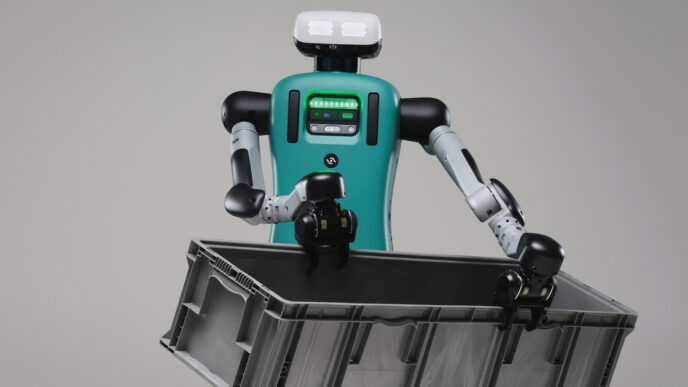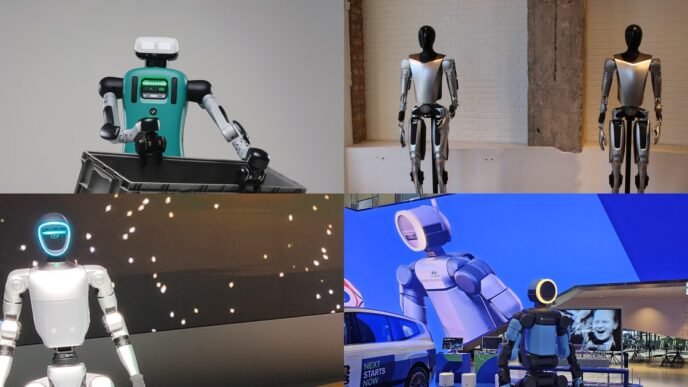
Agility Robotics’ Digit is keeping its legs. “Digit likely won’t get wheels,” co-founder and Chief Robot Officer Jonathan Hurst wrote during an hour-long Q&A on Agility’s X account on Thursday, October 22. “But wheeled robots are absolutely in our current exploratory roadmap for a family of robots that focus on being human-centric and multi-purpose.”
The Q&A came hours after Agility announced that Digit 5 will standardize on NVIDIA IGX Thor modules for its onboard compute, making NVIDIA the exclusive compute supplier for the robot’s general-availability version. Read together, the two give the clearest account yet of why Digit 5 grew to 129 kg, where its safety system lives, and what Agility thinks the robot can reliably do first, less than two weeks before shareholders vote on its SPAC deal.
- Wheels: Digit likely won’t get them. Wheeled robots are on Agility’s “exploratory” roadmap, with no product name or date.
- Compute: the general-availability Digit 5 standardizes on NVIDIA IGX Thor, and its separate safety computer moves onto IGX Thor and NVIDIA’s Halos safety framework.
- Timing: early access is expected in the first half of 2027, with availability increasing over the following six to nine months.
- The catch: still no price, and the 99% reliability figure is Agility’s own, from earlier deployments on well-defined tote tasks.
Why Digit keeps its legs, and why Hurst thinks home robots will roll
Hurst’s case for legs is about the jobs Digit does. Legs matter, he wrote, “when the robot must be dynamically stable, lift heavy things up high, and in a narrow footprint (like working in an aisle).” A foot can be placed quickly to catch a fall, while a wheel has to accelerate itself under the robot. His comparison: balancing on a Segway versus on your own two feet. Legs also handle stairs, curbs and rough ground.
Wheels win, in his telling, when a robot carries heavy loads over long distances or needs to stay statically stable and move slowly around people. That leads to the most striking line of the session, from the co-founder of a company built on legged robots: “I believe the earliest useful in-home robots will be wheeled, statically-stable devices, not balancing legged devices, simply to address the safety challenges in the near term.”
That cuts against the pitch of the two-legged home robots now taking deposits. It doesn’t mean Agility is building a home robot. Hurst described a family of “human-centric and multi-purpose” robots under exploration, and Agility hasn’t announced one.
Safety was the “hard blocker,” and it made Digit 5 heavier
Asked what had been hardest to solve, Hurst didn’t pick a motor or a model. “The biggest thing that surprised us was safety,” he wrote, calling it “a hard blocker to deploy robots until we solve it.”
“Making a 129 kg dynamically stable robot safe around people will touch nearly every part of Digit 5,” he continued: the shape of the legs and body, safety-rated sensors in protective housings, isolated computers dedicated to safety and AI-based human detection. “Each of those will add weight, power draw and size, which is a big reason the robot grew.” He said Agility didn’t grasp the scope of the problem until it tried proof-of-concept deployments with customers.
The result shapes how Digit 5 moves. In another answer, Hurst said “predictability matters more than grace,” so the robot is designed to detect people, react in real time and signal its intent with lights and sounds. “That took us two years, and I still want it to move beautifully.”
What moving to NVIDIA IGX Thor changes
Under Thursday’s announcement, Digit 5’s onboard compute will be unified on IGX Thor modules, and Agility is folding IGX Thor and additional NVIDIA Halos models into its own safe human-detection system. Agility will also take part in NVIDIA’s Halos AI Systems Inspection Lab, which it says will help evaluate Digit’s safety-related software, AI components and cybersecurity protections ahead of final third-party certification. “Moving to NVIDIA Thor modules gives us a common foundation,” Agility chief technology officer Pras Velagapudi said in the release.
Hurst’s answer on safety stops fills in the architecture. The decision to stop happens on the robot, not in the cloud. A safety system runs on an “islanded” computer, separate from the main control computer, with simple rules, such as not raising an arm above a certain height in part of a factory, and it shuts the robot down if they’re broken. Until now that computer sat “in its own yellow box.” With Digit 5 it moves into IGX Thor and Halos, in what Hurst called “a physically smaller footprint.” Agility’s Arc cloud software handles fleet orchestration, but he said a dropped connection won’t affect the robot’s current task or any safety function.
Most of the compute sits in one box at the top of the robot’s backpack, which Hurst said can be swapped as hardware improves without redesigning the rest of the robot.
The 99% claim, and what comes after totes
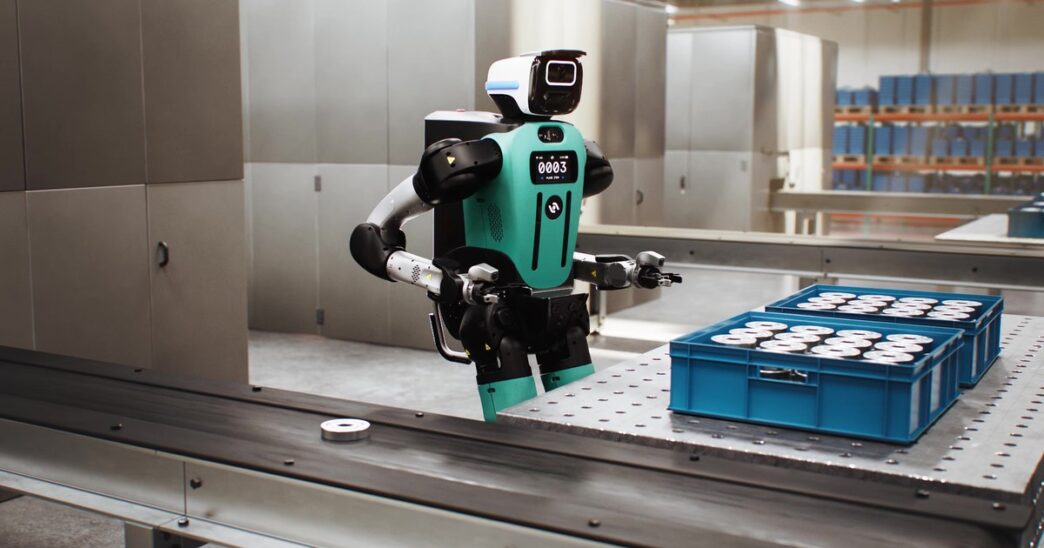
On what Digit 5 does first, Hurst was specific. Agility starts with “bins and totes,” he wrote, “because our prior deployments tell us that we can get to about 99% reliability when there’s a clear task and a clear manipulation for it.” That is Agility’s own figure, and it didn’t say how it measures it. Next comes picking individual items and building kits in bins, then cardboard boxes, with data from the deployed fleet feeding each step.
A few hardware details came out along the way. Digit 5 has a 50 lb lifting capacity, which Hurst said rules out the low-gear “quasi-direct-drive” actuators many legged robots use. Agility uses its own cycloidal transmissions instead, plus a small compliant section in the heel and a low-inertia ankle motor to soak up the impact of each step. Its battery and charging time are sized for a pack that is already a year old and working somewhere hot, he said, and battery swaps are planned as routine maintenance. And “nearly every part changed” between Digit 4 and Digit 5, with many parts redesigned for high-volume processes such as sheet metal and casting.
What to watch
Churchill Capital Corp XI shareholders vote on the Agility merger on November 2, and Agility expects the deal to close in the fourth quarter, with the company trading on Nasdaq as AGLT. Before that, co-founder and chairman Damion Shelton speaks at the Foxconn Investment Summit in Taipei on October 31; Agility says Foxconn is leading the PIPE financing for the merger. The product test comes later: early access to Digit 5 in the first half of 2027, and whether the IGX Thor safety stack clears third-party certification on schedule. Agility has promised a recap of the Q&A; if it names the wheeled family or a timeline, we’ll update this story.
Frequently asked questions
Will Agility’s Digit robot get wheels?
Probably not. Co-founder Jonathan Hurst said on October 22, 2026 that Digit likely won’t get wheels, but that wheeled robots are on Agility’s exploratory roadmap for a family of human-centric, multi-purpose robots. No product or date has been announced.
What does NVIDIA IGX Thor do in Digit 5?
Agility says the general-availability Digit 5 will standardize on NVIDIA IGX Thor modules for onboard compute, with NVIDIA as the exclusive supplier. Its separate safety computer, previously a standalone box, moves onto IGX Thor and NVIDIA’s Halos safety framework.
How heavy is Digit 5 and how much can it lift?
Hurst described Digit 5 as a 129 kg robot with a 50 lb lifting capacity. He said safety hardware, including protected sensors and isolated safety computers, is a big reason the robot grew.
When can companies get Digit 5?
Agility expects early access to begin in the first half of 2027, with increasing availability over the following six to nine months for manufacturing, warehouse and distribution operators. It hasn’t published a price.
Does Digit 5 need a network connection to stop safely?
No. Hurst said the decision to stop is made on the robot by an isolated safety system, and a dropped connection to Agility’s Arc cloud software doesn’t affect any safety function.
Sources
- Agility Robotics, “Agility Robotics Expands NVIDIA Collaboration as It Prepares Digit 5 for Commercial Scale,” October 22, 2026 (IGX Thor, Halos, inspection lab, early access timing, SPAC close, Velagapudi and Talla quotes): agilityrobotics.com
- Agility on X, Q&A with Jonathan Hurst, October 22, 2026, 4:00 to 5:07 PM ET (thread start): x.com/agilityrobotics. Answers quoted: wheels, safety, safety stops and IGX Thor, compute box and battery, reliability, actuators, predictability, Digit 4 to Digit 5 changes
- Agility on X, Damion Shelton at the Foxconn Investment Summit, October 22, 2026: x.com/agilityrobotics
- Agility Robotics on YouTube, “Agility Foundations: Functional Safety”: youtube.com
Agility pages and posts accessed October 23, 2026, at about 10:30 AM ET.
Related: More Humanoid Robots coverage · Robot companies directory
Last updated: October 23, 2026. This is not investment advice. To report an error, see our corrections page. Articles are drafted with AI assistance and reviewed and edited by an editor; see our editorial policy.