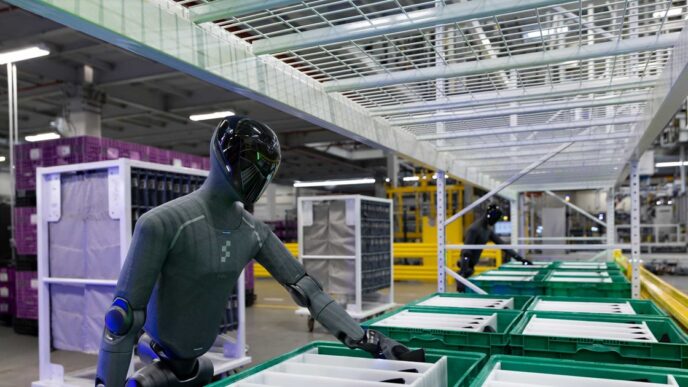
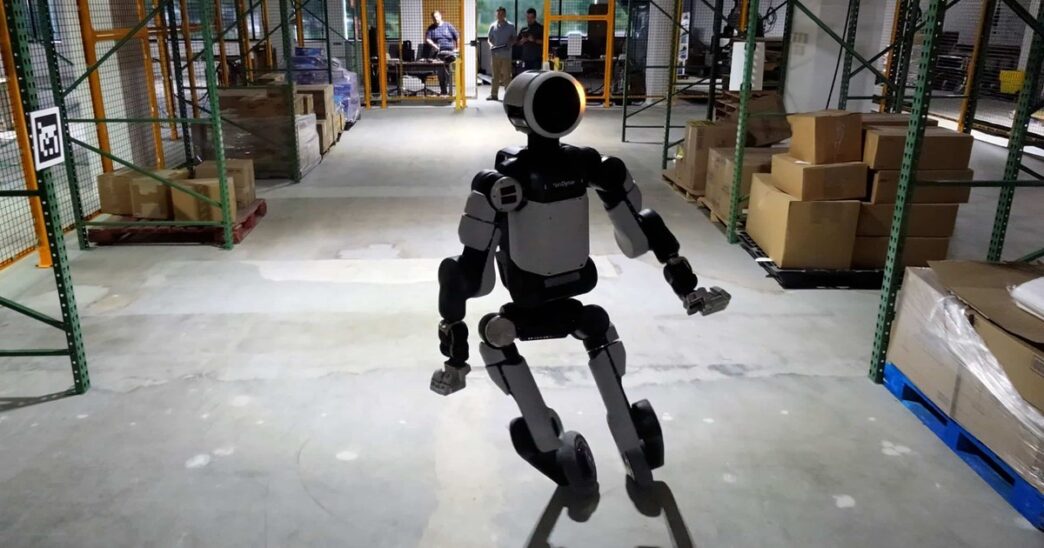
Boston Dynamics took the feet off its electric Atlas humanoid and bolted on scooter wheels. In a video and blog post published Monday, November 9, Atlas on wheels drifts across a warehouse floor, dashes sideways and spins through a 360-degree jump, all under a control policy trained in simulation. The conversion took one new part: a custom adapter that mounts an off-the-shelf scooter rim on Atlas’s existing ankle actuator.
Don’t expect to buy one. “A wheeled Atlas isn’t a product. It’s a research testbed,” the company writes. The real subject is less flashy and more useful: whether the simulated motors Boston Dynamics trains its learned controllers against behave like the real ones when they’re pushed to the edge. That matters for a robot Hyundai wants in its plants by the tens of thousands, and it adds a data point to the wheels-versus-legs argument the rest of the industry is having.
- What: Boston Dynamics fitted Atlas with scooter wheels on its ankle actuators, using one custom adapter as the only new part, and drove it with a whole-body reinforcement learning policy trained in simulation. Video and blog post published November 9, 2026.
- Why: to run the motors across their full torque-speed range under constant load and check that the simulated motor model matches the hardware. Boston Dynamics says the lessons are going back into the standard legged Atlas.
- Status: not a product. Boston Dynamics calls it a research testbed and has announced no wheeled Atlas, price or date.
- The catch: it’s a company video and blog post, with no paper, speed figure or count of attempts. The engineer describes driving the robot, so a person chooses where it goes while the learned policy handles balance and the wheels.
One adapter, a scooter rim and an ankle that spins
The blog post is written by Xiaoyu (Andy) Wu, a controls engineer on the Atlas team who, according to the post, has spent more than a decade controlling electric motors and the power electronics that drive them. He calls the hardware change “wonderfully simple.” A single custom adapter, credited to colleague Josh Geating, mounts the scooter rim on the ankle actuator, and Wu says the retrofit was “about as involved as swapping a wheel on a bicycle” because Atlas was designed from the start to be built at high volume and serviced easily. That’s Boston Dynamics’ description of its own robot, but a one-part swap is a concrete way to make the point.
The software change was smaller still. In the robot model, each wheel is simply an “ankle” that can spin continuously, so Wu took the baseline model and swapped the feet for wheels. The controller wasn’t built from scratch either. Wu writes that a few targeted changes to the reward, the range of commands the policy trains on and the way it holds its posture were enough for smooth rolling to emerge from Boston Dynamics’ existing reinforcement learning setup. The post credits MuJoCo, the open-source physics engine maintained by Google DeepMind, for the simulation.
Why put wheels on a robot built to walk
Wu’s reason has little to do with getting around. He wanted a test where the motors “had to deliver high torque and high speed continuously, carrying real load the whole time.” Walking loads a joint in bursts. Driving loads it constantly: “every launch, turn, and stop pushes the motors across their full torque-speed range.”
That’s the actual experiment. Reinforcement learning trains a policy over millions of simulated runs, and the policy only works on hardware if the simulated robot behaves like the real one, the sim-to-real gap we cover in our sim-to-real explainer. Wu’s sharper point is about the motors. If the simulation treats them as idealized, he writes, “the policy can end up learning things the real hardware can’t actually do.” So much of the project was what he calls unglamorous work: matching low-level control settings across software setups, running characterization tests, tuning the simulated motor model to what the robot actually did, and knowing “which approximations were safe to make and which ones the policy would learn to exploit.”
That last phrase is the one engineers will recognize. A learned controller is an optimizer, and it will happily use any shortcut the simulator allows. Testing at the edge of the motors’ envelope is how you find out which shortcuts were fiction. Our guide to humanoid actuators explains why the electric Atlas leans so heavily on its motors in the first place.
The 360-degree jump was the easy part
The video runs 2 minutes 51 seconds and mixes hardware runs with simulation renders. Some of the moves came from a library of human motion capture, and Wu says he deliberately picked clips with a lot of foot sliding. In the side dashes, where a person would slide their feet, the policy learned to steer the wheels and roll through instead. Wu says the trick emerged on its own: “Give the policy wheels, and it figures out how to use them.”
The jump looks like the riskiest stunt, but Wu calls it “one of the lower risk” moves. It’s a trajectory-tracking policy that follows a recording of a person doing the jump, and “it just worked first try.” What changed was traction: during the windup, the lower body rolled into place before the upward push, a move feet can’t make.
What the video leaves out matters too. Wu talks about driving the robot and compares it to “playing a video game,” so a person picks the direction and speed. The Robot Report describes the policy taking velocity commands along with the robot’s own sensor feedback. Boston Dynamics doesn’t say how many attempts the other moves took, how fast Atlas rolls, or how the clips were cut. That’s normal for a research demo, and it’s why this reads best as a controls result rather than a capability claim. Our guide to reading robot demos covers the difference.
Atlas on wheels is a different bet from a wheeled base
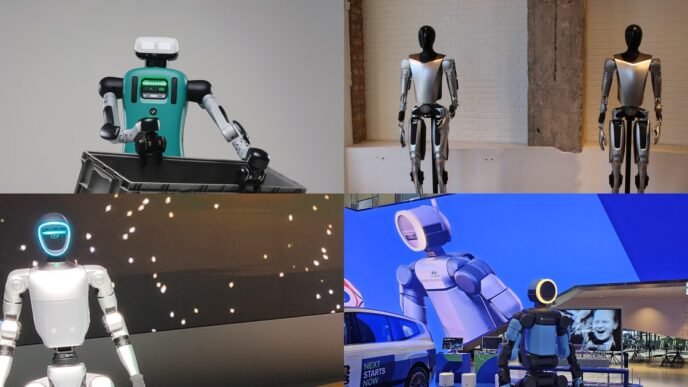
When the industry argues about wheeled humanoids, it usually means a torso on a rolling base. Embodied AI’s AIR, unveiled in Munich on November 6, is a two-armed upper body on a wheeled base that starts every job under teleoperation, as we reported in our AIR launch story. Carnegie Mellon’s Pixel puts a 17-joint upper body on a holonomic wheeled base with a vertical lift, and its paper says the hardware can be assembled for under $15,000. Apptronik sells Apollo 2 in both legged and wheeled-base versions, as our bipedal vs wheeled explainer notes.
Atlas on wheels keeps its legs. The wheels sit where the feet were, so the robot can still crouch, jump and shift its weight, and the policy decides when to roll and when to use its legs, as in the side dashes. That makes it closer to a wheel-legged design than to a mobile manipulator. Agility Robotics made the case for plain legs only last month: Digit “likely won’t get wheels,” co-founder Jonathan Hurst wrote on October 22, though wheeled robots are on Agility’s exploratory roadmap. His argument is that a foot can be placed quickly to catch a fall, while a wheel has to accelerate itself back under the robot (our report on that Q&A).
Our read: the experiment doesn’t settle that argument, but it does shrink one cost. If the same actuator, robot model and training pipeline can run feet or wheels with one bolt-on part, the choice starts to look like a configuration option rather than a new robot program. Whether Boston Dynamics ever offers that option is a question it hasn’t answered, and it says it isn’t trying to.
Why Hyundai should care about a motor model
The work matters most for the robot Boston Dynamics is actually building. Hyundai Motor Group plans to put 25,000 Atlas units to work in its plants “over the next few years,” according to Boston Dynamics, and Atlas robots have been training at a center inside Hyundai’s Georgia Metaplant since September 21, as we covered in our Atlas commercialization report. On October 27, two Korean newspapers reported that Boston Dynamics had asked suppliers to prepare parts for 10,000 robots, with Hyundai Mobis named for the joint actuators. Neither company has confirmed it (our supplier story).
A motor model is only as good as the motors it was measured on. Production actuators, whoever ends up making them, will need the same characterization Wu describes before simulation-trained skills can be trusted on them. That’s the unglamorous step that decides whether a skill learned in MuJoCo survives the move from a lab robot to a fleet. Wu’s next project points the same way: he’s working on how the policy should respond when an actuator fails, and on whether reinforcement learning can find new behaviors to cope. A humanoid that degrades predictably when a joint gives out is easier to put near people than one that doesn’t.
What to watch next
Boston Dynamics says the insights “are already being adapted back to our standard configuration.” The test of that claim is the legged Atlas: future videos, and more usefully any numbers from Hyundai’s plants on uptime and recovery from faults. The Robot Report says Boston Dynamics is preparing to ramp up Atlas testing at Hyundai facilities. Until those numbers arrive, the wheeled Atlas is a well-made controls demo with an honest label, and its most interesting line is about the motors, not the wheels.
Frequently asked questions
Is Boston Dynamics selling a wheeled Atlas?
No. Boston Dynamics says a wheeled Atlas “isn’t a product. It’s a research testbed.” It hasn’t announced a wheeled version, a price or a date, and it says the lessons are going into the standard legged Atlas.
How did Boston Dynamics put wheels on Atlas?
One custom adapter mounts an off-the-shelf scooter rim on each of Atlas’s existing ankle actuators, and that adapter is the only new part. In software, each wheel is modeled as an ankle that can spin continuously.
Is the wheeled Atlas autonomous?
Boston Dynamics doesn’t call it autonomous. The engineer behind it describes driving the robot, so a person chooses where it goes, while a reinforcement learning policy trained in simulation handles balance and how to use the wheels. The 360-degree jump follows a recording of a person doing the move.
Why did Boston Dynamics add wheels to Atlas?
To push its motors across their full torque and speed range under constant load, and to check that the simulated motor model used for training matches the real hardware. Driving stresses the motors more continuously than walking does.
Are wheeled humanoids better than legged ones?
It depends on the job. Wheels tend to win on flat floors and energy use, and legs on stairs, curbs and tight spaces. Boston Dynamics hasn’t published any comparison data from this experiment, so it doesn’t answer that question.
Sources
- Boston Dynamics: “Atlas On a Roll: Bridging Classical Motor Controls and Whole-Body RL,” Xiaoyu (Andy) Wu, published with the video on November 9, 2026 (the page shows no date)
- Boston Dynamics on YouTube: “Atlas on a Roll | Classical Motor Controls and Whole-Body RL | Boston Dynamics,” November 9, 2026, 2:51
- The Robot Report: “Boston Dynamics adds wheels to Atlas humanoid to test whole-body control,” Mike Oitzman, November 9, 2026
- The Herald Business: “Atlas on wheels: Boston Dynamics tests humanoid robot with scooter tires,” Jung Kyung-su, November 10, 2026
All sources accessed November 10, 2026.
Last updated: November 10, 2026. To report an error, see our corrections page. Articles are drafted with AI assistance and reviewed and edited by an editor; see our editorial policy.