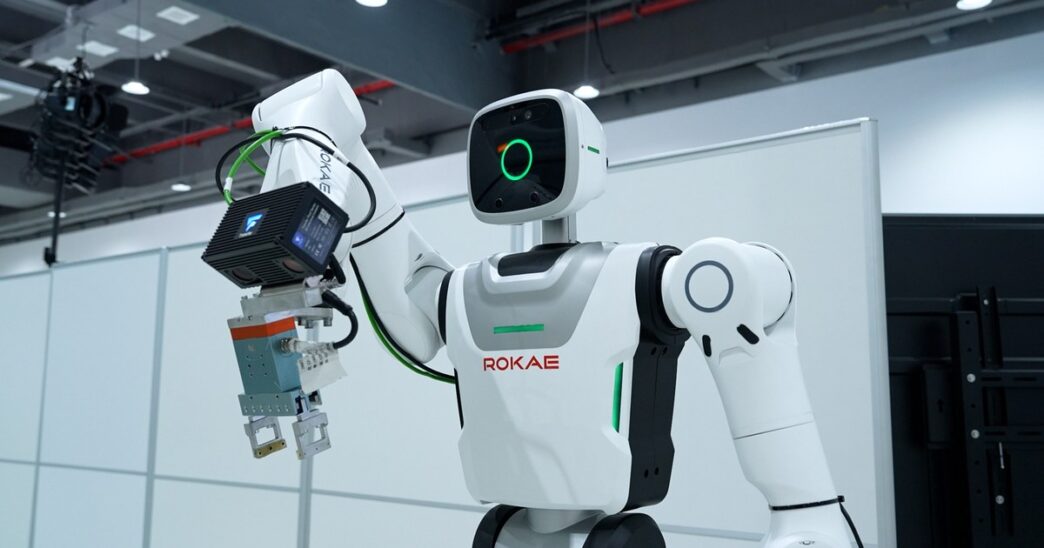
Schaeffler, the German bearing and auto-parts supplier, has started using humanoid robots to build parts for humanoid robots. On October 20, 2026, the company opened what it calls a lighthouse factory in Taicang, China, where six humanoids at five stations assemble joint modules, including the actuators that move a robot’s arms and legs. Schaeffler says the site marks the start of mass production of those components.
It is the clearest sign yet of how Schaeffler plans to make money from humanoids: not by selling robots, but by supplying the joints inside them and offering its own plants as a proving ground. The release is also notable for what it leaves out, starting with whose humanoids are on the line.
- What opened: a site of about 7,500 square meters in Taicang with an assembly line, a robot training and data center, a digital twin platform and a data center, per Schaeffler.
- Status: Schaeffler says the line, opened October 20, 2026, starts its mass production of humanoid joint modules, including linear and rotary actuators.
- Orders: about €400 million in humanoid robotics order intake after two new Greater China customers in the third quarter, the company says.
- The catch: Schaeffler has not named the robots on the line or published output, cycle times or how much of the work runs without human help.
What the Schaeffler humanoid line in Taicang does
The core of the site is an assembly line Schaeffler developed for humanoid components, “including linear and rotary actuators.” Six humanoids work across five stations, where, according to the release, they “stage and sort parts, join them, and inspect, label, and package them.” The Chinese-language version of the announcement, carried by the trade site imrobotic.com with Schaeffler as its source, is more specific: tote handling, part sorting and picking, press-fitting and screw assembly, functional testing, and marking and packaging. Actuators are the motor, gearbox and sensor packages that drive each joint, and they are among the costliest parts of a humanoid; our actuators explainer covers the main types.
A digital twin mirrors the line in real time. Schaeffler says sensors record assembly accuracy, how long each step takes, energy use and equipment condition, so changes can be tested virtually before they reach the real line. Next door, a training and data acquisition center prepares humanoids for factory jobs such as visual inspection, packaging, moving containers and restocking parts at the line side. The training setups mirror conditions in Schaeffler’s roughly 100 plants, the company says, and customers and partners can use the site to train and test their own systems. A day after the opening, Schaeffler said it is also putting digital twins of its humanoid actuators into Newton, the open-source physics engine in NVIDIA’s Isaac Lab and Isaac Sim, as what it calls the engine’s “exclusive foundational component.”
Chief operating officer Jochen Schröder called it “a closed manufacturing loop where humanoids assemble components for humanoids.” Schaeffler also posted a short tour of the factory on its official YouTube channel, where embedding is turned off, and a 22-second opening clip on its X account, below.
🤖 Humanoids making humanoids: Today Schaeffler opened a state-of-the-art lighthouse factory for humanoid robotics in Taicang, China.
Curious? Read the full press release here: https://t.co/LFIdOQyAqP#Wepioneermotion #TheMotionTechnologyCompany #HumanoidRobotics pic.twitter.com/UmSxtQJWQ1
— Schaeffler Group (@SchaefflerGroup) October 20, 2026
Video: Schaeffler. Opening clip of the Taicang lighthouse factory from the official Schaeffler Group X account, October 20, 2026 (watch on X).
Whose humanoids are these?
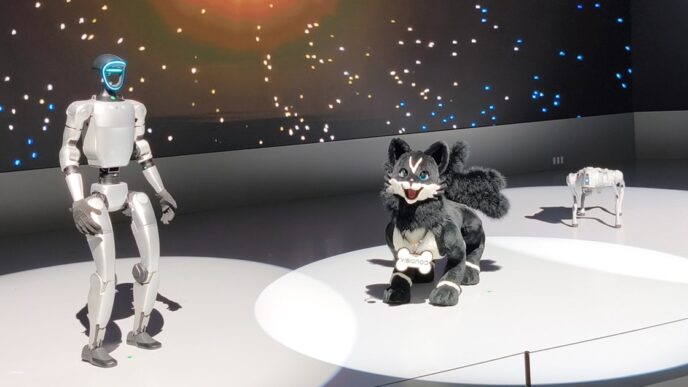
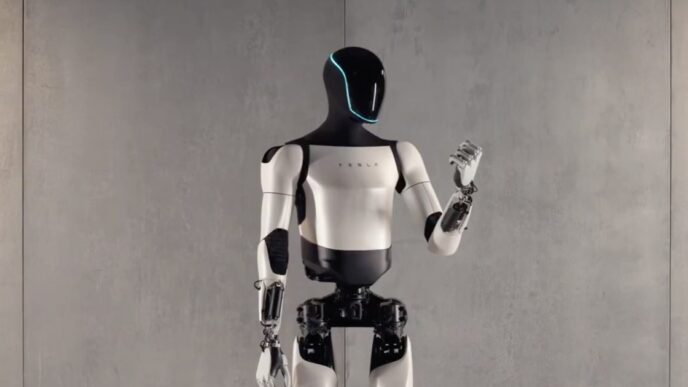
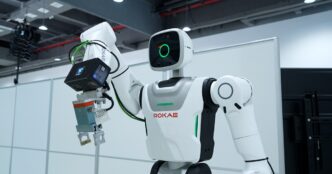
The release doesn’t say. Schaeffler’s own press photo, used above, shows a white humanoid with ROKAE branding working at a station. ROKAE, a Chinese robot maker, signed a strategic agreement with Schaeffler on April 7, 2026. Under it, Schaeffler becomes a core supplier of ROKAE’s joint modules, the two develop integrated joints together, and ROKAE takes part in automating Schaeffler’s own production. Whether every robot on the Taicang line is a ROKAE machine, Schaeffler hasn’t said.
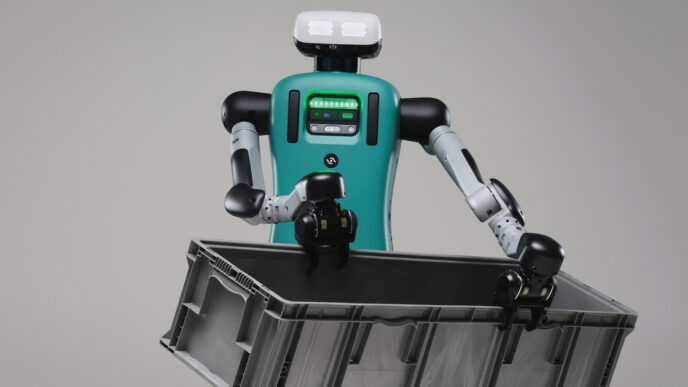
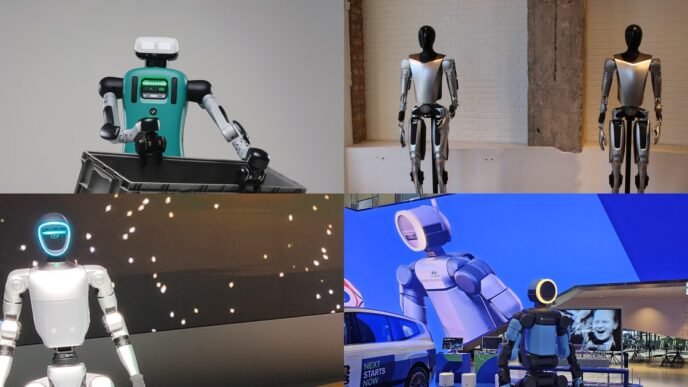
Schaeffler works with several humanoid makers at once. In January it announced a partnership with UK startup Humanoid that pairs actuator supply with a purchase agreement for humanoids; Schaeffler said it plans to integrate several hundred humanoids into its plants over the next five years. Agility Robotics lists Schaeffler as a Digit customer in its SPAC filings and repeated that in releases on October 20 and 21, and NEURA Robotics names Schaeffler as an industrial data partner for its Neuron AI model.
The bigger unknown is autonomy. Schaeffler describes the humanoids as working the line but does not say how often a person steps in, whether any station is remote-operated, or how the robots’ speed compares with a human worker’s. Its photo of the training center shows staff at workbenches with handheld rigs, the kind of setup used to record demonstrations. Until Schaeffler publishes throughput or intervention data, treat this as a production line with humanoids on it, not proof that humanoids run it alone.
€400 million in orders, and a CEO who says the hype is cooling
The factory follows Schaeffler’s October 13 update call, where chief executive Klaus Rosenfeld said two China-based customers had placed production orders, “making it five customers that now are in series production with us.” He put sample orders at 83 and the humanoid order book at €400 million. He also offered a rare dose of caution from a supplier: “For sure, the hype that was there at the beginning is calming down a bit, but we see this as one of the four new growth areas.”
Order intake is not revenue. Schaeffler hasn’t said over how many years those orders deliver or what humanoid parts brought in so far. The company set up a dedicated robotics unit in Taicang early this year, and its full third-quarter report on November 3 is the next chance for detail.
The location matters too. At a State Council Information Office briefing on October 19, China’s industry ministry said the country made more than 40,000 humanoid robots in the first half of 2026 and expects more than 100,000 for the full year. Those figures carry no public methodology, as we noted in our look at humanoid production numbers, but every one of those robots needs joints. “China’s humanoid robotics industry is entering a fast growth period,” said Yilin Zhang, Schaeffler’s regional CEO for Greater China.
What to watch: the names of the five series-production customers, any output figure for the Taicang line, and whether the humanoids trained there show up in Schaeffler’s plants outside China.
Frequently asked questions
What is Schaeffler’s Taicang lighthouse factory?
It is a site of about 7,500 square meters in Taicang, China, opened October 20, 2026. It combines an assembly line for humanoid robot components, a robot training and data acquisition center, a digital twin platform and a data center. Schaeffler says it marks the start of its mass production of humanoid joint modules.
What do the humanoid robots do at Schaeffler’s factory?
Six humanoids work across five stations, where Schaeffler says they stage and sort parts, join them, and inspect, label and package them. The products are joint modules for humanoid robots, including linear and rotary actuators.
Which humanoid robots does Schaeffler use in Taicang?
Schaeffler has not named them. Its press photo shows a ROKAE-branded humanoid at a station, and Schaeffler signed a strategic agreement with ROKAE in April 2026 that includes ROKAE helping automate Schaeffler’s production.
How big is Schaeffler’s humanoid robotics business?
Schaeffler says humanoid robotics order intake has reached about €400 million, with five customers in series production and 83 sample orders, according to its October 13, 2026 update call. It has not disclosed humanoid revenue.
Are the robots at Schaeffler’s factory fully autonomous?
Schaeffler has not said. Its release does not report how often people intervene, whether any station is remote-operated, or how fast the robots work compared with people, so the level of autonomy is not confirmed.
Sources
- Schaeffler, “Humanoids making humanoids: Schaeffler opens lighthouse factory in Taicang,” October 20, 2026 (floor space, stations, tasks, digital twin, training center, order intake, quotes, video link, press photos): schaeffler.com
- Schaeffler AG, update call transcript, October 13, 2026 (five customers in series production, 83 sample orders, €400 million order book, Rosenfeld quotes, November 3 report date): schaeffler.com (PDF)
- Schaeffler, “Schaeffler releases preliminary numbers for first nine months of 2026,” October 13, 2026: schaeffler.com
- Schaeffler China, “舍弗勒与珞石机器人签订战略合作协议” (Schaeffler and ROKAE sign strategic cooperation agreement), April 7, 2026: schaeffler.cn
- Schaeffler China, release on founding its embodied-intelligence robotics company in Taicang, February 2026: schaeffler.cn
- Schaeffler, “Schaeffler and Humanoid enter strategic technology partnership,” January 13, 2026: schaeffler.com
- Schaeffler, “Schaeffler and NVIDIA Collaborate to Accelerate Humanoid Robot Deployment Through AI-Powered Digital Twins,” October 21, 2026 (actuator digital twins in Newton): schaeffler.com
- Schaeffler, factory tour video on the official Schaeffler YouTube channel: youtube.com
- Schaeffler Group on X, Taicang opening post with video, October 20, 2026: x.com/SchaefflerGroup
- imrobotic.com, Chinese-language version of Schaeffler’s Taicang announcement (source: Schaeffler), October 20, 2026 (station tasks): imrobotic.com
- State Council Information Office, “China expects humanoid robot production to exceed 100,000 units this year,” October 20, 2026: english.scio.gov.cn
All sources accessed October 20, 2026. Schaeffler’s release, its YouTube embed setting and its X account rechecked October 21, 2026, between about 2:40 and 2:50 PM ET; Schaeffler had not named the robots or published output. Release, X embed and Schaeffler’s Oct 21 NVIDIA release rechecked October 22, 2026, about 7:30 AM ET; still no robot maker, customer names or output.
Related: More Robot Companies coverage · Robot companies directory
Last updated: October 22, 2026. To report an error, see our corrections page. Articles are drafted with AI assistance and reviewed and edited by an editor; see our editorial policy.