NVIDIA’s GR00T 2 robot model learned most of what it knows by watching people. Announced on November 9 at the Conference on Robot Learning in Austin, the world action model was pretrained on 402,730 hours of first-person human video, plus about 10,000 hours of handheld-gripper recordings and 23,500 hours of teleoperated robot data. On 50 tasks a two-handed robot had never practiced, NVIDIA says it succeeded in 40% of trials straight out of the box and in 95% after five demonstrations each.
It’s one of the clearest public tests yet of whether human video can stand in for expensive robot data, and the NVIDIA GR00T 2 whitepaper is unusually frank about where the numbers are soft. The 50 tasks were picked partly because the model could learn them, most benchmarks use 20 trials or fewer, and the code won’t arrive until December. Here’s what NVIDIA showed, what it didn’t, and how GR00T 2 compares with the rival world action models we’ve covered.
- What: GR00T 2, a 2-billion-parameter world action model built on NVIDIA Cosmos that predicts future video and robot actions together. NVIDIA calls it open. Announced November 9, 2026.
- Headline results (NVIDIA’s tests): 40% success zero-shot on 50 unseen tasks, 71% with one demonstration, 95% with five. A smaller Turbo version served popcorn on a Unitree G1 in 48 of 48 trials.
- Available now: the whitepaper and 100,000 hours of human video on Hugging Face (CC BY 4.0). The project page says code is coming in December. No GR00T 2 weights were on NVIDIA’s Hugging Face page on November 10.
- The catch: research results on NVIDIA’s own robots, mostly 20 trials or fewer per task, and the 50-task set was chosen from tasks the model could learn.
What NVIDIA GR00T 2 is
GR00T 2 is NVIDIA’s first world action model, a step away from the vision-language-action design of the GR00T N1 models we explained earlier. A VLA looks at camera images and an instruction and outputs motor commands. A world action model also predicts what the cameras should see next, so it can learn from any video of hands doing things, even video with no robot in it. Our world action model explainer covers the idea in more detail.
According to NVIDIA’s whitepaper, GR00T 2 is a single 2-billion-parameter transformer initialized from Cosmos-Predict2.5-2B, NVIDIA’s video prediction model. At each step it gets 0.8 seconds of history from up to four cameras at five frames per second, plus the robot’s joint state and a text instruction. It outputs a chunk of future video and a chunk of actions together. NVIDIA tested it on three kinds of robots: YAM gripper arms, a two-handed robot called Dexter with two 22-joint Sharpa hands, and the Unitree G1 humanoid.
The data: mostly people, not robots
The pretraining mix is the story. NVIDIA’s Human-1M collection holds about a million hours of first-person video of skilled people at work, and GR00T 2 used 402,730 hours of it, covering 13.75 million episodes from more than 51,500 people in 123,000 scenes. On top of that came 10,184 hours of demonstrations recorded with handheld UMI grippers across 2,897 tasks and 23,500 hours of teleoperation on several robot types. Pretraining ran on 1,024 NVIDIA GB300 GPUs.
For scale, LiberAI says its Liber-0 world action model learned from more than 2.2 million hours of human experience, and Alibaba’s Lambda-0 used 500 hours of human video for a humanoid. The difference with GR00T 2 is that part of the data is public: 100,000 hours went up on Hugging Face on November 4 under a CC BY 4.0 license. That matters for anyone who has read our piece on why training data is the bottleneck.
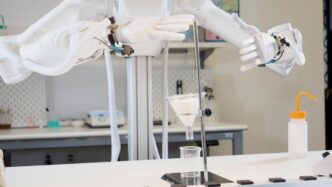
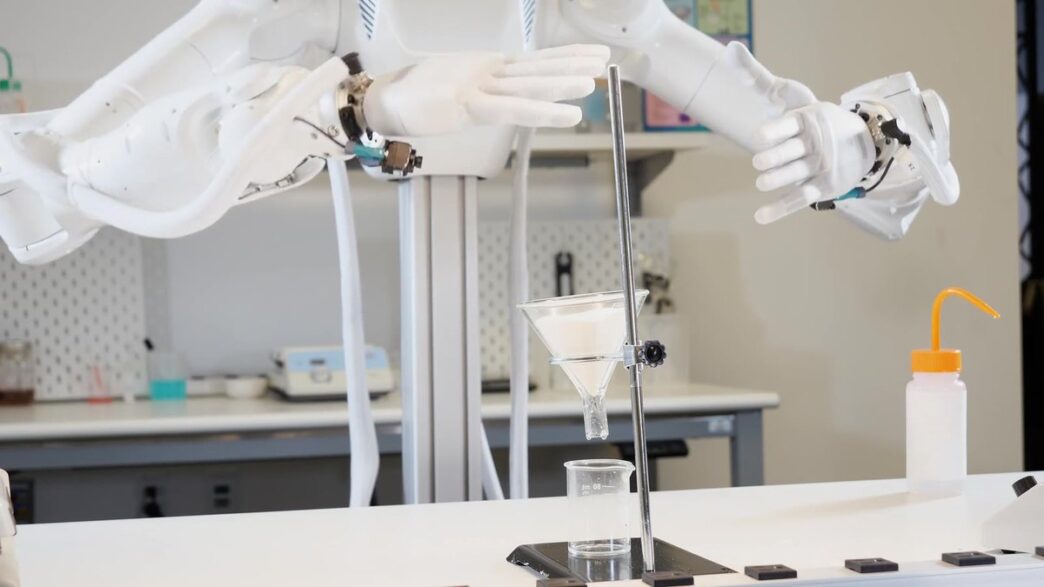
The clearest proof that human video transfers is NVIDIA’s “X-adaptability” test. Shown a task only by people, never on the robot, Dexter lined a lab funnel with filter paper and wet it with a wash bottle in 65% of trials. A YAM arm assembled a toy dump truck in 60% of trials after seeing it done only with a handheld gripper. Those are research demos, with the success rates NVIDIA reports, not shipping features.
The 95% headline, and its footnote
NVIDIA’s blog leads with the few-shot numbers: 40 of 50 unseen tasks completed at least once with no task-specific demonstrations, 71% average success with one demonstration per task and 95% with five. Five demonstrations is under three minutes of robot data, and each adaptation is a LoRA fine-tune of about 30 minutes on a single RTX 5090, the whitepaper says.
The whitepaper adds what the blog leaves out: “The 50 tasks were chosen among those the model learns with five episodes (at least 80% success), so the five-episode rate is high partly by construction.” In other words, tasks the model couldn’t learn weren’t in the set. The 40% zero-shot result doesn’t carry that problem in the same way, and it’s still a good number.
The harder benchmarks are more telling. On six long YAM tasks, such as assembling a toy car in 24 stages, GR00T 2 averaged 71.7% after post-training, against at most 12.5% for the other models tested. On seven dexterous-hand tasks, including filtering crude salt and swapping a GB300 memory module, it averaged 68.6%, while GR00T 1.7 and Physical Intelligence’s π0.5 managed at most 0.7%.
Agents and reinforcement learning push it near 100%
GR00T 2 is designed to work under a separate AI agent that plans and checks the work, the “System 2” to GR00T 2’s “System 1.” NVIDIA uses its ASPIRE code-writing framework for this. In the toughest real test, a person dumped all the parts of a toy plane, tractor or car onto the table before each run, and the robot had to find, assemble and fasten them in 5 to 14 minutes. With the agent fixing dropped parts and stalls, GR00T 2 succeeded in 98, 97 and 97 of 100 trials. The Hot Wheels car went from 23 of 100 with the basic fine-tuned model alone.
Reinforcement learning post-training helped the precision jobs. Inserting five Ethernet cables into a switch went from 12 to 19 successes out of 20, and inserting five chargers went from 2 to 20 out of 20. NVIDIA’s partner MicroAGI is using an RL-trained GR00T 2 for Ethernet cable swapping, according to NVIDIA’s blog.
GR00T 2 Turbo on the Unitree G1
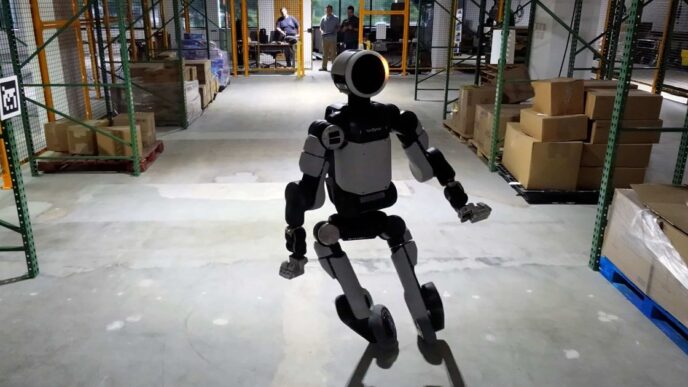
For humanoids, NVIDIA built a lighter version, GR00T 2 Turbo, that predicts a visual grid four times smaller. It plans about every second and hands its output to SONIC, NVIDIA’s whole-body motion controller (it took about 21,000 GPU-hours to train, as we noted in our SuperMimic coverage). Turbo takes 124 ms per prediction on the G1’s onboard Jetson Thor and 38 ms on an RTX 5090.
On popcorn serving, where the G1 holds a cup in one hand and scoops and pours with the other, Turbo completed all 48 trials, against 83.3% for GR00T 1.7 with the same demonstrations. Rendering recorded motions into new simulated rooms raised out-of-distribution pick-and-place from 6.7% to 63.3%, over 30 trials, versus 40.0% for GR00T 1.7. The tradeoff: Turbo halves success on the dexterous-hand tasks, from 68.6% to 34.3%.
What NVIDIA says it can’t do yet
The whitepaper’s own list of open problems is the best guide to how far this is from a product. GR00T 2 sees only 0.8 seconds of history, so anything that needs memory goes to the agent. It “does not take touch as input.” And in the long assembly tests, three of eight failures were screws left partly driven that both GR00T 2 and the agent judged complete.
On reliability, NVIDIA does the math itself: most of its post-training benchmarks use up to 20 trials per task, but “Distinguishing 95% from 99% success takes about 285 trials per policy, and 99% from 99.9% more than 1,000.” That’s the gap between a lab result and a robot a factory would trust. NVIDIA says Foxconn is applying GR00T 2 to server manufacturing and Siemens is evaluating it, but neither has published results.
Then there’s “open.” NVIDIA’s blog calls GR00T 2 “an open frontier world action model,” and GR00T N1.7 did ship with downloadable weights. But on November 10 the newest GR00T models on NVIDIA’s Hugging Face page were still N1.7 checkpoints, and the project page says only “Code Available in December.” Until the weights and license appear, “open” is a promise. Rival FLUX 3 Action is already downloadable, though at 7 billion parameters it’s more than three times GR00T 2’s size, with a license that limits commercial use.
Frequently asked questions
What is NVIDIA GR00T 2?
GR00T 2 is a robot foundation model from NVIDIA, announced on November 9, 2026. It’s a world action model, meaning it predicts future video and robot actions together, and it was pretrained mostly on first-person video of people doing tasks.
Is GR00T 2 open source?
NVIDIA calls it open, but as of November 10, 2026, the model weights weren’t on NVIDIA’s Hugging Face page. The project page says the code is coming in December. A 100,000-hour slice of the human video data is already available under CC BY 4.0.
How is GR00T 2 different from GR00T N1.7?
GR00T N1.7 is a vision-language-action model that outputs robot actions. GR00T 2 also predicts the video of what should happen next, which lets it learn from human video without robot actions attached. In NVIDIA’s tests it beat N1.7 on dexterous tasks and on humanoid popcorn serving.
Does GR00T 2 run on humanoid robots?
A smaller version, GR00T 2 Turbo, runs on the Unitree G1’s onboard Jetson Thor computer, taking 124 ms per prediction. NVIDIA pairs it with its SONIC whole-body controller.
How reliable is GR00T 2?
NVIDIA reports 95% success after five demonstrations on 50 tasks and 97% or more on cluttered toy assembly with an agent. Most tests used 20 trials or fewer per task, and NVIDIA itself says telling 95% from 99% reliability takes about 285 trials.
Sources
- NVIDIA GEAR: “GR00T 2: Scaling Robot Foundation Models for Generalization, Dexterity, and Adaptation,” whitepaper, November 2026 (Secs. 2-4, appendices C and H, Tabs. 1, 25 and 26)
- NVIDIA GEAR: GR00T 2 project page (“Code Available in December”), demo videos
- NVIDIA Blog: “Practice Makes Precise: At CoRL, NVIDIA and Partners Reveal How Robots Rehearse Delicate Work in Simulation,” Sasa Docca, November 9, 2026
- Hugging Face: nvidia/PhysicalAI-Human-1M-100K (license CC BY 4.0, created November 4, 2026)
- Hugging Face: NVIDIA model listings (GR00T models checked November 10, 2026)
All sources accessed November 10, 2026.
Last updated: November 10, 2026. To report an error, see our corrections page. Articles are drafted with AI assistance and reviewed and edited by an editor; see our editorial policy.