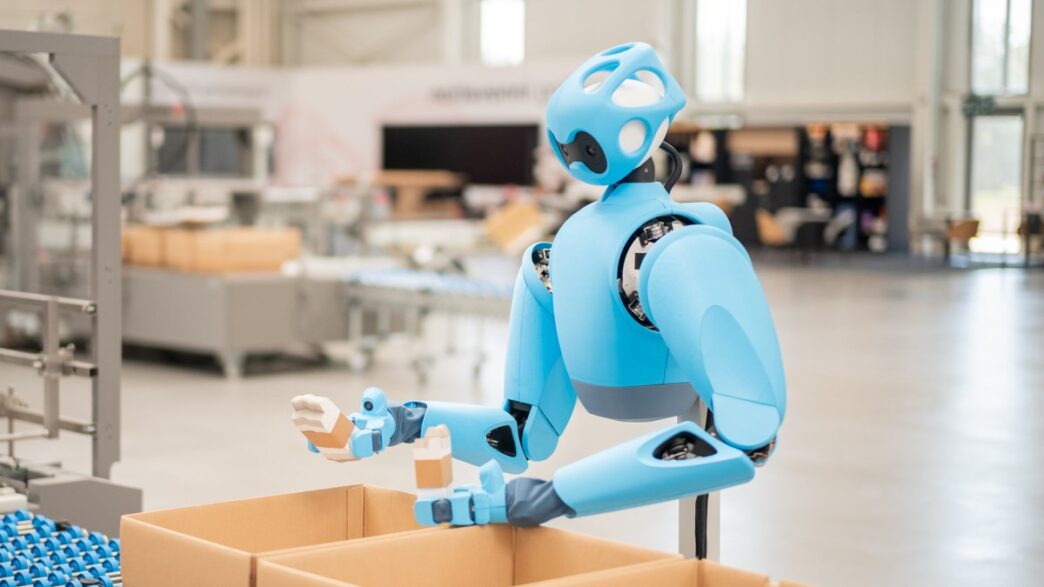
A 25-person Swiss startup unveiled a factory robot in Munich on November 6 that starts every job with a human at the controls. Embodied AI, an EPFL spin-out based in Lausanne, says its new AIR robot is driven remotely from its first shift, records everything it does, and typically takes the task over on its own within about a month. The company says orders open now that the robot has been shown at Humanoid Europe 2026. It hasn’t published a price.
Embodied AI AIR is a wheeled, two-armed upper body rather than a walking machine, and that is the point. The company is betting that a light, soft robot that can share a line with people, paid for from day one through teleoperation, will reach real factories before the big general-purpose humanoids do. It is also a clean test of a question this site keeps asking: when a robot company says “autonomous,” who was driving last month?
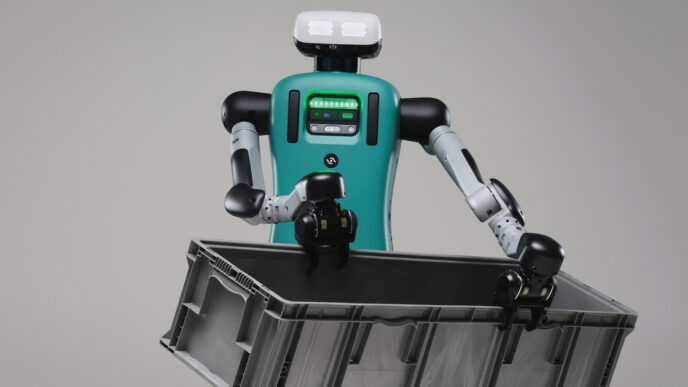
- What: AIR is a two-armed robot torso with a head on a wheeled base, unveiled by Swiss startup Embodied AI at Humanoid Europe 2026 in Munich on November 6, 2026. It is built to work beside factory staff without a safety cage.
- How it learns: a remote operator runs it from the first shift; every run is recorded, and the company says AIR typically does the task on its own within about a month.
- Company numbers: a 95% average task success rate in paid pilots with two unnamed manufacturers, and up to three people’s workload per shift on some tasks. CE marking is planned for 2027.
- The catch: no price, delivery date, height, weight, reach or battery figures; no named customer; and no definition of “success” or count of how often operators still step in.
What Embodied AI unveiled in Munich
According to the company’s launch press release, AIR “has a body and two arms on a wheeled base and is built to work beside people without a safety cage.” Chief executive Francesco Stella, 28, who earned his robotics PhD at EPFL and did research at MIT, presented it at Humanoid Europe in Munich. His co-founders are CTO Kai Junge and COO Max Polzin.
The design trick is where the weight goes. Embodied AI puts the motors, gearboxes and electronics in the torso and moves the arms with tendons, so the arms carry almost no mass and give way on contact. In a Business Wire version of the announcement, the company says safety “comes from how it is built, not from software holding it back,” and that AIR is designed under ISO/TS 15066:2016, the technical specification for collaborative robots that share space with people. It runs on wheels because, the company says, factory floors are flat and wheels are more stable.
The only arm figures so far come from an investor, not a spec sheet. Angelo Burgarello, a partner at Look AI Ventures, described “a 2 kg tendon-driven arm that lifts 5 kg” in the company’s release. Embodied AI’s website lists the robot as AIR01 and pitches it for kitting, SMT support and packaging, alongside a separate two-arm cell called Flex02 and a tendon-driven soft manipulator called HELIX that it says has nine or more degrees of freedom.
The company says it went from research to an industrial humanoid in nine months and has signed contracts with major manufacturers, though it doesn’t name them. Its backers include Faber VC, Look AI Ventures, Techshop Capital, Vento, Plug and Play, Kickfund and Excellis. No round size has been disclosed.
Teleoperation first is the business model, not a footnote
Most humanoid startups treat teleoperation as something to hide in a demo video. Embodied AI puts it on the box. AIR “starts every job under the control of a human operator, so it is productive from its first shift,” the company says. Every run is recorded, its own AI stack learns from those demonstrations, and the operator “stays on hand to cover for anything it hasn’t seen before.” Burgarello summed up the pitch as “deployed in one week and reaching an average 95% task success rate within a month.”
That is an honest description of how most robot learning works today. Our guide to teleoperation versus autonomy explains why remote control isn’t the villain; the problem is when a buyer can’t tell how much a human is still doing. South Korea’s new humanoid data factory uses 12 teleoperated robots to collect the same kind of demonstrations in a lab. Embodied AI’s twist is to collect them on a customer’s line and bill for the work while it does.
The website describes the software as compact multimodal policies, trained by imitation learning and orchestrated by a vision-language model, running on the robot itself. The company says the stack already does paid work in its two-arm industrial cell, which is why it can quote pilot results for a robot it only unveiled last week. In the Business Wire release, it says a leading consumer electronics maker tested five funded startups on a cable-handling task, none met the targets, and Embodied AI reached 98% reliability against a 90% goal.
What the 95% and the 98% don’t tell you
The two releases carry two different headline numbers, and they measure different things. The 95% is an average task success rate across paid pilots with “a leading consumer electronics manufacturer and a global automotive and industrial technology supplier.” The 98% is reliability on one cable-handling task for one customer. Neither customer is named, and neither figure comes with a definition. We don’t know:
- How success is counted. Whether a task that an operator rescued counts as a success, or a failure.
- How often operators still step in after the first month. “Typically within a month” is a goal, not an intervention rate.
- Which robot produced the numbers. The pilot figures describe the AI stack, which the company says has been doing paid work on its earlier two-arm cell. They aren’t results from AIR fleets on a line.
- What “up to three people per shift” covers. The company says one AIR can handle that workload “depending on the task” and doesn’t say which tasks.
Embodied AI also hasn’t published the basics a factory buyer would put in a request for quote: price, delivery date, height, weight, reach, full payload or battery life. The company says orders are open; its website sends buyers to a contact form and a site assessment.
The wheeled humanoid crowd is getting bigger
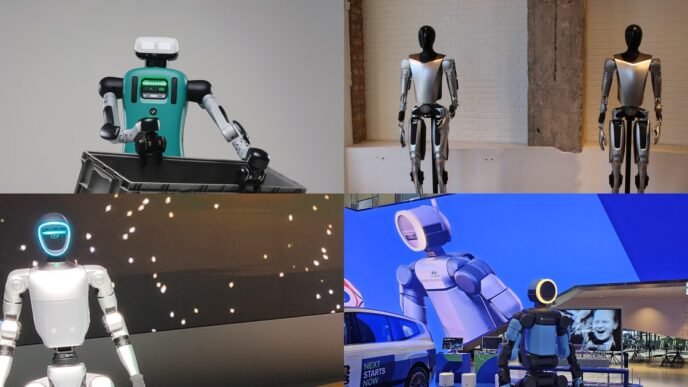
AIR is the latest in a run of humanoids that skip legs. Carnegie Mellon’s Pixel is a wheeled research platform its authors say can be built for under $15,000. Agility Robotics co-founder Jonathan Hurst said in October that Digit likely won’t get wheels, but that wheeled, statically stable robots are on Agility’s exploratory roadmap, and that he expects the earliest useful home robots to be wheeled “simply to address the safety challenges in the near term.” Embodied AI is making the same safety argument for factories, and it is selling, not researching.
The cage-free claim is the bit to watch. Factories normally fence industrial robots in. When South Korea let 20 Robros humanoids work beside people without safety fences in October, it took a special regulatory sandbox approval to do it. ISO/TS 15066, which Embodied AI cites, gives collaborative robots useful limits on force and pressure, but as our standards guide notes, it isn’t a free pass for a mobile machine in open aisles.
Why the CE mark in 2027 matters more than the demo
Embodied AI says CE marking is planned for 2027. That lines up with the date the EU’s new Machinery Regulation replaces the old directive, January 20, 2027, and the timing isn’t a coincidence. Until AIR carries the mark, it can’t be sold as finished machinery in the EU.
Here is where AIR’s business model meets the new law. The regulation treats safety components with self-evolving, machine-learning behavior as high-risk items that need third-party assessment, requires machines with that kind of behavior to record safety-related decision data, and says remote connections must not create a hazard. A robot that is teleoperated over a network and keeps learning on the customer’s line touches all three. Embodied AI’s answer is that AIR’s safety is mechanical, built into light arms that yield, rather than delegated to the learning software. If that holds up with a notified body, it is a real advantage over heavier humanoids. If the learned policies end up doing safety work, the paperwork gets much heavier. The company hasn’t said which route it expects.
What to watch next
Three things would turn AIR from a launch into a product: a published price and delivery date, a manufacturer willing to be named, and an intervention log that shows how much the remote operator is still doing after month one. The CE marking, planned for 2027, is the hard deadline. Until then, the most credible number in the launch is the one Embodied AI didn’t dress up: a human drives AIR first.
Frequently asked questions
What is Embodied AI’s AIR robot?
AIR is a two-armed robot torso with a head on a wheeled base, made by Embodied AI, a Swiss startup spun out of EPFL. It was unveiled at Humanoid Europe 2026 in Munich on November 6, 2026, and is designed to work beside factory staff without a safety cage.
Is the AIR robot autonomous?
Not at first. Embodied AI says a remote operator runs AIR from its first shift, every run is recorded as training data, and the robot typically does the task on its own within about a month, with the operator still on hand for situations it hasn’t seen before.
How much does Embodied AI’s AIR cost?
Embodied AI hasn’t published a price or delivery date. The company says orders open after the Humanoid Europe unveiling and directs buyers to a site assessment and pilot.
Is AIR a real humanoid?
Embodied AI calls it a humanoid, but it has no legs. It is an upper body with two tendon-driven arms and a head on wheels, which the company says is more stable on flat factory floors.
Can AIR be sold in Europe?
Embodied AI says it plans CE marking in 2027, around when the EU Machinery Regulation takes effect on January 20, 2027. Until a robot carries the CE mark it can’t be sold as finished machinery in the EU.
Sources
- Embodied AI / Look AI Ventures: launch press release, embargoed to November 6, 2026, 9:00 CET (25-person team, 95% pilot average, CE marking 2027, up to three people per shift, Stella and Burgarello quotes), linked from embodiedai.ch
- Business Wire: “Embodied AI Unveils AIR, a Physically Safe Humanoid Robot That Learns on the Job,” November 6, 2026 (nine months, ISO/TS 15066:2016, 98% vs 90% cable-handling test)
- Embodied AI website: AIR01, Flex02 and HELIX product pages, industries and pilot process
- Embodied AI on YouTube: “Introducing Embodied AI: Built for your world,” September 21, 2026
- Humanoids Daily: “Swiss Startup Embodied AI Unveils AIR, a Wheeled Robot Built to Work Beside Factory Staff Without a Cage,” November 6, 2026
- Greater Geneva Bern area (GGBa): “Embodied AI unveils AIR, a wheeled humanoid robot designed to work beside factory staff,” November 9, 2026
All sources accessed November 9, 2026.
Last updated: November 9, 2026. To report an error, see our corrections page. Articles are drafted with AI assistance and reviewed and edited by an editor; see our editorial policy.