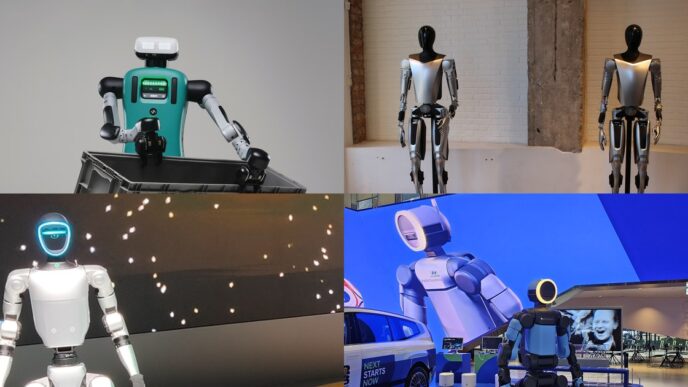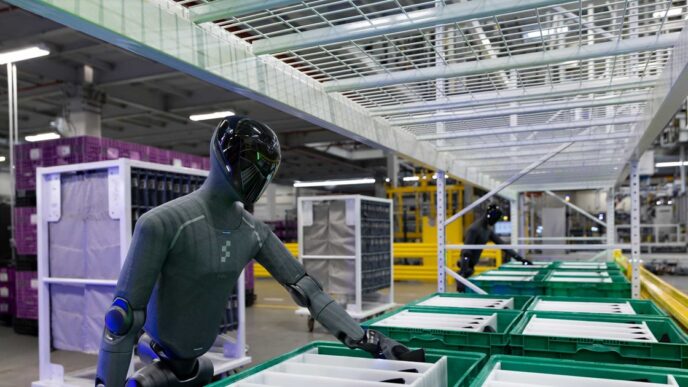
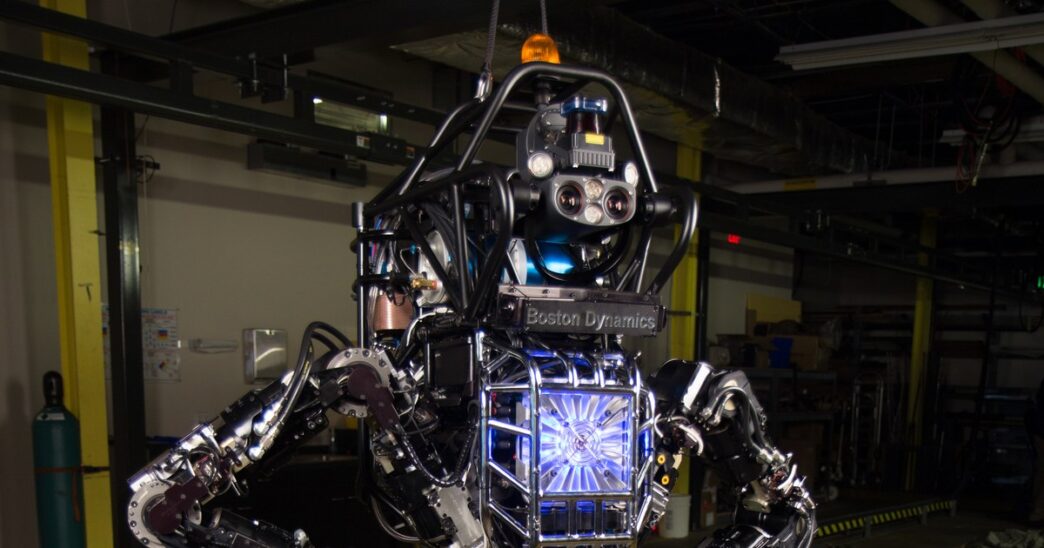
On April 16, 2024, Boston Dynamics retired arguably the most famous humanoid robot in the world. The hydraulic Atlas, the one that did parkour and backflips in viral videos, was done. The next day the company unveiled its replacement: a fully electric Atlas built for commercial work. No pumps, no hoses, no hydraulic fluid.
That switch sums up where humanoid robot actuators stand in 2026. Every joint in a humanoid is moved by an actuator: a motor or hydraulic cylinder, plus the gearing, sensors and electronics that turn power into controlled torque. Actuators decide how much a robot can lift, how fast it moves, how hot it runs, how safe it is around people and what it costs. Nearly the whole industry has now bet on electric. What’s left to argue about is which kind of electric joint, and that choice says a lot about what a robot is built to do.
Hydraulic vs electric: the trade-offs
| Hydraulic | Electric (motor + transmission) | |
|---|---|---|
| Power density | Very high; good for jumps, flips and heavy, dynamic loads | Lower per kilogram, but improving fast with high-torque-density motors |
| Supporting hardware | Pump, accumulator, valves, hoses, fluid cooling | Motor drivers, encoders, gearbox; battery feeds joints directly |
| Efficiency at rest | Pump and pressurised system draw power even when idle | Draws mainly what each joint needs; can hold some poses cheaply |
| Maintenance | Leaks, seals, fluid changes, contamination risk | Bearings, gear wear, connectors; usually cleaner |
| Noise | Pump noise is significant | Quieter; gear whine at speed |
| Control | Precise force control possible, but valve dynamics are complex | Current-based torque control; easier to model and mass-produce |
| Where used in 2026 | Mostly research and legacy platforms | Virtually every commercial humanoid program |
Why Atlas gave up hydraulics
The original DARPA Atlas, unveiled in July 2013, had 28 hydraulically actuated joints, an onboard hydraulic pump with thermal management, a 6-foot-2 frame and a weight of about 330 lb, according to DARPA. Later hydraulic versions became famous for parkour and backflips. That’s what hydraulic power density buys you.
When Boston Dynamics announced the electric Atlas in April 2024, it said the new version would be stronger, with a broader range of motion than any previous generation. The unstated part is easy to fill in: pumps, hoses and leaks fit poorly with factory deployment, scaled manufacturing and service contracts. Hyundai Motor Group has since said, in a September 2026 statement, that Hyundai Mobis supplies Atlas’s precision actuators. See our Atlas at Hyundai report for deployment timelines.
The main electric actuator types
Rotary actuator with high-ratio gearbox (strain-wave or planetary)
A brushless (often permanent-magnet synchronous) motor drives a strain-wave (harmonic) or multi-stage planetary gearbox. High ratios give high torque from a small motor and very low backlash. The trade-offs are poorer backdrivability, meaning the joint resists being pushed by an outside force, and gear teeth that take the impact loads. Common in arms, wrists and waists.
Quasi-direct-drive (QDD)
A large-diameter, high-torque motor with a low-ratio gearbox (often around 6:1 to 10:1). Popularised by legged-robot research such as the MIT Cheetah. It is backdrivable and impact-tolerant, and motor current is a good estimate of joint torque, which helps with balance and soft contact. It is less torque-dense than high-ratio designs, so it tends to run hotter under sustained heavy load.
Linear actuator (roller screw or ball screw)
A motor spins a planetary roller screw or ball screw that pushes a rod, often through a linkage, like a muscle across a joint. It handles high forces efficiently in knees, hips and ankles. At Tesla’s AI Day in 2022, Tesla described Optimus as using 28 structural actuators, half rotary and half linear, with the linear units built around planetary roller screws (that was a 2022 company presentation; Tesla hasn’t published Optimus’s current internals). Our Optimus status page tracks what is confirmed.
Series elastic and tendon-driven designs
Series elastic actuators put a spring between the motor and the load. This adds shock tolerance and lets the robot measure force from spring deflection. NASA’s Valkyrie humanoid is a well-known example. Tendon drives place motors closer to the body and pull cables to move distant joints, which keeps limbs light and compliant. 1X describes a tendon-driven design for NEO, a choice tied to its home-safety pitch. See 1X NEO status.
What the makers actually publish
Unitree is the outlier: it lists joint torque figures. Most Western makers publish payload and runtime but keep per-joint actuator specs to themselves. Here’s the October 2026 picture, all from company materials:
| Platform | Actuation | Published actuator detail |
|---|---|---|
| Unitree G1 | Electric, in-house joint motors | Low-inertia internal-rotor PMSM motors, hollow shaft, dual encoders, crossed-roller bearings; max knee torque about 90 N·m (G1) or 120 N·m (G1 EDU) |
| Unitree H1 | Electric | Peak knee torque about 360 N·m listed in Unitree H1 materials |
| Boston Dynamics Atlas (electric) | Electric | Per-joint torque tables not public; actuator supply from Hyundai Mobis (Hyundai statement) |
| Tesla Optimus | Electric, rotary + linear | 28 structural actuators in 2022 presentation; no current datasheet |
| 1X NEO | Electric, tendon-driven | Design approach published; per-joint torque not published |
| Agility Digit, Figure 03, Apptronik Apollo | Electric | Payload and runtime published; detailed per-joint actuator specs generally not public |
Prices and full specs are in Unitree prices and specs and humanoid robot prices 2026.
Actuators quietly decide runtime, safety and price
Start with heat. Electric joints derate when they hold heavy loads for long periods, so a peak torque figure says little about a full shift. Ask for continuous torque and the thermal limits behind it.
Energy follows from that. How efficient each actuator is, and how much power a joint needs just to hold a pose, drives battery life more than almost anything else; see humanoid battery and runtime limits. Safety is tied in too. Backdrivable, torque-sensing joints make it easier to limit contact forces near people, while high-ratio, stiff joints lean harder on software and sensing to do the same job (more in humanoid safety systems).
And then there’s cost. Actuators are among the largest items in a humanoid’s bill of materials. That’s why so many makers build their own joints, and why automotive suppliers like Hyundai Mobis are moving into the market.
Five actuator questions for any humanoid vendor
- Peak and continuous torque for hip, knee, shoulder and wrist joints, and at what temperature.
- Transmission type per joint (strain-wave, planetary, cycloidal, roller screw, tendon) and rated service life.
- Whether joints have torque sensing or only current-based estimation.
- Ingress protection (IP) rating of joints for dust, washdown or outdoor use.
- Joint replacement procedure, spare-part lead time and whether joints are field-swappable.
The thing to watch is whether anyone besides Unitree starts publishing continuous joint torque. As humanoids move from demo stages to shift work, that number, not the backflip, is what will separate a robot that lasts eight hours from one that cooks its knees by lunch.
Frequently asked questions
Are humanoid robots hydraulic or electric?
Almost all commercial humanoids in 2026 are electric. Hydraulics survive mainly in research and legacy machines. Boston Dynamics retired its hydraulic Atlas in April 2024 and replaced it with an electric Atlas.
Why did Boston Dynamics switch Atlas to electric?
Boston Dynamics framed the electric Atlas as built for real-world commercial applications and said it would be stronger, with a broader range of motion. Electric joints avoid pumps, hoses and fluid leaks, which matters for factory deployment and maintenance.
What is a quasi-direct-drive actuator?
A high-torque electric motor paired with a low-ratio gearbox. It is backdrivable and handles impacts well, and its motor current gives a good estimate of joint torque. That helps legged robots balance and touch objects gently.
How strong are humanoid robot joints?
It varies widely. Unitree lists about 90–120 N·m maximum knee torque for G1 and about 360 N·m for H1. Many Western makers do not publish per-joint torque, so ask for continuous torque under load, not just peak.
Sources
- DARPA, “DARPA’s ATLAS Robot Unveiled” (July 2013): darpa.mil (28 hydraulically actuated joints, onboard pump)
- Boston Dynamics, “An Electric New Era for Atlas” (April 2024): bostondynamics.com
- Unitree G1 product page and developer docs: unitree.com/g1 (joint motor, knee torque)
- Unitree H1 developer docs: support.unitree.com
- Hyundai Motor Group journal (Sep 30, 2026): Hyundai Mobis as Atlas actuator supplier [company]
- Tesla AI Day 2022 presentation (Optimus actuator architecture) [company]
Related: What is a humanoid robot? · Bipedal vs wheeled humanoids · Dexterous robot hands
Last updated: October 7, 2026. To report an error, see our corrections page. Articles are drafted with AI assistance and reviewed and edited by an editor; see our editorial policy.