NVIDIA Research has released NVIDIA Metatron, a single control policy that walks a Unitree G1 humanoid, steers it, picks it up off the floor after a fall, sits it on a sofa and lets a person physically guide it, all without swapping models between jobs. The weights went up on Hugging Face on October 27, 2026, alongside an arXiv paper, and the training and deployment code landed in NVIDIA’s open-source ProtoMotions library a day later. Anyone can download it. You still need your own G1.
The interesting part isn’t another walking demo. It’s the division of labor. Metatron is trained once and then frozen, and new behaviors are written as ordinary code that tells it what to aim for. NVIDIA says it used coding agents, including Claude Code and GPT-6 Astra, to write and refine some of that code. Here’s the catch: the robot in the videos is wired to a laptop with an RTX 5090, the hardest skills were only shown in simulation, and NVIDIA says plainly that the model is not a safety controller.
- What: a free, open-weight whole-body control policy for the Unitree G1 from NVIDIA Research, released October 27, 2026.
- Shown on a real G1: walking and steering, getting up after falls, sitting on a sofa, picking up an apple by VR teleoperation, and yielding to a person guiding it.
- Simulation only: hurdles, bowling, tennis and kicking a ball.
- The catch: it ran on a tethered RTX 5090 laptop, it is not a safety controller, and NVIDIA judged the hardware gait gains only by eye.
What NVIDIA Metatron actually is
Most humanoid demos use a stack of separate pieces: a walking controller, a motion tracker for copying human movement, maybe a separate recovery behavior. NVIDIA’s project page describes Metatron as a “promptable whole-body execution layer” instead. You give it a prompt, but not in words. A prompt here is a partial goal: put the right hand at this point in half a second, walk at this speed and heading, move in this style, or treat this box in the scene as the seat.
The policy fills in everything else for all 29 joints of the G1, 50 times a second. If you ask only for a hand position, it decides what the feet, hips and other arm should do to get there without falling over. That is the “whole-body” part, and it is why one checkpoint can cover walking, reaching and sitting.
The paper lists seven authors. Chen Tessler and Yifeng Jiang share first-author credit, and the team includes Xue Bin Peng and Gal Chechik of NVIDIA plus Alec Otto of Dollhouse Robotics. Unitree isn’t named as a partner; the G1 is simply the robot they used.
The coding-agent angle
Once training ends, NVIDIA doesn’t retrain Metatron for each new trick. A skill is a short C++ or Python program that watches the robot’s state and sends it goals. Because those programs are plain code, NVIDIA says coding agents could help write them. On hardware, the team used Claude Code to fit a compact rule for foot trajectories from motion-capture clips. For the simulated tasks, NVIDIA says GPT-6 Astra refined the goal-setting code, timing and motion references under human direction, with no task-specific policy training.
The project page is careful on one point that matters: at runtime, ordinary skill code supplies the goals, not a language model in the robot’s control loop, and a human decides whether a skill gets deployed. That is a much smaller claim than “an AI agent programs the robot,” and a more believable one. It sits close to what NVIDIA argued with its GR00T models: keep a general low-level body controller and change the layer above it.
What the real Unitree G1 did, and what stayed in simulation
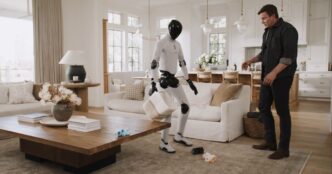
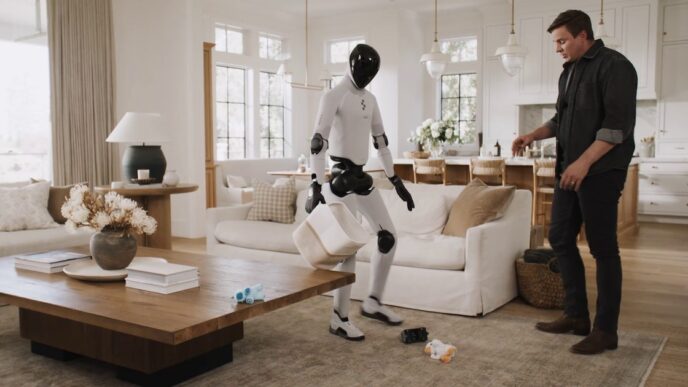
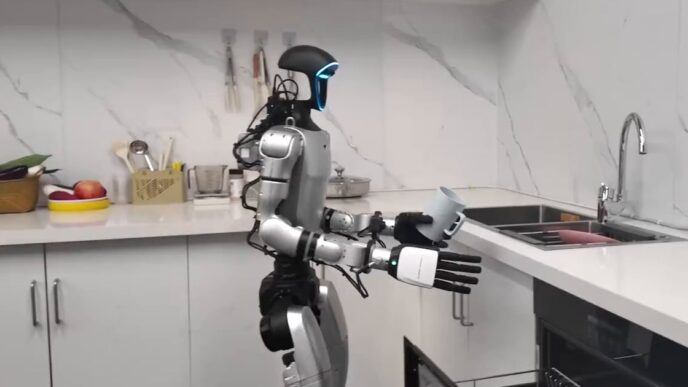
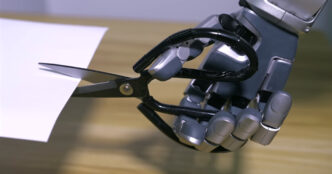
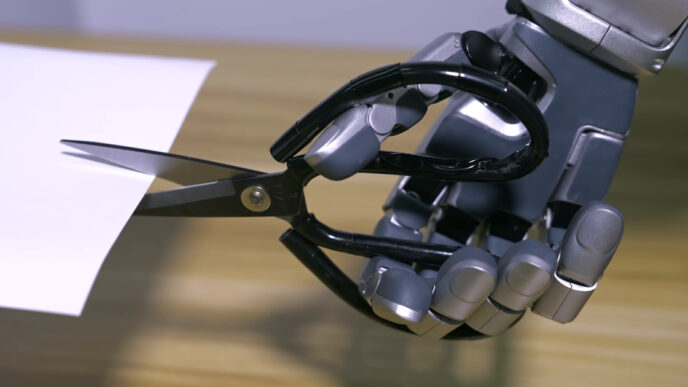
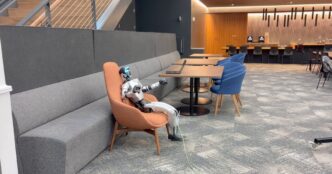
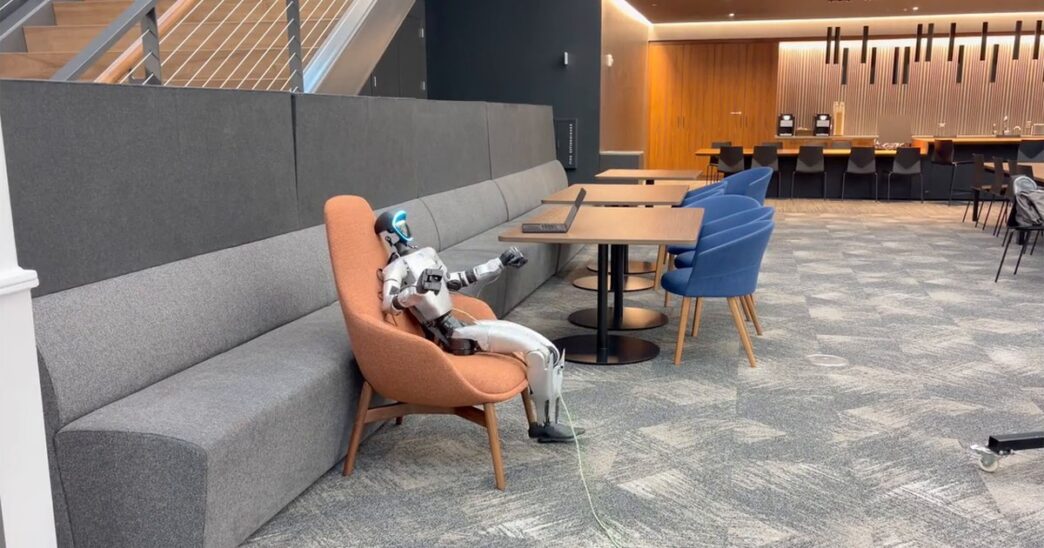
NVIDIA’s project page and its three-minute film show the same frozen checkpoint on a physical G1 in six modes: walking and turning, including backward, on commands from an Xbox controller; reaching and picking up an apple while an operator wears a PICO VR headset; turning and sitting down on a sofa or armchair, then standing up and walking away; getting back up after a fall, including from lying face down; yielding to a person who physically guides it; and tracking dense motion targets. The apple pickup is teleoperated, so it shows the body controller following a human’s hand motions, not the robot deciding to grab fruit.
The flashier clips are simulated. In MuJoCo, the policy clears four 20 cm hurdles set 5 m apart, knocks down nine of ten bowling pins, hits a tennis ball at 5.37 m/s and kicks a ball at 4.82 m/s. In one fall test it runs into a 40 cm bar at 3.83 m/s, goes down, and is running again 3.28 seconds later. NVIDIA says it kept these dynamic skills off the real robot to avoid damaging the G1 and its three-finger hands, which is sensible and also means none of them is a hardware result.
The sofa scene has a footnote of its own. The paper says the robot was placed near the furniture and given the nearby object as a cue. Walking across a room, finding a chair and sitting in it on its own was not shown.
The numbers NVIDIA published
NVIDIA compared Metatron with two pipelines built around SONIC, its own earlier motion-tracking controller, in simulation. On a reaching test with 54 targets, Metatron got the hand to 83% of them, against 39% and 28% for the two SONIC pipelines. In a push test during a 1 m/s walk, it stayed up in 75% of trials at both 800 N and 1,000 N, while both baselines fell every time at those forces. These are NVIDIA’s own tests, the Metatron used for them was trained without recovery data, and the paper notes that it does not pin down which design choice causes the gap.
For the real robot, the claims are softer. NVIDIA says the gait improvement on hardware was assessed qualitatively, and the paper’s limitations section says trials across starting and operating conditions would be needed to quantify recovery reliability and gait stability. Its success-rate tables come from simulation. The paper also flags a known failure: commanding 2 m/s abruptly from a standstill often makes the robot roll forward.
What you need to run it
The download is free. The model card lists a native G1 checkpoint of about 460 MB and two ONNX exports of about 403 MB each, one for a browser demo and one for a six-robot “G1 Racer” game. The weights are under the NVIDIA Open Model License, a separate license from the Apache-2.0 code in ProtoMotions, so read it before building a product on them. The training data and training checkpoint aren’t included.
On hardware, NVIDIA’s deployment ran a C++ stack with TensorRT on a laptop with an NVIDIA RTX 5090 GPU, connected to the robot by an Ethernet cable, with 1.3 ms from sensor reading to command. Training the G1 policy used 20 GPUs in Isaac Lab. If you just want to see it move, NVIDIA’s interactive demo runs the policy in a web browser, with WebGPU recommended.
The model card’s warning is blunt. Metatron is not a safety controller or a collision-avoidance system, and hardware use requires independent validation, joint and torque limits, supervised testing and an emergency stop. G1 owners should take that literally. A frozen research policy that can roll a robot forward on a bad speed command belongs in a cleared lab with a hand on the e-stop, not in a living room.
What to watch next
Two things would turn this from a strong research release into something G1 owners can lean on. The first is hardware numbers: fall-recovery success rates and gait measurements on the real robot, which the paper says it doesn’t have yet. The second is untethered running, with the policy on the robot’s own compute instead of a laptop on a cable. Also watch the ProtoMotions repository, where NVIDIA says the retargeted motion dataset it used for sitting will be released upon publication, and whether other labs start publishing skills written for the same frozen checkpoint.
Frequently asked questions
What is NVIDIA Metatron?
Metatron is a whole-body control policy for the Unitree G1 humanoid from NVIDIA Research. It takes partial goals, such as a hand target, a walking speed or a seat location, and works out the motion of all 29 joints. NVIDIA released the weights on October 27, 2026.
Is NVIDIA Metatron free and open source?
The weights are a free download from Hugging Face under the NVIDIA Open Model License, and the training and deployment code in ProtoMotions is Apache-2.0. The training dataset and the training checkpoint are not included, so you can run and adapt the released policy but not fully reproduce training from the download alone.
Does Metatron work on a real Unitree G1?
Yes, for some skills. NVIDIA’s video shows a physical G1 walking, recovering from falls, sitting on a sofa, picking up an apple by VR teleoperation and yielding to a person who guides it. Hurdles, bowling, tennis and kicking were shown only in simulation, and the hardware tests ran on a laptop tethered by Ethernet.
How did coding agents help build Metatron skills?
Skills are ordinary C++ or Python programs that send goals to the frozen policy. NVIDIA says it used Claude Code to fit a foot-trajectory rule from motion-capture clips, and GPT-6 Astra to refine goal-setting code for simulated tasks under human direction. No language model runs inside the robot’s control loop.
Is it safe to run Metatron on my own G1?
Not without precautions. NVIDIA’s model card says Metatron is not a safety controller or collision-avoidance system and that hardware use needs independent validation, joint and torque limits, supervised testing and an emergency stop. The paper also notes that an abrupt 2 m/s command can make the robot roll forward.
Sources
- NVIDIA Research: Metatron project page and project film
- Tessler, Jiang et al., “Metatron,” arXiv:2610.38027, submitted October 27, 2026
- Hugging Face: nvidia/Metatron-v1 model card (files, license and safety notes)
- ProtoMotions documentation: pretrained models
- NVlabs/ProtoMotions on GitHub (Apache-2.0), Metatron release commit October 28, 2026
- NVIDIA: Metatron interactive browser demo
All sources accessed November 2, 2026.
Last updated: November 2, 2026. To report an error, see our corrections page. Articles are drafted with AI assistance and reviewed and edited by an editor; see our editorial policy.