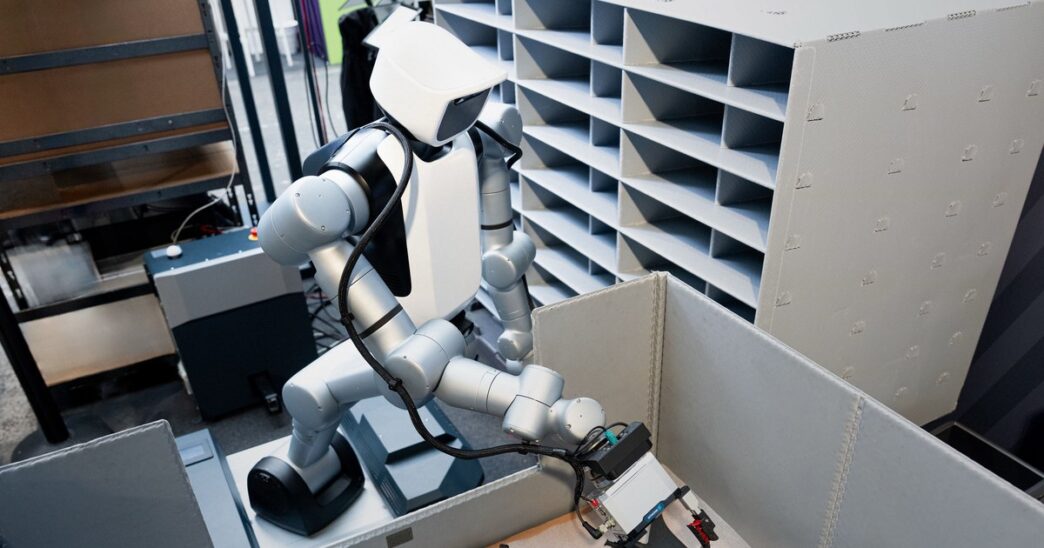
Audi is testing whether humanoid robots can handle one of the most stubborn jobs in car-factory logistics: picking mixed parts out of bins and lining them up in the exact order the assembly line needs them. Agile Robots, Audi, Dassault Systèmes and NVIDIA announced the Audi humanoid robot proof of concept at NVIDIA GTC Berlin on October 21, 2026, with dual-arm mobile humanoids from Munich-based Agile Robots picking parts in Audi’s Production Lab for its Ingolstadt plant.
The announcement is heavy on ambition and light on numbers. Audi says its sequencing operation handles around one million picks a day, but the companies have not said how many robots are involved, how fast they pick, or when, if ever, they will work on a live production line.
- What: a proof of concept in which Agile Robots’ mobile humanoids pick parts from containers and place them in sequence for Audi’s final assembly.
- Where: Audi’s Production Lab, its test space for future production and logistics technology, for the Ingolstadt plant. Audi says the project is “already underway.”
- The twist: the robot’s task is first modeled in a Dassault Systèmes DELMIA virtual twin built with NVIDIA Omniverse libraries, before physical testing.
- Not disclosed: robot count, model name, pick rate, success rate, timeline to the production line and cost.
What the Audi humanoid robot test is
The joint release, published by both Audi and Agile Robots, calls the project a proof of concept to automate parts sequencing at Audi’s Ingolstadt plant using mobile humanoids. Sequencing is the step in demand-driven material supply where parts are pulled from storage and arranged so that the right part reaches the right workstation in the right order. Audi says around one million picks a day go into that process.
The testing is happening in the Production Lab, which Audi describes as its innovation space for testing future production and logistics technologies. In the release’s words, “mobile humanoids from Agile Robots are picking parts from material containers and placing them in the correct sequence for final assembly of Audi premium vehicles.” Audi’s supply chain experts supply the sequencing know-how and define the operational requirements for testing the use case “under real-world conditions.”
That wording matters. This is a lab proof of concept, not a deployment on the Ingolstadt line, and the release does not say how many of the million daily picks the robots are expected to take over. The parts in Audi’s own press photo, long black interior trim pieces in a lined container, give a sense of the kind of semi-rigid, awkward components involved.
Why parts sequencing is hard to automate
Gerd Walker, Audi’s board member for production and logistics, framed the problem directly: “For decades, picking within the sequencing process has remained one of the toughest automation challenges in automotive logistics.” The release names two reasons. One is handling high-variant or semi-rigid parts. The other is reliably picking unsorted components from containers, where parts sit in mixed positions and packaging rather than neatly fixtured.
Agile Robots says its robots are designed to address both. According to the companies, dual-arm manipulation lets the robots handle large and flexible parts, and AI-powered perception lets them identify, grasp and manipulate a wide variety of components “even when stored in mixed containers or presented in varying positions and packaging.” Those are company claims; no pick-success figures have been published to back them up.
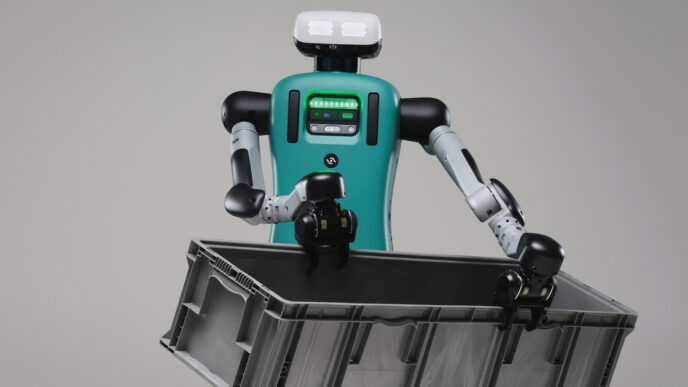
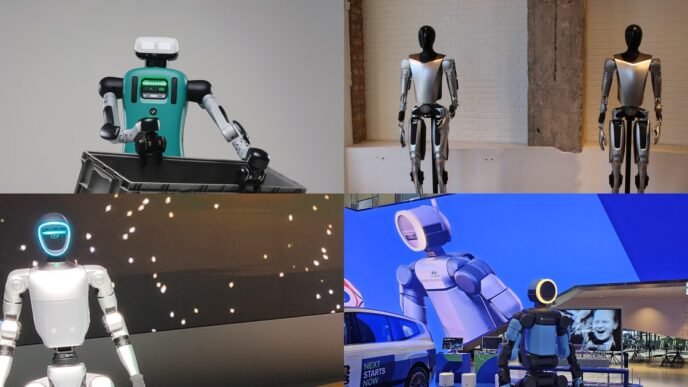
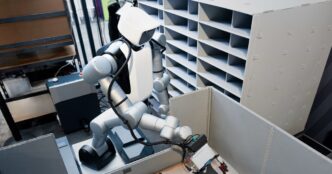
The robots themselves are described only in general terms. The release calls them “newly developed mobile humanoid robots” that combine humanoid reach and dexterity with the robustness of a mobile base and work at human height, so they “slot into Audi’s existing environment.” Audi’s photo shows a white-and-silver robot with two long arms reaching into a parts container. Agile Robots also markets a full-size Agile ONE humanoid for industrial work, but the Audi release does not name the model being tested.
The virtual twin comes first
The part of the project the companies explained in the most detail happens before a robot touches a real part. A virtual twin of Audi’s logistics environment is being built in Dassault Systèmes’ DELMIA application on the 3DEXPERIENCE platform, using Dassault’s Industry World Models and NVIDIA Omniverse libraries. Feasibility, timings, ergonomics and safety for the robot’s task are tested there first.
An Agile Robots blog post published the same day describes what that looks like. The virtual workcell is assembled from 2D and 3D layouts, product data, CAD, scans, images or video, and the robot model adds the humanoid’s dimensions, joints and movement limits. Engineers then check questions such as:
- Can the robot reach the component from its intended position?
- Does the gripper have enough space?
- Can the humanoid approach the rack without interfering with nearby equipment?
The company says the simulation also gives “an initial indication of cycle time” and shows which steps influence it most. Scaled up, the model adds more stations, more humanoids, autonomous mobile robots and material flows, so teams can look for waiting times and bottlenecks, for example when a robot finishes its pick correctly but an autonomous mobile robot arrives late. Agile Robots says the humanoid uses AI-based control policies to respond to variations, and the post notes that a single rack placed “a few centimetres away from its actual location” can change the robot’s approach, which is why model accuracy matters. The setup uses NVIDIA Omniverse libraries and OpenUSD for physics, visualization and data exchange.
Dassault Systèmes makes the boldest claim here. The release says that “in the future,” LEO, its AI-powered virtual companion, will assist engineers and accelerate the process “from months to days.” Philippe Laufer, executive vice president of 3DS Global Brands, said the breakthrough is being able to “engineer and validate” a humanoid’s role “before they ever enter it physically.” LEO is not yet part of the work, and no before-and-after timing has been published.
Who Agile Robots is
Agile Robots was founded in Munich in 2018 by robotics researchers from the German Aerospace Center (DLR). In the Audi release, the company says it employs more than 3,500 people from almost 60 nations, has installed more than 20,000 robot solutions worldwide and has filed more than 650 patents. Its subsidiaries include BÄR Automation, Franka Robotics, idealworks and Krause Automation. Those figures are the company’s own and cover its whole robotics business, most of which is not humanoids.
The Audi project was one of two Agile Robots humanoid announcements at GTC Berlin. The same day, the company launched Agile ONE SN, a compact research humanoid built with NVIDIA, which is not due until early 2027. CEO Zhaopeng Chen said of the Audi work: “Working with Audi we show how our mobile humanoids can perform high-value, critical tasks that were previously impossible to automate.”
What Audi and Agile Robots have not disclosed
For a project pitched as solving “a previously unsolvable problem,” the public record is thin on results. Here is what the companies have not said:
- How many robots are being tested, or how many Audi might eventually need.
- Which robot: no model name, payload, speed, battery life or safety rating.
- Performance: no pick rate, success rate or cycle time from either the virtual twin or the physical tests.
- Timeline: no date for moving from the Production Lab to the Ingolstadt line, and no commitment to do so.
- Money: no contract value, price or investment figure.
The release does say the work aims at “paving the way for high-volume series production,” and NVIDIA’s Deepu Talla said it tackles the workflow “with minimal changes to existing operations.” Both are statements of intent. On our readiness scale it sits just short of Level 4, pilot: a named customer is involved and real robots are handling real parts, but in a test lab rather than a working plant, with no published metrics.
What to watch next
The useful signals will be numbers: a pick rate or success rate from the Production Lab, a robot count, or a named model with a spec sheet. A move from the lab to a real sequencing area in Ingolstadt would be the clearest sign the proof of concept worked. Also watch for LEO, Dassault’s virtual companion, to show up in the workflow with a measured time saving, and for Agile Robots to say whether the robot Audi is testing is the full-size Agile ONE or something new.
Frequently asked questions
What is Audi testing with Agile Robots?
A proof of concept in which Agile Robots’ dual-arm mobile humanoids pick parts from material containers and place them in the correct sequence for final assembly. The work takes place in Audi’s Production Lab, its test space for future production and logistics technology, and targets the sequencing process at the Ingolstadt plant.
Are the humanoid robots working on Audi’s production line?
Not according to the announcement. The October 21, 2026 release describes a proof of concept in the Production Lab that is already underway. It gives no date for moving the robots to the Ingolstadt assembly line and does not commit to doing so.
How many picks does Audi’s sequencing process involve?
Audi says around one million picks a day ensure that the right parts reach the right workstation in the right order. That figure describes Audi’s whole sequencing operation, not the share the humanoid robots are handling or expected to handle.
What do Dassault Systemes and NVIDIA contribute?
Dassault Systemes provides the DELMIA virtual twin on its 3DEXPERIENCE platform, where the robot’s reach, timing, ergonomics and safety are tested before physical trials. NVIDIA contributes Omniverse physical AI libraries and OpenUSD for physics simulation, visualization and data exchange inside that twin.
Which humanoid robot model is Audi using?
The companies have not said. The release describes newly developed mobile humanoids that combine two arms and humanoid reach with a mobile base and work at human height. Agile Robots also sells a full-size Agile ONE humanoid for industry, but it has not confirmed that this is the robot in the Audi test.
Sources
- Audi, “Agile Robots and Audi to transform automotive logistics with mobile humanoids, supported by Dassault Systèmes and NVIDIA” (media release, Berlin, October 21, 2026): audi.com
- Agile Robots, same release (October 21, 2026): agile-robots.com
- Agile Robots blog, “From Simulation to Physical Validation: What DELMIA Reveals Before Deployment” (October 21, 2026): agile-robots.com
- Agile Robots SE, “Virtual Twin in Dassault Systèmes’ DELMIA for Parts Sequencing with Audi” (YouTube, October 22, 2026): youtube.com
- Robotica Guide, “NVIDIA’s New Reference Humanoid Has a Spec Sheet, Not a Price” (Agile ONE SN and Agile ONE background): roboticaguide.com/
All sources accessed November 1, 2026.
Last updated: November 1, 2026. To report an error, see our corrections page. Articles are drafted with AI assistance and reviewed and edited by an editor; see our editorial policy.