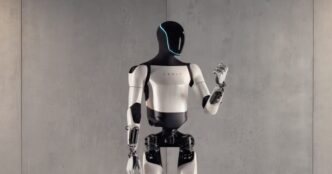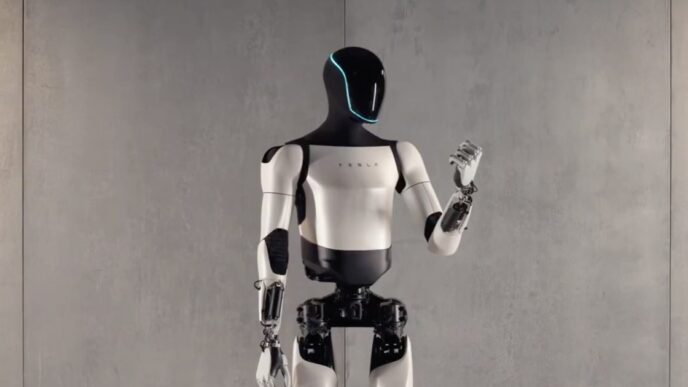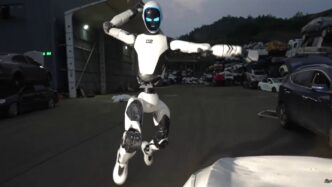
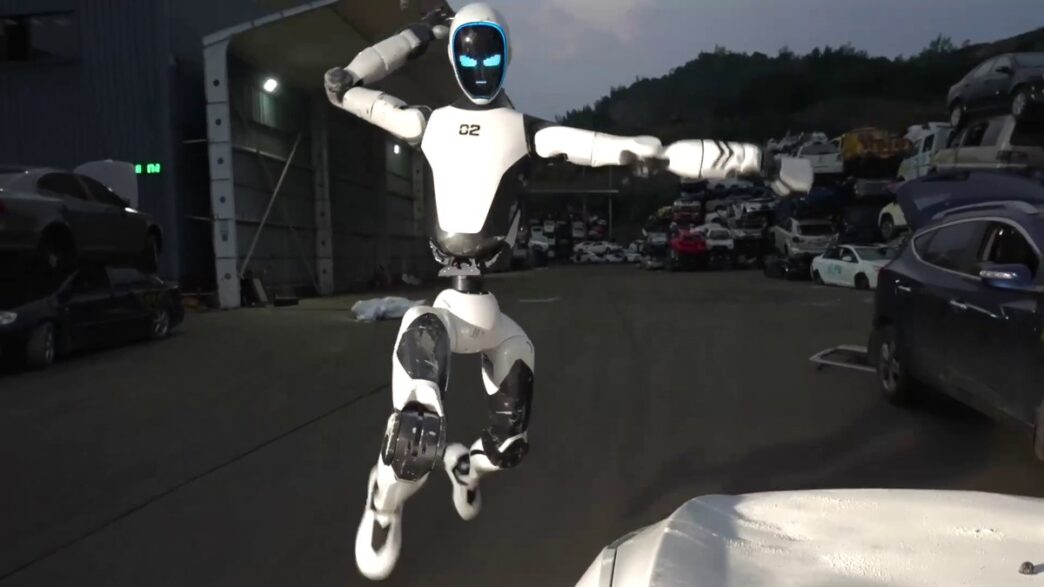
Unitree’s newest humanoid leaps over a sedan, drops off a four-meter container, steps between a woman and a man holding a knife, and lifts the front of a car off a trapped figure. The 61-second video introducing the H2-X “Kung Fu Legend Guardian”, posted on October 21, had passed 8.4 million impressions on X by Friday morning.
The fine print is in the video itself. The “approximately 8 hours” of endurance Unitree advertises is labeled on screen as standing time. The rescue scenes carry a caption saying the people in them are props. And Unitree hasn’t published a product page, a price, a spec sheet or a word on whether a person was steering the robot. A day later, at its first partner conference in Hangzhou, founder Wang Xingxing put the spotlight somewhere else: on software that he says will let robots teach themselves.
- What it is: a full-size Unitree humanoid shown in an October 21, 2026, promo video doing kung fu, “guard” and rescue scenes.
- Price and release: not announced. There’s no H2-X page on unitree.com. The standard H2 lists at $29,900 before tax and shipping.
- The 8 hours: the video’s caption says “Standing for Approximately 8 Hours.” Unitree lists the standard H2’s battery life as about 3 hours.
- What’s staged: rescue scenes are captioned “Real Footage of Props for Reference Only.” Unitree says the footage isn’t sped up, but hasn’t said whether the robot acted autonomously, was remote-controlled or ran preset moves.
What the Unitree H2-X video shows
The clip opens with a caption reading “Real Footage Throughout No Speed-Up.” The H2-X, white with a dark visor and glowing blue eyes, leaps over a car in a scrapyard at dusk and kicks a car door hard enough to dent it. It jumps from the roof of a red shipping container labeled as a “4 Meter High Platform,” lands, and goes straight into a run of punches and kicks.
The second half turns to the “Guardian” idea. A hooded man with a knife walks toward a woman at a patio table, and the robot moves between them. In daylight, it braces against a car and lifts its front end off a figure lying underneath. At night, it shoves a figure out of the path of a moving car and gets knocked over. Those rescue shots carry the caption “Real Footage of Props for Reference Only,” meaning the “victims” are stand-ins.
The video ends on a card of warnings. Unitree asks users not to make “dangerous modifications,” to keep people and robots “a safe distance of at least 2–3 meters or more” apart, and adds: “Extreme testing. No imitation!” and “Features vary by models and versions.” The last line is unusually frank for a product launch: the humanoid field “is in the early stages of exploration worldwide,” and buyers should “thoroughly understand the limitations of humanoid robots before making a purchase.”
A robot that has to stay two to three meters from people is an awkward fit for a bodyguard, and nothing in the clip shows the H2-X spotting a threat on its own. Our guide to reading robot demos explains why the control method matters more than the stunt.
The 8-hour battery is standing time
Unitree’s X post and YouTube description both say the H2-X has “a maximum endurance of approximately 8 hours.” The caption on screen is more specific: “Ultra Long Endurance, Standing for Approximately 8 Hours.” Standing still draws far less power than leaping, fighting or lifting a car, so the figure says little about how long the robot would last doing any of the things in the video.
For comparison, Unitree’s H2 product page lists the standard H2 at $29,900, 1.82 meters tall, about 70 kg with battery, 31 degrees of freedom and a battery life of “about 3h,” without saying what activity that covers. Press reports describe the H2-X as an H2 variant. Unitree hasn’t said so, and it hasn’t published height, weight, battery size or a price for the H2-X. A request for unitree.com/H2-X returns a 404 page. Our Unitree price and spec guide covers what the listed models cost.
In Hangzhou, Wang talked about robots that train themselves
On October 22, Unitree held what it called the 2026 World Physical AI Conference and Unitree Partner Ecosystem Conference in Hangzhou, its first partner conference in ten years, according to 36Kr. The H2-X was on display. Wang’s talk was about software.
He unveiled a project the South China Morning Post reported as “Unitree Rehearsal,” and called it the company’s most important initiative of the year. As described, AI agents would search research papers, write robot-control code, test it in simulation, try it on physical robots and feed the results back to an evaluation system, so the loop runs with less hand programming. 36Kr reported the system’s name as “Physical AI Robot Self-Evolution V1.” Unitree hasn’t published a paper, a demo or any success rates, so for now it’s a plan.
Wang also gave his timeline again. He said physical AI could see a major breakthrough within one to two years “if everything goes well,” or two to three otherwise, according to 36Kr. At an industry fair in Shanghai earlier this month, he put embodied AI’s tipping point at one to two years. He said he hopes Unitree robots can enter ordinary homes by the end of this year or next and handle chores like tidying a room by voice command.
A $10 million competition and a G1 production range
Unitree’s website now has a page for a World Physical AI Competition with “Annual Funding $10M,” open to teams and individuals worldwide. The asterisk matters: the final amount is “determined annually based on award results; not fixed.” It lists eight categories (locomotion, athletics, combat, dexterity, production, sports, human-robot interaction and healthcare), and the rules are still “to be announced.” Unitree also launched a “Unitree Creation Program” to recruit startups building robot parts, AI models, data tools and applications, 36Kr reported.
The one hard number from the stage was a loose one. Wang said the G1 has been produced in a cumulative total of 10,000 to 20,000 units, per 36Kr. That’s a production range, not sales. Unitree reportedly said in July that it had produced about 18,000 bipedal humanoids across all models; our breakdown of humanoid production numbers explains why produced, shipped and sold are three different figures.
What to watch
An H2-X product page with a price, a battery figure measured while walking or working, and a plain statement of how the stunts were controlled. Rules and prize amounts for the $10 million competition. And any published result from Unitree’s self-training loop, since that’s the part Wang says matters most.
Frequently asked questions
What is the Unitree H2-X?
The H2-X “Kung Fu Legend Guardian” is a full-size Unitree humanoid introduced in a promotional video on October 21, 2026. The video shows it doing kung fu moves, jumping from a four-meter platform and acting out guard and rescue scenes. Unitree hasn’t published a product page or full specs.
How much does the Unitree H2-X cost?
Unitree hasn’t announced a price or release date. The standard H2 is listed at $29,900, excluding tax and shipping, on Unitree’s website.
Does the H2-X really last 8 hours?
Unitree says its maximum endurance is approximately 8 hours, and the video labels that as standing time. Unitree hasn’t published battery life for walking, lifting or other work. It lists the standard H2’s battery life as about 3 hours.
Is the H2-X video real or staged?
Unitree’s caption says the footage is real and not sped up, but the rescue scenes are labeled as using props, and the scenarios are staged. Unitree hasn’t said whether the robot acted autonomously, was remote-controlled or ran pre-programmed moves.
What is Unitree Rehearsal?
Unitree Rehearsal is a self-improving robot software project Wang Xingxing unveiled on October 22, 2026, according to the South China Morning Post. AI would search research papers, write code, test it in simulation and then on real robots, and use the results to improve. Unitree hasn’t published results.
Sources
- Unitree on YouTube, “Unitree Introducing: H2-X Kung Fu Legend Guardian,” October 21, 2026 (on-screen captions: “Real Footage Throughout No Speed-Up,” “4 Meter High Platform,” “Standing for Approximately 8 Hours,” “Real Footage of Props for Reference Only,” closing safety card): youtube.com
- Unitree on X, H2-X post, October 21, 2026 (“maximum endurance of approximately 8 hours”; 8.4 million impressions on October 23): x.com/UnitreeRobotics
- Unitree, H2 product page (price $29,900, 1820 mm, about 70 kg, 31 DoF, battery life about 3h): unitree.com/H2
- Unitree, World Physical AI Competition page (“Annual Funding $10M,” not fixed, eight categories, rules to be announced): unitree.com
- South China Morning Post, “Unitree developing AI system to let humanoid robots improve themselves,” Minxiao Chang, October 22, 2026: scmp.com
- 36Kr, “Wang Xingxing from Unitree: Physical AI will achieve breakthroughs in the next two to three years,” Qiu Xiaofen, October 23, 2026 (conference, Self-Evolution V1, G1 production range, home-robot goal, Creation Program): eu.36kr.com
- 36Kr / Tencent Technology, “Unitree H2-X is here,” Zhou Xiaoyan, October 22, 2026: eu.36kr.com
All sources accessed October 23, 2026, between about 7:30 and 7:50 AM ET.
Related: More Humanoid Robots coverage · Robot companies directory
Last updated: October 23, 2026. To report an error, see our corrections page. Articles are drafted with AI assistance and reviewed and edited by an editor; see our editorial policy.