Unitree has turned the software behind its robot dance troupes into a free desktop app. On October 16, 2026, the Hangzhou company introduced UniUni on X as an “Intelligent Swarm Control System” for “rapid, intelligent choreography of swarm robot movements and formations, real-time device status monitoring, safety braking, and more.” The UniUni download page lists Unitree’s H2 and G1 humanoids as the supported robots, with free builds for Windows (v1.1.14, x64) and macOS (v1.1.15, Apple Silicon).
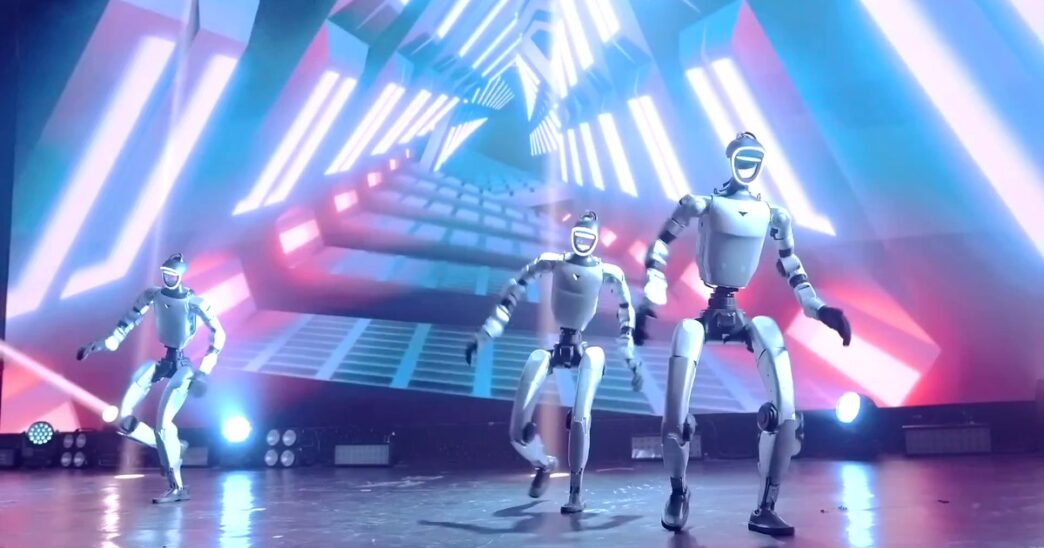
That matters because group performances are where Unitree’s humanoids get most of their public attention. Unitree says the same toolset it used for showcase performances is now “open to all Unitree users,” and it comes with an AI feature that drafts formations from typed instructions.
What Unitree UniUni does, according to Unitree
The product page describes four modules. Everything below is Unitree’s description of its own software; we have not run the app on robots.
- Choreography. Operators draw each robot’s path as a Bezier curve in a 2D view, check the formation in a 3D view (built with Three.js and the robots’ URDF models), and drag motions onto a timeline that calls the robots’ motion API. There are three playback modes: music accompaniment, dance debugging and loop execution. A letter-formation feature turns typed characters into formations, which the page says can run continuously and collision-free with “百机” in the Chinese copy, rendered as “hundreds of robots” on the English version of the page.
- Mapping and localization. A five-step flow takes a lidar point cloud, builds and manages maps, localizes robots in 3D, converts coordinates and runs a positioning test. Operators can lay out N×M grids with set spacing and offsets, and the software checks for collisions automatically. The page headline promises “centimeter-level” positioning.
- Motion store. A community library of motions that installs, uninstalls and syncs through the cloud, linked to Unitree’s existing UniStore.
- AI choreography. The app generates trajectories and picks matching motions from a user’s instructions, then drops the sequence onto the timeline for manual fine-tuning.
Setup is meant to be simple. Users sign in with a Unitree account, the app scans the local network for Unitree robots, and the operator moves each robot to its starting mark, initializes localization and syncs the map, trajectories and tasks to the group before starting the show.
What the launch video shows
Unitree’s 50-second launch video, marked “Real Footage Throughout, No Speed Up,” plays as a short drama. A stage team gets last-minute changes before a show, edits paths on a laptop and adds robots to the routine. One sequence shows a typed request asking for a synchronized routine with no collisions between any two robots, after which the app reports “Added 24 blocks” and offers buttons to apply the result to the timeline, regenerate it or discard it. Another shows a monitoring panel with per-robot temperature readings and E-Stop buttons, and a staged moment where a robot’s critical battery triggers an emergency stop.
The closing card is worth reading. Unitree asks customers to keep people and robots at least two to three meters apart, labels the footage “Extreme testing. No imitation!” and notes that “features vary by models and versions.” It is a reminder that these are full-size machines running pre-planned routines, not robots improvising around people. Our explainer on humanoid robot safety systems covers why stop functions and separation distance matter.
From Spring Festival stage to customer laptops
Unitree says UniUni has already run real performances: the CCTV Spring Festival Gala, a show at Beijing’s China Central Radio and TV Tower, a China–US ping-pong diplomacy event and the Hong Kong Sevens rugby tournament. We have not independently confirmed which of those shows used this exact software build.
The audience is clear enough: venues, schools, exhibitors and resellers that already own several H2 or G1 units and want them to perform together. For prices and specs on those robots, see our Unitree G1, R1 and H2 price guide and our look at the G1 Plus versus the original G1. Choreographed dance is also a different skill from autonomy; our guide to teleoperation versus autonomy in humanoid demos explains how to read performances like these.
What Unitree has not said
Several basics are missing from the launch materials. Unitree does not publish a maximum fleet size beyond the “百机” (“hundreds of robots” in the English copy) line for letter formations, the network setup a large show needs, measured positioning accuracy behind the “centimeter-level” claim, or which AI model drafts choreography from text. The page names only H2 and G1, so support for the R1 or Unitree’s quadrupeds is unconfirmed. The app is free, but the materials say nothing about whether motion-store content will carry a price.
What to watch: whether customers post multi-robot shows built in UniUni rather than by Unitree’s own team, whether Unitree publishes fleet-size and network requirements, and whether more robot models appear on the supported list.
Frequently asked questions
What is Unitree UniUni?
UniUni is Unitree’s desktop “intelligent swarm control system,” announced October 16, 2026. It lets operators plan paths, formations and timed motions for groups of Unitree humanoid robots, monitor their status during a show and trigger emergency stops.
Is UniUni free, and what computers does it run on?
Yes. Unitree’s page offers a free download for Windows (v1.1.14, x64) and macOS (v1.1.15, Apple Silicon). Users sign in with a Unitree account, and the app finds Unitree robots on the local network.
Which robots does UniUni support?
The product page lists Unitree’s H2 and G1 humanoids. Unitree has not said whether the R1 or its quadruped robots are supported, and its video notes that features vary by model and version.
Can UniUni create a dance from a text prompt?
Unitree says its AI choreography module generates trajectories and matching motions from user instructions, then places them on the timeline for manual adjustment. The company has not said which AI model powers the feature, and we have not tested it.
How many robots can UniUni control at once?
Unitree has not published a hard limit. Its page says letter formations can run continuously and collision-free with “百机” in Chinese, or “hundreds of robots” in its English copy, but it gives no network or hardware requirements for a fleet that size.
Sources
- Unitree Robotics on X, “Unitree Introducing: UniUni Intelligent Swarm Control System,” October 16, 2026, 4:45 a.m. ET, with 50-second launch video: x.com/UnitreeRobotics
- Unitree, UniUni product and download page (modules, supported robots H2 and G1, Windows v1.1.14 and macOS v1.1.15, showcase events): uniuni.unitree.com
- Pandaily, “Unitree Releases UniUni Swarm Control Software, Free for Its Users, Starting With H2 and G1,” October 17, 2026: pandaily.com
All sources accessed October 18–19, 2026.
Related: Unitree G1, R1 and H2 prices · Unitree G1 Plus vs G1 · Humanoid robot safety systems · Teleoperation vs autonomy · More Robot Companies coverage
Last updated: October 19, 2026. To report an error, see our corrections page. Articles are drafted with AI assistance and reviewed and edited by an editor; see our editorial policy.