Unitree founder and CTO Wang Xingxing says his team has put OpenAI’s GPT-6 on its robots and liked what it saw. Speaking on stage at the opening of the 26th China International Industry Fair (CIIF) in Shanghai on Monday, October 12, he said embodied AI’s technical tipping point could arrive within one or two years “if things go fast,” and that a GPT-7 next year might “punch straight through” the problem.
That’s a shorter clock than the one he gave in August. It’s also a set of remarks from a panel, reported by Chinese financial press, not a Unitree product announcement. Unitree hasn’t published a transcript, test results or a description of what GPT-6 actually did on its machines, and the outlet that reported the panel in most detail framed his timeline as a judgment about model progress, not a date for selling anything. Here’s what he said, what changed since August, and what’s still missing.
What Wang said on stage
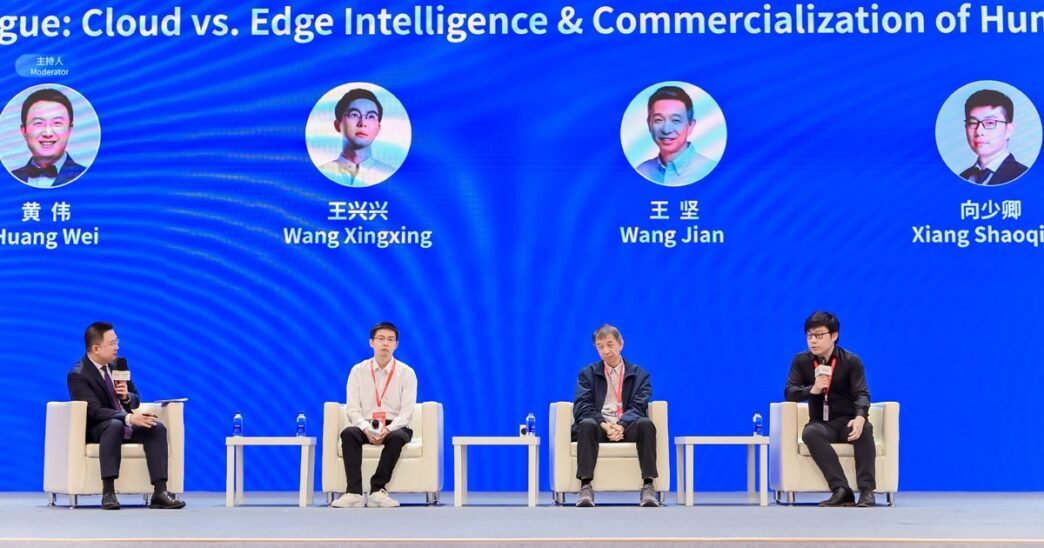
Wang shared the stage with Wang Jian, the director of Zhejiang Lab and an academician of the Chinese Academy of Engineering, and Sharpa co-founder Xiang Shaoqing, in a dialogue the CIIF backdrop titled “Cloud vs. Edge Intelligence & Commercialization of Humanoid Robots.” The quotes below come from two reports: Jiemian (republished by Sina Finance) and the Shanghai Securities Journal (republished by 10jqka). Translations are ours.
| Topic | What Wang said, as reported | What it is |
|---|---|---|
| His biggest mistake | “The biggest mistake I’ve made over the past ten-plus years is not believing in AI enough.” (both outlets) | Opinion |
| GPT-6 on Unitree robots | “We put it on all kinds of robots to test all kinds of tasks, and the results were actually very good” (Shanghai Securities Journal). Jiemian’s version: results were “pretty good” | Company claim, no data published |
| Tipping point | Could come within one or two years at the earliest (both outlets) | Forecast |
| GPT-7 | If GPT-7 comes out next year, it could “punch straight through the embodied-intelligence problem” (both outlets) | Speculation about a model OpenAI hasn’t announced |
| Factories | Unitree and other robot companies have pilots in factories; scaling up needs better generalization and efficiency (both outlets) | Pilots, not mass deployment |
| Where robots go first | Some commercial-service settings may move faster than industry; homes demand more and may come later (Jiemian; the Shanghai Securities Journal quotes the service-before-industry part) | Opinion |
He also said AI is making big leaps “every one or two months,” and that the GPT-6 release did a lot to change how people in embodied AI think about what’s possible.
From “two to three years” to “one or two”
Wang has a specific yardstick for the “ChatGPT moment” in robotics. The Shanghai Securities Journal recapped it: the turning point arrives when a robot can complete 80% of tasks in 80% of unfamiliar settings from voice commands alone. At the World Robot Conference in August, the paper reported, he put that “two to three years away if fast, five or ten years if slow.” On Monday the fast case became “within a year or two.”
That’s a real shift in tone from one of China’s best-known robot makers, and it lines up with how fast the foundation models have moved since the summer. But two caveats matter. First, the earlier window had a slow case, and Monday’s reports don’t say whether he dropped it. Second, Jiemian wrote that his one-to-two-year view is “a judgment based on model progress, not a definite commercialization milestone.” Nobody should read it as a Unitree ship date.
What “GPT-6 on our robots” does and doesn’t tell you
OpenAI introduced its first GPT-6 models, GPT-6 Sol and GPT-6 Luna, in September, and on October 7 began rolling GPT-6 out across ChatGPT (our GPT-6 explainer covers the split). Neither reported account says which GPT-6 model Unitree used, which robots, which tasks, how many trials, or what “very good” was measured against. We found no Unitree or OpenAI statement describing the tests.
The missing detail matters because a large language model on its own doesn’t move motors. In most robot stacks, a model like GPT-6 would sit at the top, turning a spoken request into a plan, while lower-level controllers and a robot-specific model handle balance, joints and grasping. Unitree has its own model for that layer: the 6-billion-parameter UnifoLM-WLA-1.0, which it open-sourced without publishing success rates, as far as we could find. Our explainer on robot foundation models walks through how those layers fit together. Until Unitree shows which layer GPT-6 replaced or helped, “it worked well” is an impression, not a result.
The GPT-7 line deserves even more caution. OpenAI hasn’t announced GPT-7 or given it a date, as far as we could find, so Wang was guessing about the capabilities of a model nobody outside OpenAI has seen.
Why robots still aren’t in factories at scale
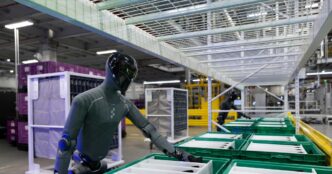
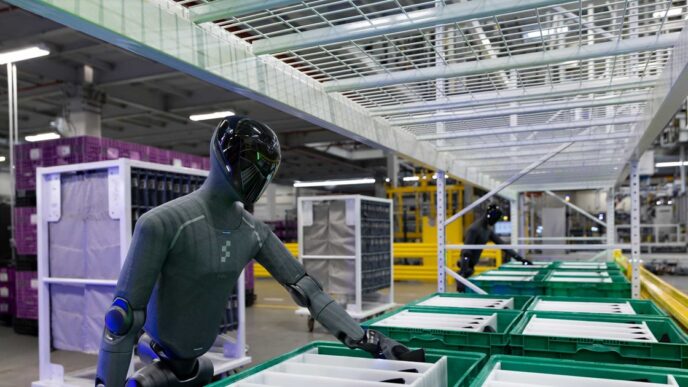
The more grounded half of Wang’s remarks was about what’s in the way. Jiemian reported him saying robots entering factories “isn’t starting from zero”: Unitree ran pilot projects with several carmakers as early as 2024. Turning one-off trials into large-scale use, he said, still needs robots that generalize better to new situations and work faster.
Industry numbers back up the caution. In its September 29 report, the research firm IDC said global humanoid shipments reached nearly 25,000 units in the first half of 2026, up 432.1% year over year, with more than 19,000 in China. But research and education, performances and exhibitions, and government data-collection centers still made up 69% of shipments. Factories, retail and logistics are growing, but they aren’t yet where most humanoids go. (Our guide to teleoperation versus autonomy explains how to tell a pilot from a polished demo.)
Wang also suggested the order of arrival may surprise people: some business-facing service jobs could move faster than factory work, and homes, which demand the most adaptability, may come later.
Cloud or onboard? Unitree splits it
The panel’s stated subject was where a robot’s computing should live. Wang explained Unitree’s approach, according to Jiemian: space, battery power and heat make it impossible to put lots of high-end compute in every robot, so real-time work such as motion control stays on the robot, while complex decisions and adapting to unfamiliar settings lean on the cloud where possible. Onboard compute can be configured to the customer’s needs. If future models get small enough to run on the robot itself, he said, that would be the better option.
Xiang Shaoqing said he expects much of the heavy computing to stay in the cloud for the next three to five years, with actions executed on the device, and that growing robot fleets will eventually push more work back onto local hardware because of cloud load and bandwidth. Wang Jian argued it isn’t an either-or choice, pointing to smartphones, which use both.
The last few millimeters still need real robots
On training data, Wang said first-person video of humans doing tasks is useful, but the final few millimeters of contact and manipulation still have to be tuned with data from real robots, which is why Unitree focuses on testing feedback from real environments. Wang Jian made a pointed appeal for factories to share their data: “All of industry’s data is still locked in everyone’s drawer today.” Wang Xingxing’s reply was that AI needs all kinds of data, but companies have confidentiality obligations, and using industrial data without leaking trade secrets is still unsolved. (More on that problem in our guide to humanoid robot training data.)
He also called robot-model development “primitive”: engineers read papers, write models, train them and hand them to testers, then repeat, with people bridging most steps. He wants AI to take over more of the coding, training and test loop, but said human evaluation is still needed to judge whether a robot’s movements are appropriate and whether it actually succeeded.
Sharpa’s 30,000-robot plan, and a six-minute ice cream
Xiang told the audience that Sharpa plans to deploy 30,000 robots across restaurants, retail and hotels, according to Jiemian. That’s a stated plan. Sharpa’s robot restaurant with DQ in Shanghai opened on August 28, and Jiemian’s own reporter had earlier watched a robot there take about six minutes to make an ice cream, compared with two to three minutes for a practiced employee. Sharpa co-founder Li Yifan told Jiemian at the time that the setup wasn’t profitable yet, that a full installation was still priced in the hundreds of thousands of yuan, and that the long-term goal was around 100,000 yuan.
What would make this more than a talk
Wang has the credibility of a founder who ships: Unitree’s G1, R1 and H2 have public list prices (see our Unitree price guide). What would turn Monday’s optimism into news is evidence: a video or paper showing what GPT-6 did on a Unitree robot, success rates against Wang’s own 80/80 yardstick, or a factory customer moving from pilot to fleet. Until then, treat the one-to-two-year line as a founder’s read on how fast AI is moving, not a forecast you can plan a purchase around.
Frequently asked questions
What did Wang Xingxing say about GPT-6?
At the CIIF opening in Shanghai on October 12, 2026, the Unitree founder said his team had put GPT-6 on various robots for task tests and that the results were “very good,” according to the Shanghai Securities Journal (Jiemian reported “pretty good”). He didn’t share which GPT-6 model, which tasks or any success rates.
Is Unitree using GPT-6 in its products?
Not that we know of. Wang described tests. Neither Unitree nor OpenAI has announced a product that uses GPT-6, and Unitree’s own open robot model is UnifoLM-WLA-1.0.
When does Wang think embodied AI will reach its tipping point?
Within one or two years at the earliest, he said on October 12. At the World Robot Conference in August he had said two to three years in a fast scenario and five to ten years in a slow one. His yardstick is a robot completing 80% of tasks in 80% of unfamiliar settings from voice commands alone.
Did Wang say GPT-7 will solve robotics?
He said that if GPT-7 arrives next year it might “punch straight through” embodied AI’s problems. That’s speculation: OpenAI hasn’t announced GPT-7 or a release date, as far as we could find.
Why aren’t humanoid robots in factories at scale yet?
Wang said robots still need better generalization and efficiency. IDC said 69% of humanoids shipped in the first half of 2026 went to research and education, exhibitions and government data-collection centers, not factories, retail or logistics.
Sources
All accessed October 12, 2026.
- Xu Meihui, “王兴兴对AI更乐观了,机器人为何还没大规模进厂?” (Wang Xingxing is more optimistic about AI. Why haven’t robots entered factories at scale?), Jiemian, October 12, 2026: jiemian.com; republished by Sina Finance: finance.sina.com.cn
- Shanghai Securities Journal / cnstock.com, “王兴兴:明年GPT-7可能’直接把具身智能问题打穿'” (Wang Xingxing: GPT-7 next year may “punch straight through” embodied AI), October 12, 2026, republished by 10jqka: news.10jqka.com.cn
- The Yangtzeer, “Unitree founder says underestimating AI was his biggest mistake,” October 12, 2026 (English summary, used for cross-checking only): yangtzeer.com
- IDC, global humanoid robot tracker summary (Chinese), September 29, 2026: idc.com
- OpenAI, “GPT-6 and Intelligent UI for everyone,” October 7, 2026: openai.com
Related: Unitree open-sourced its 6B humanoid model · Unitree G1, R1 and H2 prices and specs · What is a vision-language-action model?
Last updated: October 12, 2026. To report an error, see our corrections page. Articles are drafted with AI assistance and reviewed and edited by an editor; see our editorial policy.