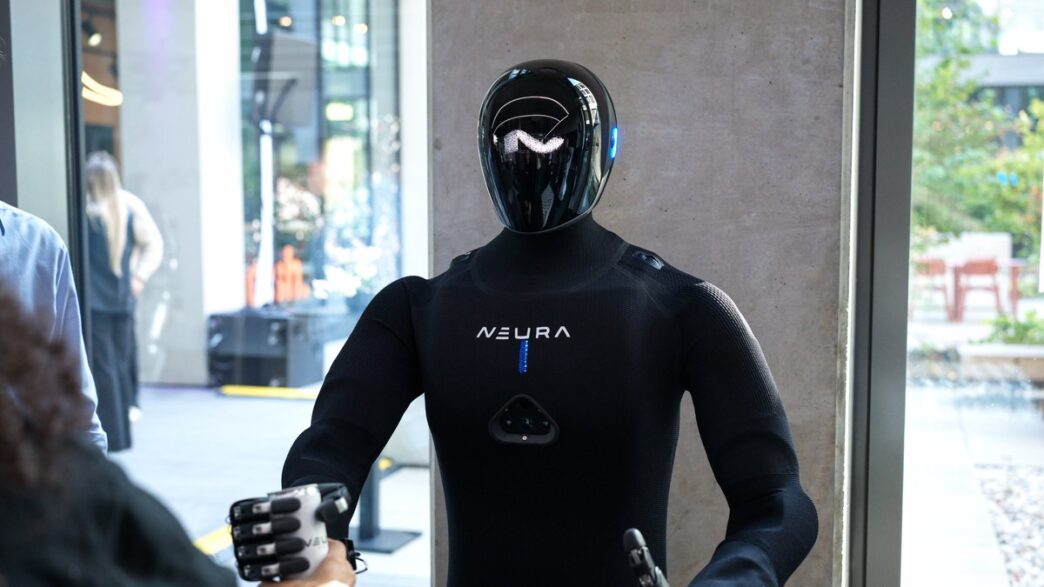
NEURA Robotics showed off a new humanoid on Thursday, and the first thing you notice is that it’s wearing clothes. 4NE1 Gen 4, unveiled on October 22 at the opening of a robot training center near Munich Airport, is wrapped in a black textile skin. The German company says it’s 20 percent lighter than the previous generation and “designed for serial production.”
The robot arrived alongside the thing NEURA really wants to talk about: the TUM RoboGym, a 2,300-square-meter center it built with the Technical University of Munich where companies pay to teach robots their jobs and the robots generate training data for NEURA’s AI. That pairing is the story. NEURA is betting that whoever collects the most real-world robot data wins, and Gen 4 is the body it wants doing the collecting. What it hasn’t published yet is a Gen 4 spec sheet, a price or a delivery date.
- Price: not announced. NEURA’s 4NE1 page offers a contact form, not a price or order page.
- Status: unveiled October 22, 2026; NEURA says it is “being prepared for series production” and already working at the TUM RoboGym and NEURA’s own gyms. No delivery date.
- What’s new: a slimmer body with a textile skin, 20 percent less weight than the last generation, better hands, reflexes built into each limb, and NEURA’s Neuron AI model running on board (all company claims).
- The catch: the only 4NE1 datasheet NEURA links is dated June 5, 2026 (80 kg, 180 cm), so there’s no published Gen 4 weight, height or payload yet.
What NEURA changed in 4NE1 Gen 4
NEURA lists four changes, all in its own words and without numbers beyond the weight cut. The body is slimmer and covered in fabric, which the company says makes the robot “appear more approachable” and leaves room for “simple customization.” The hands are “advanced” and grip more accurately. A feature NEURA calls Smart Limbs builds reflexes into each limb, so a limb “can respond independently.” And the robot runs Neuron AI, the perception-language-action model NEURA launched on October 14, which mixes vision with touch, force, sound and the robot’s own state. The 4NE1 product page adds that this all “runs locally on the robot.”
NEURA’s example of why touch matters is a modest, factory-floor one: a robot that can tell whether a fastener has clicked into place. That’s a more honest pitch than most humanoid launches, and it lines up with what the RoboGym is set up to teach.
The numbers are where the launch gets thin. NEURA’s product page now leads with Gen 4, but the spec block underneath and the “Download Datasheet” link still point to a datasheet marked V7, dated June 5, 2026: 180 cm tall, 80 kg, 55 degrees of freedom, 12 per hand, 20 kg arm payload and 5 km/h. If those June figures describe the generation Gen 4 replaces, a 20 percent cut would land somewhere around 64 kg. That’s our arithmetic, not a NEURA number, and NEURA hasn’t said which figures carry over. The same page still invites reservations for a smaller 4NE1 Mini to be delivered “in Spring 2026,” a date that has already passed.
Coming today. Stay tuned! pic.twitter.com/d9GeludiT4
— NEURA Robotics (@NEURARobotics) October 22, 2026
Video: NEURA Robotics. A 15-second teaser of 4NE1 Gen 4 posted by the official NEURA Robotics account on X on the morning of the launch (watch on X). It’s a styled reveal, not a task demonstration.
A gym where companies teach robots their jobs
The TUM RoboGym sits in the TUM Convergence Center at LabCampus, next to Munich Airport. TUM says it starts with about 100 humanoid and service robots in 48 training cells, with one or two robots per cell, according to the university’s Q&A on the center. The robots practice tasks like folding boxes, assembling components, using tools and stocking shelves. TUM’s photos from the opening show a humanoid sorting defective parts into a bin and 4NE1 learning to fold a box.
NEURA says partners have been training workflows there since September, from “more than ten industries” including automotive, pharmaceuticals, packaging, logistics, agriculture and care, and that capacity “is already in strong demand.” It hasn’t named any of those companies.
The money is modest by humanoid standards. The two partners say they’re investing about €17 million over an initial three years, with NEURA putting in roughly €11 million. NEURA supplies the robots, computing, infrastructure and operating staff; TUM’s robotics institute, MIRMI, supplies the space and the researchers. For comparison, NEURA announced a Series C of “up to $1.4 billion” in June, as logged in our robotics funding tracker.
Why the data matters more than the fabric
Language models learned from the internet. Robots don’t have an internet of physical experience to learn from, which is why TUM’s release spends most of its length on data. The RoboGym collects it three ways, per NEURA: sensor logs from robots doing the tasks, human demonstrations captured with sensor suits, motion capture and teleoperation, and simulation that adds variations before skills are checked on real robots. The data flows into what TUM calls a curated cloud “data lake” for training physical AI models.
That’s the same race other companies are running. AgiBot is putting robots into universities, and NVIDIA this week pitched a shared reference humanoid to labs. NEURA’s twist is that customers bring their own tasks and process knowledge, and NEURA says skills learned by one robot can be shared with others through its Neuraverse platform. CEO David Reger frames it as a way for Germany’s mid-sized manufacturers, the Mittelstand, to put generations of shop-floor know-how into machines, and says companies should “decide for themselves” where and under what conditions they share it. NEURA hasn’t published who owns the data a customer generates in the gym, or the terms for sharing a trained skill.
Two caveats are worth keeping in mind. Teleoperation is one of the RoboGym’s data sources, so a robot seen doing a task there may be learning from a person, not working on its own; our guide to teleoperated demos explains why that matters. And “already in operation” at a training center is a pilot setting. On our readiness scale, Gen 4 is an announced product in training environments, not a robot shipping to customers.
What happened to the laundry demo
NEURA had promised that its humanoid would run an 11-minute laundry sequence on its own at NVIDIA’s GTC Berlin from October 20 to 22: sort clothes, load a washer, close and reopen it, unload it and move the load to a dryer. NEURA streamed from GTC on its YouTube channel on October 21, and it says Gen 4 also appeared at GTC, where Jensen Huang signed the robot. As of Friday morning, though, NEURA hadn’t published a run report, a full uncut video or an intervention count for the laundry demo, the numbers that would show whether the sequence really ran without help.
What to watch
A Gen 4 datasheet comes first: weight, height, payload, battery life, and whether the 55 degrees of freedom and 20 kg payload carried over. After that, a price and a delivery date for “series production.” NEURA says more gyms are coming in Europe, the US and China, starting with one being built with RWTH Aachen. The first named RoboGym customer that moves a trained skill into its own factory would be the clearest sign that this is more than a showroom.
Frequently asked questions
What is 4NE1 Gen 4?
4NE1 Gen 4 is the fourth generation of NEURA Robotics’ humanoid robot, unveiled on October 22, 2026, at the opening of the TUM RoboGym near Munich. NEURA says it is 20 percent lighter than the previous generation, has a slimmer body with a black textile skin, improved hands and reflexes built into each limb, and runs NEURA’s Neuron AI model.
How much does 4NE1 Gen 4 cost?
NEURA hasn’t published a price. Its 4NE1 page offers a contact form and a reservation inquiry, not a price list or an order page.
When can you buy 4NE1 Gen 4?
NEURA hasn’t given a date. It says Gen 4 is being prepared for series production and is already working at the TUM RoboGym and NEURA’s gyms, where companies can train tasks with it.
How much does 4NE1 Gen 4 weigh?
NEURA hasn’t published a Gen 4 weight. It says Gen 4 is 20 percent lighter than the previous generation. The only datasheet linked from its site is dated June 5, 2026, and lists 80 kg and 180 cm.
What is the TUM RoboGym?
The TUM RoboGym is a robot training and research center run by the Technical University of Munich’s MIRMI institute and NEURA Robotics at LabCampus near Munich Airport. It opened on October 22, 2026, with 48 training cells and about 100 robots, and the partners are investing about €17 million over three years.
Sources
- NEURA Robotics, “A Powerhouse for Physical AI: NEURA Robotics and TUM Open RoboGym in Munich,” October 22, 2026 (Gen 4 changes, series production, €17 million / €11 million, partners since September, more than ten industries, three data sources, gym network, Reger quotes): neura-robotics.com
- Technical University of Munich, “Making robots smarter: New TUM RoboGym robotics center opens in collaboration with NEURA,” October 22, 2026 (about 100 robots, 48 cells, data lake, tasks): tum.de
- TUM MIRMI, “Q&A on the TUM RoboGym (powered by NEURA),” October 22, 2026 (one to two robots per cell, access, location): mirmi.tum.de
- NEURA Robotics, 4NE1 product page (Gen 4 copy, runs locally, 4NE1 Mini “Spring 2026” reservation text): neura-robotics.com
- NEURA Robotics, 4NE1 datasheet V7, June 5, 2026 (80 kg, 180 cm, 55 DoF, 20 kg arm payload, 5 km/h): neurarobotics.px.media (PDF)
- NEURA Robotics on X, 4NE1 Gen 4 launch post (GTC Berlin appearance, Jensen Huang signature, Lugano), October 22, 2026: x.com/NEURARobotics
- NEURA Robotics on X, 4NE1 Gen 4 teaser video, October 22, 2026: x.com/NEURARobotics
- NEURA Robotics, “NEURA Robotics Introduces Neuron AI,” October 14, 2026 (GTC Berlin laundry demo plan): neura-robotics.com
All sources accessed October 23, 2026, between about 7:00 and 7:45 AM ET.
Related: More Robot Companies coverage · Robot companies directory
Last updated: October 23, 2026. To report an error, see our corrections page. Articles are drafted with AI assistance and reviewed and edited by an editor; see our editorial policy.