Volvo’s first humanoid robots are two Hexagon AEON units now training at Volvo Car Gent, the carmaker’s plant in Ghent, Belgium. Volvo Cars announced the program on November 26, 2026. Its own engineers are teaching the wheeled robots to place components into two fixtures with high precision, working with Hexagon’s Robotics division. More robots are due for a factory pilot in the first half of 2027, and Volvo says it wants them in real production from mid-2027.
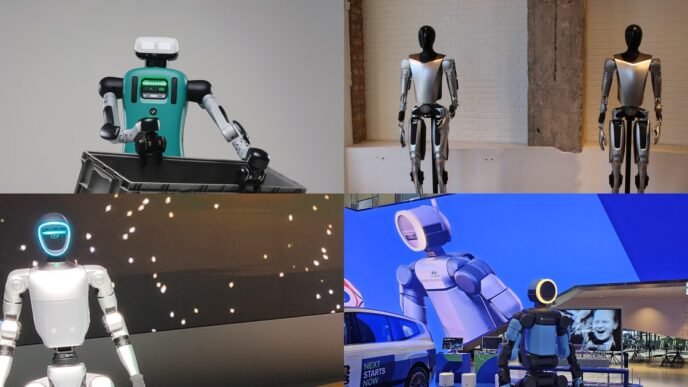
That makes Volvo the latest carmaker to bring humanoids into a plant, after BMW, Mercedes-Benz, Hyundai and Xiaomi. The announcement is careful about what it claims. We set it against Hexagon’s own spec sheet and Hexagon’s earlier deployment promises, and put it in a table with the other automaker humanoid programs we have covered.
- What: Volvo Cars is training Hexagon Robotics’ AEON humanoids at its Ghent plant with imitation learning. The first task is placing parts into two fixtures.
- How many: two robots for now, a Volvo spokesperson told Belgian broadcaster VRT. More arrive for a pilot in the first half of 2027.
- When it counts: Volvo’s aim is real production use from mid-2027.
- The catch: this is training before a pilot. No success rate, cycle time, robot count for 2027 or price has been published, and Hexagon has moved its own “in production” dates before.
What Volvo and Hexagon announced
Volvo’s release says Ghent is the first Volvo plant to try humanoid robots. The robots are “currently learning alongside employees and existing automation,” trained by Volvo’s own team with Hexagon. The method is imitation learning, where the robot learns a task by copying how a person does it. Once the first fixture-loading task is proven, Volvo plans to make the work harder step by step: several parts at once, moving around the production area, and working with the plant’s automated systems. Hexagon Robotics posted the same news the same day, with a quote from its president, Arnaud Robert: “The purpose of humanoid robotics is to deliver business value to our customers.”
Neither release gives a number of robots. VRT NWS reported that two AEON robots are being trained and tested in Ghent, and quoted Volvo spokesperson Barbara Blomme saying the goal is not to replace staff but to make production more efficient and hand some ergonomically difficult tasks to the robots. VRT also reported that Volvo wants to add humanoids gradually if the project succeeds. TechSpot noted that Volvo hasn’t disclosed how many robots will join the line or what that means for the people doing those jobs now.
Volvo’s case for the human shape is specific. Its release says fixed robot arms are excellent at stable, repetitive work in one place, but some ergonomically hard tasks need more flexibility than a bolted-down arm offers. Chief manufacturing officer Magnus Nilsson put it this way: “AEON’s humanoid design means it can fit into our production as it is today, alongside our teams and existing automation.” In other words, the bet is that a humanoid can use stations built for people without the plant being rebuilt around it.
AEON’s specs: Volvo’s numbers against Hexagon’s
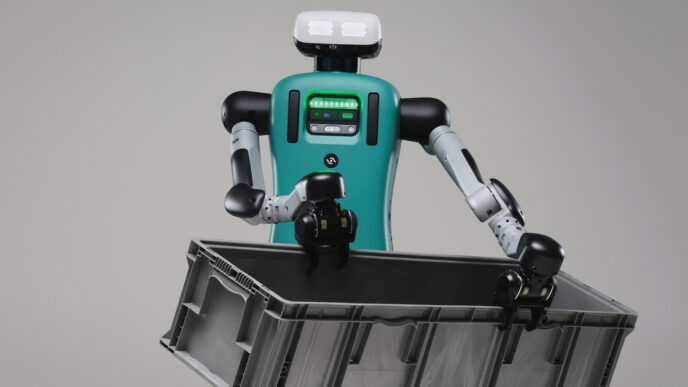
Volvo describes AEON as 1.65 m tall and 60 kg, moving on wheels instead of feet at up to 2.4 m/s, “about the pace of a light jog,” and able to carry 10 kg. Hexagon’s AEON product page matches the height, weight and speed. It adds 34 degrees of freedom, about 5 hours of work per charge and a self-swap mechanism that changes batteries in about a minute, which Hexagon says “basically means 24/7 operations.”
The payload is where the two documents differ. Hexagon lists 15 kg short-term and 8 kg constant carry. Volvo’s 10 kg sits between the two, and Volvo doesn’t say which case it means. That isn’t an error so much as a reminder that payload depends on how long and how far a load is held. For fixture loading, the figure that matters will be the continuous one, and Hexagon puts that at 8 kg. AEON’s legs end in wheels rather than feet, so it is closer to the wheeled humanoids we compared in our bipedal vs wheeled explainer than to a walking robot like Atlas.
What Volvo’s video and photo show
Volvo Car Gent’s 54-second video, posted on the plant’s YouTube channel on November 26, shows AEON rolling through the plant, handling a pressed metal part at a fixture, with captions such as “New task. Ready to learn.” and “One Workflow today. Scaling up tomorrow.” It is a produced company clip, not a timed run: it doesn’t show a full cycle, a cycle count or a failure.
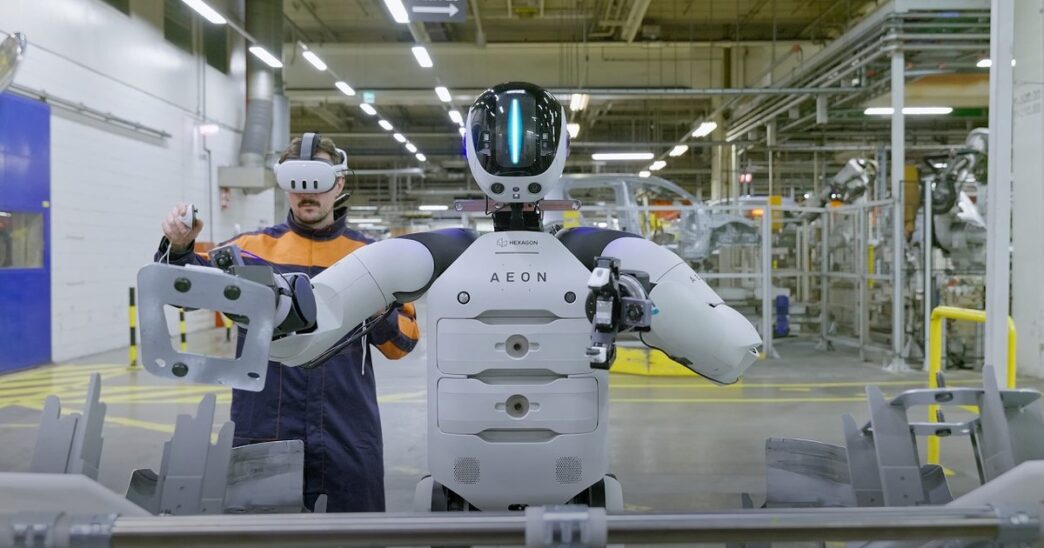
The video’s cover image, which Hexagon also used on its news page, is more telling. It shows a worker in a VR headset holding hand controllers, standing behind an AEON that grips a part over a row of fixtures. Volvo doesn’t describe how its demonstrations are recorded, but this is what teleoperated data collection usually looks like: a person moves the robot’s arms remotely, and those recordings become the examples an imitation-learning policy copies. That’s a normal way to train robots, as we explain in our guide to teleoperation vs autonomy in humanoid demos. It also means the photo shows training, not autonomous work, and buyers should read it that way.
Hexagon’s deployment dates keep moving
Hexagon has been here before, and its own releases let us track how its timeline has shifted:
- June 17, 2025: at AEON’s launch, Robert said: “over the next six months we’ll be deploying AEON in production environments before expanding our commercial rollout.” Schaeffler and Pilatus were named as pilot partners.
- June 2026: Hexagon said AEON had begun “performing production tasks within BMW Group Plant Leipzig” while still being trained, and that it “will be deployed in production by the end of 2026.”
- October 15, 2026: Schaeffler described training AEON at its Humanoid Gym in Erlangen on representative production scenarios “before they reach the factory floor.”
- November 26, 2026: Volvo: training now, pilot in the first half of 2027, production from mid-2027.
Pilatus, the Swiss aircraft maker, is testing AEON in its production hangars on a first job: checking that workers have fitted the right component in the right place on an assembly such as a PC-24 side wall. Its head of structure assembly, Benjamin Mettler, was frank: the system “still needs a lot of work before it’s ready for use,” and there is a long way to go. Read together, AEON is in training or early production tasks at several big industrial names. But the 2025 promise of production work within six months turned into first production tasks at BMW in June 2026, a full production deployment target at BMW for the end of 2026, and a mid-2027 target at Volvo.
How Volvo’s program compares with other carmakers
We built this table from the companies’ own statements and our earlier reporting. Every one of these programs is company-described; none has published an independent audit of uptime or human interventions.
| Carmaker and robot | Site | Stage, as the companies describe it | Published numbers | Next stated date |
|---|---|---|---|---|
| Volvo Cars: Hexagon AEON | Ghent, Belgium | Training on a fixture-loading task | 2 robots (VRT); no success rate | Pilot H1 2027; production from mid-2027 |
| BMW: Hexagon AEON | Leipzig, Germany | Production tasks while training (June 2026) | No robot count or rate published | “Deployed in production by the end of 2026” |
| BMW: Figure 03 | Spartanburg, US | Logistics workflow demonstration, June 30, 2026 | Figure says Figure 02 contributed to 30,000 cars | None published |
| Mercedes-Benz: Apptronik Apollo 2 | Kecskemét and Sindelfingen | Kitting proof of concept | 96% success rate (Google DeepMind claim) | None published |
| Hyundai: Boston Dynamics Atlas | Application center, Georgia | Training since September 21, 2026 | Plan for 25,000 units “over the next few years” | Work at the Metaplant from 2028 |
| Xiaomi: own humanoid | Xiaomi’s car factory, China | Trial at a trim-sorting station | 8 h 5 min run, two charging breaks | None published |
Sources for the other rows: our reports on the Mercedes-Benz kitting pilot, Hyundai’s Atlas plan, Figure 03 at BMW and Xiaomi’s 8-hour shift, each linked to the companies’ own posts. Two patterns stand out. Most of these programs start by moving and placing parts, through sequencing, kitting or loading fixtures, rather than complex assembly. And the disclosure gap is wide: Google DeepMind (for the Mercedes-Benz pilot) and Xiaomi published a number, while Volvo and BMW have published dates.
Our take: a sensible start, judged by 2027
We like how modest this announcement is. Volvo calls the current phase training, names a single first task, gives a pilot window and doesn’t claim autonomy or a success rate it can’t show yet. On our readiness scale, Ghent is not yet a Level 4 pilot by Volvo’s own description; the pilot is what starts in the first half of 2027. That’s honest, and more useful than a polished demo.
The weak point is evidence, not ambition. Hexagon’s own dates have slipped since launch, and BMW’s end-of-2026 deadline is five weeks away; the newest public word on Leipzig we found is an August 7 Hexagon post about a newspaper feature, with no numbers. Two robots learning one fixture task is a long way from a production line, and the hard parts Volvo lists for later, mobility around the plant and handing off to automated systems, are where most humanoid pilots stall. What would change our view: a cycle time and success rate for the fixture task, the number of robots in the 2027 pilot, how often a person has to step in, and whether BMW confirms AEON in production at Leipzig by year-end. Safety rules are another open question. Workplace safety for mobile humanoids working next to people is still being worked out; in the US, NIOSH is only now asking for public input on it.
We’ll add Hexagon Robotics and AEON to our robot companies directory and update this page when Volvo or Hexagon publish pilot numbers.
Frequently asked questions
Does Volvo use humanoid robots?
Yes, in training. Volvo Cars announced on November 26, 2026 that Hexagon Robotics’ AEON humanoids are being trained and validated at its Ghent plant in Belgium, its first plant to try humanoids. A factory pilot is planned for the first half of 2027 and production use from mid-2027.
Which humanoid robot is Volvo using?
Volvo is using AEON, made by the Robotics division of Swedish technology group Hexagon. AEON is 1.65 m tall, weighs 60 kg and moves on wheels at up to 2.4 m/s, according to Volvo and Hexagon.
How many humanoid robots does Volvo have?
Two AEON robots are being trained in Ghent, a Volvo spokesperson told Belgian broadcaster VRT. Volvo says more units will arrive for the 2027 pilot but didn’t give a number.
How much can the AEON robot carry?
Volvo says AEON can carry 10 kg. Hexagon’s spec sheet lists 15 kg short-term and 8 kg for constant carrying.
Sources
- Volvo Cars: “Volvo Cars trains Hexagon Robotics’ humanoids for manufacturing” (November 26, 2026)
- Hexagon Robotics: “Volvo Cars trains Hexagon Robotics’ humanoids for manufacturing” (November 26, 2026)
- Volvo Car Gent on YouTube: “Volvo Cars trains Hexagon Robotics’ humanoids for manufacturing” (November 26, 2026)
- VRT NWS: Volvo humanoid robots in Ghent (November 26, 2026, in Dutch)
- TechSpot: “Volvo workers are teaching humanoid robots to do their jobs” (November 27, 2026)
- Hexagon Robotics: AEON product page and spec sheet (accessed November 27, 2026)
- Hexagon Robotics: “Hexagon launches AEON, a humanoid built for industry” (June 17, 2025)
- Hexagon Robotics: “New milestone with BMW Group: industrial humanoid deployment” (June 2026)
- Hexagon Robotics: Schaeffler Humanoid Gym (October 15, 2026)
- Pilatus Aircraft: “Pure Innovation: Pilatus Tests a Humanoid Robot”
All sources accessed November 27, 2026.
Last updated: November 27, 2026. To report an error, see our corrections page. See our editorial policy.