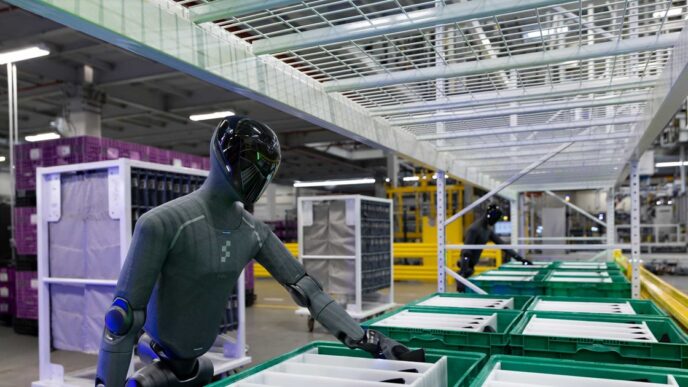
NEURA Robotics introduced Neuron AI on October 14: a multimodal foundation model that folds 3D vision, touch, force, audio, robot state and language into one Perception-Language-Action stack, with memory so a robot can keep track of objects that leave the camera frame. The Metzingen, Germany company says the same model runs across five of its robot embodiments, and that its 4NE1 humanoid will run an eleven-minute laundry sequence with Neuron AI at NVIDIA GTC Berlin from October 20 to 22.
That is a company model launch with a dated demo on the calendar, not a customer deployment report. Here is what NEURA published, how it positions Neuron AI against vision-only VLAs, and what still has to be shown on the show floor.
What NEURA says Neuron AI does
NEURA’s pitch is that camera-only models stop at the surface. Opening a lock, feeling whether a screw has caught, or hearing a connector click are contact and sound events a flat image does not carry. Neuron AI encodes those extra senses with robot state and language in one shared space over time, then turns them into a single action stream. NEURA calls the architecture Perception-Language-Action, or PLA, and contrasts it with vision-language-action models that, in its telling, reason mostly from the current camera frame.
Memory is part of the same claim. NEURA says the model is trained to retain object permanence when things leave view, because a robot acts in a continuous physical world rather than a chat turn. Those are NEURA’s design claims. Independent benchmarks that isolate touch, audio or memory contributions are not in the October 14 release.
One model, five NEURA bodies
Neuron AI is trained, NEURA says, on three data pillars: real-world robot data from NEURA Gyms and field environments; simulation-amplified variations; and human demonstration data from sensor-equipped suits. The company lists industrial data partnerships with Schaeffler and Bosch as complements to gym training. The shared foundation is supposed to cover five embodiments with different grippers and hands. The Neuron AI product page names 4NE-1 Gen 3, 4NE-1 Gen 4, a wheeled 4NE-1, and two further bimanual platforms.
Inference is described as on-robot, without a required cloud round trip, which NEURA frames as a latency, resilience and European data-control point for manufacturers. Customers can fine-tune skills and deploy them across fleets through Neuraverse, with “Time-to-Skill” as the central progress metric. No public skill catalog, fine-tune API pricing or fleet customer list was attached to the launch.
The GTC Berlin laundry demo is the near-term test
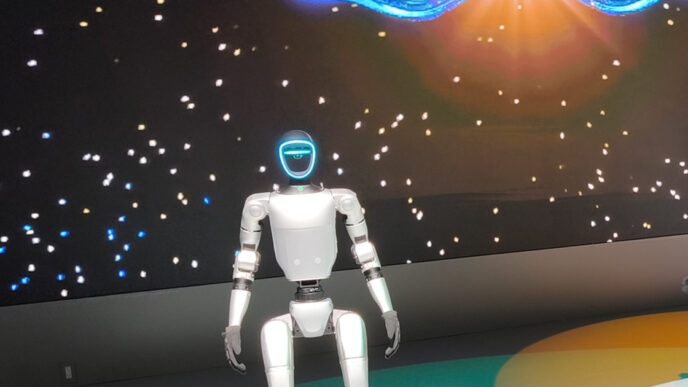
At Station-Berlin, Hall 3, Booth #3031, October 20–22, NEURA says 4NE1 (“For Anyone”) will sort laundry, load a washing machine, close and reopen it, unload it and move the load to a dryer in an eleven-minute sequence without human intervention. The company is explicit that the hard part is carrying context across steps, not any single motion. That is still a planned conference demonstration. Until visitors or NEURA publish intervention counts, failure modes and whether the run was continuous under show-floor conditions, treat it as a scheduled demo, not a readiness-level jump.
For how we separate demos, pilots and commercial work elsewhere on the site, see our humanoid readiness levels framework and our guide to teleoperation versus autonomy in humanoid demos.
How this sits next to other robot models
Neuron AI is a closed, company-stack model for NEURA hardware. It is not an open download like Unitree’s UnifoLM WLA, and it is not Google’s Gemini robotics line covered in our Gemini Robotics 2 explainer. For vocabulary on foundation models and VLAs, see what a robot foundation model is and what a VLA is.
The useful near-term questions are concrete: whether the GTC laundry run completes without resets, whether NEURA publishes any third-party or customer evaluation of the PLA stack, and whether Neuraverse skills show up outside NEURA’s own booth narrative.
Frequently asked questions
What is NEURA Neuron AI?
Neuron AI is NEURA Robotics’ multimodal foundation model for Physical AI, introduced October 14, 2026. NEURA says it combines 3D vision, touch, force, audio, robot state and language with memory in a Perception-Language-Action architecture, and runs on five of the company’s robot embodiments.
How is Neuron AI different from a VLA?
NEURA contrasts vision-language-action models, which it says are led by camera input, with Neuron AI’s addition of touch, sound and memory so robots can act on events cameras miss. That framing is NEURA’s; there is no side-by-side public benchmark in the launch materials.
Will Neuron AI be demonstrated live soon?
Yes, according to NEURA: its 4NE1 humanoid is scheduled to run an eleven-minute laundry-handling sequence with Neuron AI at NVIDIA GTC Berlin, Station-Berlin Hall 3 Booth #3031, October 20–22, 2026.
Does Neuron AI require the cloud?
NEURA says no. The company states Neuron AI is deployed for real-time inference on the robot, so production data can stay under the customer’s control.
Where is Neuron AI developed?
NEURA says it was developed and trained in-house in Metzingen, Germany, using robot gym data, simulation amplification and human demonstration suits, with industrial data partners including Schaeffler and Bosch.
Sources
- NEURA Robotics, “NEURA Robotics Introduces Neuron AI: The Brain of the Physical World,” October 14, 2026: neura-robotics.com
- NEURA Robotics, Neuron AI product page: neura-robotics.com/neuron-ai
Related: What is a VLA model? · Robot foundation models · More AI Models coverage
Last updated: October 15, 2026. To report an error, see our corrections page. Articles are drafted with AI assistance and reviewed and edited by an editor; see our editorial policy.