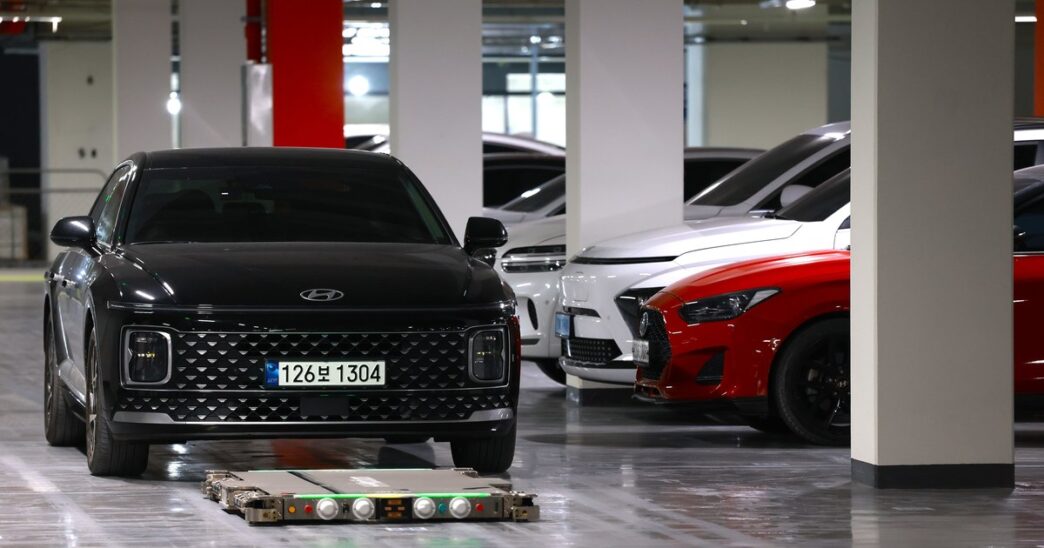
Hyundai Motor Group has shown its parking robots working in a real apartment complex. In the demonstration, a resident taps a wall pad at home and the car is brought to the pickup area in about three minutes. At a demonstration on Thursday, October 29, at Hillstate The Wave City in Siheung, southwest of Seoul, the Hyundai parking robot lifted cars by their wheels, cleared a double-parked vehicle and handled pickup and drop-off requests that arrived at the same time.
Hyundai says it’s the first time parking robots have been tested in a Korean apartment complex, and in a car park of more than 50 spaces. It’s still a government-backed pilot of two robot sets in a 53-space zone, though, and Hyundai hasn’t announced a price or a date for selling the system to apartment builders.
- What happened: on October 29, 2026, Hyundai Motor, Hyundai WIA and Hyundai E&C demonstrated parking robots in the underground car park of an apartment complex in Siheung, South Korea. Hyundai shared the results on October 30.
- How it works: a pair of flat robots, 110 mm thick, slides under a car, lifts it by the wheels and carries it to a free space. Hyundai says they move at up to 1.2 m/s and can handle SUVs of up to 3.4 tonnes.
- Status: a pilot under Korea’s smart-city regulatory sandbox, with two robot sets in a separate 53-space zone. There’s no price and no commercial launch date.
- The catch: Hyundai hasn’t published measured results yet. The 20 to 50% capacity gain and the three-minute pickup are company figures from a demonstration.
What Hyundai showed at the Siheung apartments
The pilot is run by a consortium of three Hyundai Motor Group companies: Hyundai Motor, Hyundai WIA, which builds the robots, and Hyundai Engineering & Construction, whose Hillstate brand the complex carries. Officials from Korea’s Ministry of Land, Infrastructure and Transport, Gyeonggi Province, Siheung and Suwon, the Korea Land and Housing Corporation and several public research and transport agencies came to watch.
Hyundai ran three scenarios based on everyday problems in apartment garages:
- Pickups and drop-offs at the same time. Requests to park and to retrieve cars came in together, and the system had to schedule the robots around each other. A resident requested a car from the wall pad inside their flat, and the robot moved it to the pickup area. Hyundai says that took about three minutes.
- Clearing double parking. In crowded Korean apartment garages, cars are often parked across other cars, left in neutral so neighbors can push them aside. Here the robot moved and rearranged the blocking car instead.
- Temporary retrieval. If a resident calls the car and then doesn’t drive away, or only needs something from the boot, the robot brings the car out and then puts it back in its space.
Hyundai says it also linked the robots to the complex’s other systems: the entrance barriers, the wall pads in each flat and an AI-based vehicle inspection system. The idea is that parking, storage, inspection and retrieval run as one service.
How the Hyundai parking robot works
Hyundai WIA’s parking robot comes as a pair of wide, flat units. Each is 110 mm thick, low enough to slide under a car. The two units go under the front and rear axles, find the tires and lift the car by its wheels, then carry it to an empty space. Hyundai’s August release lists these specs:
- Height: 110 mm per robot.
- Load: SUVs of up to 3.4 tonnes, up from the 2.2 tonnes Hyundai quoted for the 2024 version.
- Speed: up to 1.2 meters per second.
- Sensing: LiDAR to find the size and position of the wheels. Hyundai’s 2024 description says cameras locate the wheels and LiDAR watches for people nearby.
- Movement: it can drive in any direction, so it can move cars through tight gaps and fit more spaces into the same area.
- Calling a car: from a kiosk in the garage or from the wall pad in a resident’s flat.
Drivers get out at a set drop-off area rather than driving into the garage themselves. Hyundai says that keeps cars and pedestrians apart and cuts down on idling while drivers hunt for a space. It expects 20 to 50% more cars to fit in the same floor area.
The software has grown too. In 2024, Hyundai WIA said its smart parking control system could run 50 robots at once. Hyundai now says version 2.0 can control up to 200 robots at the same time, routing them and assigning jobs.
Not Hyundai WIA’s first parking job
Parking robots are already working at Hyundai’s own sites. Hyundai WIA says it supplies them to the Hyundai Motor Group Innovation Center in Singapore, where the robot was first commercialized in 2023, and to Hyundai’s Alabama plant and its Metaplant America in Georgia. In June 2024, Hyundai put the robot into Factorial Seongsu, an office building in Seoul, and called that the first commercial autonomous parking robot service in Korea.
An apartment complex is a harder test than a factory lot or an office garage. Residents come and go at the same peak hours, park badly, double-park and expect their car on demand. That’s also why the pilot needed special permission. It runs under Korea’s smart-city regulatory sandbox, which lets new services be tested before the rules catch up, with Ministry of Land approval and government funding.
What Hyundai is measuring, and what’s next
Hyundai’s August release lists what it will track during the pilot: the time to park and retrieve each car, how long residents actually wait, the parking success rate, robot utilization, monthly job counts and how much better the space is used. None of those numbers has been published yet.
The group says it’ll use the data to build a virtual model of different garage layouts, from homes and shops to offices, transit hubs and public buildings. The aim is to work out how many spaces and robots each building type needs, and to write operating standards. Hyundai also plans to work with government agencies on the rule changes that wider use would need.
“This pilot confirms the potential of parking robot technology and is meaningful as a process of applying robotics and mobility technology to real urban spaces,” said Jung Ho-geun, vice president of Hyundai Motor’s Future Strategy Division. He said Hyundai wants parking spaces to become smart-city hubs “where people, mobility, robots and urban infrastructure are connected.”
For buyers and developers, the takeaway is that this is a pilot, not a product you can order for your building. Hyundai hasn’t said what a robot set costs, how many a 500-space garage would need, or when Hyundai E&C’s new complexes might include it. The measured results from Siheung will be the real test of the three-minute and 50% claims. Watch for them, and for any change to Korea’s parking rules.
Frequently asked questions
What is the Hyundai parking robot?
It’s a pair of flat, 110 mm-thick robots built by Hyundai WIA that slide under a car, lift it by the wheels and carry it to a parking space. Hyundai says it can move SUVs of up to 3.4 tonnes at up to 1.2 meters per second.
Where is Hyundai testing parking robots in apartments?
At Hillstate The Wave City in Siheung, Gyeonggi Province, South Korea. The pilot uses two robot sets in a separate 53-space zone on the first basement level and was demonstrated on October 29, 2026.
How long does it take to get your car?
In the demonstration, a resident requested a car from the wall pad in their flat and the robot moved it to the pickup area in about three minutes, according to Hyundai.
Can you buy Hyundai parking robots for an apartment building?
Not yet. The apartment system is a pilot under Korea’s smart-city regulatory sandbox, and Hyundai hasn’t announced a price or launch date. Hyundai WIA already supplies parking robots to Hyundai sites in Singapore and the US and to an office building in Seoul.
How many robots can the system control?
Hyundai says version 2.0 of its smart parking control system can control up to 200 parking robots at the same time, up from the 50 Hyundai WIA quoted in 2024.
Sources
- Hyundai Motor Group, “Hyundai Motor Group holds apartment parking robot demonstration” (Korean press release, October 30, 2026): hyundaimotorgroup.com
- Hyundai Motor Group, “Hyundai Motor Group to pilot apartment parking robots” (Korean press release, August 10, 2026), hyundaimotorgroup.com
- Hyundai WIA, Mobility Solution: Robot (parking robot supply list): hyundai-wia.com
- Hyundai Motor Group, “Hyundai Motor Group Powers Up Robotic Services at Smart Office Building in Seoul” (June 20, 2024): hyundai.news
- The Korea Herald, “Hyundai puts parking robots in driver’s seat” (October 30, 2026): koreaherald.com
- Hyundai E&C, “First in Korea: parking robots are coming to apartment complexes!” (official YouTube channel, October 2026): youtube.com
All sources accessed October 31, 2026.
Last updated: October 31, 2026. To report an error, see our corrections page. Articles are drafted with AI assistance and reviewed and edited by an editor; see our editorial policy.