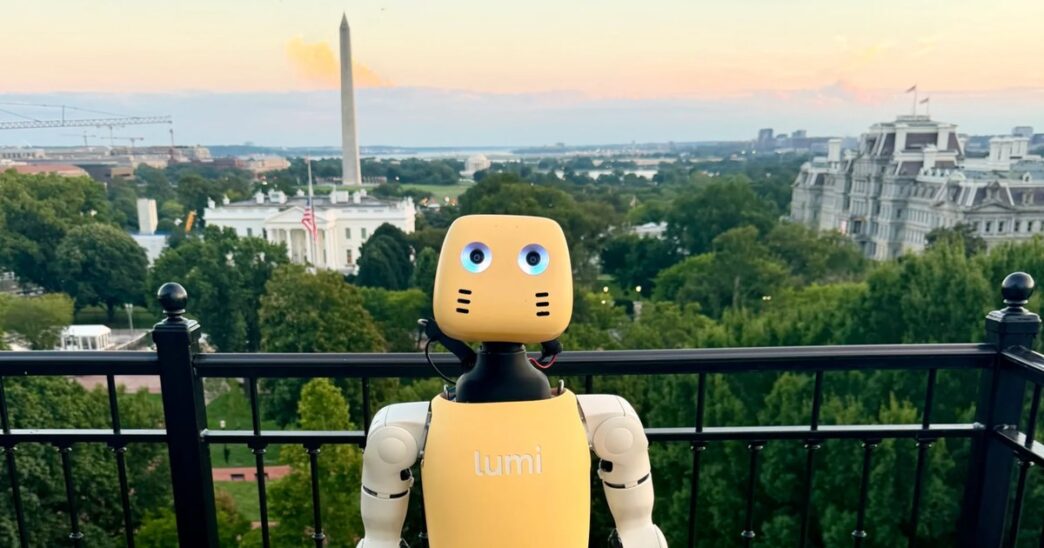
A small San Francisco startup has become the first humanoid robot maker cleared to sell a new robot in the United States under the FCC’s ban on foreign-produced robots. On Friday, October 30, the FCC’s Public Safety and Homeland Security Bureau said the Department of War had granted a Conditional Approval for “Lightberry Holdings, Inc.’s Lumi Interactive mobile robots,” which removes the Lightberry Lumi from the agency’s Covered List.
The twist is what’s underneath. Lumi is built on a Unitree G1, the Chinese company’s best-selling small humanoid, with Lightberry’s own sensors, computer and software on top. The approval is conditional: it depends on Lightberry keeping a plan to move manufacturing to the US, and it can be withdrawn.
- What happened: on October 30, 2026, the FCC exempted Lightberry’s Lumi robots from its Covered List after the Department of War granted a Conditional Approval. Lightberry says Lumi is the first humanoid to get one.
- Price: $39,990 for a Founder Edition, limited to the first 100 units, with a $200 refundable deposit. Lightberry says later hardware pricing will move into the $20,000 range.
- Status: reservations are open and Lightberry lists shipping as “2026.” It hasn’t said how many robots have shipped.
- The catch: the base is a Unitree G1, and the exemption depends on an onshoring plan and ongoing vetting. Lightberry’s US manufacturing starts with the body, head and hands; the rest comes later.
What the FCC approved
Since July 28, 2026, “foreign-produced advanced robotic devices” have been on the FCC’s Covered List, a national-security list of equipment that can’t receive new FCC equipment authorization. Without that authorization, a new robot model generally can’t be imported, marketed or sold in the US. The one way out written into the rule is a Conditional Approval from the Department of War. Our buyer’s guide to the FCC Covered List explains how the rule works and what it means for robots people already own.
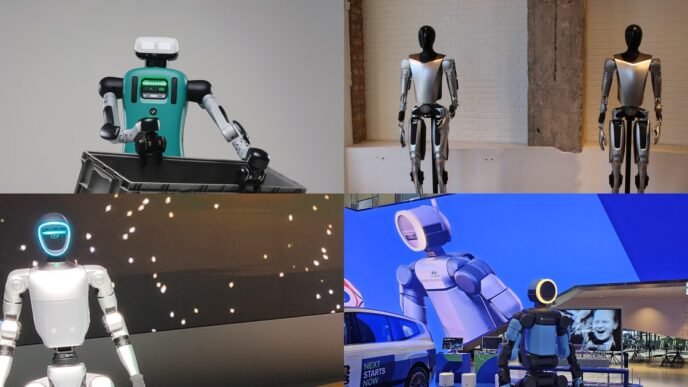
Friday’s public notice, DA 26-1181, lists the latest batch of those approvals. Six are for robots: ARAPL’s autonomous pallet trucks and forklifts, ATI Motors’ Sherpa and FlexFork platforms, Lightberry’s Lumi, SunScout’s solar robotic platforms, Swap Robotics’ V7 and OMRON’s LD-150 and LD-300 mobile robots.
The FCC’s robotics approvals table now has 13 entries, dating back to Husqvarna’s robot platforms on September 9. When we last checked it, on October 2, it had three. Lumi is the only humanoid on it. The rest are warehouse robots, a floor cleaner and other mobile platforms.
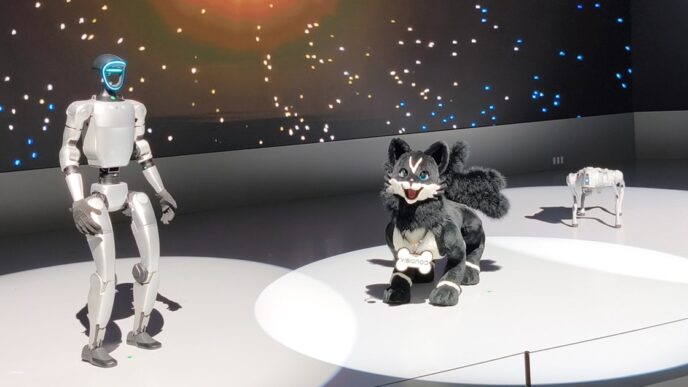
Lightberry Lumi is built on a Unitree G1
Lightberry doesn’t hide where Lumi comes from. Its product page describes Lumi as Lightberry’s “custom sensors and software with a G1 base,” and lists a 29-degree-of-freedom “G1-compatible” body. The press release calls compatibility with the Unitree G1 a feature. Lightberry adds a new head that can nod, shake and tilt, which brings the total to 34 degrees of freedom.
That explains why it needed an approval at all. The FCC’s notice groups Lumi with the other “foreign-produced” devices it cleared. Unitree has said the stock G1 was authorized before the July rule, so it can still be sold, though that’s a company statement. Lumi, with a different head, sensors and computer, is a new product, and new foreign-produced robots are exactly what the rule blocks.
The company says its approval rests on two commitments. First, it replaces the robot’s sensors, onboard computer and software with its own. Second, it’s moving manufacturing to the US, “starting with the body, head and hands, with the rest to follow.” Lightberry says the approval is tied to that plan and to ongoing security vetting.
“A humanoid robot works right next to people, with cameras and microphones, so you need to know exactly what’s running inside it,” co-founder and CEO Ali Attar said in the release. “That’s why we replaced every sensor and all of the software on Lumi, and why we’re investing in American manufacturing.”
What “conditional” means here
The FCC’s notice is specific about the strings attached. The exemptions are subject to each company’s continuing “compliance with the onshoring plan[s] outlined in [their] conditional approval application[s] and pursuant to updated vetting of [their] products.” For the six robotics approvals, the notice adds that these conditions apply unless a later national security determination supersedes them.
A footnote spells out the downside. Failing to follow the onshoring plan, or the discovery of a false statement or misrepresentation in the application, could end the approval and put the product back on the Covered List. Approvals without an end date, like these, stay in effect indefinitely as long as the company sticks to its plan.
Neither the FCC nor Lightberry has published the onshoring plan, its deadlines, or how much of Lumi has to be made in the US. Buyers are relying on promises nobody outside the government can check yet.
Lumi price and specs
Lightberry is taking reservations for a Lumi Founder Edition at $39,990. Its order page says it will ship 100 Founder Edition units, “starting in 2026,” before “bringing hardware pricing into the $20k range.” The Founder Edition includes a year of Lightberry software access, which the company values at $20,000, plus direct Slack support. The deposit is $200 and fully refundable. The same page’s metadata also mentions a cheaper Lumi Basic shipping in late 2027, which Lightberry hasn’t priced.
Here’s what Lightberry’s spec sheet lists:
- Size: 4 feet 2 inches (1.3 meters) tall, about 40 kg.
- Joints: 34 degrees of freedom in total, 29 of them in the G1-compatible body.
- Battery: 421 Wh, rated at 2.5 to 3.5 hours.
- Computer: NVIDIA Jetson Thor with 64 GiB of memory, and 10-gigabit networking.
- Sensing: cameras at 1920 by 1200 per eye at 30 frames per second, and a beamforming microphone array.
- Software: Lightberry OS with an SDK, and two USB-C 3.1 ports for add-ons.
For context, Unitree’s own pages list the standard G1 from $13,500, excluding tax and shipping, as of our last check in October. The Founder Edition costs nearly three times that. The extra buys Lightberry’s head, sensors, computer, software and support on top of the same G1-compatible legs.
Who Lightberry is selling to
Lightberry was founded in 2025 by Ali Attar and Stephan Koenigstorfer. The company says half its team are artists from studios such as Pixar and Disney and half are engineers from companies such as Google and GE. It pitches Lumi as an interactive robot for businesses whose teams aren’t technical, the kind of robot that greets visitors or entertains a crowd rather than carrying boxes.
The press release calls Lightberry “the first and only humanoid company” to get this approval and says Lumi robots are now “cleared to go to work across the country.” The first part matches the FCC’s table as of October 30. The second needs a caveat: clearance under the Covered List is one step. A new model still has to complete normal FCC equipment authorization, and Lightberry hasn’t said where it stands on that or how many reservations it holds.
For buyers, the takeaway is broader than one startup. The FCC rule doesn’t stop US companies from building on Chinese hardware, as long as the sensitive parts are replaced and the work moves onshore. Watch for whether other humanoid makers with imported bases follow Lightberry through the same door, and whether any approval is ever terminated.
Frequently asked questions
What is Lightberry Lumi?
Lumi is an interactive humanoid robot from San Francisco startup Lightberry. It uses a Unitree G1-compatible body with Lightberry’s own head, sensors, onboard computer and software, and stands about 4 feet 2 inches tall.
How much does Lightberry Lumi cost?
The Lumi Founder Edition costs $39,990, limited to the first 100 units, with a $200 fully refundable deposit. Lightberry says it plans to bring hardware pricing into the $20,000 range after that.
Is Lumi exempt from the FCC robot ban?
Yes, conditionally. On October 30, 2026, the FCC removed Lightberry’s Lumi Interactive mobile robots from its Covered List after the Department of War granted a Conditional Approval. The exemption depends on Lightberry following its onshoring plan and passing updated vetting.
Is Lumi made in America?
Not yet fully. Lightberry says it is moving manufacturing to the US, starting with the body, head and hands, with the rest to follow. The base design is Unitree’s G1, and the FCC’s notice lists Lumi among the foreign-produced devices it cleared.
Can the approval be taken away?
Yes. The FCC says failing to comply with the onshoring plan, or a false statement or misrepresentation in the application, could end the Conditional Approval and return the product to the Covered List.
Sources
- FCC Public Safety and Homeland Security Bureau, Public Notice DA 26-1181, Department of War Conditional Approvals and Covered List update (October 30, 2026): docs.fcc.gov
- Lightberry, “Lightberry Lumi is the First and Only American Humanoid Robot Company cleared by the U.S. Government” (press release, October 30, 2026): lightberry.com
- Lightberry, Lumi product page and specifications: lightberry.com
- Lightberry, Lumi Founder Edition order page: lightberry.com
- FCC Public Safety and Homeland Security Bureau, Public Notice DA 26-786, adding foreign-produced advanced robotic devices to the Covered List (July 28, 2026): docs.fcc.gov
All sources accessed October 31, 2026.
Last updated: October 31, 2026. To report an error, see our corrections page. Articles are drafted with AI assistance and reviewed and edited by an editor; see our editorial policy.