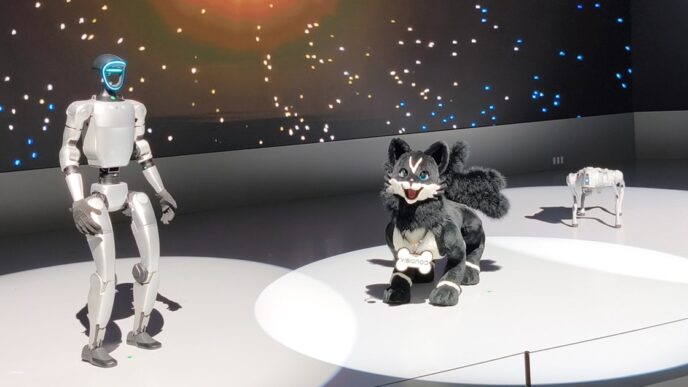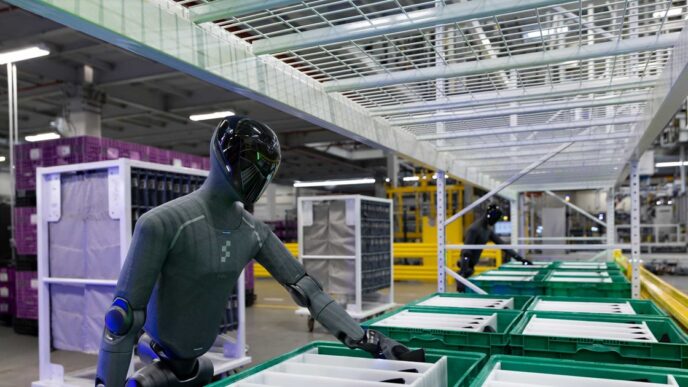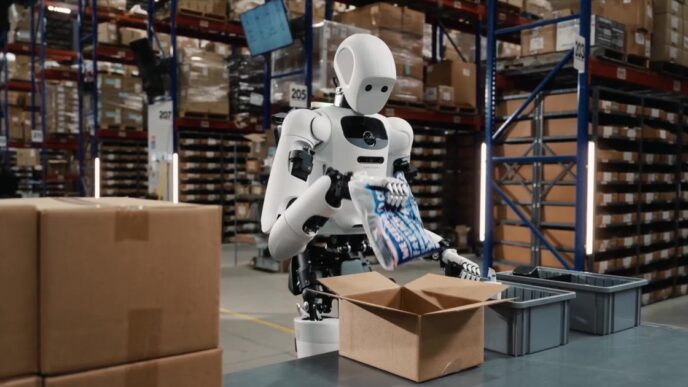
On November 2, humanoid robots tried to climb the stone steps of Mount Tai in eastern China, in the first World Robot Mount Taishan Climbing Competition organized by China Media Group. CGTN’s footage shows humanoids stumbling and slipping on the steep steps while a four-legged robot dog climbed with ease. It was the latest in a crowded calendar of humanoid robot competitions in 2026: a half marathon in April, RoboCup in July and the World Humanoid Robot Games in August.
Races make headlines, but they measure something narrow. Researchers rely on a different tool, the benchmark: a fixed set of tasks, scored the same way for every robot or AI model. This guide explains how the two differ, what the biggest 2026 events actually tested, and how to read a winning time or a leaderboard score without being misled.
- Competitions: public events such as races, soccer and stair climbs. They test hardware, balance and endurance under one set of conditions, often with human help allowed.
- Benchmarks: standard task suites such as LIBERO, RoboTwin 2.0, RoboDojo and RoboArena. They score robot AI models so results can be compared.
- What neither proves: that a robot can do paid work reliably, for a full shift, in an unprepared workplace.
- The catch: rules differ. Check whether a robot was remote-controlled, whether the test ran in simulation or reality, and who submitted the score.
Humanoid robot competitions vs benchmarks
A competition puts real robots in front of judges and an audience. It is a one-off test under conditions the organizer sets, and it rewards whoever does best on the day. That makes it good at exposing hardware problems such as overheating motors, falls and battery limits, and bad at telling you how often a robot succeeds, because each robot usually gets one attempt.
A benchmark is a repeatable exam. It defines tasks, the number of trials, what counts as success and how scores are combined, so a team in Shanghai and a team in California can compare results. Most robot benchmarks test the AI model, the software that decides what the robot does, rather than the body. Many run partly or entirely in simulation, because real-robot testing is slow and expensive. Our explainer on how robots train in simulation and transfer to the real world covers why that gap matters.
The big humanoid robot events of 2026
Beijing E-Town humanoid robot half marathon (April 19). More than 100 teams ran the 21.0975 km course, which included more than ten types of terrain. A robot called Shandian (“Lightning”) from Team Monkey King won in 50 minutes 26 seconds, according to the Beijing municipal government. The rules are the interesting part. Fully autonomous and remote-controlled robots raced together, but a remote-controlled robot’s time was multiplied by 1.2. A judge in a golf cart followed each robot and logged rule violations, battery swaps and penalties.
World Humanoid Robot Games (Beijing, ended August 26). The second edition combined track events with contests in nine application scenarios, such as smart charging and general service tasks. The winning large-group 100 m time was 8.64 seconds, and the 1,500 m was won in 2 minutes 21.64 seconds, down from 6:34.40 at the first Games. In the smart charging event, robots had to charge three vehicles within 30 minutes, which says more about useful skills than any sprint time.
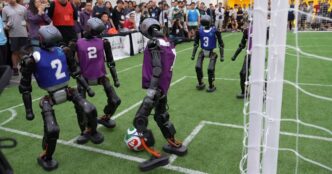
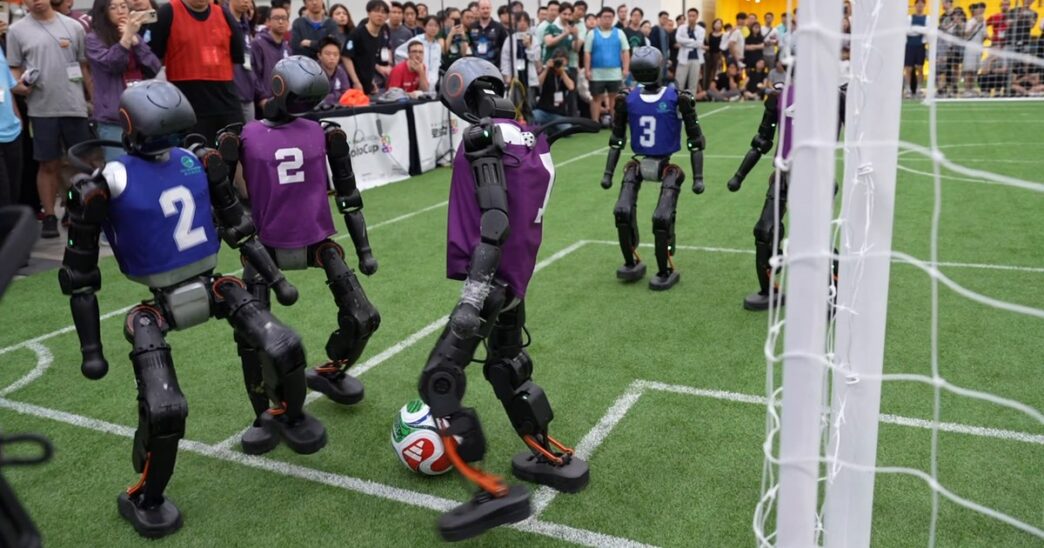
RoboCup 2026 (Incheon, South Korea, July). RoboCup has run robot soccer since the 1990s. This year its Standard Platform League and Humanoid League merged into a single Humanoid Soccer League with three size divisions. Tsinghua Hephaestus won the Large division, beating CAU Mountain&Sea 6-2 in the final. B-Human, from the University of Bremen and DFKI, won the Middle division, and Invic, from Wuhan University, won the Small division. Booster Robotics says all three champions played on its robots.
Mount Tai climbing competition (November 2). The newest event tests the hardest terrain: uneven, centuries-old stone steps on a real mountain. Early footage suggests legged robot dogs are far ahead of humanoids on stairs like these, which matches what engineers would expect from four points of contact versus two.
What a race result does and doesn’t prove
A fast time proves that a robot’s legs, motors, cooling and batteries can survive a hard effort, and that a team can keep it running. That is real engineering progress. The 1,500 m time falling by more than four minutes in a year reflects better hardware and better walking controllers.
It doesn’t prove autonomy unless the rules require it. The half marathon allowed remote control, with only a time penalty, and battery swaps. It also doesn’t prove reliability. One finish says nothing about how many attempts failed in practice, and organizers don’t publish that. Finally, it doesn’t prove usefulness. Running fast is not a job most buyers need done. Our guide to teleoperation versus autonomy in robot demos explains how to check what you’re watching.
The robot AI benchmarks to know
LIBERO. A simulation benchmark from the University of Texas at Austin with 130 language-instructed manipulation tasks in four suites, each with human-teleoperated demonstrations. It was built to study how robots learn new tasks over time. Because many recent models report very high success rates on its standard suites, a high LIBERO number on its own says less than it used to.
RoboTwin 2.0. A simulation benchmark for two-armed robots with 50 tasks across five robot types. Its harder setting adds clutter, different lighting, backgrounds and table heights. The paper’s own results show why that matters: average success for the pretrained model Pi0 fell from 46.4% in clean scenes to 16.3% in randomized ones.
RoboDojo. Launched July 6, 2026, it combines 42 simulation tasks with 18 real-world tasks on three robot embodiments, which outside teams can have evaluated remotely. Its simulation tasks score five abilities: generalization, memory, precision, long-horizon execution and open-vocabulary instructions. The site says a non-profit, AI MMLab Club, maintains the leaderboard. Most new entries are contributed by the teams that built the models. AgiBot, for example, submitted its own GO-3 Nano Preview score, and some top entries are listed on a separate “agent track,” so check which table a company is quoting.
RoboArena. Run by researchers from UC Berkeley, Stanford and other institutions, it takes a different approach. Volunteer evaluators at different sites pick any task they like and compare two policies head to head on the same DROID robot setup, without knowing which policy is which. Rankings come from many of these double-blind pairwise comparisons, a method similar to chatbot arenas. The organizers say it will run live through December 2026.
How to read a benchmark claim
When a company says its model is “number one” on a robot benchmark, five questions sort a strong claim from a weak one:
- Simulation or real robot? A simulation score is useful evidence, not proof of real-world performance.
- Who ran the test? Results run by the benchmark’s maintainers or blind evaluators carry more weight than self-submitted scores.
- Which track or split? Leaderboards often have several tables. Being first in one isn’t being first overall.
- Score or success rate? RoboDojo, for instance, reports both, and they differ.
- How many trials? A success rate from a handful of attempts can swing widely.
None of these benchmarks measures what a warehouse or factory buyer cares about most: uptime, interventions per hour and cost per task over months. That is why we treat paid deployments, not leaderboard positions, as the strongest evidence. Some companies are starting to publish work-based metrics, such as AgiBot’s productivity measure, but they are self-reported too.
What to watch next
Look for competitions that make autonomy mandatory and publish failure counts, not just winners, and for scenario events like the World Humanoid Robot Games’ charging task to grow at the expense of sprints. On the benchmark side, the test is whether real-robot leaderboards such as RoboDojo’s real-world track and RoboArena attract the big Western labs, and whether independent evaluators start re-running companies’ self-reported scores.
Frequently asked questions
What is the difference between a robot competition and a robot benchmark?
A competition is a public event, such as a race or soccer tournament, where real robots compete once under the organizer’s rules. A benchmark is a fixed, repeatable set of tasks with defined scoring, used to compare robot AI models. Many benchmarks run in simulation; competitions use physical robots.
Who won the 2026 humanoid robot half marathon in Beijing?
A robot called Shandian (“Lightning”) from Team Monkey King won the Beijing E-Town humanoid robot half marathon on April 19, 2026, in 50 minutes 26 seconds, according to the Beijing municipal government. Remote-controlled robots were allowed but had their times multiplied by 1.2.
Were the robots in these races autonomous?
Not always. The Beijing half marathon allowed both fully autonomous and remote-controlled robots, with a time penalty for remote control, and judges logged battery swaps. RoboCup soccer robots play autonomously during matches. Check each event’s rules before treating a result as evidence of autonomy.
What is RoboDojo?
RoboDojo is a robot manipulation benchmark launched in July 2026 with 42 simulation tasks and 18 real-world tasks. Its public leaderboard is maintained by AI MMLab Club, a non-profit, and most entries are submitted by the teams that built the models, such as AgiBot.
Do benchmark scores show a robot is ready for work?
No. Benchmarks compare AI models on standard tasks, often in simulation and over limited trials. They don’t measure uptime, human interventions per hour or cost per task in a real workplace over months, which are what buyers need. Paid commercial deployments remain the stronger evidence.
Sources
- CGTN: “Battle on Mount Taishan: Humanoid robots stumble on steep steps as robot dog climbs with ease,” November 2, 2026
- Beijing municipal government: “Who is Winner? Champion Crowned for Humanoid Robot Half Marathon,” April 19, 2026
- Beijing municipal government: “2nd World Humanoid Robot Games Conclude,” August 28, 2026
- RoboCup Humanoid Soccer League: RoboCup 2026 results and tournament structure
- Liu et al., “LIBERO: Benchmarking Knowledge Transfer for Lifelong Robot Learning,” arXiv:2306.03310
- Chen et al., “RoboTwin 2.0,” arXiv:2506.18088
- RoboDojo benchmark site and leaderboard (arXiv:2607.04434)
- RoboArena: Distributed Real-World Evaluation of Generalist Robot Policies
All sources accessed November 3, 2026.
Last updated: November 3, 2026. To report an error, see our corrections page. Articles are drafted with AI assistance and reviewed and edited by an editor; see our editorial policy.