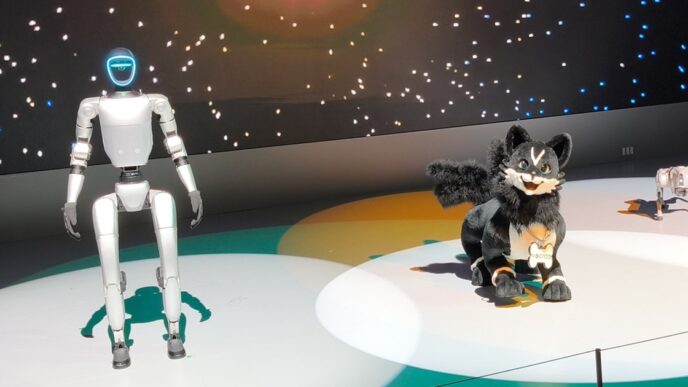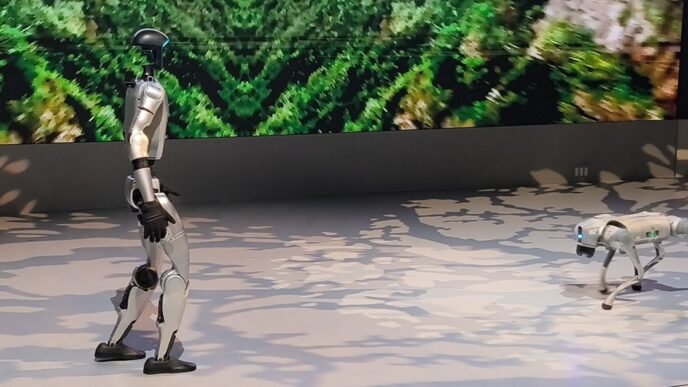
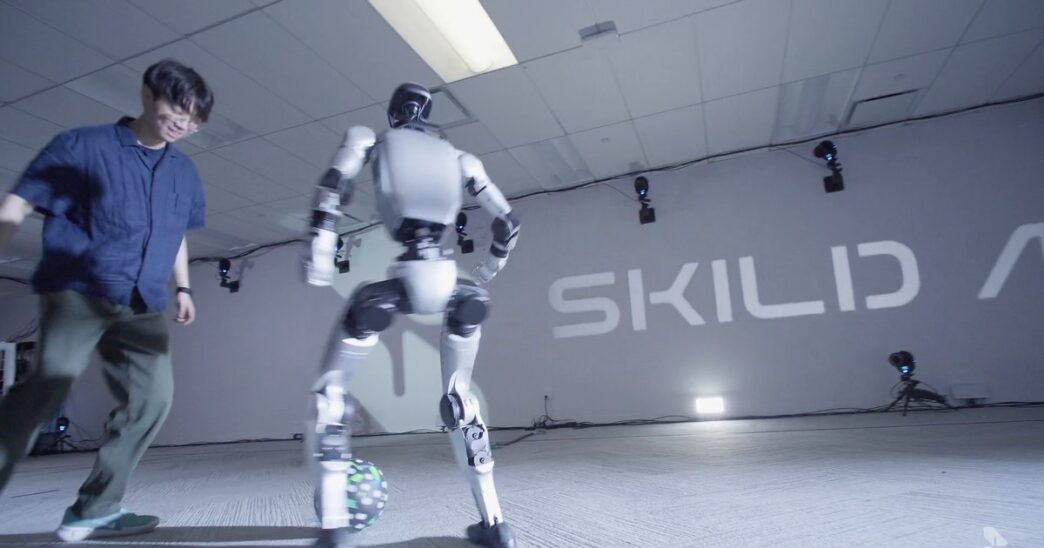
Skild AI’s humanoid soccer clips are circulating again in robotics coverage, and they are worth a closer look. In them, a bipedal robot dribbles, shields the ball and tackles a human opponent in front of a wall-sized Skild logo. Skild says nobody taught it those moves. In a September 23 post, the Pittsburgh company said it gave a policy “a single objective: score,” let it play recent versions of itself for 140 simulated years in NVIDIA’s Isaac Sim, then moved it onto a real humanoid.
The soccer demo is the flashiest piece of a bigger pitch. Skild is building one “robot brain” that it sells to companies running many kinds of robots, and over the past two months it has published three things that explain how it thinks that brain should learn: S1, a model that copies a task from a single video; self-play, which aims to push past what humans can show; and a revenue update meant to prove customers are paying for it. Here is what each claim says, and what Skild has not shown yet.
S1: learning a new task from one video
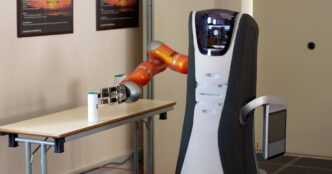
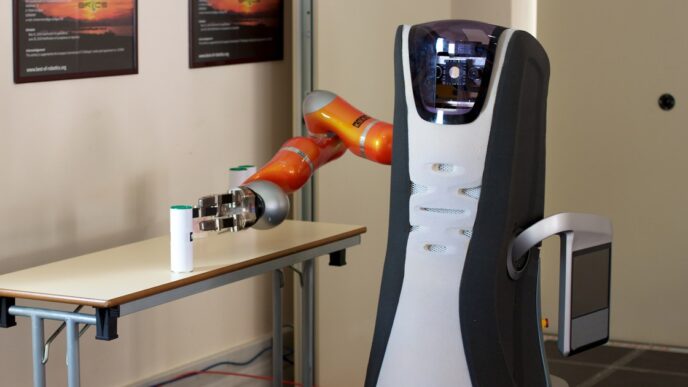
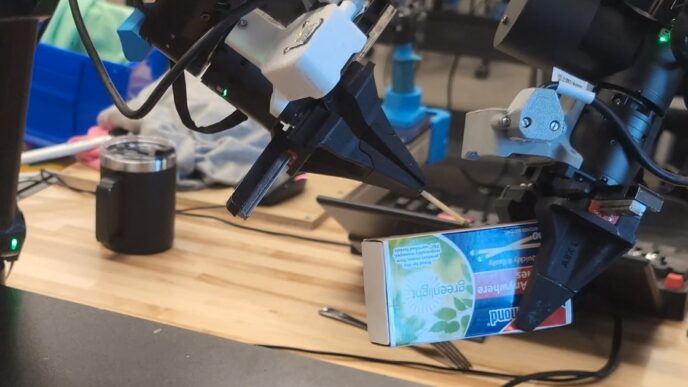
Skild introduced S1 on August 18 as an “in-context learner.” Instead of collecting hours of robot data and fine-tuning for every new job, an operator records one video of a person doing the task and feeds it to the model as a prompt. The weights do not change. It is the robotics version of prompting a chatbot, and it is a different idea from the language-instruction approach most robot foundation models use today.
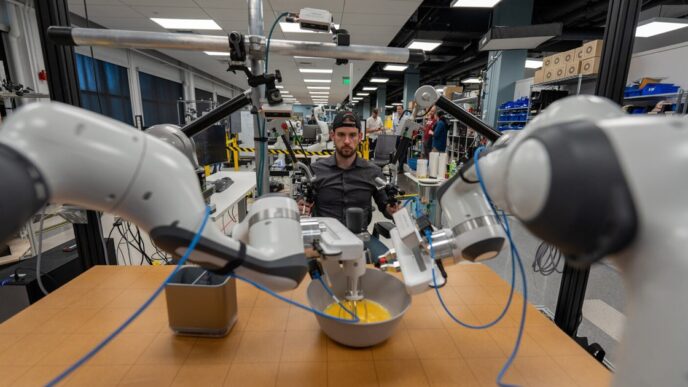
Skild showed S1 handling four tasks it says were never in its training data: potting a plant, cooking a pancake, brewing pour-over coffee and assembling a kit, each running up to 10 minutes. For the plant, the company says 11 minutes passed between starting to record the demonstration and the robot working on its own.
The headline numbers come from Skild’s own tests:
- Unseen tasks: after pre-training on 100,000 hours of data, S1 averaged a 66% per-step success rate on long tasks it had never seen, against 9% for a language-prompted model trained on the same data.
- Seen tasks: about 96% for S1. At the smallest scale tested, 1,000 hours, the language-prompted model was ahead, 53% to 43%.
- Data savings: one video in the prompt matched roughly 380 fine-tuning demonstrations, which Skild says take 50 to 100 hours of teleoperation to collect. Fine-tuning did win eventually, reaching 86% with 2,000 demonstrations.
Two caveats sit in Skild’s own write-up. The benchmarks are internal suites, not a public test anyone else can run. And people stepped in to recover failed attempts so every step could be graded, which Skild says was used mainly for the baseline. A 66% per-step rate also means a long task still fails often unless the robot recovers by itself.
Self-play: the soccer experiment
S1 learns from human demonstrations, and Skild argues that caps it “at human capability.” Self-play is its answer, borrowed from game-playing systems such as AlphaGo Zero. In simulation the policy competed only against recent copies of itself, so every improvement made its opponent harder. Skild says it could barely walk for the first few simulated months, learned to get up after falls, and later picked up dribbling, shielding and tackling without a reward for any of them.
What the post leaves out matters as much. Skild does not name the humanoid it used, say how many real matches it played, give scores or success rates, or say how many attempts it took to get the published footage. It describes the work as a post-training result for “a strong base model like S1” without spelling out the setup. The clips carry an “autonomous 1x” label, which indicates no teleoperation and real-time playback, but that is Skild’s label, not independent verification. The company says it is extending self-play to everyday tasks and that its next release will look at larger teams.
The business case behind the demos
Skild is unusually blunt about demos. In a September 10 post, co-founders Deepak Pathak and Abhinav Gupta wrote that “a successful clip from a robot with 5%, 10%, or 99% accuracy can look exactly the same.” Their evidence of progress is commercial: more than $100 million in annual recurring revenue ten months after the first deployment, 60-plus paying customers and $50 million already recognized. They say about 90% of revenue comes from manipulation work, with mobility at 10%, including the warehouse robots Skild got by buying Zebra Technologies’ robotics unit (formerly Fetch Robotics) in April.
Named projects include assembling NVIDIA Blackwell systems with NVIDIA and Foxconn, kitchen pilots with Mitsui and work toward wire-harness automation at Sumitomo Wiring Systems. Pittsburgh International Airport also plans a pilot with four legged robots running Skild software, first checking air quality. Skild is private, so the revenue figures are unaudited company claims. Its $1.4 billion Series C in January, led by SoftBank, valued it at more than $14 billion, according to the company, and it is in our funding tracker.
What to watch
Three things would make these claims easier to judge: S1 results on a public benchmark, numbers from the soccer transfer (matches, goals, failures) along with the robot’s identity, and customer-reported figures from deployments such as the Foxconn line. Skild says more posts on how S1 is trained are coming. Until then, the soccer footage is a well-made demo by Skild’s own definition: something to note, not proof.
Frequently asked questions
What is Skild AI’s S1?
S1 is Skild AI’s flagship robot foundation model, introduced on August 18, 2026. It is built to learn a new task from a single video demonstration given as a prompt, without retraining, and Skild says it handles unseen tasks lasting up to 10 minutes.
How did Skild AI train a robot to play soccer?
Skild says it gave a policy the single goal of scoring and had it play recent versions of itself in NVIDIA Isaac Sim for 140 simulated years. Skills such as dribbling, shielding and tackling emerged without separate rewards, and the policy was then transferred to a real humanoid.
Which robot did Skild AI use for the soccer demo?
Skild has not named the humanoid in its self-play post. It also has not published how many real matches were played or how often the transferred policy succeeded.
How accurate is Skild S1?
In Skild’s internal tests, S1 averaged a 66% per-step success rate on long tasks it had never seen and about 96% on seen tasks. A language-prompted model trained on the same data scored 9% on the unseen tasks. No public benchmark results have been released.
How much revenue does Skild AI make?
Skild said on September 10, 2026, that it had passed $100 million in annual recurring revenue, with more than 60 paying customers and $50 million recognized. The company is private and the figures are not audited.
Sources
- Skild AI, “Physical Self-Play,” September 23, 2026 (single scoring objective, 140 simulated years in Isaac Sim, sim-to-humanoid transfer; videos at assets.skild.ai): skild.ai
- Skild AI, “Introducing S1: In-Context Learning for Robotics,” August 18, 2026 (unseen tasks, 66% vs 9%, 96%, 380 demonstrations, 86% with 2,000, human interventions): skild.ai
- Deepak Pathak and Abhinav Gupta, “The Hidden Pillar of Robotics,” Skild AI, September 10, 2026 ($100 million ARR, 60+ customers, revenue mix, NVIDIA/Foxconn, Mitsui, Sumitomo Wiring Systems): skild.ai
- Skild AI blog index (Series C, January 14, 2026; Zebra Technologies robotics acquisition, April 15, 2026): skild.ai/blogs
- NVIDIA Blog, “Skild AI Taps NVIDIA Physical AI to Teach Robots New Tasks From a Single Video,” September 10, 2026: blogs.nvidia.com
- Pittsburgh Business Times via WPXI, “Pittsburgh International Airport taps Skild AI-powered robots for pilot program,” October 1, 2026: wpxi.com
- Robotics & Automation News, “Skild AI trains robots to learn physical skills through self-play,” October 16, 2026: roboticsandautomationnews.com
All sources accessed October 19, 2026.
Related: What is a robot foundation model? · Where humanoid training data comes from · NVIDIA ASPIRE and robot skills · Teleoperation vs autonomy · More AI Models coverage
Last updated: October 19, 2026. To report an error, see our corrections page. Articles are drafted with AI assistance and reviewed and edited by an editor; see our editorial policy.