Foundry Robotics, a startup that wants robots to do final assembly on drones, satellites and defense electronics, has raised a $100 million Series A. The company announced the round on Wednesday, October 28. Marlinspike Partners led it, and the oversubscribed Foundry Robotics Series A comes roughly nine months after the company first went public with a $13.5 million seed round in January.
The money is going into a 130,000-square-foot facility in Emeryville, California, across the bay from San Francisco. Foundry says that site expands its operating footprint twentyfold. Its pitch is simple to state and hard to do: take hardware that’s usually built by hand in small batches and assemble it in robot work cells that can switch from one product to another without retooling a whole line.
- The round: $100 million Series A, announced October 28, 2026, led by Marlinspike Partners. No valuation was disclosed.
- What it pays for: buildout of a 130,000-square-foot factory in Emeryville, California, plus AI model deployment and hiring.
- Status: confirmed by the company. Its CEO says Foundry is already shipping to paying customers in energy, telecom, autonomous vehicles and defense.
- The catch: Foundry hasn’t named customers or published revenue, volumes or prices. “America’s first autonomous factory for assembly” is its own description.
Who invested in the Foundry Robotics Series A
Marlinspike Partners led the round. Khosla Ventures, which led Foundry’s seed, came back, as did Red Glass Ventures. New investors are SE Ventures, the venture arm tied to Schneider Electric, Wing VC and Axiom Ventures. Earlier backers Hanabi Capital and Zero Shot Fund also took part. Foundry didn’t disclose a valuation or say how the money splits among the firms.
The jump in size is steep. Foundry announced a $13.5 million seed led by Khosla in January. By April, co-founder Emmanuel Lamacchia wrote on LinkedIn that the company had closed more than $19 million in total seed and follow-on funding. Six months later it has five times that in a single round.
It lands in a busy stretch for robotics money. Two days earlier, Bedrock Robotics raised $600 million for self-driving excavators, and our robotics funding tracker logs the year’s other big rounds. Foundry is a different bet from most of them. It isn’t selling robots. It’s selling the output of a factory that robots run.
What Foundry actually builds
Foundry describes itself as a contract manufacturer for “complex, low-volume, high-mix” electro-mechanical products. Its website calls the model Manufacturing-as-a-Service. The list of things it says it can assemble is long: drones, autonomous vehicle subassemblies, wire harnesses, underwater vehicles, telecom and data center equipment, ground robots, rugged computers, robot compute boxes and satellites.
Those products have something in common. They’re built in batches too small to justify a dedicated automated line, so the work usually falls to skilled technicians. Founder and CEO Adarsh Kulkarni argued in the announcement that traditional production lines take months to set up and are expensive to reconfigure for a single product. Foundry’s answer is to own the final assembly step itself and use AI to adapt as demand shifts.
According to The Information, as summarized by Benzinga, the factory is organized into work cells by skill, such as cabling, fastening and precise part placement, rather than by product. A job moves through whichever cells it needs. Foundry’s software layer, which it calls FoundryOS, coordinates those cells. The company also promotes what it calls Design for Robotic Assembly: reworking a customer’s product to cut parts and simplify assembly steps so robots can build it repeatably.
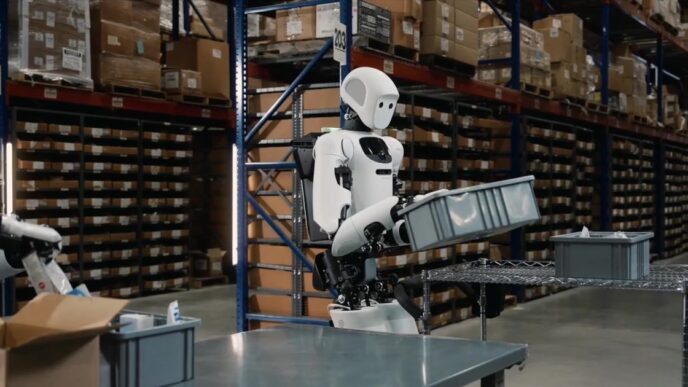
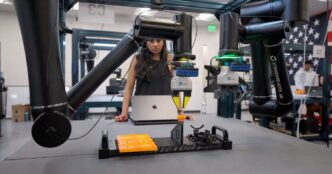
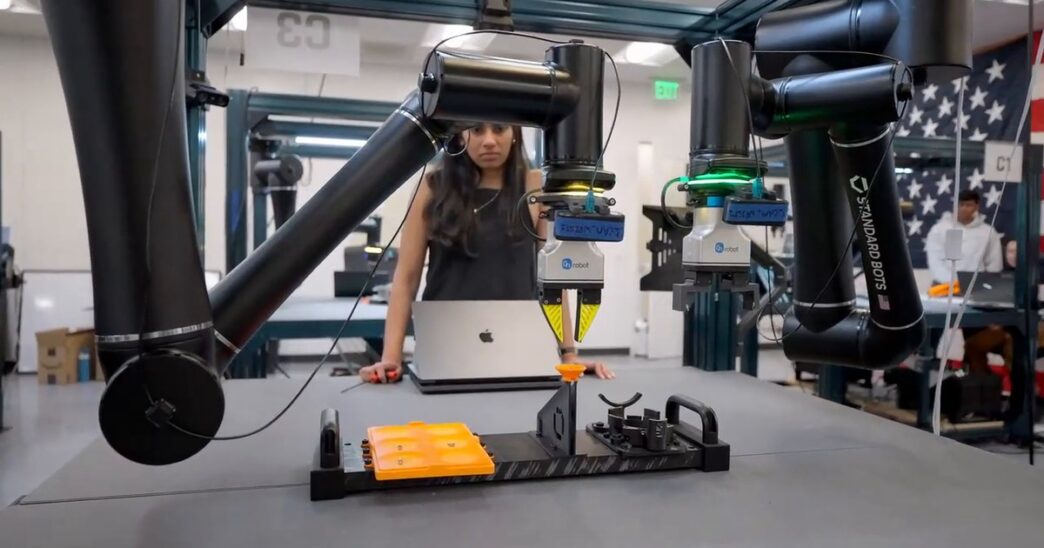
The featured image above comes from the hero video on Foundry’s homepage. It shows the kind of setup the company is describing: a technician at a bench, ceiling-mounted robot arms over a fixture, and colored parts laid out for assembly. It’s a marketing clip, so it shows a cell, not a full production run.
Defense is a big part of the pitch
Foundry serves defense and commercial customers, and its website leans on the defense side. It says the company is ITAR registered, which matters for handling controlled military technology, and CMMC 2 compliant, the Pentagon’s cybersecurity standard for contractors. Its homepage calls the operation “The New American Factory” and pitches onshore production to hardware makers that don’t want to depend on overseas assembly.
Kulkarni’s background fits that. He previously worked at Ghost Robotics, which makes legged robots used by militaries, and led robotics work at Scale AI. Lamacchia was a program manager on Tesla’s Model Y, according to the company’s announcement. The pairing is deliberate: one founder from robots and AI data, one from scaling a car factory.
Is it really already shipping?
Kulkarni says yes. In a post on X on October 28, he wrote that Foundry is “already shipping to paying customers across energy, telecom, autonomous vehicles, and defense.” That’s a meaningful claim for a company that announced itself in January, but it comes with no names, no unit counts and no revenue. The Information reported that the company was founded less than a year ago.
The word “autonomous” deserves the same care. Foundry calls Emeryville “America’s first autonomous factory for assembly,” but it hasn’t published how much of the assembly robots do without a person stepping in, or how many technicians work in the building. Its own homepage describes a floor “coordinating our technicians and robots,” and it’s hiring factory operations staff, so people are clearly part of the system. That isn’t a knock. Nearly every “lights-out” factory claim in this industry turns out to mean “far fewer people per unit,” and that would still be a big deal for low-volume hardware.
Why investors care about high-mix assembly
Most factory automation pays off on volume. A car plant can spend years and hundreds of millions of dollars setting up a line because it will build the same model for a long time. A drone startup ordering a few hundred units, or a satellite maker building dozens, can’t do that. Those jobs go to manual assembly, often overseas.
The bet behind Foundry, and behind a lot of recent “physical AI” funding, is that robots guided by learned models can handle enough variety to make automation pay at low volume. Formic, which raised $50 million to rent robots to factories, is betting on the same economics from the other side: put robots into existing plants instead of building a new one. Foundry wants to own the plant.
That choice has a cost. Running a factory means real estate, inventory, quality systems and customer contracts, all before the robots prove themselves at scale. It also gives Foundry something most robot startups lack: a production floor of its own where every job generates training data and its software gets tested on paying work.
What the money is for
Foundry listed three uses: building out the Emeryville facility, deploying its AI models into real manufacturing, and hiring across robotics research, engineering and factory operations. It didn’t give a timeline for when the 130,000-square-foot site will be fully running or how many work cells it will hold.
The next useful signal is a named customer. A defense prime or a well-known drone or satellite company saying “Foundry builds our units” would tell us more than the round size does. So would any number on throughput, defect rates or how quickly a new product can move from design review to finished units.
Frequently asked questions
How much did Foundry Robotics raise?
Foundry Robotics raised a $100 million Series A, announced on October 28, 2026. Marlinspike Partners led the oversubscribed round. The company didn’t disclose a valuation.
Who invested in Foundry Robotics’ Series A?
Marlinspike Partners led it. Khosla Ventures and Red Glass Ventures returned, SE Ventures, Wing VC and Axiom Ventures joined as new investors, and existing backers Hanabi Capital and Zero Shot Fund also took part.
What does Foundry Robotics make?
It doesn’t sell robots. Foundry is a contract manufacturer that uses robot work cells and its FoundryOS software to assemble low-volume, high-mix hardware such as drones, wire harnesses, autonomous vehicle subassemblies, rugged computers and satellites for defense and commercial customers.
Where is Foundry Robotics’ factory?
Its main facility is a 130,000-square-foot site in Emeryville, California. Foundry says the site expands its operating footprint twentyfold, and part of the Series A will pay for building it out.
Who founded Foundry Robotics?
CEO Adarsh Kulkarni, who previously worked at Ghost Robotics and led robotics at Scale AI, and Emmanuel Lamacchia, a former Tesla Model Y program manager. The company announced itself with a $13.5 million seed round led by Khosla Ventures in January 2026.
Sources
- Foundry Robotics, “Foundry Robotics Raises $100 Million Series A to Build America’s First Autonomous Factory for Assembly” (press release, October 28, 2026): businesswire.com
- RobotsBeat, “Foundry Robotics Raises $100M for Autonomous Assembly Factory” (October 28, 2026): robotsbeat.com
- Runtime Wire, “Foundry Robotics raises $100M to build a factory for complex assembly” (October 28, 2026): runtimewire.com
- Silicon Report, Nate Russo, “Foundry Robotics plans expansion after raising $100 million” (October 28, 2026): siliconreport.com
- Benzinga, “Foundry Raises $100 Million for Autonomous Factories,” summarizing The Information (October 28, 2026): benzinga.com
- Adarsh Kulkarni on X (October 28, 2026): x.com
- Adarsh Kulkarni on LinkedIn, announcing Foundry Robotics and its seed round (January 2026): linkedin.com
- Emmanuel Lamacchia on LinkedIn, seed and follow-on funding update (April 2026): linkedin.com
- Foundry Robotics website: foundryrobotics.ai
- Foundry Robotics, “Foundry Robotics x Hanabi Capital: Fireside Chat” (official YouTube channel): youtube.com
All sources accessed October 29, 2026, between about 9:45 and 10:30 AM ET.
Last updated: October 29, 2026. To report an error, see our corrections page. Articles are drafted with AI assistance and reviewed and edited by an editor; see our editorial policy.