A startup run by former leads of NVIDIA’s GR00T robotics research now sells robot control the way AI labs sell text: by the hour, through an API anyone can sign up for. Dream Labs came out of stealth on October 19, 2026 with Dream-1, a model it says can run two-armed robots it has never seen, and a $90 million seed round led by B Capital.
The headline number is $3 an hour, published on day one. That makes Dream-1 easy to try and easy to compare, and it is more than rivals such as Physical Intelligence have shown: its API beta still has no public price. Dream Labs also launched with API terms that, for now, rule out the use its launch post pitches hardest: putting a robot to paid work.
- Price: $3 an hour for Dream-1 and $2 an hour for Dream-1-flash, per Dream Labs’ launch post. A fine-tuning job costs $200, per its docs.
- Status: Dream API opened to the public as a research beta on October 19, 2026.
- Works with: two-armed robots with parallel grippers out of the box. Other hands and grippers need the robot’s own data.
- The catch: the API terms allow research, evaluation and development only. Commercial use, or any task with a person inside the robot’s reach, needs a separate written agreement.
What Dream Labs’ Dream-1 does with a robot it has never seen
Dream Labs calls Dream-1 a World Action Model. It takes camera images (a head camera and two wrist cameras in the company’s setup), the robot’s current state and a typed instruction, then predicts both what the scene should look like next and what the arms should do. The company links the approach to DreamZero, a February 2026 research paper; our world action models explainer covers how this family differs from vision-language-action models.
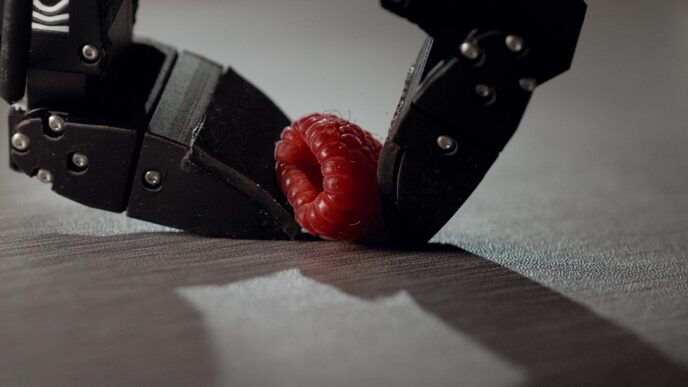
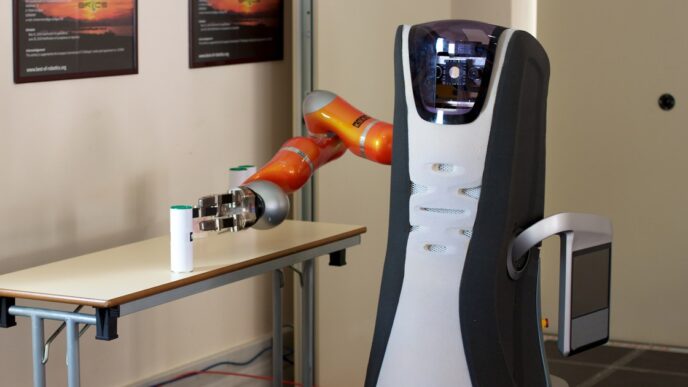
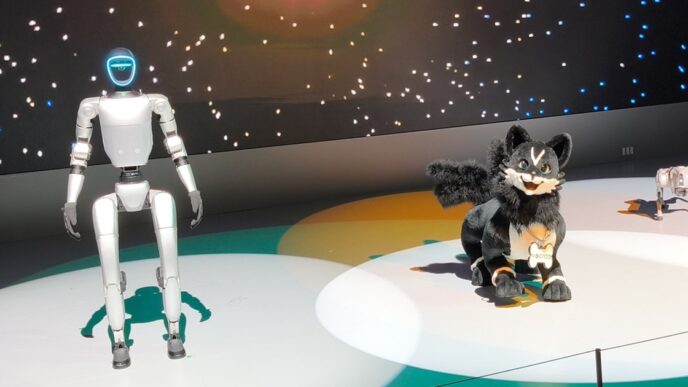
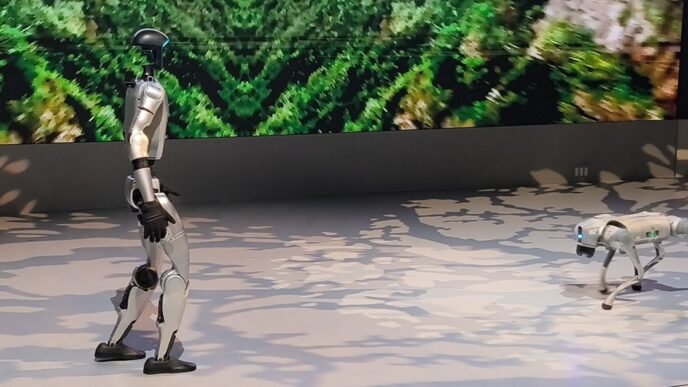
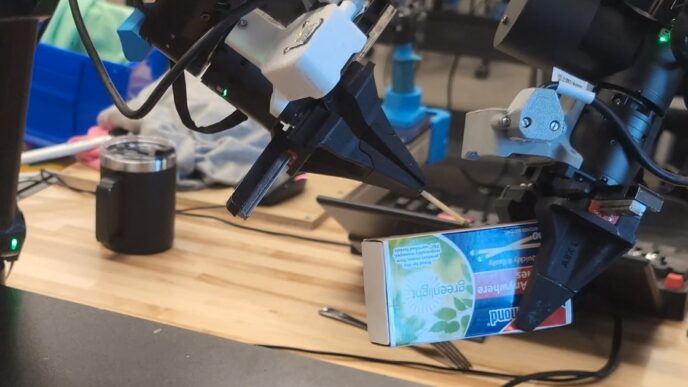
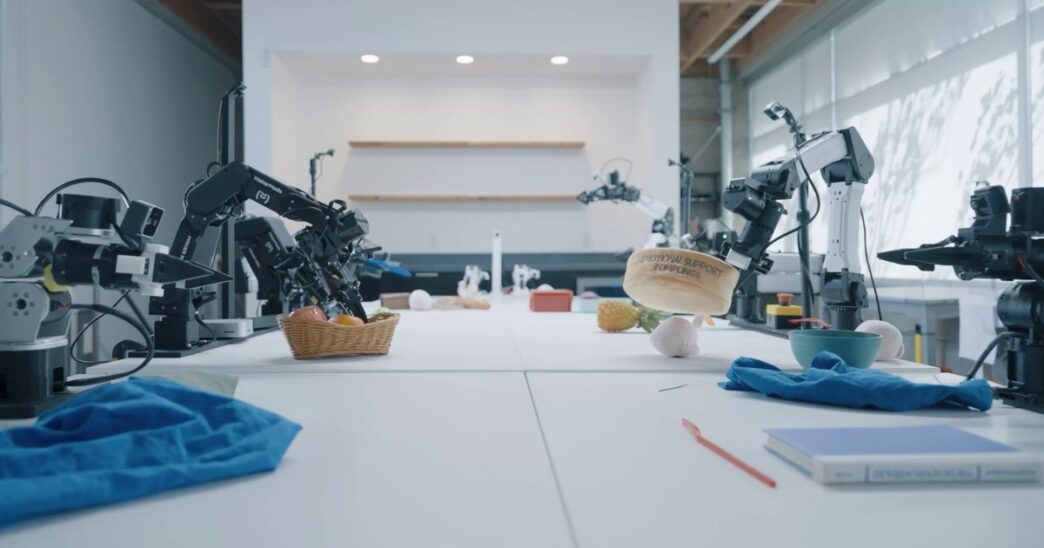
The part that lets one model drive many robots is the output. Dream-1 predicts where the grippers should go (end-effector poses) instead of motor commands for one specific arm, and each robot’s own inverse-kinematics solver turns those targets into joint motions. Every API call returns 1.6 seconds of actions. The model was trained on YAM, a two-arm setup, and Dream Labs says it then ran 27 robots it had never trained on in simulation, at 300 rollouts each, plus real machines from its hardware partners. One clip shows the PR2, a research robot Willow Garage released 18 years ago.
“Zero-shot” does not mean any robot. The launch post scopes Dream-1 to “bimanual robots with parallel grippers,” and its own chart shows results varying from robot to robot. The Business Wire release is looser, saying Dream-1 can control “any robot with grippers, zero-shot.” The tasks shown are tabletop jobs: turning a dial, lifting a pot by its handles, pressing a button, picking up a knife by the handle.
Today, Dream Labs is coming out of stealth with Dream-1, a robot foundation model that controls bimanual robots it has never seen, on tasks it was never shown, in places it has never been, from $3/hour.
Dream API is live for everyone, today. 🧵 pic.twitter.com/MB1snhUOAJ
— Dream Labs (@dreamlabs_ai) October 19, 2026
Video: Dream Labs. Dream-1 launch video from the official Dream Labs X account, October 19, 2026 (watch on X).
The $3-an-hour math, and the fine-tuning bill
Dream Labs bills for robot time, not tokens. Its launch post prices Dream-1 at $3 an hour and the lighter Dream-1-flash at $2 an hour. At 1.6 seconds of actions per call, an hour is 2,250 calls, which the company puts at about $0.0013 per action for Dream-1 and $0.0009 for flash. Forbes, which interviewed the founders, reported the smaller model at 75 cents an hour. Dream Labs’ own post says $2, its billing page sits behind a login, and we are using the published figure until the company clarifies.
Adapting the model to an unfamiliar robot costs extra. Dream Labs’ platform docs list a fine-tuning job at $200 “at the time of writing.” The company says five minutes of a robot’s own data improved two partner arms, Seeed Studio’s reBot B601 and the Maker Arm. Bodies further from the training robot took more: 77 minutes of data for a Dexmate robot with Sharpa dexterous hands, and 98 minutes for a YAM fitted with a compliant gripper and a modified knife gripper.
The docs flag two practical limits. A model that hasn’t been running, such as a freshly fine-tuned one, “can take up to an hour” to start (25 to 50 minutes in Dream Labs’ tests), and each session can make three calls in a row, then one every 0.7 seconds. The robots Dream-1 supports today cost about $2,000 to $10,000, according to the company, which says it works with more than 20 hardware makers.
The benchmark is outside, but not at arm’s length
Dream Labs leans on an outside score from Robocurve, which calls itself a public benefit corporation that measures robot capabilities. It tested Dream-1 before launch on its RoboDojo-RC Tier 1 tasks. In its report, Dream-1 averaged 59 per task attempt, against 48 for Google’s Gemini 4 Argon (high), 43 for OpenAI’s GPT-6 Astra (high) and 10 for NVIDIA’s GR00T N1.7. Language models were capped at 40 model calls per attempt and robot policies at 3,600 control steps.
Two caveats. Robocurve also appears in the list of beta testers on Dream Labs’ own site, so this is an early-access evaluation, not a blind one. And the chart puts general-purpose models that steer a robot through repeated calls, such as Gemini 4 Argon, next to policies built for motor control. Robocurve’s separate RoboHarm safety chart does not include Dream-1.
The fine print: research, evaluation and development only
The launch post sells a business: “If people will pay for what your robot does, you keep everything above the hourly cost.” The API terms Dream Labs published the same day (version 1.0, effective October 19) are narrower. Section 10.7 says the services “are licensed for research, evaluation, and development only” and that “you must not use the Services or Output for production or commercial operations.” A separate written agreement is required for any production or commercial deployment, and for any use where a person must be inside the “Hazard Zone,” which the terms define as the full space the robot and anything it holds can reach.
The launch post itself calls Dream-1 “a research beta” that “has not been validated for safety-critical use,” and the terms describe “an experimental beta offering” in which a robot “may do the wrong thing, fail without warning, or damage property.” That is a sensible stance for a model this new. It also means $3 an hour is, for now, the price of an experiment. Dream Labs has not published what a commercial agreement costs.
How Dream-1 compares, and what Dream Labs does next
Dream Labs calls Dream API the first publicly available API for a robot foundation model. Physical Intelligence opened a Pi API beta on October 13 but has not published a price or a hardware list. NVIDIA’s GR00T models, by contrast, are downloadable weights you run yourself. Dream-1 is offered only through the hosted API; its client SDK is open source, but the model weights are not.
The company says it has 12 researchers and engineers, led by chief executive Joel Jang and chief technology officer Yunhao Ge. “The hardware is ready. What’s been missing is a brain any robot can use,” Jang said in the funding release. A.Capital, Kindred Ventures, Unusual Ventures, SV Angel, Wing VC, Scribble VC and Adrian Aoun joined B Capital in the round. According to Forbes, support for wheeled mobile robots and dexterous hands comes next, and most of the money goes to compute. No dates were given.
What to watch: results from testers who are not on the beta list, whether the flash price settles at $2 or the 75 cents Forbes reported, and what Dream Labs charges the first customer who wants a robot doing paid work.
Frequently asked questions
How much does Dream-1 cost?
Dream Labs’ launch post prices Dream-1 at $3 per hour of robot time and Dream-1-flash at $2 per hour, or about $0.0013 and $0.0009 per 1.6-second action call. Forbes reported the smaller model at 75 cents an hour. Fine-tuning jobs cost $200 each, according to the platform docs.
Which robots does Dream-1 work with?
Out of the box, two-armed robots with parallel grippers. Dream Labs says it tested 27 unseen robots in simulation plus real partner robots, including the PR2. Robots with dexterous hands or unusual grippers need fine-tuning on their own data, and support for wheeled mobile robots has not launched.
Can I use Dream-1 for a commercial robot?
Not under the standard terms. Dream Labs’ API Terms (version 1.0, effective October 19, 2026) license the service for research, evaluation and development only. Production or commercial deployment, or any task with a person inside the robot’s reach, requires a separate written agreement.
Who founded Dream Labs and how much has it raised?
Dream Labs was founded by former leads of NVIDIA’s GR00T robotics research, with Joel Jang as chief executive and Yunhao Ge as chief technology officer. It raised a $90 million seed round led by B Capital, announced October 19, 2026.
How did Dream-1 score against Gemini and GPT models?
On Robocurve’s RoboDojo-RC Tier 1 tasks, Dream-1 averaged 59 per attempt, versus 48 for Gemini 4 Argon (high), 43 for GPT-6 Astra (high) and 10 for GR00T N1.7. Robocurve is also listed as a Dream Labs beta tester, and no fully independent evaluation has been published yet.
Sources
- Dream Labs, “Zero-Shot to New Robots: Introducing Dream-1,” October 2026 (World Action Model, 1.6-second action calls, $3 and $2 hourly prices, 27 simulated robots, PR2, fine-tuning data times, Robocurve chart, research beta and safety statement, launch video): dreamlabs.ai
- Dream Labs via Business Wire, “Dream Labs Raises $90M Seed to Build the Brain for Everyday Robots,” October 19, 2026 (round, investors, Jang quote, robot cost range, hardware partners): businesswire.com
- Dream Labs platform documentation (fine-tuning price, cold start, latency, rate limit) and API Terms v1.0, effective October 19, 2026 (sections 4.4, 10.7): platform.dreamlabs.ai
- Dream Labs, launch post on X, October 19, 2026: x.com/dreamlabs_ai
- Robocurve, RoboDojo-RC evaluation of Dream-1: robocurve.org
- John Koetsier, Forbes, “Robot Brains For 75 Cents/Hour? Former Nvidia Researchers Raise $90 Million,” October 19, 2026 (flash price as reported, roadmap, use of funds): forbes.com
- DreamZero paper: arXiv 2602.10556
All sources accessed October 20, 2026. Prices, the Dream-1 research page and Robocurve’s scores rechecked October 21, 2026. Dream Labs’ platform docs and API terms now sit behind a sign-in page, so those details are as published on October 20.
Related: More AI Models coverage · Robot companies directory
Last updated: October 21, 2026. To report an error, see our corrections page. Articles are drafted with AI assistance and reviewed and edited by an editor; see our editorial policy.