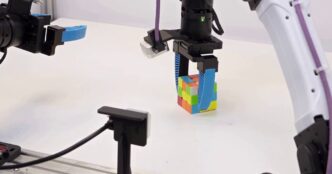
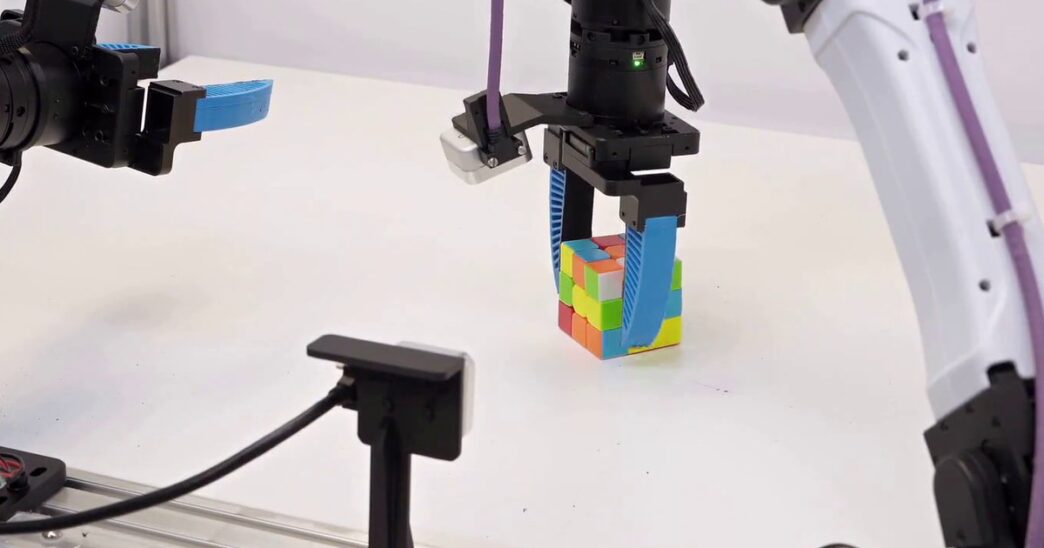
The first time NVIDIA’s robot arms tried to solve a Rubik’s Cube with ASPIRE, they managed three face turns in 51 minutes and never finished. Each of those turns cost about $16.85 in AI model fees. By the third attempt in the same session, the robot was solving the cube at about three minutes and $2.89 per turn, and nobody had shown it how.
NVIDIA ASPIRE is the system behind that demo, and NVIDIA’s GEAR robotics lab released version 1.0 as open source on October 16 under the Apache 2.0 license. Instead of training a robot model on hours of human demonstrations, ASPIRE has a coding agent like GPT-6 Astra or Claude write the robot’s control program, watch it run, figure out what broke and save the fix as a reusable “skill.” It’s a different answer to a question robotics labs keep arguing about: whether robots should learn from data or borrow their intelligence from the big language models. NVIDIA’s own numbers also show what that borrowed intelligence costs.
What NVIDIA open-sourced with ASPIRE
The code is on GitHub under NVlabs, with a project page and a paper first posted on arXiv on June 30. The v1.0 commit landed late on October 15, Eastern time, and the team announced it the next day. The project leads are Runyu Lu, Yuke Zhu, Linxi “Jim” Fan and Guanzhi Wang, with co-authors from the University of Michigan, UIUC, UC Berkeley and Carnegie Mellon.
The README describes the idea in three lines: “training” is skill refinement instead of gradient descent, and the “trained model” is a repository of sensorimotor skills, not a file of weights. In practice, ASPIRE has three parts. An execution engine records what the robot saw, which grasps it considered and where motions failed. A skill library stores fixes that worked. And an evolutionary search tries many program variants in parallel instead of debugging one at a time. You run it by pointing Claude Code or OpenAI’s Codex at the repo.
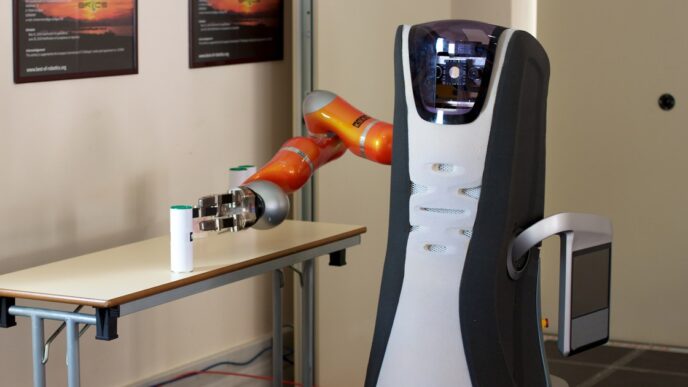
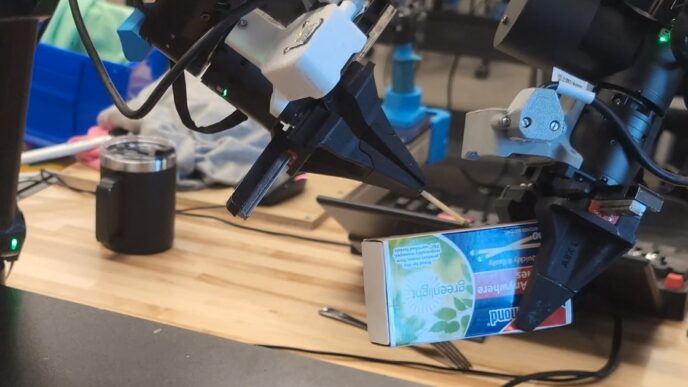
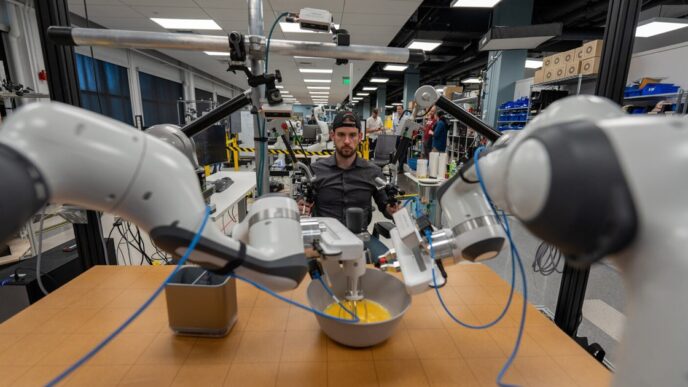
The physical demos run on a bimanual YAM station, two six-joint arms with soft grippers and calibrated cameras. Besides the cube, NVIDIA shows the arms unscrewing a bottle cap, putting a pill in a bottle and closing it, and nesting cups upside down. Guanzhi Wang wrote on X that the cube solve needed “no teleoperation demos or simulation training.” One detail matters, though: the move sequence comes from a standard symbolic cube solver, according to NVIDIA’s operator runbook. ASPIRE’s job is the hard physical part of grasping, turning and checking the cube.
The Rubik’s Cube got cheaper as the robot practiced
The project page publishes per-turn figures for three back-to-back cube episodes in one GPT-6 Astra session. NVIDIA says the numbers are amortized over the full episode, including failed attempts, recovery and context compaction.
| Episode | Outcome | Face turns | Episode time | Time per turn | Tokens per turn | Cost per turn |
|---|---|---|---|---|---|---|
| 1 | Unsolved | 3 | 50 min 54 s | 16 min 58 s | 11.27M | $16.85 |
| 2 | Solved | 5 | 39 min | 7 min 48 s | 5.56M | not published |
| 3 | Solved | 25 | 77 min 10 s | 3 min 05 s | 2.01M | $2.89 |
That’s the “continual learning” pitch in miniature: the skills and context the agent built up in earlier episodes made later ones faster and cheaper. It’s also one session on one station, so treat it as a demonstration, not a reliability figure. Three minutes a turn is a long way from a human cuber.
The model you rent decides whether the robot works
The most useful chart for anyone budgeting a project compares coding agents on the same ten LIBERO-Pro simulation tasks, with objects moved from their usual positions. NVIDIA’s README says success “rises from 15% (GPT-6 Luna) to 99% (Claude Opus 5.5)” with nothing else changed. Costs are at list API prices.
| Coding agent | Held-out success | API cost per task | Agent time per task |
|---|---|---|---|
| Claude Opus 5.5 | 99.2% | $18.29 | 51 min |
| Claude Sonnet 5.5 | 98.8% | $12.11 | 56 min |
| GPT-6 Astra | 94.4% | $35.37 | 31 min |
| GPT-6.1 Sol | 88.0% | $9.52 | 49 min |
| Kimi K3 (open weights) | 78.4% | $58.19 | 139 min |
| Claude Haiku 5.5 | 68.0% | $3.97 | 54 min |
| GPT-6 Luna | 14.8% | $0.83 | 47 min |
Jim Fan, who co-leads GEAR, summed it up on X: “On the day Astra arrived, our lab switched the backend model and saturated all the benchmarks to ~99% over night.” He added that Sonnet 5.5 “hits the Pareto frontier of cost vs. robot capability, $12/task.” Astra was the fastest agent in the table but cost nearly three times as much per task as Sonnet. If you’ve been following the GPT-6.1 Sol versus Astra pricing story, the same trade-off shows up here with a robot attached.
Big scores, with an asterisk on the comparison
All of these results come from NVIDIA’s team, not an independent evaluation. On LIBERO-Pro with shifted object positions, NVIDIA reports ASPIRE with GPT-6 Astra at 99%, 97% and 99% on its Object, Goal and Spatial suites, against 17%, 38% and 20% for Physical Intelligence’s π0.5. That’s a striking gap, but it isn’t like for like. π0.5 is a vision-language-action model that runs on the robot and outputs motor commands directly. ASPIRE uses a frontier language model, usually through an API, that writes Python against a fixed menu of perception and motion tools, including Meta’s SAM 3 segmentation model, and it gets to debug on a separate split of seeds before it’s scored.
The real-robot transfer test is smaller but more telling. With a skill borrowed from simulation, the agent’s code opened and pushed a drawer in 11 of 20 trials, up from 0 of 20 without it, and used about a quarter of the tokens to get there. Lifting a soda can went from 13 of 20 to 19 of 20.
What ASPIRE still can’t do
NVIDIA lists the limits on its own project page. ASPIRE isn’t yet a fully autonomous real-world learner, because a physical robot still needs reliable success detection, safe resets, safety monitoring and calibration. It depends on a frozen frontier model, and the team hasn’t shown that smaller models can keep the debugging loop going. It’s limited to a predefined set of primitives. And the search loop burns a lot of model calls.
The README also carries a blunt warning: ASPIRE executes language-model-generated Python with full import access, and its watchdogs “are not a security sandbox.” NVIDIA tells users to run it on an isolated machine without credentials and never to give a simulation agent access to physical hardware. That’s sensible advice for any lab tempted to wire a chatbot to a robot arm.
The open question is whether the cost curve holds outside NVIDIA’s lab. The skills are plain text, so anyone with a YAM station and an API budget can try the cube runbook. If other labs get similar per-turn costs on different arms, or if cheaper models like Haiku close the gap, “rent a frontier model to program your robot” stops being a research trick and becomes a line item.
Frequently asked questions
What is NVIDIA ASPIRE?
ASPIRE (Agentic Skill Programming through Iterative Robot Exploration) is a framework from NVIDIA’s GEAR robotics lab in which an AI coding agent writes robot control programs, runs them, diagnoses failures and saves working fixes as reusable text skills. Version 1.0 was open-sourced on October 16, 2026.
Is NVIDIA ASPIRE free to use?
The code is free under the Apache 2.0 license on GitHub, but running it isn’t. ASPIRE calls a commercial or open-weight language model, so you pay API or compute costs, and it needs an NVIDIA GPU with CUDA plus access to Meta’s gated SAM 3 weights. Third-party parts keep their own licenses.
How much does it cost to run ASPIRE?
In NVIDIA’s tests on ten LIBERO-Pro simulation tasks, API costs ranged from $0.83 per task with GPT-6 Luna (14.8% success) to $58.19 with Kimi K3, with Claude Sonnet 5.5 at $12.11 and 98.8% success. On the real Rubik’s Cube, GPT-6 Astra cost $16.85 per face turn in the first episode and $2.89 in the third.
Which robots does ASPIRE work with?
NVIDIA’s real-robot demos use a two-arm YAM station with soft grippers and calibrated cameras, and the simulation results cover LIBERO-Pro, Robosuite and BEHAVIOR-1K. NVIDIA says skills found in simulation carried over to real arms. The project page doesn’t show results on a humanoid.
Is ASPIRE a vision-language-action model?
No. A VLA like π0.5 or NVIDIA’s own GR00T is a trained neural network that turns camera images and instructions into motor commands. ASPIRE doesn’t train weights at all. It uses a general-purpose language model to write and fix code that calls perception and motion tools.
Sources
- NVIDIA GEAR, “ASPIRE: Agentic /Skills Discovery for Robotics,” project page (method, limitations, benchmark charts and data file): research.nvidia.com
- NVlabs/ASPIRE on GitHub (README, Apache 2.0 license, v1.0 release commit of October 16, 2026 03:57 UTC): github.com
- NVlabs/ASPIRE, “System 2 operator runbook” (real-robot setup and Rubik’s Cube task): github.com
- Runyu Lu et al., “ASPIRE: Agentic /Skills Discovery for Robotics,” arXiv:2607.00272, submitted June 30, 2026: arxiv.org
- Jim Fan on X, ASPIRE v1.0 announcement, October 16, 2026: x.com
- Guanzhi Wang on X, ASPIRE Rubik’s Cube demo, October 16, 2026: x.com
All sources accessed October 18, 2026. Costs are NVIDIA’s figures at list API prices; we haven’t run ASPIRE ourselves.
Related: NVIDIA GR00T, explained · Physical Intelligence’s π API beta · More AI Models coverage
Last updated: October 18, 2026. To report an error, see our corrections page. Articles are drafted with AI assistance and reviewed and edited by an editor; see our editorial policy.