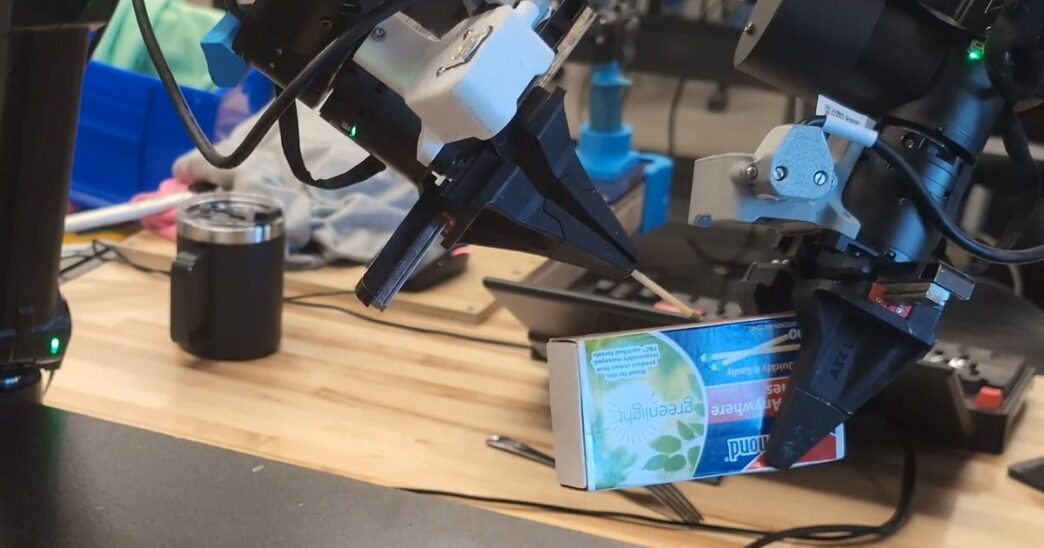
π0 (pronounced “pi-zero”) is a robot AI model from the San Francisco startup Physical Intelligence. You give it camera images, a plain-language instruction such as “fold the towel,” and the robot’s joint positions, and it outputs the next second or so of motor commands. It belongs to a class called vision-language-action (VLA) models. What made it matter is that Physical Intelligence released the code and weights in February 2025, so anyone with a capable GPU and a robot arm can fine-tune it.
π0 is now the oldest member of a family. Physical Intelligence has since published π0-FAST, π0.5, π0.6, an RL-trained π*0.6 and, in April 2026, π0.7. Only the first three are open, and in October 2026 the company started renting access to its newer models through a paid beta API. This guide covers how π0 works, what each version added, which parts you can download today, what hardware you need, and how π0 compares with other open robot models. We checked the repository, model card and company posts on November 12, 2026.
- What it is: a generalist VLA. A roughly 3-billion-parameter vision-language model plus a 300-million-parameter “action expert” that uses flow matching to output chunks of 50 continuous actions.
- Open: π0, π0-FAST and π0.5 base checkpoints are in the openpi repository (Apache 2.0 code), pretrained on more than 10,000 hours of robot data. π0.6, π*0.6 and π0.7 are not.
- Hardware: more than 8 GB of GPU memory to run it, more than 22.5 GB for LoRA fine-tuning and more than 70 GB for full fine-tuning, per the openpi README.
- The catch: Physical Intelligence warns that π0 “may or may not work” on your robot. The open checkpoints are tuned for research arms such as ALOHA and DROID’s Franka setup, not for commercial humanoids.
Updated November 12, 2026: this guide was rewritten and expanded. New: every π release from π0 to π0.7 and the Pi API, what is and isn’t open, GPU requirements, which checkpoint to start with, and a comparison with other open robot models.
How π0 turns a picture and a sentence into motion
π0 starts from a pretrained vision-language model, the kind of AI that already understands images and text from the web. On top of it, Physical Intelligence added a smaller network it calls the action expert. Instead of writing actions out as text tokens, as earlier VLAs such as Google’s RT-2 did, the action expert uses flow matching, a technique related to diffusion, to generate smooth, continuous joint commands. According to the π0 paper (arXiv 2410.24164), the whole model is about 3.3 billion parameters and outputs 50 future actions at a time, an “action chunk.”
That design is about speed and smoothness. Company materials describe control at up to about 50 Hz, fast enough for contact-rich work such as folding laundry or bagging groceries. The training data is deliberately mixed: the paper describes data from single-arm robots, two-arm setups and mobile manipulators, and the openpi base checkpoints are pretrained on “10k+ hours of robot data.” The bet is that a model that has seen many robot bodies learns something general about manipulation, which a new robot can then pick up with a small amount of fine-tuning data.
If the VLA idea is new, start with our plain-English VLA explainer. For where π0 sits among other robot foundation models, see our robot foundation models timeline.
The π family, release by release
| Date | Release | What changed | Can you download it? |
|---|---|---|---|
| Oct 31, 2024 | π0 | First generalist policy: VLM plus flow-matching action expert, trained across many robot types | Yes, since Feb 4, 2025 |
| Jan 16, 2025 | FAST tokenizer / π0-FAST | A way to compress actions into tokens. Physical Intelligence says it trains generalist policies 5x faster | Yes (π0-FAST), since Feb 4, 2025 |
| Feb 4, 2025 | openpi | Weights and code for π0 and π0-FAST released on GitHub | Yes |
| Apr 22, 2025 | π0.5 | Co-trained on robot, web and high-level task data. First predicts a text subtask (“pick up the cutting board”), then a 1-second action chunk. Cleaned kitchens and bedrooms in homes it had never seen | Yes, added to openpi in September 2025 (flow-matching head only), with PyTorch support |
| May 28 and Jun 9, 2025 | Knowledge insulation; real-time action chunking | Training that keeps the VLM’s web knowledge intact, and a way to keep large models responsive despite latency | Methods. openpi says its π0.5 model was trained with knowledge insulation |
| Nov 17, 2025 | π0.6 and π*0.6 | π0.6 moves to a Gemma 3 4B backbone with an action expert of about 860M parameters. π*0.6 adds reinforcement learning from the robot’s own experience (“Recap”) | No. A model card and blog post only |
| Mar 2026 | Memory (MEM) and RL Token | Long- and short-term memory for tasks over ten minutes; faster online RL on precise tasks | No |
| Apr 16, 2026 | π0.7 | A “steerable” model prompted with language, metadata (how fast or how well to do a task) and visual subgoal images from a small world model. Physical Intelligence reports early signs of combining skills to solve new tasks | No |
| Oct 13, 2026 | Pi API beta | Upload data, fine-tune on Physical Intelligence’s compute, run hosted inference on your own robots | No. Paid access by application; no public price |
The pattern is clear from the table. Physical Intelligence opened its first generation, then kept everything from π0.6 onward closed, and now sells access to its newer models instead. For researchers, that freezes the best open π model at π0.5, which was announced in April 2025.
What π0.6, π*0.6 and π0.7 added (and why they matter even if you can’t download them)
π0.6 keeps π0.5’s two-level design but uses a larger backbone. Its model card lists a Gemma 3 4B vision-language model, an action expert of about 860 million parameters and up to four camera images. With five denoising steps and three cameras, it takes 63 milliseconds to produce an action chunk on a single NVIDIA H100, according to Physical Intelligence.
π*0.6 is π0.6 trained further with reinforcement learning on the robot’s own attempts, plus human corrections. Physical Intelligence says this more than doubled throughput on some of its hardest tasks and cut failure rates by half or more. Its demos: espresso drinks from 5:30 a.m. to 11:30 p.m., 50 unfamiliar laundry items folded in a new home, and 59 chocolate boxes assembled in a real factory. These are the company’s own runs, shown in its own videos.
π0.7 is the steerable one. Besides an instruction, it takes metadata about how a task should be done and images that show what the end of each step should look like. Physical Intelligence says a single π0.7 model matched the RL-trained π*0.6 specialists on laundry, espresso and box folding, and could operate kitchen appliances it hadn’t been trained on after step-by-step language coaching. The air fryer example in its post finished only part of the task before coaching. Treat all of this as company evaluation until outside groups can test the model.
What you need to run or fine-tune π0
From the openpi README, checked November 12, 2026:
| Job | GPU memory | Example GPU |
|---|---|---|
| Inference | More than 8 GB | RTX 4090 |
| Fine-tuning with LoRA | More than 22.5 GB | RTX 4090 |
| Full fine-tuning | More than 70 GB | A100 (80 GB) or H100 |
The repository is tested on Ubuntu 22.04 only, and its training script doesn’t yet support multi-node training. You can run the model on a separate server and stream actions to the robot over a websocket, which keeps a heavy GPU off the robot. If you already use Hugging Face’s LeRobot library, it ships π0 as a policy type with a lerobot/pi0_base checkpoint, so you can fine-tune with LeRobot’s own training command instead of openpi’s JAX setup.
A realistic first project: convert your robot’s demonstrations to a LeRobot dataset, fine-tune the π0.5 base checkpoint with LoRA on one 24 GB-class GPU, then run inference remotely. Physical Intelligence’s own LIBERO example follows exactly those steps.
Which checkpoint to start with
| Checkpoint | Use | Best for |
|---|---|---|
| π0.5 base | Fine-tuning | Most new projects. It’s the newest open base model, with the best open-world generalization |
| π0 base / π0-FAST base | Fine-tuning | Comparing against published π0 results, or when you want the autoregressive FAST variant |
| π0.5-DROID | Inference or fine-tuning | A Franka arm in the DROID setup. Fast inference and good language-following, per openpi |
| π0-FAST-DROID | Inference | Simple tabletop tasks zero-shot on the DROID platform |
| π0.5-LIBERO | Inference | The LIBERO simulation benchmark |
| π0-ALOHA (towel, tupperware, pen uncap) | Inference | The specific ALOHA tasks they were tuned on |
None of these is tuned for a humanoid. Getting π0 onto a Unitree G1 or another humanoid means collecting your own demonstrations for that body and fine-tuning, which is the “serious embodiment work” most vendor claims gloss over.
π0 compared with other open robot models
| Model | Maker | Size | Open? | Note |
|---|---|---|---|---|
| π0 / π0.5 | Physical Intelligence | About 3.3B (π0) | Yes, openpi | Flow-matching action expert; strongest open π models |
| OpenVLA | Stanford-led team | 7B | Yes | June 2024; Llama 2 based, trained on 970,000 robot demonstrations; outputs action tokens |
| SmolVLA | Hugging Face | Small (built to train on one GPU) | Yes | June 2025; aimed at affordable community robots and consumer GPUs |
| Isaac GR00T N1.7 | NVIDIA | Not stated here | Yes, commercial licence | Built for humanoids, with tools for custom robot bodies |
| GR00T 2 | NVIDIA | 2B | Announced as open; weights not posted as of Nov 10, 2026 | A world action model that predicts video and actions together |
| UnifoLM-WLA-1.0 | Unitree | See our report | Yes, Hugging Face | Tied to Unitree’s own humanoids |
| Gemini Robotics 2.5 | Google DeepMind | Not disclosed | No. Partners only | The closed benchmark π models are usually measured against |
Nobody has published a fair head-to-head of these models on the same robot and tasks, so this table doesn’t rank them. What it shows is how much you can inspect, fine-tune and ship yourself. For NVIDIA’s family, see our GR00T explainer.
Our take: why π0 still matters
π0 matters less as a model than as a reference point. It’s the open baseline that research papers compare against, the checkpoint robotics startups fine-tune first, and the reason “VLA” became a household term in robot labs. Physical Intelligence’s later work, such as RL from experience and steerable prompts, is arguably more important, but none of it is open.
That creates a tension worth watching. Bloomberg reported on October 27, 2026 that Physical Intelligence is in talks to raise at least $1 billion at about a $20 billion valuation, and that it has no revenue. The Pi API is its first visible product. If the company keeps its newest models behind the API, the open community will build on π0.5 and on rivals’ open models such as GR00T and SmolVLA. If it releases a newer generation to openpi, π0’s lineage stays the default starting point. The next openpi commit will tell you which way it’s going.
One practical warning. When a robot vendor says its machine “runs π0,” ask which checkpoint, fine-tuned on what data, on which robot, with what success rate and how many interventions. An open base model is a starting point, not a finished product.
Frequently asked questions
What is Physical Intelligence’s π0?
π0 is a vision-language-action model that takes camera images, a language instruction and the robot’s state and outputs chunks of continuous robot actions. It combines a roughly 3-billion-parameter vision-language model with a 300-million-parameter flow-matching action expert, and its code and weights are open in the openpi repository.
Is π0 open source?
The openpi repository is released under the Apache 2.0 licence and includes base checkpoints for π0, π0-FAST and π0.5, plus fine-tuned checkpoints for DROID, ALOHA and LIBERO. π0.6, π*0.6 and π0.7 have not been released as of November 12, 2026.
What GPU do I need to run π0?
The openpi README lists more than 8 GB of GPU memory for inference, more than 22.5 GB for LoRA fine-tuning (for example an RTX 4090) and more than 70 GB for full fine-tuning (an 80 GB A100 or H100). It is tested on Ubuntu 22.04.
What is the difference between π0 and π0.5?
π0.5 builds on π0 but is co-trained on robot, web and high-level task data. It first predicts a text subtask, then the motor actions for it, which helps it generalize to new environments such as homes it has never seen. Both are available in openpi.
What is π0.7?
π0.7, announced April 16, 2026, is Physical Intelligence’s steerable model. It accepts language plus metadata about how to perform a task and visual subgoal images. Physical Intelligence reports that it matches its RL-trained specialist models and shows early signs of combining skills for new tasks. It is not publicly downloadable.
Sources
- Physical Intelligence, “π0: A Vision-Language-Action Flow Model for General Robot Control,” arXiv:2410.24164, October 31, 2024: arxiv.org
- Physical Intelligence, openpi repository and README (checkpoints, GPU requirements, Apache 2.0 licence), checked November 12, 2026: github.com
- Physical Intelligence blog index (release dates from π0 to the Pi API beta), checked November 12, 2026: www.pi.website
- Physical Intelligence, “π0.5: a VLA with Open-World Generalization,” April 22, 2025, and arXiv:2504.16054: www.pi.website
- Physical Intelligence, π0.6 model card (Gemma 3 4B backbone, 860M action expert, 63 ms per chunk): website.pi-asset.com
- Physical Intelligence, “π*0.6: a VLA that Learns from Experience,” November 17, 2025: www.pi.website
- Physical Intelligence, “π0.7: a Steerable Model with Emergent Capabilities,” April 16, 2026: www.pi.website
- Hugging Face LeRobot documentation, π0 policy: huggingface.co
- Kim et al., “OpenVLA: An Open-Source Vision-Language-Action Model,” arXiv:2406.09246, June 2024: arxiv.org
- Shukor et al., “SmolVLA: A Vision-Language-Action Model for Affordable and Efficient Robotics,” arXiv:2506.01844, June 2025: arxiv.org
- Robotica Guide reports on the Pi API beta (October 16, 2026), the reported $20 billion valuation talks (Bloomberg, October 27, 2026) and NVIDIA GR00T 2 (November 10, 2026), each with primary sources: roboticaguide.com
All sources accessed or rechecked between October 2026 and November 12, 2026; each linked Robotica Guide report lists the primary sources it used and the date they were checked.
Last updated: November 12, 2026. To report an error, see our corrections page. See our editorial policy.