A robot gripper that costs less than $1,000 just helped make a startup that left stealth six months ago worth $1.45 billion. Eka Robotics, founded by MIT professor Pulkit Agrawal and former Google DeepMind researcher Tuomas Haarnoja, has closed a $150 million Series A led by a16z and F-Prime, TechCrunch reported on October 20.
The pitch is that robots should feel their way through a grasp instead of mostly looking at it. Eka calls its approach a Vision-Force-Action model, and the numbers it is quoting are big: about 1,500 picks an hour against roughly 600 for a person. What Eka hasn’t shown yet is the thing factory buyers care about most, which is a named customer running the system for months without a break.
- The deal: a $150 million Series A at a $1.45 billion post-money valuation, led by a16z and F-Prime, per TechCrunch.
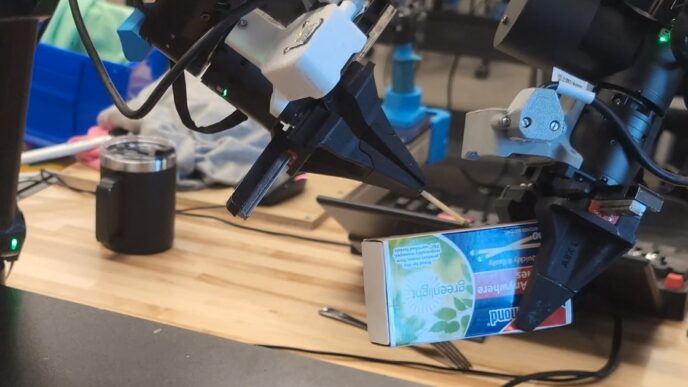
- The hardware: Eka’s gripper costs less than $1,000 and is rated for 5 million duty cycles, according to co-founder Pulkit Agrawal. The goal is 20 million.
- Status: unnamed industrial pilots in pick-and-place and wire handling. No public product, price list or model release.
- The catch: the 1,500-picks-an-hour and 95% reliability figures are Eka’s own lab numbers. No paper or outside benchmark has been published.
What Eka Robotics means by a Vision-Force-Action model
Most of the robot models we cover are vision-language-action models: they take in camera images and a typed instruction and put out motor commands. Eka’s website describes a different stack built around force, which it calls “the physical world in its native language.” Cameras tell the robot roughly where an object is. Force readings from the hand tell it whether the grasp is slipping or about to crush something.
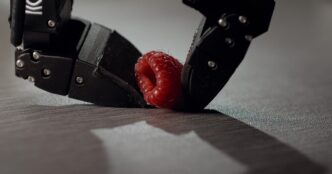
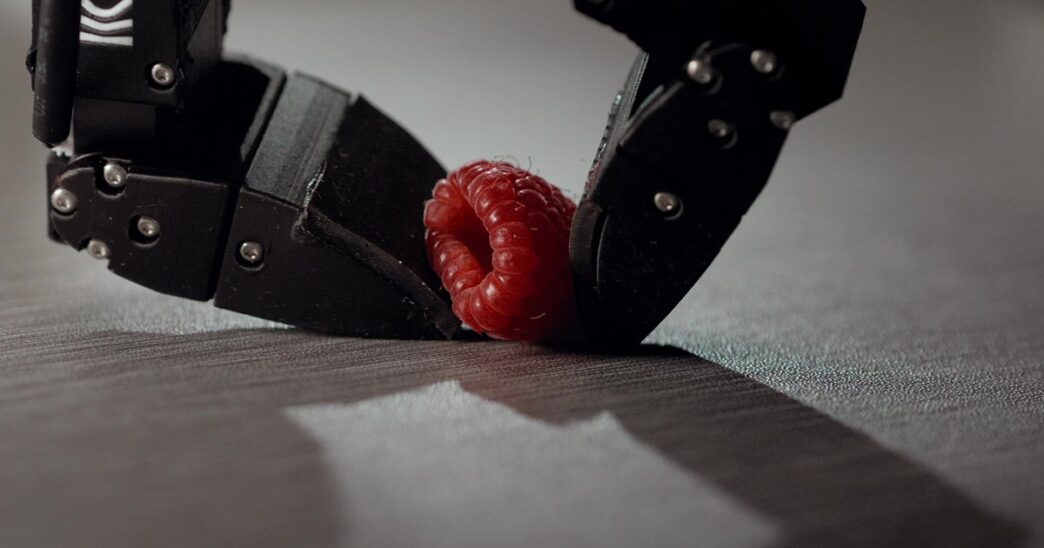
“Vision is not the primary way in which you close this last millimeter problem,” Agrawal told TechCrunch. “Vision tells you roughly where the object is, what the pose is, but the actual grabbing, the actual searching is happening through forces.” To get those readings, Eka designed its own gripper with more force sensors and more give than a standard industrial gripper. In a slow-motion clip on Eka’s site, it closes on a raspberry without squashing it.
The founders are guarded about the details. According to TechCrunch, Eka models the forces of a grasp in a physics simulator and runs reinforcement learning there at scale, which it says produces thousands of hours of robot experience in minutes. That is a bet against the industry’s current habit of paying people to record demonstrations, a data problem we looked at in our piece on humanoid training data. a16z’s investment post notes that Haarnoja co-created Soft Actor-Critic, a widely used reinforcement learning algorithm, at Berkeley before training simulated humanoids at DeepMind.
The 1,500-picks-an-hour claim, and who is making it
TechCrunch reports that Eka’s robot can pick up about 1,500 objects weighing up to 1 kilogram in an hour, compared with about 600 for a human, and that Eka says it succeeds more than 95% of the time. a16z’s post narrows the setting: up to 1,500 picks per hour “in laboratory induction and bin-picking tasks.” Both figures come from the company and its lead investor. Eka’s own announcement says the robots hit that rate on “a wide variety of objects outside the training distribution” and puts it at “roughly two and a half times” a human. Eka hasn’t published a test protocol, an object list or a failure breakdown.
@EkaRobotics has raised a $150M Series A.
Generality v/s Performance is the fundamental tension at the frontier of robotics. Generality without performance is just a prototype. Performance without generality is just a single-purpose tool.
Customers shouldn’t have to choose. Eka… pic.twitter.com/fdu5IO5o7D
— Pulkit Agrawal (@pulkitology) October 20, 2026
Video: Eka Robotics. A 24-second demo labeled “Eka’s Vision-Force-Action (VFA) Model at 1500 picks/hour” and “1X SPEED,” posted on X by co-founder Pulkit Agrawal on October 20, 2026, and quoted in Eka’s own Series A post (watch on X). The clip doesn’t show a pick count or failure rate.
The outside praise in the TechCrunch story is real but anecdotal. Kris Hauser, a professor at the University of Illinois Urbana-Champaign, said the robot had a “wow factor” and “was able to adapt to a large number of different objects without retraining.” An unnamed roboticist at a frontier lab compared seeing it to the moment legged robots learned to walk reliably. Raghu Raghuram, the a16z general partner who co-led the round, said Eka is “already exceeding superhuman performance for certain tasks.”
A $1,000 gripper that has to last 20 million cycles
The hardware economics are where Eka gets concrete. Agrawal told TechCrunch the gripper costs less than $1,000 and is rated for 5 million duty cycles today. Standard industrial arms are built for about 20 million, and that is Eka’s target. At 1,500 picks an hour, 5 million cycles works out to roughly 3,300 hours of picking, or about 140 days of round-the-clock work. That’s our arithmetic, not an Eka figure, and it assumes one cycle per pick.
That gap is the open question Hauser raised. “What’s going to be a big challenge is when they work with integrators on real assembly lines, and it needs to run without breaking for an entire year,” he told TechCrunch. He also asked how far the approach generalizes beyond pick-and-place, which is most of what he has seen. Eka says it is starting with two verticals, pick-arrange-place and wire handling, in pilots with industrial customers it won’t name.
Agrawal’s MIT lab is pushing the same idea from the research side. On October 16 it posted a paper on “blind” assembly policies that feel parts only through the robot’s own joint readings, with no cameras or force sensors, trained entirely in simulation. On a real arm, the peg-insertion policy succeeded in 73% of trials. That work is MIT’s, not Eka’s, but it shows how hard the last millimeter still is outside a demo.
How Eka got here, and what to watch
Eka came out of stealth on April 29, 2026, with a WIRED feature by Will Knight that showed its gripper sorting food and screwing in lightbulbs. Its site says the team comes from MIT, Berkeley, Harvard, CMU, DeepMind, Microsoft and Boston Dynamics, among others. Eka confirmed the round in its own announcement and on X on October 20. The post lists seed leads Obvious Ventures and E14 Fund, plus MFV Partners, Bison Ventures, Glasswing Ventures, Samsung Next and “several Fortune-500 strategics,” alongside a16z and F-Prime. It doesn’t give a valuation; the $1.45 billion figure comes from TechCrunch.
TechCrunch frames Eka as the hands for slower, more general models such as OpenAI’s GPT-6 Astra: the big model decides that plates go in the cupboard, and Eka’s model picks up the plate without breaking it. Whether that division of labor sticks depends on the next proof point. The first named customer, or a published success rate from a full production shift, would tell buyers far more than another valuation headline.
Frequently asked questions
How much is Eka Robotics worth?
Eka Robotics is valued at $1.45 billion post-money after a $150 million Series A led by a16z and F-Prime, according to TechCrunch’s October 20, 2026 report. Eka’s own announcement confirms the $150 million round and its lead investors but doesn’t state a valuation.
What is a Vision-Force-Action model?
It’s Eka’s name for a robot model that combines camera images with force readings from the robot’s hand to decide how to move. The idea is that vision finds the object, and force feedback handles the grasp itself, such as noticing a slip or easing off before crushing something soft.
How fast is Eka’s robot?
Eka says its system picks about 1,500 objects of up to 1 kilogram per hour, versus about 600 for a person, with more than 95% success. a16z describes the 1,500 figure as coming from laboratory induction and bin-picking tasks. No independent test has been published.
Can you buy Eka’s gripper?
Not publicly. Eka is running pilots with industrial customers it hasn’t named, starting with pick-and-place and wire handling. Co-founder Pulkit Agrawal told TechCrunch the gripper costs less than $1,000 to make and is rated for 5 million duty cycles, but there’s no public price or order page.
Who founded Eka Robotics?
MIT professor Pulkit Agrawal and Tuomas Haarnoja, a former Google DeepMind researcher who co-created the Soft Actor-Critic reinforcement learning algorithm. The company is based in Cambridge, Massachusetts, and came out of stealth in April 2026.
Sources
- Tim Fernholz, TechCrunch, “Eka is worth $1.45B thanks to a physical AI model that has experts raving,” October 20, 2026 (round, valuation, investors, pick rate, 95% figure, gripper cost and duty cycles, pilots, Agrawal, Haarnoja, Hauser and Raghuram quotes): techcrunch.com
- Yoko Li and Raghu Raghuram, a16z, “Investing in Eka Robotics,” October 20, 2026 (Series A lead, laboratory pick rate, simulation training, founder backgrounds): a16z.news
- Eka Robotics, “Eka Robotics Raises $150M to Build Superhuman Intelligence for the Physical World,” October 20, 2026 (Series A, lead and other investors, 1,500 operations per hour claim, light bulb and wire tasks): ekarobotics.com
- Eka Robotics on X, Series A announcement, October 20, 2026: x.com/EkaRobotics
- Pulkit Agrawal (Eka co-founder) on X, Series A post with Eka’s 1x-speed demo video, October 20, 2026: x.com/pulkitology
- Eka Robotics website (Vision-Force-Action model, team, demo clips): ekarobotics.com
- Will Knight, WIRED, “I’ve Covered Robots for Years. This One Is Different,” April 29, 2026: wired.com
- Antonia Bronars, Younghyo Park, Kushal Kedia and Pulkit Agrawal, “Blind Precise Assembly: Proprioceptive Sim-to-Real Peg-in-Hole for Diverse Parts,” arXiv, October 16, 2026: arXiv 2610.23849
All sources accessed October 20–21, 2026. TechCrunch, a16z, Eka’s blog and Eka’s X posts rechecked October 21, 2026, between about 2:40 and 2:50 PM ET; TechCrunch carried no correction.
Related: More Embodied AI coverage · Robot companies directory
Last updated: October 21, 2026. To report an error, see our corrections page. Articles are drafted with AI assistance and reviewed and edited by an editor; see our editorial policy.