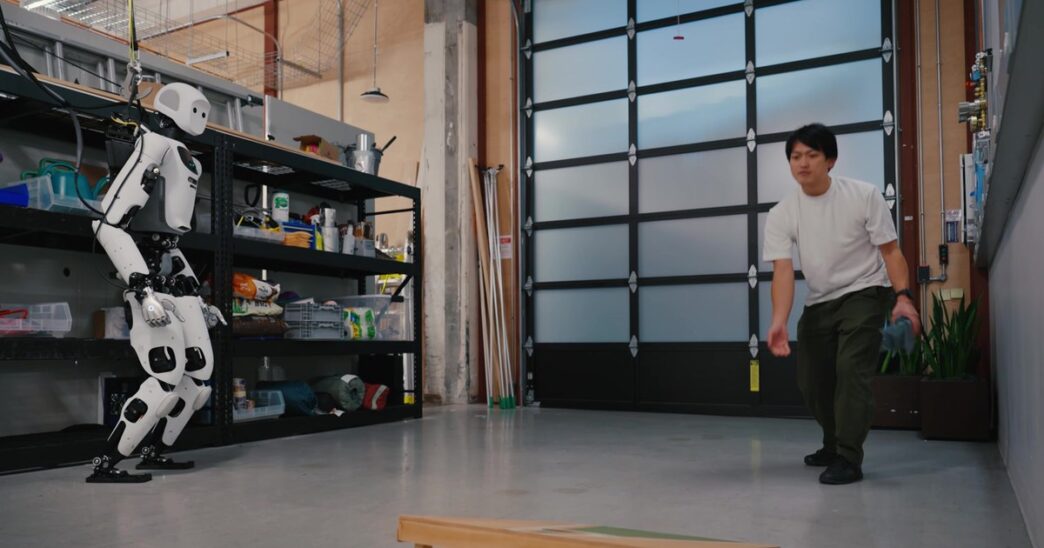
Google says Gemini 4 Argon watched a video of a person playing cornhole, built its own physics simulation, and then helped Apptronik’s Apollo humanoid sink seven throws in a row. The company framed the Oct. 13 demo as an internal “Video-to-Sim-to-Real” test, not a product you can buy, and published it alongside Argon’s global launch for developers.
That matters because the hard part of teaching a humanoid a new skill isn’t usually the language model. It’s turning a messy real-world scene into something a robot can practice safely, then transferring the result onto hardware. Google’s claim is that Argon can do more of that stack itself. Here’s what it published, what the Apollo clip actually shows, and what it leaves open.
What Google says Apollo did
In Google’s announcement post, Argon watched raw video of a human playing cornhole, mapped spatial coordinates, calculated whole-body joint movements, and “autonomously built the simulation code.” When that policy was transferred onto Apptronik’s Apollo, Google says the robot sank seven consecutive shots in a real-world trial. The company calls the pipeline “Video-to-Sim-to-Real” and says it can compress weeks of manual simulation work into a few hours.
Google DeepMind also posted an official YouTube video of the cornhole work. The footage shows Apollo in a lab, tethered from above, throwing bean bags at a board while engineers watch. That’s a controlled demo under safety hardware, not an untethered factory floor. Treat it as a lab result until somebody publishes intervention rates, failure modes or a customer deployment.
The rest of the robotics pitch
A companion Google Developers Blog post by principal software engineer Kanishka Rao walks through other Argon robotics workflows Google wants developers to try:
- Spot trash practice. Argon builds a MuJoCo twin of a foot-pedal trash bin, practices the move in simulation, then has a Boston Dynamics Spot step on the pedal and drop cans in. Google presents this as Real-to-Sim-to-Real on a quadruped with an arm, not a humanoid.
- Human video to simulation. From egocentric human video, Argon is supposed to rebuild objects as contact-ready meshes and retarget the hand trajectory onto a 76-DoF bimanual humanoid with 22-DoF five-fingered hands in MuJoCo.
- Sketch to simulation. A hand-drawn sketch of an Apollo-class humanoid throwing at a box stack becomes a
mujoco_warpscene and a verified whole-body throw, in Google’s description. - Action improvement via simulation. Starting from one real tabletop photo, Argon builds a sim twin, defines tasks and synthesizes thousands of domain-randomized episodes. Google reports a VLA success-rate lift from 56% to 75% and faster completion on its internal eval. Those numbers are Google’s; no third party has reproduced them.
None of that is a shipping robot skill library. It’s a set of prompts and internal result claims for a model that also writes simulation code. Our earlier guide to Gemini Robotics 2 covered Google’s prior robotics stack; Argon is the new frontier model Google is pointing at that stack.
The ERQA score, and what it isn’t
Google says Argon scores 87% on Embodied Reasoning Question Answering (ERQA), a benchmark for physical and spatial problems in 3D, and that it outperforms other frontier models when relying on pure reasoning. That’s a company-reported benchmark result, not a robot success rate. A high ERQA score means the model answers questions about physical scenes well. It does not mean Apollo can unload trucks.
For context on how robot companies talk about foundation models versus what you can download or measure, see our explainer on robot foundation models and our piece on world and action models.
Price and access (for the robotics angle)
Argon launched globally on October 13, 2026 for developers on the paid Gemini API (model id gemini-4-argon), for Google AI Ultra subscribers in Google Antigravity and AI Studio, and for Ultra and Pro subscribers in the Gemini app. Google’s introductory API price is $2 per million input tokens and $10 per million output tokens, with cached input at 95% off. After November 30, 2026, Google says that rises to $4 / $20 per million. The LLM News beat will cover pricing and API details in more depth; the point for robotics readers is that the same model Google used in the Apollo demo is the one on the public API, not a private research checkpoint.
What this does not prove
- No commercial Apollo deployment. Google labels the cornhole work an internal test. Apptronik has not published a customer site where Apollo learned a skill this way.
- No published failure data. Seven in a row is a streak, not a distribution. We don’t have miss rate, recovery behavior or how often a human reset the scene.
- Tethers and labs. The DeepMind video shows overhead support cables. That’s normal for early humanoid testing; it is not the same as free walking on a factory floor.
- Not a replacement for robot-specific models. Google is selling a general frontier model that can write simulators and steer robots. Dedicated robot VLAs and company stacks still exist; Argon is another layer on top.
What to watch next
The useful follow-ups are public: a third-party team reproducing video-to-sim on hardware that isn’t Google’s, Apptronik saying whether any warehouse pilot used this pipeline, and whether Google publishes ERQA prompts or evaluation code. Until then, the story is a strong lab demo with primary sources from Google, not a readiness-level jump for Apollo in the field.
Frequently asked questions
What did Gemini 4 Argon do with Apptronik’s Apollo?
Google says that in an internal test, Argon watched a human play cornhole, built simulation code, and helped transfer the skill so Apollo sank seven consecutive shots. Google DeepMind also released a lab video of the work. It is a company demo, not a commercial rollout.
Is Gemini 4 Argon a robot foundation model?
Google markets Argon as a general frontier model with strong physical reasoning and code generation, applied across robotics workflows (control, Real2Sim, labeling, sim-to-real improvement). It is available on the Gemini API as gemini-4-argon. It is not the same product line as Gemini Robotics 2.
What is Google’s ERQA score for Argon?
Google reports 87% on Embodied Reasoning Question Answering (ERQA), saying Argon leads other frontier models on that benchmark using pure reasoning. ERQA measures answering questions about physical scenes, not robot task success in the wild.
How much does Gemini 4 Argon cost?
Google’s introductory Gemini API price is $2 per million input tokens and $10 per million output tokens (cached input 95% off). After November 30, 2026, Google says the price becomes $4 / $20 per million. Ultra and Pro subscriber access in Gemini apps is separate from API billing.
Did Boston Dynamics Spot also get an Argon demo?
Yes, in Google’s developers post: Argon practices opening a foot-pedal trash bin in MuJoCo, then Spot performs the move on hardware. Like the Apollo clip, it is Google’s demonstration content, not an announced Spot product feature.
Sources
- Google, Koray Kavukcuoglu, “Gemini 4 Argon: Built to solve your hardest problems,” October 13, 2026: blog.google
- Google Developers Blog, Kanishka Rao, “Gemini 4 Argon for Robotics,” October 13, 2026: developers.googleblog.com
- Google DeepMind, “Teaching a humanoid robot to play cornhole with Gemini 4 Argon” (official video), October 2026: youtube.com
- Google DeepMind, “Gemini Robotics: Developing the next generation of humanoid robots with Apptronik”: youtube.com
- Google DeepMind models page (Gemini 4 Argon robotics section): deepmind.google
Related: Gemini Robotics 2 explained · Apptronik Apollo status · More AI Models coverage
Last updated: October 14, 2026. To report an error, see our corrections page. Articles are drafted with AI assistance and reviewed and edited by an editor; see our editorial policy.