SenseNova-RoboRSI-27B is SenseTime’s new open-weights robot model. It’s a 27-billion-parameter vision-language model that decides how a robot arm should move: hand a motion to a vision-language-action (VLA) policy, check that policy’s proposed trajectory, or write code that computes where the gripper should go. SenseTime announced the full release on November 25, 2026, under the Apache 2.0 license. Its headline says the model “outscores GPT-6-Astra” on the RoboDojo simulation benchmark, and that the same weights, trained only on simulation data, stacked blocks on a real arm in 9 of 10 tries.
We downloaded the file list and config from Hugging Face, read the GitHub repo and technical write-up, and checked the RoboDojo leaderboard itself. The weights are real, complete and ungated. The benchmark claim needs more context than the headline gives it.
- What: an open 27B “robot brain” that chooses between a VLA policy and writing control code (Code as Policy), released by SenseTime on November 25, 2026.
- What you can download: 27.36 billion BF16 parameters in 12 safetensors files (54.7 GB), plus GGUF builds from 16.7 GB, under Apache 2.0 with no access gate. SenseTime’s guide serves it on four GPUs.
- Results: 34.7 on RoboDojo in SenseTime’s own run, against 27.6 for GPT-6 Astra on the RoboDojo team’s leaderboard. On real arms, 9 of 10 block stacks and 6 of 10 pick-and-place tries.
- The catch: the 34.7 isn’t on the leaderboard yet, Anthropic’s Opus 5.5 scored higher in SenseTime’s own table, and the real-robot tests are 20 trials in total.
What SenseTime actually released
The Hugging Face repository holds the full checkpoint, not a demo. Its metadata lists 27,356,728,560 parameters in BF16, split across 12 safetensors shards that add up to 54.7 GB, along with the tokenizer, processor and chat template. The config names the architecture Qwen3_5ForConditionalGeneration, 64 layers with a 262,144-token context window. The earlier Preview model’s card lists Alibaba’s Qwen3.8-27B as its base, and the full release’s card lists the Preview as its base. The repo isn’t gated, so there is no click-through form, and the license is plain Apache 2.0, which allows commercial use.
There’s also a GGUF version for llama.cpp, with 4-bit (Q4_K_M, 16.7 GB), 5-bit (19.3 GB) and 8-bit (28.6 GB) files. SenseTime’s own quickstart runs the full BF16 model with vLLM across four NVIDIA GPUs using tensor parallelism. The model is only half of the system. The other half is the RoboRSI Harness on GitHub, also Apache 2.0, which connects the model to cameras, robot state, a VLA and a simulator. A smaller 9B version is listed as “Coming Soon.”
How it decides between a VLA and code
Most robot foundation models, like the ones in our VLA explainer, turn camera images straight into motor commands. RoboRSI-27B sits a level above that. At each step it looks at the scene and picks a tool. It can ask a VLA policy for a motion, inspect where that motion would take the gripper and accept, trim or reject it, or write a short program that calculates a target pose. SenseTime says that across the release model’s recorded steps, 41.9% used VLA actions and 58.1% used code.
Its own example is bowl stacking. The model used the VLA to grasp and lift a bowl, saw from a fresh camera view that it sat slightly left of the stack, kept its grip and used code to move the target 2 cm right before letting go. That split makes sense: a VLA is good at fluid motions such as approaching a moving object or pouring, while code is better at exact geometry like a stack height or a keypad press.
The training method gives the model its name. RSI stands for recursive self-improvement, and here it means three rounds in which OpenAI’s GPT-6 Astra acted as the teacher. In each round Astra ran tasks with the current Harness, its failures guided changes to the tools, and selected Astra trajectories were used to fine-tune the 27B student. SenseTime reports that updating only the Harness took the score from 10.0 to 24.8, updating only the model reached 32.2, and doing both reached 34.7. A second technique, VLA2Agent, turns existing open VLA demonstrations into “where should the gripper end up” examples. On 374 test actions it raised the share of predictions within 5 mm of the recorded target from 4.3% to 15.5% and cut the median error from 119.7 mm to 51.6 mm. SenseTime estimates each such example costs about $0.02 to make, against about $0.50 from full agent runs.
The RoboDojo score, checked against the leaderboard
The “outscores GPT-6-Astra” claim compares two numbers produced in different ways. SenseTime ran its own model and six others on RoboDojo at a single seed and layout (seed 0, layout 0), using its general-purpose Harness with no task-specific skills. The 27.6 for GPT-6 Astra wasn’t from that run. It’s the RoboDojo team’s own entry, added to the leaderboard on September 16 at 27.63. SenseTime’s model card says it will publish its reproduction script after it submits to the leaderboard, while the GitHub news log says one-command reproduction scripts went up on November 26. Either way, the 34.7 is not a leaderboard entry yet.
SenseTime’s own table also shows a model that beat it. Anthropic’s Opus 5.5 scored 40.7 under the same Harness, ahead of RoboRSI-27B’s 34.7, with GPT-6.1 Sol at 33.7, Qwen4-Max at 18.9 and the Qwen3.8-27B base at 9.1. So the fair summary is that the open 27B model beat its own base model by a wide margin, edged past GPT-6.1 Sol, topped a GPT-6 Astra score measured by someone else’s setup, and trailed Opus 5.5. That’s still a strong result for a model small enough to run on your own hardware. It just isn’t “beats the frontier.”
The leaderboard adds a complication of its own. SenseTime’s earlier system, the RoboRSI Harness driven by GPT-6 Astra, is listed on the RoboDojo Agent leaderboard at 57.10, added November 14, but with an asterisk. RoboDojo’s reviewers write that its task names selected “dedicated ICL knowledge bundles” of prewritten task experience, which they call “task-specific solution injection,” and that this breaks the current Agent Track generality rule. They add that the entry was tested before the new rules came out and that the finding “does not establish” the files held simulator ground truth or hidden rewards. SenseTime says the 27B evaluation used no task-specific examples, skills or preset procedures, which reads like an answer to that rule.
One rule is still worth watching. RoboDojo’s protocol bars using rollouts on RoboDojo layouts, including “rollout rewards, scores, failures,” to tune a model or improve “prompts, harnesses, tools, or skill libraries.” SenseTime’s write-up says its RSI loop used the simulator’s task score and episode scores to revise the Harness and pick training trajectories, and it reports a RoboDojo score after each round. It doesn’t say which tasks or layouts those training rollouts used. We aren’t calling that a breach. But it’s exactly the question RoboDojo’s committee will ask when SenseTime submits, and the answer will decide whether 34.7 becomes a ranked score. For more on how far a benchmark number can be trusted, see our guide to robot benchmarks and competitions.
Real-robot results: promising, and 20 trials
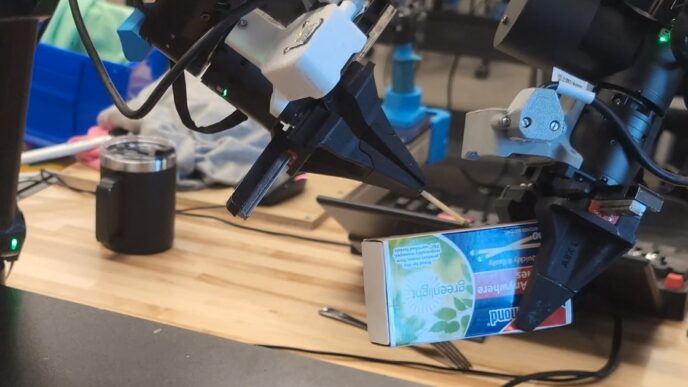
The hardware tests used Piper and Piper X, small six-axis research arms sold by China’s AgileX Robotics. AgileX lists Piper X at 4.5 kg with a 1.5 kg payload and 669 mm reach. SenseTime adapted only the camera, state and control interfaces for each robot and gave every model ten attempts per task:
- Piper X, block stacking (VLA plus code): 9/10 for the release, 3/10 for the Preview, 0/10 for the Qwen3.8-27B base.
- Piper, placing objects in a dish (code only): 6/10 for the release, 2/10 for the Preview, 0/10 for the base.
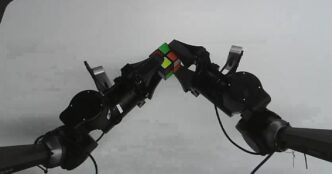
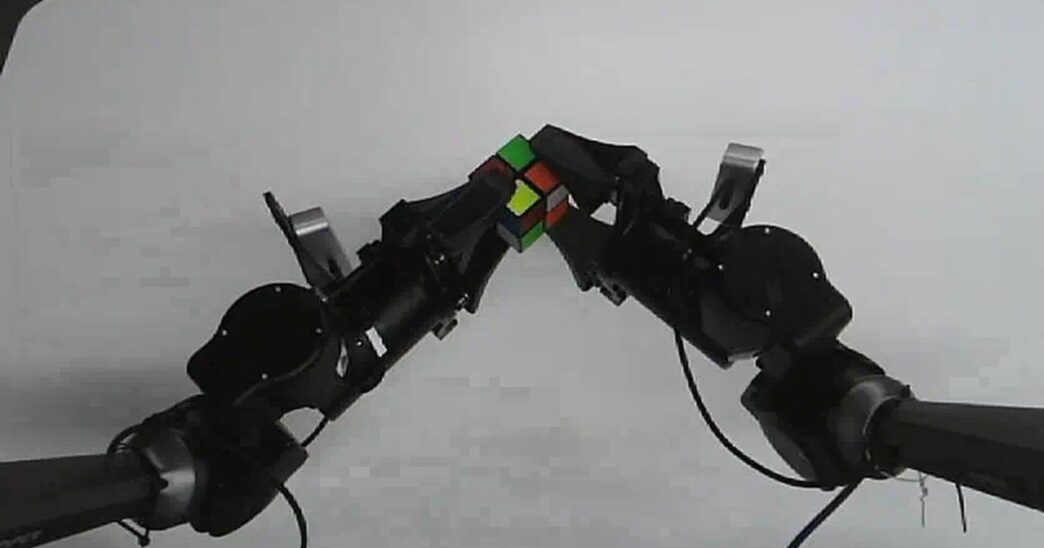
Ten tries per task is a small sample. A standard 95% confidence interval for 9 successes in 10 tries runs from about 55% to over 99%, so these numbers show the model can work on hardware, not how reliable it is. The demo clips do show useful behavior, such as moving one wrist camera to find an object for the other arm and picking up a block again after it landed outside the dish. A separate clip shows two arms solving a 2×2 puzzle cube with code alone; that is one recorded solve, not a success rate.
“No real-robot data” also needs a qualifier. It’s true of the 27B model’s embodied post-training. But SenseTime’s write-up says the VLA it called in the Piper X stacking demo was trained this way: SenseTime “reconstructed the physical tabletop in simulation, generated block-handling demonstrations there and combined them with real demonstrations from another task.” So the system that stacked the blocks did include real-robot data, just not in the 27B model. That’s the honest version of the sim-to-real story, and it’s still a meaningful step.
How it compares with the open robot models we’ve covered
We built this table from the model cards and our earlier checks. Every headline result is the developer’s own test except where a leaderboard verified it.
| Model | What it is | Weights and license | Download and hardware | Headline result, and who measured it |
|---|---|---|---|---|
| SenseNova-RoboRSI-27B (SenseTime) | Vision-language “agent” that calls a VLA or writes control code | Open, Apache 2.0, ungated | 54.7 GB BF16; GGUF from 16.7 GB; four GPUs in SenseTime’s guide | 34.7 on RoboDojo (SenseTime’s own run, not yet on the leaderboard); 9/10 and 6/10 on real arms |
| Praxis-1 (Runway) | 27B mixture-of-experts world action model, 2.8B active per step | Open, Apache 2.0 | One 80 GB GPU for standard inference | 46.2% on NVIDIA’s RoboLab-120 (verified leaderboard entry) |
| AIRoA-0 (AIRoA) | VLA built from Physical Intelligence’s π0.5 base | Open, Gemma Terms of Use, click-through | About 12.4 GB per checkpoint; eight H200 GPUs to post-train a new task | 78% average on ten tasks (AIRoA’s tests) |
| GPT-6 Astra (OpenAI) | Closed general model used as a robot policy | Closed, API only | Cloud; 11.5 to 21.7 seconds per decision in NVIDIA’s test | 74.8% on RoboLab-120 (NVIDIA’s Astranomy study); 27.6 on RoboDojo (RoboDojo team) |
Sources for the other rows: our reports on Praxis-1’s open weights, AIRoA-0 and NVIDIA’s GPT-6 Astra robot test, each linked to the developers’ own documents. RoboDojo and RoboLab-120 are different benchmarks, so the scores across rows can’t be compared directly. What the table does show is that RoboRSI-27B is a different kind of model. Praxis-1 and AIRoA-0 output motions themselves, while RoboRSI-27B is closer to an open, smaller stand-in for what GPT-6 Astra does: a reasoning model that plans and checks, with a VLA or code doing the moving.
Our take: a real open release with an oversold headline
This is one of the more useful open robot-model releases of the year, for a simple reason: everything needed to run it is public. The weights are complete, the license is permissive, there’s no access gate, the Harness code is out, and SenseTime published its ablations, including the base model’s 0/10 hardware scores. Labs that can’t afford GPT-6 Astra calls for every robot step now have an open planner to test against their own VLA. A 4-bit file of 16.7 GB should also fit on a single high-memory GPU, though SenseTime’s guide uses four GPUs, it hasn’t published speed figures and we haven’t run it ourselves.
The headline is the weak part. “Outscores GPT-6-Astra” is true only against a score SenseTime didn’t produce, from a different harness, while Opus 5.5 beat RoboRSI-27B in SenseTime’s own comparison. The ranked number doesn’t exist yet, and RoboDojo has already starred SenseTime’s previous entry. The model was trained by distilling Astra’s behavior, so it’s a capable student rather than a rival to its teacher. And the real-robot claims rest on 20 trials on two small arms. What would change our view: a verified RoboDojo leaderboard entry for the 27B model, larger real-robot trials on other hardware, published latency per step (the number that made Astra slow in NVIDIA’s test), and the promised 9B model.
We’ll add SenseNova-RoboRSI-27B to our robot foundation models timeline and update this page when RoboDojo posts a ranked score.
Frequently asked questions
What is SenseNova-RoboRSI-27B?
It’s an open-weights vision-language model from SenseTime for robot manipulation, released November 25, 2026. Instead of outputting motor commands directly, it decides whether to call a vision-language-action policy, review that policy’s proposed trajectory, or write code that computes the gripper’s target pose.
Is SenseNova-RoboRSI-27B open source?
The weights are released under the Apache 2.0 license on Hugging Face with no access gate, and the RoboRSI Harness code is Apache 2.0 on GitHub. The full checkpoint is 54.7 GB in BF16, and GGUF builds start at 16.7 GB.
What hardware does SenseNova-RoboRSI-27B need?
SenseTime’s quickstart serves the BF16 model with vLLM across four NVIDIA GPUs. Quantized GGUF files (16.7 GB at 4-bit, 28.6 GB at 8-bit) can run with llama.cpp. SenseTime hasn’t published per-step speed figures.
Did SenseNova-RoboRSI-27B beat GPT-6 Astra?
SenseTime reports 34.7 on RoboDojo in its own run, against 27.6 for GPT-6 Astra on the RoboDojo team’s leaderboard. The two scores were produced differently, the 34.7 isn’t a leaderboard entry yet, and Anthropic’s Opus 5.5 scored 40.7 in SenseTime’s own comparison.
Sources
- SenseTime: “SenseNova-RoboRSI-27B Full Release Outscores GPT-6-Astra, Pushing the Limits of a 27B Model with Recursive Self-Improvement” (November 25, 2026)
- Hugging Face: sensenova/SenseNova-RoboRSI-27B model card, file list and config (accessed November 28, 2026)
- Hugging Face: sensenova/SenseNova-RoboRSI-27B-GGUF
- Hugging Face: sensenova/SenseNova-RoboRSI-27B-Preview model card
- GitHub: OpenSenseNova/SenseNova-RoboRSI (README, news log and 27B technical write-up)
- Hugging Face blog: SenseNova RoboRSI technical blog
- RoboDojo: leaderboard, update log and Agent Track rules (accessed November 28, 2026)
- SenseNova: “Has GPT-6-Astra Achieved Embodied Intelligence?”
- AgileX Robotics: PiPER-X product page
All sources accessed November 28, 2026.
Last updated: November 28, 2026. To report an error, see our corrections page. See our editorial policy.