Runway has released Praxis-1, its world action model for robots, as open weights under the Apache 2.0 license. The video-AI company published the checkpoints on Hugging Face and the code on GitHub on November 11, 2026, after introducing the model in September and promising to release it publicly “in the coming months.” The license allows commercial use, the clearest difference from Black Forest Labs’ FLUX 3 Action, the rival it edges on NVIDIA’s leaderboard.
The Praxis-1 open weights come with real numbers attached: 555 of 1,200 episodes solved on NVIDIA’s RoboLab-120 simulation benchmark, a verified entry on NVIDIA’s leaderboard, and published latency tables. They also come with a hardware bill most hobbyists can’t meet. Runway’s own model card says inference “needs one 80 GB GPU,” and the leaderboard lists the model at about 70 GB of video memory.
- What: Praxis-1, a 27-billion-parameter mixture-of-experts world action model that predicts robot actions and the video that follows, released November 11, 2026 with base, single-arm (DROID/Franka) and two-arm (YAM) checkpoints.
- License: Apache 2.0 for the weights and the inference and fine-tuning code, including commercial use. The frozen Wan2.2 VAE and Qwen3.5-2B text encoder keep their own licenses.
- Score: 46.2% on RoboLab-120 (555 of 1,200 episodes, verified by NVIDIA’s leaderboard), the top world action model there. It ranks fifth overall behind two LLM agents, a “Lakeside” world model and the BiMind v0.5 VLA.
- The catch: a single 80 GB GPU for standard inference and LoRA fine-tuning; consumer Blackwell cards need an experimental 4-bit mode. RoboLab is a simulation, and Runway’s real-robot and speed comparisons are its own tests.
What Runway released
According to Runway’s launch post, Praxis-1 is “a 27B-parameter mixture-of-experts diffusion transformer that predicts video and actions together.” The technical report breaks that down into a 26.9-billion-parameter video backbone, with 2.8 billion parameters active per step, and a 314-million-parameter action expert that reads the backbone’s internal state as it imagines the next moment. Each call returns a predicted chunk of video plus 24 rows of actions, 1.6 seconds of motion at 15 Hz. (The Hugging Face card rounds the total to 27.2 billion; NVIDIA’s leaderboard lists 27.3 billion.)
There are three main checkpoints on Hugging Face: praxis-1-base, which has no action heads and is the starting point for a new robot; praxis-1-droid, for a single Franka arm with an exterior and a wrist camera; and praxis-1-yam, for two YAM arms. Each robot checkpoint also comes in an NVFP4 version trained for 4-bit inference and in a layout for Hugging Face’s LeRobot toolkit. The GitHub repository has the inference code, a policy server, a MuJoCo simulation and instructions for full and LoRA fine-tuning. A checkpoint for the low-cost SO-101 arm is listed as “coming.”
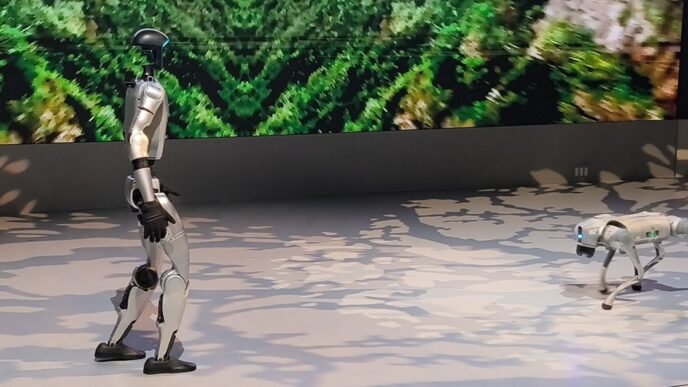
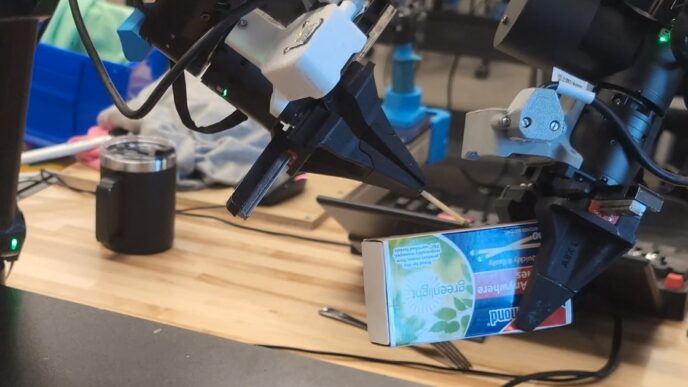
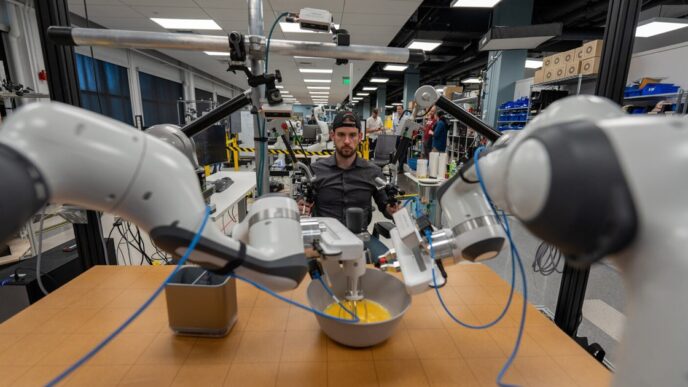
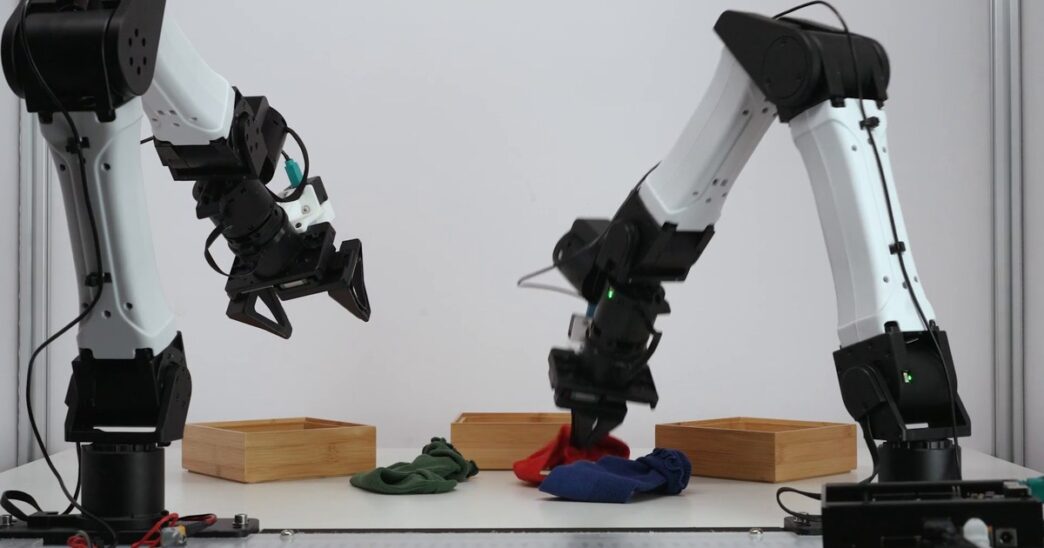
Runway says launch partners Noble Machines, Standard Bots and Ultra have run the model on a legged humanoid, a six-axis industrial arm and a dual-arm warehouse robot. It hasn’t published results from those partners, so for now they’re names, not data. Runway’s own demo clips, all labeled as playing at 1x speed, show its single-arm and two-arm setups doing short tabletop tasks.
The RoboLab-120 score, checked against NVIDIA’s board
Runway’s headline claim is that Praxis-1 is “the top-performing world action model on NVIDIA’s RoboLab-120 leaderboard” and that “it outperforms every open-weight VLA.” NVIDIA’s leaderboard backs up the first part. Its Praxis-1 entry is marked as a verified submission, dated November 5, fine-tuned on public DROID demonstrations and run on an NVIDIA L4, with 555 successes in 1,200 episodes (46.2%). That’s ahead of every other entry the board labels a world action model, including FLUX 3 Action at 42.9% and NVIDIA’s own Cosmos3-Nano-Policy at 36.8%. Physical Intelligence’s π0.5 scores 28.0%.
The fuller picture is that Praxis-1 is fifth overall. Two agentic language-model entries sit at the top, AMP1 at 86.0% and SenseNova-RoboRSI at 57.1%, followed by “Lakeside,” labeled a different model type (LWM), at 51.0%, and BiMind v0.5, a vision-language-action model, at 49.2%. BiMind’s entry says it used RoboLab and Isaac simulation data in fine-tuning and doesn’t say whether its weights are public; Runway’s comparison chart leaves it out. So “best open-weight VLA” depends on which entries you count. When we covered this race in October, Lakeside was already ahead of FLUX 3 Action and nobody could find a write-up of it (our world action models explainer). That’s still true.
The board’s difficulty breakdown shows where Praxis-1 actually differs from FLUX 3 Action. On simple tasks FLUX does slightly better (49.1% against 46.9%). On complex, multi-step tasks Praxis-1 solves 68 of 170 (40.0%) against 48 of 170 (28.2%) for FLUX. That gap, 20 more successful complex-task episodes out of 170, is the most useful number in the release for anyone choosing between the two, and it’s NVIDIA’s measurement, not Runway’s. The usual RoboLab caveat applies: it’s 120 tabletop tasks in simulation on a simulated Franka arm, ten tries each, not a test in your building.
What you need to run Praxis-1
Runway’s launch post says Praxis-1 “runs out of the box across NVIDIA hardware,” from H100 and B200 data-center GPUs to RTX 5090 and RTX PRO 6000 workstation cards and Jetson Thor on the robot. The repository is more specific. Its quick start “needs Python 3.12, one CUDA GPU with at least 80 GB of memory and the CUDA 13.0 driver.” The weights alone are 54.4 GB in bfloat16, split into 17 files, and LoRA fine-tuning is documented on “one 80 GB GPU.”
The smaller cards get in through a side door. The NVFP4 checkpoints keep 4-bit versions of the routed expert layers; on Blackwell workstation GPUs (the RTX 5090 and RTX PRO 6000) that shrinks the policy in memory from 54.4 GB to 17.5 GB, a mode the model card calls “experimental.” You still download the full 54.4 GB. The README documents a separate 4-bit path for Jetson Thor and says the H100 rejects the 4-bit mode. In other words, the claim that it runs on a desktop card or on the robot is true with a quantized setup, and the standard setup is an 80 GB data-center GPU.
Speed looks workable for tabletop arms. On one H100, Runway’s README measures a typical policy call at about 501 milliseconds at the median with default settings, about a third of the 1.6 seconds of motion each call returns. In RoboLab runs against a hosted server, the client saw a median of 1.1 to 1.4 seconds per call once network and image encoding were added. The first call after start-up took 35.0 seconds while the GPU kernels compiled. The README also says a fresh install on another H100 took 17 minutes from cloning to first results, 13 of them on installation, mostly compiling one dependency.
Apache 2.0 vs FLUX 3 Action’s license
The license is the part that changes who can use a world action model. FLUX 3 Action ships under the FLUX Kommunity License, which allows commercial use only for companies with less than $5 million in gross annualized revenue. Praxis-1’s weights and code are Apache 2.0, which lets a robot maker of any size build it into a product without asking Runway. That puts Praxis-1 alongside Unitree’s open UnifoLM-WLA model and ahead of NVIDIA’s GR00T 2, which NVIDIA calls open but whose project page says code is coming in December.
Runway frames the release as part of a push for American open models in physical AI and says it’s a founding member of the Cosmos Coalition for open world models. NVIDIA’s robotics account congratulated Runway on the release on X and pointed developers to the 4-bit checkpoint. Our read of the business logic: Runway also offers hosted Praxis-1 inference through its Reactor service and invites teams planning a deployment to contact its robotics group, so free weights work as an on-ramp to paid services.
What Runway’s own tests claim, and the limits it admits
Two of Runway’s bigger claims come from its own runs. Fine-tuned on Google’s RT-1 robot, which Runway says never appeared in its training data, Praxis-1 reached 80.0% on the SimplerEnv simulation against 52.4% for the original RT-1 policy. And on a two-arm teleoperation station, Runway timed Praxis-1 against OpenAI’s GPT-6 Astra driving the same robot on three tasks. Runway reports Astra took 15.6 times longer and cost 51 times more per completed task, averaging 16 seconds and $0.04 for Praxis-1 against 4 minutes 13 seconds and $1.87 for Astra, with Praxis-1 costed at one H100 for $3.95 an hour. That’s three tasks on Runway’s rig, with data collected November 9.
The technical report is unusually direct about failures. The most common real-robot mistake is reaching for an object that looks like the target. Vague instructions are “noticeably harder” than ones that name a color or size. And chaining several steps from one prompt “remains hard,” which is why Runway suggests pairing Praxis-1 with a language model that breaks a job into steps. On the single-arm checkpoint’s own prompt-adherence test, the model card reports 52.5% full adherence, with a 95% confidence interval of 35.8% to 68.3%.
We didn’t find a warning about joint speed, force or workspace limits in the README or model cards like the one on FLUX 3 Action’s card. The rule is the same either way: a policy model doesn’t enforce safety limits, so the robot controller has to, with a hardware stop in reach.
Frequently asked questions
Is Runway Praxis-1 free to use commercially?
Yes. Runway released the Praxis-1 weights and its inference and fine-tuning code under the Apache 2.0 license on November 11, 2026, which permits commercial use. The frozen Wan2.2 VAE and Qwen3.5-2B text encoder it depends on are distributed under their own licenses.
What GPU do I need to run Praxis-1?
Runway’s standard setup needs one CUDA GPU with at least 80 GB of memory, and the weights are 54.4 GB. An experimental 4-bit NVFP4 mode cuts memory use to 17.5 GB on Blackwell workstation cards such as the RTX 5090 and RTX PRO 6000, and the code has a separate 4-bit path for Jetson Thor.
How does Praxis-1 score on RoboLab-120?
It solved 555 of 1,200 episodes (46.2%) in a verified submission on NVIDIA’s RoboLab-120 leaderboard, the best of any entry labeled a world action model. It ranks fifth overall, behind two LLM-agent entries, the Lakeside world model (51.0%) and BiMind v0.5 (49.2%).
Which robots does Praxis-1 support?
Runway released checkpoints for a single Franka arm on the DROID setup and for two YAM arms, plus a base model for fine-tuning on new robots. An SO-101 checkpoint is listed as coming. Runway says partners have also run it on a legged humanoid, an industrial arm and a dual-arm warehouse robot.
What is a world action model?
A world action model predicts both the robot’s next actions and a video of what should happen next, in one model. Praxis-1 builds on Runway’s video-generation models, betting that knowledge learned from ordinary video reduces how much robot-specific data a policy needs.
Sources
- Runway: “Praxis-1 Is Now Available,” November 11, 2026 (license, RoboLab-120 claim, hardware, partners, RT-1 result)
- Runway Research: “Praxis-1: From Video Pretraining to Robot Control,” technical report, November 2026 (architecture, GPT-6 Astra comparison, limitations)
- Hugging Face: runwayml/praxis-1-droid model card (size, weights, 80 GB GPU, prompt adherence)
- Hugging Face: runwayml/praxis-1-droid-nvfp4 model card (NVFP4 memory use)
- GitHub: runwayml/praxis-1-oss README (requirements, latency, Thor support)
- NVIDIA: RoboLab-120 leaderboard (Praxis-1 verified entry, difficulty breakdown)
- NVIDIA Robotics on X: post on the Praxis-1 open-weight release, November 11, 2026
- Runway Research: “Introducing Praxis-1,” September 2026
All sources accessed November 12, 2026.
Last updated: November 12, 2026. To report an error, see our corrections page. See our editorial policy.