Embo, the robotics AI startup founded by Dreamer creator Danijar Hafner, came out of stealth on November 23, 2026 with a $110M seed round led by Andreessen Horowitz. The San Francisco company says it is building “the brain for intelligent robots”: one Embo world model, pretrained from scratch on internet video, fine-tuned on data from its own humanoid fleet and then sharpened with reinforcement learning, so robots can work in places they have never seen.
That is a nine-figure seed for a company with no product, no customers and no published results. What Embo does have is a decade of public research behind its method, and that is what investors are paying for. We read Embo’s announcement and a16z’s investment post, watched the launch video, went back to the Dreamer papers the pitch rests on, and set the round next to the other robot-brain deals we track.
- The round: $110 million seed, announced November 23, 2026, led by Andreessen Horowitz with Khosla Ventures, DST Global and NVIDIA’s NVentures. No valuation was disclosed.
- The team: CEO Danijar Hafner, who created the Dreamer world-model agents at Google DeepMind, and co-founder Wilson Yan, who built VideoGPT.
- The method: learn how the physical world behaves from internet video, then let the robot practice skills inside that learned model before acting for real.
- The catch: Embo has published no model, benchmark, customer or robot maker. Its closest public evidence is Dreamer 4, which learned Minecraft, not a robot task.
What Embo announced, and what it left out
Embo’s launch post describes “one unified model, pretrained from scratch at internet scale, finetuned on robot experience from our humanoid fleet, and post-trained by reinforcement learning.” It says its architecture handles “the information density of streaming video and high-frequency motor skills that language models lack.” The company also says its team has “developed the infrastructure to train multimodal models across 70,000 GPUs” in previous jobs. That is a claim about past experience, not about Embo’s own compute, and Embo doesn’t say where it was done.
The investor list differs slightly by source. Embo’s post names Andreessen Horowitz as lead, plus Khosla Ventures, DST Global, NVIDIA “and other strategic investors.” Hafner’s own launch post on X adds Striker Venture Partners and spells NVIDIA’s stake as NVentures. The round had been reported before it closed: The Information said in March that Embo was in talks to raise more than $100 million led by a16z, according to Servospace’s summary of that report.
Andreessen Horowitz’s investment post, by partners Justine Moore, Raghu Raghuram and Matt Bornstein, frames the bet as two problems: generalization (a robot trained in one kitchen working in a kitchen it has never seen) and resilience (recovering when an object slips or a drawer sticks). It says “early results have been remarkably promising.” Neither the firm nor Embo has shown those results.
What is missing matters as much as what is there. Embo hasn’t disclosed a valuation, headcount, revenue, a first customer, a release date for any model, or which company builds its humanoids. MIT Technology Review, which visited Hafner’s office in San Francisco’s SoMa district for its Innovators Under 35 profile in September, reported that humanoids “hang like marionettes from racks” there and that Hafner imports them from China. It also reported that he left Google DeepMind to start the company in the fall of 2025.
The research trail behind the pitch
Embo’s method is not new to its founders, which is the strongest argument for the round. A world model is a neural network that predicts what happens next, given what it sees and what the agent does. Hafner’s line of agents, PlaNet and then the Dreamer series, trains behavior inside such a model instead of through endless real-world trial and error. We checked the three papers that matter most for a robotics company.
DayDreamer (June 2022). The one paper with real robots. In DayDreamer, Hafner and co-authors at UC Berkeley applied Dreamer to four robots learning directly in the real world, with no simulator. A quadruped learned to roll off its back, stand up and walk “from scratch and without resets in only 1 hour,” and adapted within 10 minutes when pushed. Two robot arms learned pick-and-place from camera images. That was online learning on single tasks, though, not a general model.
DreamerV3 (January 2023). DreamerV3 used one configuration across more than 150 tasks and was the first algorithm to collect diamonds in Minecraft from scratch, without human data. It showed the method generalizes across domains. All of those domains were simulated.
Dreamer 4 (September 2025). This is the paper Embo’s plan most resembles. Dreamer 4, by Hafner, Wilson Yan and Timothy Lillicrap, learned most of its knowledge from unlabeled video, needed only a small amount of action-labeled data, and trained its behavior entirely in imagination. It became the first agent to obtain Minecraft diamonds “purely from offline data,” a task the paper says takes over 20,000 mouse and keyboard actions from raw pixels, and its world model runs in real time on a single GPU. The authors explicitly pitch offline learning as a fit for robotics, “where learning from environment interaction can be unsafe and slow.”
The gap is plain once the papers sit side by side. The recipe Embo describes (video pretraining, small amounts of robot data, practice in imagination) has been shown at scale in a video game. On hardware, the published evidence is DayDreamer’s single-task learning from 2022. Turning one into the other, on a humanoid with two hands and dozens of joints, is the unproven part, and it is exactly what the $110 million is for.
What the launch video shows
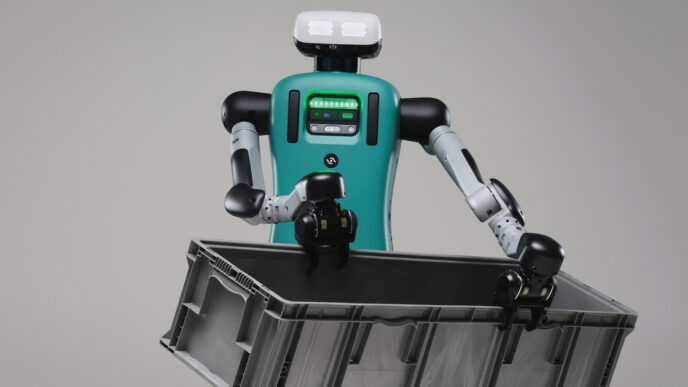
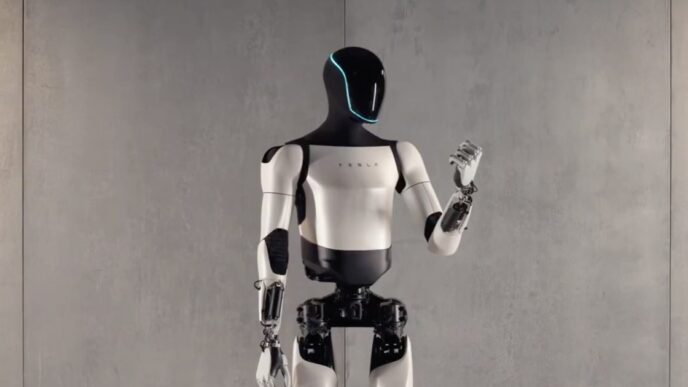
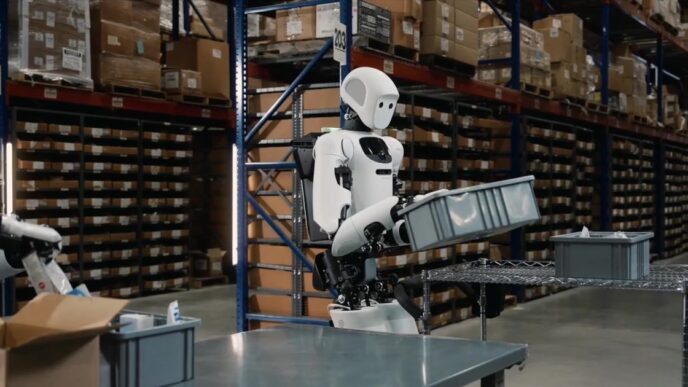
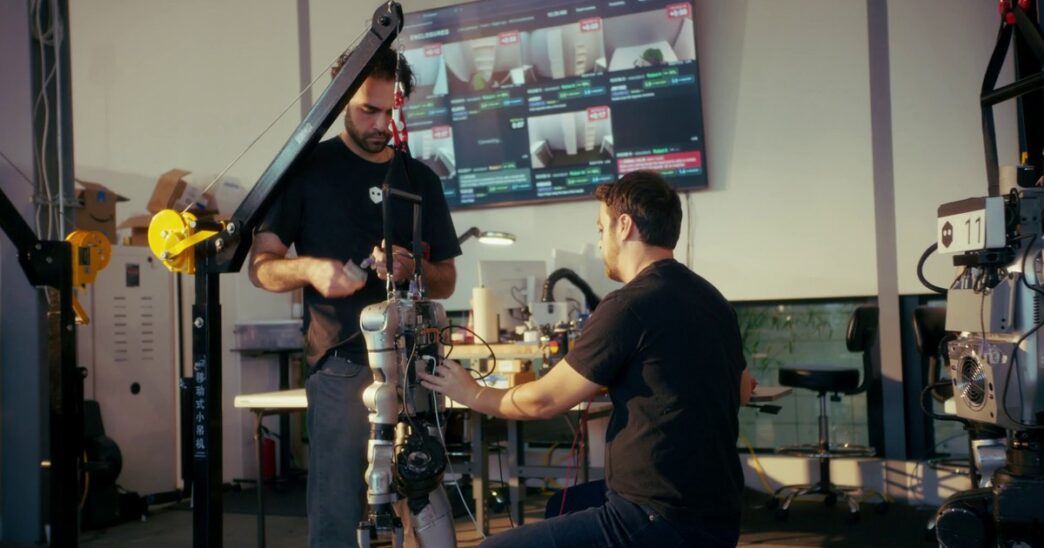
Embo’s 83-second launch video mixes interviews with Hafner and Yan with short robot clips: a humanoid handling a towel and cabinet doors in plain white rooms, people wearing VR headsets, and engineers working on humanoids hung from support gantries in a lab. Embo’s website labels its robot clip “Autonomous · Real time.” The video itself doesn’t say whether each clip is autonomous or teleoperated, meaning remotely controlled by a person, and Embo hasn’t said what the headsets are used for. Its site also shows a separate set of short household clips under “Self-improvement by imagination” without saying which are camera footage and which are generated.
How Embo’s bet compares with other world-model robot efforts
Embo is not alone in betting that video prediction is the route to general robot skills. The difference is how much each group has put in public. We lined up the efforts we have covered, using each company’s own published numbers.
| Effort | What it is | What is public | Robot evidence so far |
|---|---|---|---|
| Embo (Nov 23, 2026) | One model: video pretraining, humanoid-fleet fine-tuning, reinforcement learning in imagination | Launch post, website, 83-second video | None published; a16z calls early results “remarkably promising” |
| Dreamer 4 (Sep 2025, Hafner, Yan, Lillicrap) | Research agent trained inside a video world model | Paper on arXiv | None; Minecraft diamonds from offline data only |
| NVIDIA GR00T 2 (Nov 9, 2026) | 2-billion-parameter world action model on Cosmos | Whitepaper and 100,000 hours of human video; code promised for December | NVIDIA’s tests: 40% zero-shot on 50 unseen tasks, 95% after five demonstrations |
| LiberAI Liber-0 (Nov 3, 2026) | World action model trained on more than 2.2 million hours of human experience | Announcement, technical blog, video; no weights | LiberAI’s tests: 36.0% over 600 trials; multi-step jobs 10.5% |
| Google Genie 4 (API Nov 19, 2026) | Interactive world generator Google pitches partly for training robots and agents | Paid API, about $0.10 per second of generated world | None; returns video and audio, no joint states, forces or rewards |
Two things stand out. Embo’s design is closer to Dreamer than to GR00T 2 or Liber-0: those are world action models that predict video and actions together and are tuned with demonstrations, while Embo puts reinforcement learning inside the model at the center. And Embo is the only entry here with a nine-figure check and nothing yet to download, test or read.
How a $110 million seed compares with other robot-brain rounds
Seed rounds this size used to be rare. In robot AI they are becoming a category. Here is Embo next to the rounds in our robotics funding tracker and earlier coverage, all company-announced unless marked.
| Company | Round and date | Amount | Valuation | Product status when it raised |
|---|---|---|---|---|
| Embo | Seed, Nov 23, 2026 | $110M | Not disclosed | No public model or customers |
| Genesis AI | Seed, July 2025; Series A, Nov 17, 2026 | $105M; then $500M | $3.5B post-money (Series A) | Eno robot in unnamed customer pilots at the Series A |
| Walden Robotics | Seed, July 15, 2026 | $300M | $1.1B (company) | General-purpose industrial robots; company launched with the round |
| Machenta | Seed, Oct 27, 2026 | $40M | Not disclosed | Research stage, waitlist, trained only in simulation |
| Generalist AI | June 2026 | $400M | $2B reported by Bloomberg, not in company post | Robot AI model |
| Skild AI | January 2026 | Close to $1.4B | Over $14B (company) | Robot AI model |
Khosla Ventures appears in both Embo’s and Genesis AI’s rounds. Genesis is the useful precedent: a $105 million seed in July 2025 turned into a $500 million Series A 16 months later, by which point it had a robot, a model and customer pilots to show. Physical Intelligence, another robot-brain lab, is reported by Bloomberg to be in talks at about $20 billion. Embo’s $110 million buys it time to produce its first public evidence before the next round prices it.
Our take: a bet on a recipe, with nothing yet to test
Our readiness scale rates robots, and Embo doesn’t sell one. If we apply it to the robot brain, the public evidence puts Embo at Level 2 at most: company video of robots doing household tasks, with no stated autonomy level per clip, no outside test and no customer. That’s normal for a seed company. It is unusual for a seed company with $110 million.
We think the round is a sensible bet on people and a less certain bet on timing. Hafner’s record on world models is public, peer-reviewed and specific, which is more than most robot-brain pitches offer. But every published Dreamer result outside DayDreamer is in a simulated world, and the hard part of household robotics (contact, deformable objects, hands that wear out) is exactly where learned world models tend to drift. Google’s own Genie 4 documentation warns that objects can shift after a few seconds out of view. A model that imagines a towel wrongly teaches a robot the wrong fold.
Signals that would change this read: a technical report or paper with real-robot success rates; a public model or API; named hardware partners; a first pilot customer; or a clip Embo labels as fully autonomous with the task, trials and failure count stated. Embo says it “will share our progress as it unfolds.” We’ll update this page when it does.
Frequently asked questions
What is Embo?
Embo is a San Francisco robotics AI startup that came out of stealth on November 23, 2026. It is building a single AI model to act as the “brain” for humanoid robots, trained on internet video, data from its own humanoid fleet and reinforcement learning inside a learned world model. It has not released a product.
Who founded Embo?
Danijar Hafner is founder and CEO. He created the Dreamer world-model agents and left Google DeepMind in the fall of 2025 to start the company, according to MIT Technology Review. Co-founder Wilson Yan built VideoGPT and co-wrote Dreamer 4 with Hafner.
How much has Embo raised, and from whom?
Embo announced a $110 million seed round led by Andreessen Horowitz, with Khosla Ventures, DST Global, NVIDIA’s NVentures and other strategic investors. Hafner’s post on X also names Striker Venture Partners. Embo did not disclose a valuation.
Does Embo build its own robots?
No. Embo says it runs a humanoid fleet to collect robot data, but it hasn’t named the maker or said how many robots it has. MIT Technology Review reported in September that Hafner imports his humanoids from China.
Sources
- Embo: “Introducing Embo” (November 23, 2026)
- Embo website: “Building the brain of the humanoid workforce”
- Andreessen Horowitz: “Investing in Embo,” Justine Moore, Raghu Raghuram and Matt Bornstein (November 23, 2026)
- Embo on YouTube: “Embo is building the brain for general robots” (November 23, 2026)
- Danijar Hafner on X: launch post naming the investors (November 23, 2026)
- MIT Technology Review: “This entrepreneur is developing agents that can plan ahead,” Mat Honan (September 8, 2026)
- Servospace: “Embo raises $110 million seed round led by a16z” (November 23, 2026), citing The Information’s March report
- Hafner, Yan, Lillicrap: “Training Agents Inside of Scalable World Models” (Dreamer 4), arXiv, September 2025
- Hafner et al.: “Mastering Diverse Domains through World Models” (DreamerV3), arXiv, January 2023
- Wu, Escontrela, Hafner, Goldberg, Abbeel: “DayDreamer: World Models for Physical Robot Learning,” arXiv, June 2022
- Yan et al.: “VideoGPT: Video Generation using VQ-VAE and Transformers,” arXiv, April 2021
- RoboticaGuide: Robotics Funding Tracker 2026 (Walden Robotics, Generalist AI, Skild AI rows and their primary sources)
- RoboticaGuide: Genesis AI $500M Series A
- RoboticaGuide: NVIDIA GR00T 2
- RoboticaGuide: LiberAI Liber-0
- RoboticaGuide: Genie 4 API and robot training
All sources accessed November 24, 2026.
Last updated: November 24, 2026. To report an error, see our corrections page. See our editorial policy.