Machenta, a London startup spun out of Imperial College London’s robot learning lab, has raised a $40 million seed round to build what it calls instant robot learning: a model that teaches a robot a new task from a single demonstration, with no extra training. Creandum and Union Square Ventures co-led the round, which the company disclosed on Tuesday on its website and to Business Insider.
The unusual part is the training data. Most robot foundation model companies are racing to collect real-world demonstrations. Machenta says its model was trained entirely in simulation, and Business Insider reports it was built without using a “single pixel of real-world data.” The only real data it needs is the one demonstration a person gives it on the job.
- What happened: Machenta announced a $40 million seed round on October 27, 2026, co-led by Creandum and Union Square Ventures. It didn’t disclose a valuation.
- What it builds: A “vision-demo-action” model, trained only in simulation, that it says learns a new task from one demonstration with no fine-tuning, across six different robots.
- Status and price: Research stage. There’s an early-access waitlist, no price and no release date, and Business Insider reports no near-term plans to commercialize.
- The catch: The evidence so far is Machenta’s own videos and a one-hour stress test on simple tasks. Business Insider reports that precise and complex tasks remain hard.
What Machenta’s $40 million buys
Machenta’s homepage announces the “$40M Seed round, co-led by” Creandum and USV. Machenta declined to disclose its valuation, Business Insider reported. The company has 11 employees and plans to spend the money on hiring and on training its model with more computing power and more simulated data, according to the report.
The founders are Edward Johns, a professor of robot learning at Imperial who is Machenta’s CEO, and Vitalis Vosylius, his former PhD student and now CTO. Johns started a research group on one-shot robot learning at Imperial in 2020, and the team page says every author on five of the lab’s key papers now works at the company. Johns and Vosylius founded Machenta late last year, per Business Insider. It’s based in King’s Cross, London, and is hiring for robot learning, control and simulation roles.
For scale, $40 million is a big seed for an 11-person research team and a small sum next to the companies it’s up against. Business Insider puts Physical Intelligence at roughly $11 billion and Skild AI at more than $14 billion. Our robotics funding tracker logs the year’s bigger rounds.
How instant robot learning at Machenta works
Today’s robot models are usually vision-language-action models. They take in camera images and a text instruction and output motor commands. To get one working on a specific job, teams typically collect fresh demonstrations and fine-tune it, which Machenta’s launch post says can take days or weeks per task.
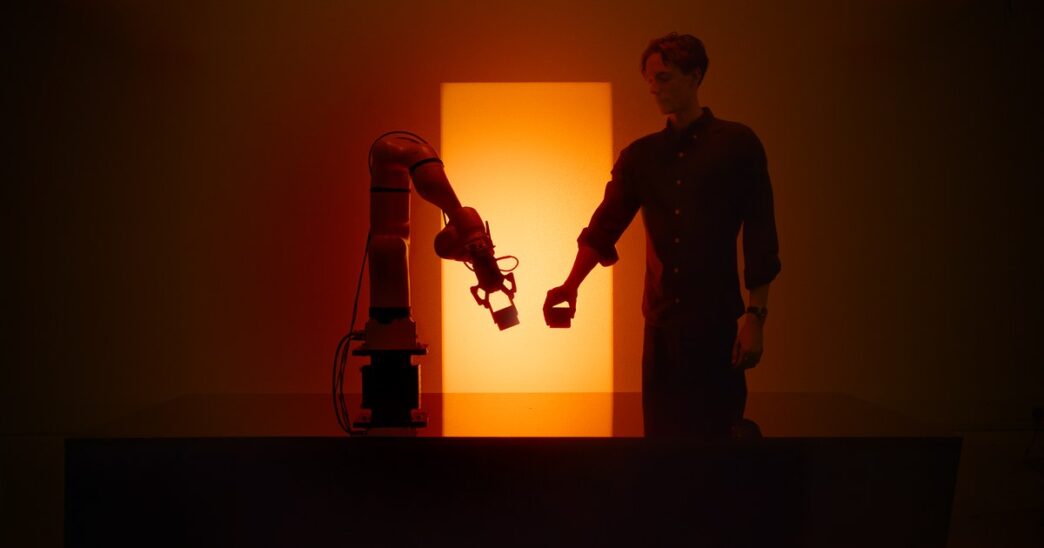
Machenta’s approach to instant robot learning swaps the text instruction for a demonstration. It calls the result a vision-demo-action, or VDA, model. Instead of learning one task, the model is trained to learn how to learn tasks, using huge numbers of randomized simulated scenes, objects and demonstrations. At work, a person shows the robot the task once, rearranges the objects and steps back. The model then runs the task in a closed loop from camera images.
The obvious objection is the sim-to-real gap: skills learned in a simulator often break on real hardware. Machenta’s answer is that it doesn’t use simulation to learn any real task. It uses simulation to learn the learning process, so the demonstration and the camera feed both come from the real world at test time. “To the model, reality is just one more environment to adapt to,” the post says. That’s a hypothesis the company says early results support, not a settled result.
The work builds on two of the founders’ papers, Implicit Graph Alignment (CoRL 2023) and Instant Policy (ICLR 2025), which showed in-context learning for robots after pre-training only in simulation.
What the demos show, and what they don’t
The launch post is a long page of uncut videos. Each one shows a person demonstrating a task once on objects the robot hasn’t seen, shuffling the objects, and the robot then doing the task on its own. Tasks include tidying a toolbox, stacking cans in a rack, tending a bag sealer, sorting cables and dressing a mannequin. Machenta says the same model runs on six different robots with different grippers and camera setups, and learns from four kinds of teaching: a leader-follower arm, a VR controller, physically guiding the robot, and a person’s bare hands. A three-robot “one-person factory” video shows a small assembly line taught, Machenta says, in about two minutes.
The company also published a reliability test. Over a weekend it ran self-resetting tasks continuously for an hour each. The robots completed 74 of 74 block placements into a bowl, 78 of 78 screwdriver handovers and 97 of 99 attempts to stand a bottle upright. Machenta calls those tasks “relatively simple.”
What’s missing is anything independent. There’s no head-to-head benchmark against other models, Machenta hasn’t published a paper on this specific model, and no outside customer is using it. Business Insider reports that more precise tasks and complex movements remain challenging for the model. Humanoid hands and learning from human hands appear only as “early experiments” that “aren’t our main focus.” Machenta also calls its model the first of its kind, a claim we can’t check.
Not the only one-demo bet
Machenta isn’t alone in chasing learning from a single demonstration. Business Insider notes that Skild AI unveiled a model in August that it said could perform previously unseen tasks lasting up to 10 minutes after watching one video, and Machenta’s own post credits in-context learning work at Rhoda AI, Generalist and Skild AI. The difference is the data recipe. Those companies are scaling up real-world data collection, a race we covered in our piece on humanoid robot training data. Machenta is betting that compute and simulation can do the job instead.
What to watch next
Machenta’s site invites robot owners to register for early access to the model and asks which arm they plan to use, but lists no date or price. The next useful evidence would be a paper or benchmark on the VDA model, results on harder, more precise tasks, and an outside team getting the same one-shot results on its own robot. Until then, this is a well-funded, well-credentialed research bet with good-looking demos, and nothing a factory can buy.
Frequently asked questions
How much did Machenta raise?
$40 million in a seed round announced October 27, 2026, co-led by Creandum and Union Square Ventures. Machenta didn’t disclose a valuation.
What is instant robot learning?
It’s Machenta’s term for a robot learning a new task from a single demonstration with no further training. A person shows the task once, and the model performs it on new arrangements of the objects.
Is Machenta’s model trained on real-world data?
No, according to the company. Machenta says its vision-demo-action model is trained entirely in simulation. The only real-world data is the one demonstration given at the time of use.
Can I buy or use Machenta’s model?
Not yet. The website has an early-access sign-up but no price or release date, and Business Insider reports the company has no near-term plans to commercialize.
Who founded Machenta?
Edward Johns, a professor of robot learning at Imperial College London, who is CEO, and Vitalis Vosylius, his former PhD student, who is CTO. The company is based in London and has 11 employees.
Sources
- Machenta, homepage (“$40M Seed round, co-led by” Creandum and USV; trained entirely in simulation; early-access form): machenta.com
- Machenta, “Introducing Instant Robot Learning” (published October 27, 2026; VDA model, six robots, four teaching modes, task list, one-person factory, 74/74, 78/78 and 97/99 stress test, humanoid and human-hand experiments, Rhoda AI, Generalist and Skild AI references): machenta.com/blog/instant-robot-learning
- Machenta, Team page (founders’ roles, Imperial lab history since 2020, papers, King’s Cross location, open roles): machenta.com/team
- Business Insider, “An 11-person startup raised $40 million to challenge robotics’ data-hungry giants” by Rya Jetha (October 27, 2026; valuation not disclosed, 11 employees, no near-term commercialization, harder tasks still challenging, use of funds, founding late last year, rival valuations, Skild AI August model): businessinsider.com
All sources accessed October 27, 2026, between about 7:35 and 7:50 AM ET.
Last updated: October 27, 2026. To report an error, see our corrections page. Articles are drafted with AI assistance and reviewed and edited by an editor; see our editorial policy.