Path Robotics, the Columbus, Ohio, company that sells AI-driven welding robots, has raised $300 million at a $2.45 billion post-money valuation. The Path Robotics Series E was announced on Tuesday, November 10, and led by Georgian, a Toronto growth-equity firm whose partner Emily Walsh is joining Path’s board.
Welding was the wedge, and the money is meant to pull Path past it. CEO Andy Lonsberry says the goal “isn’t to automate one step, but to automate the entire factory,” and the company says the round will pay for new manufacturing tasks, new robot form factors and more AI model training. The pitch leans hard on two numbers: annual recurring revenue up 17-fold in 18 months, and a $600 million shipbuilding agreement with HII. Both are real claims with real fine print, and neither comes with the dollar figure an investor would ask for first.
- The deal: $300 million Series E at a $2.45 billion post-money valuation, led by Georgian, announced November 10, 2026.
- The traction: Path says its ARR grew 17-fold in 18 months, and Georgian says Path has deployed dozens of welding cells in the U.S., Canada and Mexico.
- The money is for: more welding deployments, tasks beyond welding, new form factors like its four-legged Rove robot, and compute for model training.
- The catch: Path hasn’t disclosed revenue in dollars, and the $600 million HII agreement only pays out over seven years if Path hits HII’s milestones.
Who is in the Path Robotics Series E
Georgian led. Existing investors Addition, Drive Capital, IronArc Ventures, Tiger Global and Yamaha Motor Ventures came back, and D. E. Shaw Ventures and NAVER Ventures, the venture arm of the South Korean internet company, joined, according to Path’s release. Neither Path nor Georgian said how the $300 million splits among them.
Lockheed Martin shows up in the announcement too, but in a different role. Path lists Lockheed as a customer, and Chris Moran, vice president and general manager of Lockheed Martin Ventures, supplied a quote calling the round “an important milestone.” Lockheed isn’t on the release’s investor list, so don’t read the quote as a check.
For scale, the last round we can document is a $100 million Series D that Path closed in October 2024, co-led by Matter Venture Partners and Drive Capital, according to an announcement by Taiwania Capital, one of the investors. Path didn’t publish a valuation then. Forge Global, which estimates private-company valuations from share-price filings, lists a $50 million Series D-2 in November 2025 at about $570 million post-money. Path hasn’t confirmed that estimate, but if it’s close, the new valuation is a bit more than four times that figure from a year ago.
Georgian has made this kind of bet before. It was an existing backer in Bedrock Robotics’ $600 million Series C at $4.1 billion two weeks ago, another company selling autonomy into an old, labor-short trade (excavation, in Bedrock’s case). Both rounds price the same idea: a narrow job, done for paying customers, with a data loop that’s supposed to make the next job easier.
A 17x revenue claim on a chart with no dollar axis
Path says ARR grew 17-fold over the past 18 months. The release illustrates it with a bar chart that runs from 2025 into 2026 and labels the vertical axis “ARR,” with no numbers on it. Seventeen times a small base can still be a small number, and Path hasn’t said what the base was. Georgian’s memo adds that “multiple customers” more than doubled their spending year over year, without naming them or saying how many.
The hiring numbers are easier to picture. Path says its workforce grew 97% year over year and that it plans to reach 400 employees by the end of 2026. Georgian says the company runs a 180,000-square-foot manufacturing facility with more than 30,000 square feet of extra warehouse space. That’s a company building and shipping hardware, not just licensing software.
Path also named customers, which funding announcements often don’t. Alongside HII, Lockheed Martin and Saronic, it lists mid-sized fabricators EK Machine, Millerbernd Manufacturing Company, TransAmerican Power Products and TYCROP. It didn’t say how many cells each one runs or whether any of them pays on a subscription.
What Obsidian does, and what the yield numbers rest on
Traditional welding robots replay a programmed path on identical parts, which is why they’ve mostly stayed in high-volume plants like car factories. Path’s system is built for the opposite: big, varied, imprecise parts in shipbuilding, energy, data center and heavy-equipment work. Its welding model, Obsidian, finds the weld joints on each part, plans the weld and adjusts as it goes, according to Path. SiliconANGLE, which covered the round, reports that Obsidian uses four lasers on the torch and a pair of cameras to watch how parts shift and warp from the heat.
Georgian’s investment memo describes a second model underneath: the Weld World Model, a neural simulator trained on “tens of millions of welded inches” of fleet and internal data, inside which Obsidian is trained. Data from before, during and after every weld feeds back into it. That’s the compounding loop investors are paying for.
The quality claim comes with a label you should read. “According to internal Path Robotics test results,” Georgian writes, first-pass yield (the share of welds that pass inspection without rework) exceeds 97%, against roughly 70% to 85% for a human welder on the same kind of complex, high-mix work. Georgian also relays what customers told it in diligence calls: one unnamed fabricator said Path’s cells beat its own skilled welders on first-pass yield by more than 10% on a complex part, and another reported cost-per-weld savings of about 40% versus manual labor. None of that has been published as an independent test.
The $600 million Navy deal is a ceiling, not a backlog
The biggest number in the pitch is the HII agreement, and it’s worth reading HII’s own description. In its August 6 announcement, the shipbuilder said it “intends to award up to $900 million in total shipbuilding work” to Path and GrayMatter Robotics over seven years, through its High-Yield Production Robotics (HYPR) program, “contingent on the two companies meeting clearly defined technology and manufacturing readiness, and performance milestones.” HII didn’t split the total. Path and Georgian put Path’s share at $600 million.
The work comes in two stages. First, a development stage in which the companies develop and qualify welding, grinding, blasting, painting, assembly and inspection techniques to U.S. Navy standards and fold them into an autonomous production line. Then a delivery stage, where HII starts sourcing work through that line “contingent upon favorable cost, schedule, and quality performance,” beginning with small steel structures and growing to units and modules. So the $600 million is the most Path can earn over seven years if it qualifies, not money already on the books.
HII’s demand is real, though. It said it plans to outsource more than 2.5 million hours of shipbuilding work in 2026, 30% more than in 2025. In the Series E release, HII executive vice president Eric Chewning says the company wants adaptive automation in its fabrication processes “that support increased throughput and acceleration of production.”
Beyond welding: a four-legged welder and assembly work
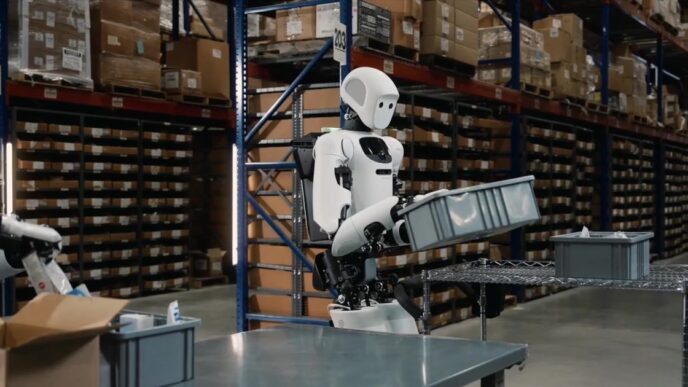
The first new form factor already exists. Path launched Rove on April 16: Obsidian running on a quadruped robot, meant to walk to parts too big to move into a welding cell, such as ship sections. At launch Path opened an early adopter program, and Saronic, which builds autonomous vessels, signed on to evaluate Rove at its shipyard in Franklin, Louisiana. Path hasn’t said whether Rove has moved from evaluation into paid production work anywhere.
Georgian says Path is also extending Obsidian into assembly. That’s the same territory Foundry Robotics, which raised $100 million in October, is chasing for drones and defense hardware, and it’s where Path’s welding data helps least. A model trained on tens of millions of welded inches knows a lot about weld pools; how much of that carries over to bolting a bracket is the open technical question behind the “entire factory” line.
The money also pays for compute. Path says the funding will go into “increased investment in compute and model training” as it adds form factors, which makes it look more like the AI labs in our robotics funding tracker than a classic industrial-automation vendor. The difference is that Path already sells a product people pay for.
What to watch next
The cleanest test is HII. If Path clears the HYPR development stage and HII starts sending it steel structures, the $600 million stops being a ceiling and starts becoming revenue. Short of that, watch for Rove’s first paid deployment outside an evaluation, and for the first time Path puts a dollar figure next to “17x.” A company that just raised at $2.45 billion and plans to hit 400 employees by year-end will have to say more about revenue eventually. The interesting part is whether it does so before the next round or because of it.
Frequently asked questions
How much did Path Robotics raise in its Series E?
Path Robotics raised $300 million in a Series E announced November 10, 2026. Georgian led the round, with Addition, Drive Capital, IronArc Ventures, Tiger Global, Yamaha Motor Ventures, D. E. Shaw Ventures and NAVER Ventures participating.
What is Path Robotics worth?
The Series E values Path Robotics at $2.45 billion post-money, according to the company and Georgian. Path didn’t publish a valuation for its 2024 Series D; Forge Global estimates its November 2025 Series D-2 at about $570 million.
What does Path Robotics make?
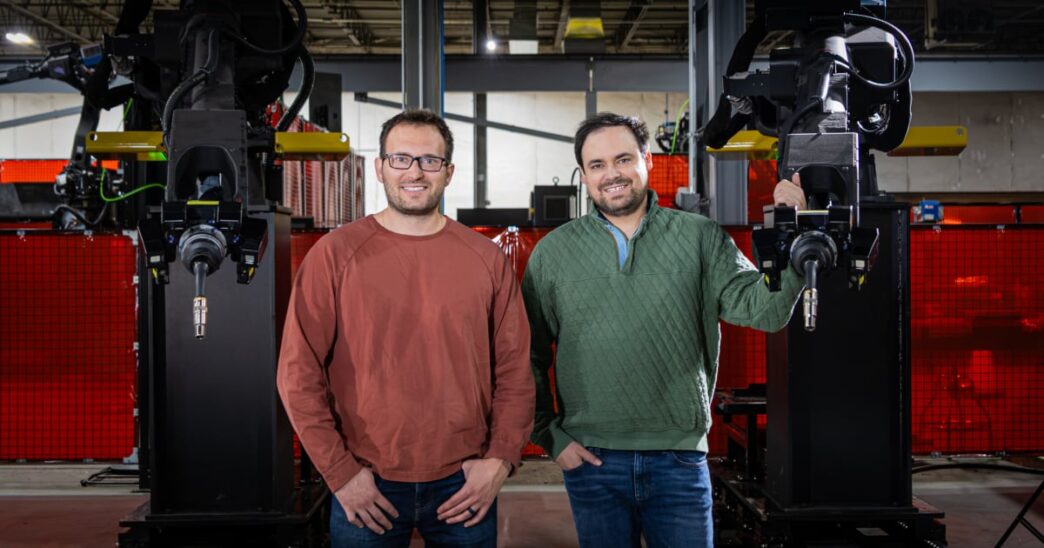
Path builds AI-driven robotic welding cells powered by its Obsidian welding model, plus Rove, a mobile welding system that puts Obsidian on a four-legged robot. It’s based in Columbus, Ohio, and was founded by brothers Andy and Alex Lonsberry.
Is Path Robotics’ HII deal worth $600 million?
Up to that much. HII said it intends to award up to $900 million in shipbuilding work to Path and GrayMatter Robotics over seven years, contingent on technology, readiness and performance milestones. Path says its share is $600 million, so it’s a ceiling Path has to earn, not guaranteed revenue.
Who are Path Robotics’ customers?
Path names HII, Lockheed Martin and Saronic, plus mid-sized manufacturers EK Machine, Millerbernd Manufacturing Company, TransAmerican Power Products and TYCROP. Georgian says Path has dozens of welding cells running with customers in the U.S., Canada and Mexico.
Sources
- Path Robotics: “Path Robotics Announces $300 Million Series E Financing at $2.45 Billion Valuation to Scale Physical AI for Manufacturing,” November 10, 2026 (also on Business Wire)
- Georgian: “Why Georgian Invested in Path Robotics,” by Emily Walsh and Ferris Symoom, November 10, 2026
- HII: “HII signs performance-based production agreements with Path Robotics and GrayMatter Robotics,” August 6, 2026 (via Path Robotics’ newsroom)
- Path Robotics: Rove launch announcement, April 16, 2026
- SiliconANGLE: “Industrial automation startup Path Robotics raises $300M in funding,” by Maria Deutscher, November 10, 2026
- Taiwania Capital: “Path Robotics Secures $100M of Venture Capital Funding,” October 14, 2024
- Forge Global: Path Robotics funding rounds and estimated valuations (third-party estimates)
- Path Robotics on YouTube: “Path Robotics: Physical AI for Manufacturing – Series E,” November 10, 2026
All sources accessed November 12, 2026.
Last updated: November 12, 2026. To report an error, see our corrections page. See our editorial policy.