South Korea wants to build its own humanoid robot joints and batteries, and on November 11, 2026 it put numbers on the plan. At an emergency economic ministers’ meeting in Seoul, chaired by Deputy Prime Minister and Finance and Economy Minister Lee Hyoung-il, the government approved detailed plans for three new “Super-Innovation Economy” projects: next-generation sensors, actuators and batteries for humanoid robots. Korean and English-language outlets added up the programs behind the South Korea humanoid parts plan and reported about 440 billion won, roughly $330 million at KED Global’s conversion.
That total is real, but it isn’t one humanoid budget, and it isn’t next year’s spending. We read the government’s 18-page plan. Most of the 440.2 billion won is a five-year battery R&D program that covers more than robots, the money runs from 2027 to as late as 2031, and the amount tied to humanoid parts in the 2027 budget proposal is far smaller.
- What: South Korea’s plan, approved November 11, 2026, to back domestic humanoid actuators, humanoid batteries and AI sensors with R&D, field tests and policy finance, aiming for mass production by 2030.
- The money: three programs worth 100 billion won (actuators, 2027 to 2029), 271.4 billion won (batteries, 2027 to 2031) and 68.8 billion won (sensors, 2027 to 2031), or 440.2 billion won in total. That figure is a media sum; the government lists the programs separately.
- For 2027: about 58 billion won in the budget proposal by our count, including 30 billion won for actuator R&D and 13.3 billion won marked for humanoid batteries.
- Why: the plan says actuators are 60% to 70% of a humanoid’s cost, only 19.7% of Korea’s robot drive parts are made at home, and China built 86% of the world’s 15,000 humanoids.
- The catch: 62% of the headline total is a battery program that isn’t only for robots, and every 2027 figure is a budget proposal the National Assembly hasn’t passed.
What South Korea approved on November 11
The Super-Innovation Economy projects are the government’s list of industries it backs from lab to factory with grants, tax breaks, policy loans and regulatory changes. Fifteen were picked in August 2025, covering things like power chips, LNG cargo tanks and offshore wind. Sensors, actuators and humanoid batteries were added in the government’s growth strategy on July 14, 2026. The November 11 meeting approved what each one will actually do.
The plan frames all three as parts of physical AI. In the finance ministry’s words, if chips are AI’s brain, physical AI is its body, and these are the components that body is made of. Each project gets a public-private task force. For actuators, the industry ministry runs the R&D and factory tests, while the finance ministry and the Financial Services Commission handle tax support and funds.
Here’s what each program covers, according to the plan:
- Actuators: a 100 billion won robot core-parts R&D program from 2027 to 2029, with 30 billion won in the 2027 budget proposal, plus about 3 billion won in 2027 to fit the new parts to humanoids and test them in factories. Actuator makers also get access to the National Growth Fund, and the plan supports auto-parts suppliers that want to switch to robot parts.
- Humanoid batteries: a 271.4 billion won battery competitiveness R&D program from 2027 to 2031. Of the 2027 proposal, 13.3 billion won is earmarked for humanoid batteries: 5.7 billion won for eight high-performance projects and 7.6 billion won for ten solid-state and standards projects.
- Sensors: 49.8 billion won for on-sensor AI chips from 2027 to 2030 (9 billion won in 2027), aimed at robots, defense and mobility, plus 9 billion won for training and 10 billion won for manufacturing infrastructure, each running 2027 to 2031.
The 440.2 billion won headline, unpacked
Add the multi-year totals and you get 440.2 billion won, the figure KED Global and Hankyung led with. But 271.4 billion won of it, about 62% by our calculation, is the battery program, and the plan describes that as dedicated battery R&D to win back market share in high-performance and solid-state cells generally. Humanoid batteries are the named focus, and the only part with a stated humanoid earmark is the 13.3 billion won in 2027.
Count only the 2027 lines, and the total is about 58 billion won: roughly 33 billion won for actuators, 13.3 billion won for humanoid batteries and 11.8 billion won for the three sensor programs, by our calculation. Some of the sensor money serves defense and car makers, not robots. Every 2027 figure is from the government’s budget proposal, which the National Assembly hasn’t passed. Some early reports described the 271.4 billion won as next year’s spending; the plan’s own table says 2027 to 2031.
That doesn’t make the plan small. It makes it a starting budget for a five-year industrial push, with the bigger promises in what comes after 2028: a shared prototype, testing and certification center for robot parts, and more policy finance.
Why actuators come first
The plan’s case for actuators is cost. An actuator is the motor, gearbox and control unit that moves a robot’s arms, legs and fingers, and a humanoid uses anywhere from 20 to 50 of them. The plan puts actuators at 60% to 70% of a humanoid’s cost, with the hands another 10% to 20%. (Our actuator explainer covers why electric designs won.)
Korea doesn’t make many of them. Citing the Korea Electronics Technology Institute, the plan says domestic parts made up 44.9% of the country’s robot components in 2023, barely changed from 41.1% in 2016, and just 19.7% of drive parts, the category that includes actuators. The goal is 80% for core robot parts by 2030. Some headlines attached that 80% to actuators alone; the plan applies it to robot core parts overall.
The technical targets are steep. The R&D program aims to raise torque density about fivefold, from 35 to at least 165 newton-meters per kilogram, raise durability from 300,000 to at least 1 million cycles, and cut actuators’ share of a robot’s weight from 45% to 30% or less. The timeline is core technology in 2027, test records with Korean parts in 2028, mass production starting in 2029, and large-scale production and exports in 2030.
The plan also gives a security reason. It calls weak parts supply chains a potential national-security risk and points to the US FCC’s July 29 move against foreign-made robots, which we covered in our FCC Covered List guide. A Korean humanoid full of imported joints would face the same questions in the US as a Chinese one.
China is the benchmark
Every comparison in the plan points at China. It says China accounted for 86% of the roughly 15,000 humanoids produced worldwide, while Korean startups are at about 1%. On batteries, it says Korea’s share of the global market fell from 31.1% in 2021 to 15.3% in 2025 while China’s rose from 55.1% to 79.4%. Beijing is moving on rules as well as volume: it issued its first humanoid standards this fall and has proposed an ID code for every robot it builds.
Korea’s argument is that it already has the factories this needs. The plan wants to stretch the country’s strengths in chips, cars and batteries into robots, and the AI Robot M.AX Alliance it runs through has more than 280 members, including Samsung Electronics, Hyundai Motor and Seoul National University. Hyundai’s own supply chain is already moving: Korean outlets reported last month that Boston Dynamics is lining up Korean suppliers, including Hyundai Mobis for actuators, for up to 10,000 Atlas robots.
Private companies are also moving faster than the public money. At Robo World on November 4, Robotis told Business Post it plans to make 800,000 to 1 million actuators a year at a new plant in Uzbekistan starting next year and reach 5 million a year by 2031, and Rainbow Robotics said it plans to build about 1,000 humanoid-type robots in 2027. Those are company plans, not orders. Against them, 30 billion won of actuator R&D in 2027 is a nudge toward better parts, not a subsidy for volume.
What the battery targets mean for humanoids
The battery targets are the most concrete in the plan. Against today’s packs, which the plan says run a humanoid for one to two hours at one to two times their capacity per hour (1C to 2C), the target is eight hours of work, enough for a full factory shift, and output of 8C to 10C, to handle the sudden bursts of power a robot needs to jump, lift something heavy or catch its balance. On safety, the plan’s table lists today’s packs at “10 minutes” without defining the measure, and sets the goal as “No Fire.” It also asks for packs that can be swapped with one touch and can’t be inserted the wrong way.
Eight hours is the number every humanoid maker is chasing. Agility says its next Digit will charge in nine minutes instead, and Unitree’s eight-hour claim for its H2-X turned out to be for standing. The plan’s schedule is standards in 2027, materials and cells in 2028, pack demonstrations in 2029 and commercial batteries in 2030. One company quoted in the plan, identified only as “D,” says it aims to mass-produce a pouch-type solid-state battery for physical AI in the second half of 2027.
Sensors get the least detail. The plan wants “on-sensor AI” chips that detect and decide in the same part, and it will show Korean sensors at a K-Sensor pavilion at CES 2027.
What to watch next
The first test is the National Assembly’s vote on the 2027 budget, which decides whether the 30 billion won and 13.3 billion won lines survive. After that, it’s the calls for projects in 2027, which will show which companies get the actuator money, and whether Korean parts end up in Korean humanoids in 2028 as the plan promises. The government also says it will publish a broader 2027 economic growth strategy in December. For now, South Korea has a clear diagnosis and a modest first budget, and the real spending decisions come after 2028.
Frequently asked questions
How much is South Korea spending on humanoid robot parts?
The three programs in the November 11, 2026 plan total 440.2 billion won over 2027 to 2031: 100 billion won for actuators, 271.4 billion won for battery R&D and 68.8 billion won for sensors. The 2027 budget proposal includes about 58 billion won across the three, by our count, and the National Assembly still has to approve it.
Is the 440.2 billion won all for humanoids?
No. The largest part, 271.4 billion won, is a general battery competitiveness program that runs to 2031. Only 13.3 billion won of its 2027 budget is marked for humanoid batteries, and the sensor money also covers defense and mobility.
Why is South Korea focusing on actuators?
The government’s plan says actuators make up 60% to 70% of a humanoid’s cost and that only 19.7% of Korea’s robot drive parts are made domestically. It wants 80% of core robot parts made in Korea by 2030 and calls weak supply chains a security risk.
What battery is South Korea trying to build for humanoids?
The plan targets packs that run a humanoid for eight hours instead of one to two, deliver 8C to 10C bursts of power, don’t catch fire, and can be swapped quickly. It aims for standards in 2027 and commercial batteries in 2030.
Which companies are involved?
The government hasn’t named grant winners; projects are put out to tender in 2027. The plan works through the AI Robot M.AX Alliance, which has more than 280 members including Samsung Electronics, Hyundai Motor and Seoul National University.
Sources
- Ministry of Finance and Economy: press release on the November 11, 2026 emergency economic ministers’ meeting (Korean, via Korea.kr)
- Interministerial plan: “Super-Innovation Economy leading projects, new project plan (I),” November 11, 2026 (Korean PDF; program budgets, targets, timeline)
- Yonhap: report on the new sensor, actuator and humanoid battery projects, November 11, 2026 (Korean)
- Hankyung: report on the 440 billion won humanoid parts plan, November 11, 2026 (Korean)
- KED Global: report on the 440.2 billion won ($330 million) plan, November 11, 2026
- Business Post: Robo World 2026 report with Robotis and Rainbow Robotics production plans, November 4, 2026 (Korean)
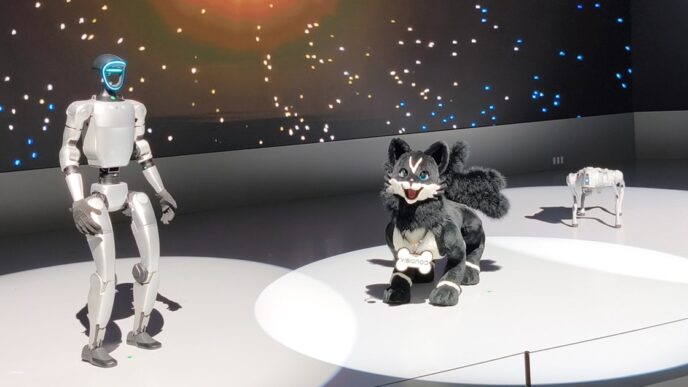
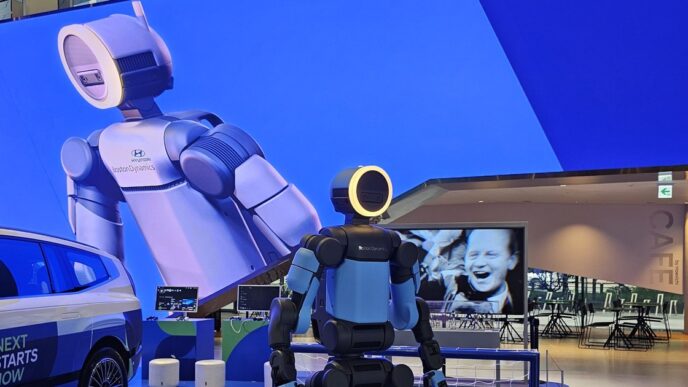
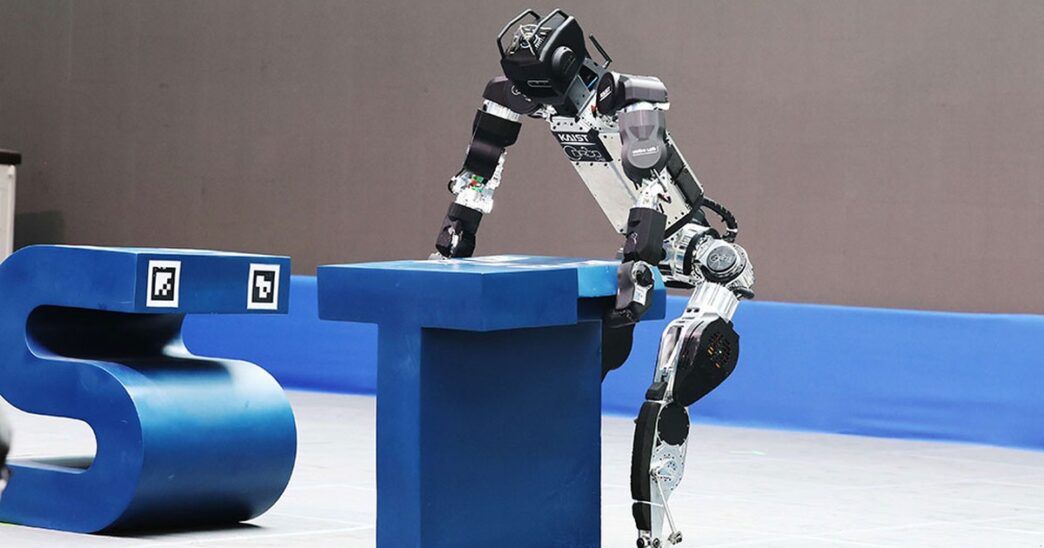
- KAIST: Physical AI KOREA 2026 release and photos, October 13, 2026 (Korean; featured image)
All sources accessed November 11, 2026.
Last updated: November 11, 2026. To report an error, see our corrections page. Articles are drafted with AI assistance and reviewed and edited by an editor; see our editorial policy.