Google’s world model is now something developers can call from code. On November 19, 2026, Google made Genie 4 available in the Gemini API and Google AI Studio, one day after it reached Google AI Ultra subscribers in Project Genie. The Genie 4 API turns a text prompt or a single image into a live, explorable 720p world with sound, steered by keyboard keys and typed events. Google’s announcement lists “training robotics and AI agents” among the uses.
That last line is the reason this is on a robotics site. We read Google’s developer documentation, pricing page, rate limits and the Genie 4 model card to see what a robot team actually gets for its money, worked out what a session costs, and set Genie 4 next to the physics simulators robot developers already use. The short version: it is an impressive world generator with a robotics pitch, not yet a robot-training tool.
- What launched: Google DeepMind’s Genie 4 world model as
genie-4on the Gemini API’s Interactions API (v1beta) and in Google AI Studio, November 19, 2026. Paid tier only. - What you get: a live 1280×720 world at 24 frames per second with 48 kHz stereo audio, seeded by text or one 16:9 image and steered with WASD and arrow keys plus text events, for up to 120 seconds per session.
- Cost: about $0.10 per second of generated world, roughly $6.05 a minute, by Google’s pricing page. A full 120-second session works out to about $12.10.
- Can it train robots? Not in the way physics simulators do. It returns video and audio only: no joint states, contact forces or rewards, and Google’s own docs warn that objects can shift after a few seconds out of view.
What the Genie 4 API gives developers
Genie 4 was first shown on October 27, when Google DeepMind announced it as a research preview for trusted testers. On November 18 it went to Google AI Ultra subscribers in Project Genie, Google’s consumer world-building app, according to Google’s launch post, and DeepMind published its model card the same day. The Gemini API changelog for November 19 lists genie-4 as “generally available.”
The developer guide describes a four-step session. Your server creates an interaction for the model genie-4 on v1beta; a browser or script connects over WebRTC or WebSocket; you send one world_setup event with a text prompt, a 16:9 reference image or both; then you steer the world until you call complete(). Google warns that closing a tab or socket does not stop generation or billing on its own.
| Item | What Google’s documentation says |
|---|---|
| Model and access | genie-4 on the Interactions API (v1beta); Python and JavaScript SDKs; paid-tier Gemini API key required |
| Inputs | Text prompt, one 16:9 reference image, movement keys W, A, S, D and arrow keys for the camera, plus mid-session text events |
| Output | 1280×720 video at 24 fps with 48 kHz stereo audio: JPEG frames and PCM audio over WebSocket, or video and Opus audio tracks over WebRTC |
| Session length | Up to 120 seconds; coherence and object permanence “strongest during the first 45-90 seconds” |
| Response time | Key presses show up in about 0.2-0.5 seconds; text events in about 1-2 seconds |
| Rate limits | Tier 1: 2 concurrent sessions, 50 requests a day; Tier 2: 5 and 250; Tier 3: 10 and 1,000. No free tier |
| Not supported | Function calling, structured outputs, search grounding, live microphone or camera input, session resumption, Batch API, Flex and Priority inference |
| Serving regions | United States, Western Europe and Japan; higher latency elsewhere can lower the frame rate |
| Watermark | Every output carries Google’s SynthID watermark |
The control scheme matters most for robotics. Genie 4 was trained on eight native inputs: four movement keys and four camera directions. The wire format also accepts key_e and space, but the docs say Genie 4 attaches no built-in “jump” or “interact” behavior to them. Anything else, opening a door or picking up a cup, has to be written as a text event. The docs suggest sending a brief action prompt 10 times at 150-millisecond intervals so the model’s planner, which samples text every four frames, picks it up.
What a Genie 4 session costs
Google bills Genie 4 by video output tokens: 240 tokens per frame, which is 5,760 tokens per second at 24 fps. On the pricing page, those cost $17.50 per million with the audio included, and input costs $1.50 per million tokens. Google’s own conversion is about $0.10 a second, or about $6.05 a minute. We took it to the limits in the rate-limit table.
| Usage | Video output tokens | Approximate cost |
|---|---|---|
| 1 second of world | 5,760 | $0.10 |
| 1 minute | 345,600 | $6.05 |
| One maximum 120-second session | 691,200 | $12.10 |
| Tier 1 daily ceiling (50 sessions of 120 seconds, 144,000 frames) | 34.56 million | $605 |
| Tier 3 daily ceiling (1,000 sessions of 120 seconds, 2.88 million frames) | 691.2 million | $12,096 |
The daily ceilings assume each session counts as one request; Google says in-session key presses and text events don’t count against the daily quota. For a creative prototype, $6 a minute is modest. For robot learning it is a different scale problem. Genie 4 streams at a fixed real-time rate, and Google says frame rates are not configurable, so a 120-second session yields 120 seconds of experience. GPU physics simulators work the other way: as our sim-to-real explainer describes, a 2021 ETH Zurich and NVIDIA study trained thousands of simulated ANYmal robots in parallel on one workstation GPU and produced a flat-ground walking policy in under four minutes.
Google’s robotics pitch, and what its demo shows
Google’s claims for robotics are broad. The model card says Genie 4 can help with “developing training environments for robots and agents,” and DeepMind’s Genie 4 page calls its robotics experiment “an infinite playground for robotics simulations.” DeepMind also says Genie 4 “simulates real-world physics scenarios, such as aerodynamics, collisions, and more.” The same model card lists “complex physical interactions” and “spatial accuracy” among the “active areas of ongoing research.”
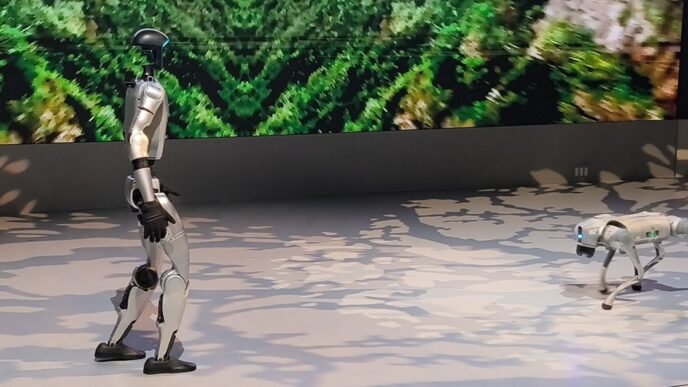
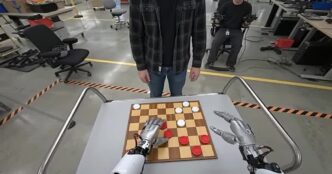
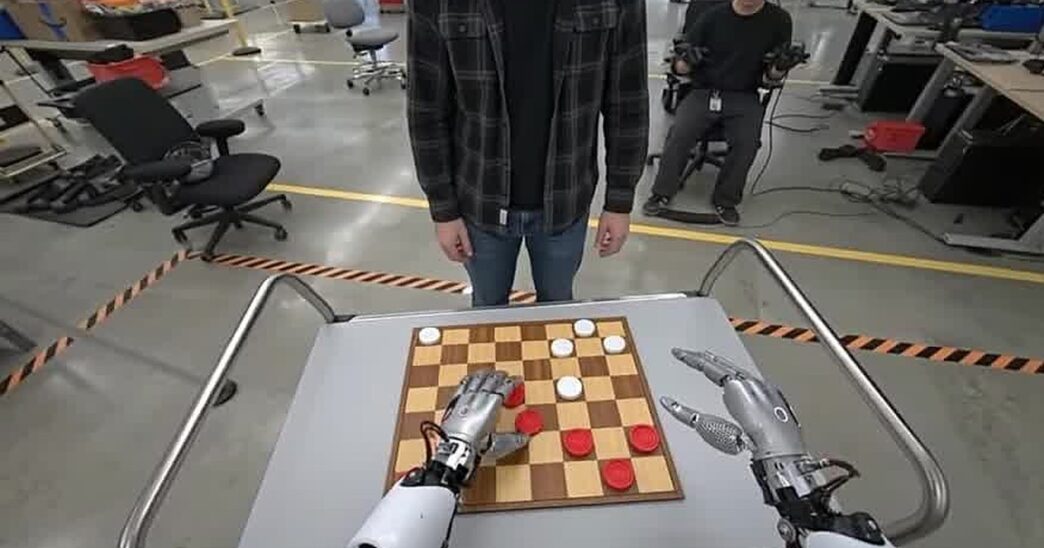
The robotics example comes from the October 27 launch post. Gemini 4 Argon, one of Google’s Gemini 4 models, breaks a task into steps, and the steps are fed to Genie 4 as text captions while it renders. DeepMind says the pair “simulate Apptronik’s Apollo humanoid playing a game of checkers.” In DeepMind’s demo clip, Argon’s steps read like stage directions: the robot’s left hand moves a red piece to a square in the third row while the right hand rests on the railing. Genie 4 then draws that happening.
That is a test of a planner’s instructions, rendered as video. As DeepMind describes it, no robot policy sends motor commands, and nothing in the world reports whether the piece really landed. In the material we read, DeepMind published no success rate, repeat count or real-robot result for the experiment. DeepMind also says Gemini 3.8 Flash serves as “a guiding agent in the loop,” watching incoming frames and checking whether each step succeeded, and the model card says Genie 4 uses Gemini “for reasoning and real-time steering.” So what a viewer sees as physics is partly a language model’s judgment of what should happen next.
Google has made this pitch before. When DeepMind introduced Genie 3 in August 2025, it ran its SIMA agent inside generated worlds, sending navigation actions, and said Genie 3 could “provide a vast space to train agents like robots and autonomous systems.” It listed a “limited action space” as a limitation then. Fifteen months later, the developer version of Genie 4 still exposes eight trained movement and camera inputs.
How it compares with the simulators robot teams use
Robot developers already train in simulation. The difference is what the simulator knows. A physics engine keeps an explicit model of the robot and the scene, so a program can send it control inputs and read back exact positions and contact forces. Genie 4 keeps no such model. Its docs say it works “over a rolling temporal window rather than maintaining a persistent 3D scene graph.”
| Tool | What it is | What a robot program can send | What comes back | Access |
|---|---|---|---|---|
| Genie 4 (Google DeepMind) | Generated interactive world, rendered in real time | Movement and camera keys; text events | 720p video and stereo audio | Closed model, paid Gemini API, about $0.10 a second |
| MuJoCo (Google DeepMind) | Physics engine; the name stands for Multi-Joint dynamics with Contact | Controls for modeled actuators, from motors to hydraulic cylinders | The full simulation state, stepped by mj_step |
Open source, Apache 2.0 |
| Isaac Lab 3.0 with Newton (NVIDIA) | Robot-learning framework; 3.0 released in October 2026 with the Newton physics backend | Actuation inputs (Newton’s Control object) | State arrays and optional contact data | Open source on GitHub |
| Cosmos 3 (NVIDIA) | Open world foundation models: Super 64B, Nano 16B, Edge 4B parameters | Text, image, video, sound and action input | Generated future video; a backbone for robot policies | Open models; post-train on your own robot data |
The Isaac Lab 3.0 release notes describe Newton as a backend covering rigid bodies, deformables and particles, and NVIDIA’s Newton docs describe live State, Control and Contacts objects a training script can read. MuJoCo’s documentation describes the same kind of explicit state. That is what reinforcement learning needs: a reward computed from known positions, thousands of copies running at once and the ability to reset a scene exactly.
Cosmos is the closer cousin. It is also a generative world model, and NVIDIA’s Cosmos page pitches Cosmos 3 as a “physics-grounded world simulator” that takes action input, which is NVIDIA’s claim. Its weights are open, so robot teams can retrain it on their own camera and robot data. NVIDIA built its GR00T 2 robot model on Cosmos, and the world action models we covered last month use video prediction the same way, to output robot actions. Genie 4 is the opposite trade: higher-fidelity worlds and sound, but a closed model behind an API with keyboard-style controls. The Odyssey-3 world model made a similar pitch in October, and its record physics score turned out to rest on a best-of-eight method.
The clearest contrast is inside Google, with the same robot. When Google showed Gemini 4 Argon working with Apptronik’s Apollo in October, Argon wrote a physics simulation from a video of a person playing cornhole, and Google says Apollo then sank seven throws in a row on real hardware. In another Argon workflow, a simulated copy of a real tabletop generated thousands of randomized practice episodes, and Google reported a robot-model success rate rising from 56% to 75% on its internal test. Several of those workflows run in MuJoCo, and this week’s Gemini 4 Hydrogen robotics plugin builds its practice scenes there too. Google’s robot results so far come from physics simulation, not from the world model; Apollo’s checkers game in Genie 4 has no real-world counterpart yet.
Our take: a scenario sketchpad for robot teams, not a training ground yet
Genie 4 is a striking piece of generative AI, and putting it behind a public API with clear prices is a real step for world models. For robot teams, the near-term uses are the visual ones. A lab could draft a warehouse aisle or a kitchen in seconds before modeling it properly, check which lighting and clutter variations a camera-based system should be tested against, or watch whether a planning model’s step list makes sense when it is played out, which is what DeepMind’s checkers demo does. DeepMind’s own example prompts include a Universal Robots UR5 arm holding a pipette, which shows Genie 4 can draw a named industrial robot. It does not know that robot’s joint limits or payload.
It is not a place to train a robot’s motor skills today, for four reasons from Google’s own documentation. There is no robot action space: a program sends keys and sentences, not joint commands. There is no ground truth: the output is pixels and sound, with no state, contacts or reward to learn from. The world drifts: Google says landmarks and buttons can shift after 8 or more seconds out of view, and that exact object counts drift as the camera pans. And it runs in real time, two to ten sessions at once, at about $6 a minute. A robot policy trained on a world that rearranges itself would learn the wrong lesson.
Google’s messaging also needs tidying. The changelog calls Genie 4 generally available and the model page lists genie-4 as stable, while the model card and DeepMind’s Genie page call it a preview. DeepMind’s page says the model supports “around a minute of continuous interaction”; the API allows 120 seconds. Genie 3 in Project Genie now runs up to 3 minutes per generation, longer than its successor in the API. We’d change our view if Google opens an action-conditioned interface that accepts robot actions, returns scene state alongside frames, or publishes a policy trained in Genie worlds and tested on a real robot with success rates.
Claims, docs and our own math: where each point stands
- Verified in Google’s documentation: model code,
v1betaInteractions API, inputs and outputs, 120-second cap, 45-90-second coherence note, prices, rate limits, unsupported features, serving regions, SynthID. - Our calculations: the per-session and daily cost and frame ceilings, from Google’s token rate and rate limits.
- Google DeepMind claims: robot and agent training use, “infinite playground for robotics simulations,” physics realism, the Argon and Apollo checkers simulation.
- Not disclosed: any success rate, repeat count or real-robot transfer result for Genie-based robot work; what the separately priced text output tokens ($9 per million) are used for, which the docs we read don’t explain.
Frequently asked questions
What is Genie 4?
Genie 4 is Google DeepMind’s world model. It generates an interactive, photorealistic world with synchronized audio in real time from a text prompt or an image, which a user can walk through and change with typed events. DeepMind announced it on October 27, 2026, and opened it to developers in the Gemini API on November 19.
How much does the Genie 4 API cost?
Genie 4 requires a paid Gemini API key. Video output costs $17.50 per million tokens at 240 tokens per frame, about $0.10 per second or $6.05 per minute with audio included, and input costs $1.50 per million tokens. A maximum 120-second session costs about $12.10.
Can Genie 4 be used to train robots?
Google says it can help build training environments for robots and agents, and DeepMind has shown Gemini 4 Argon and Genie 4 simulating Apptronik’s Apollo playing checkers. The API accepts only movement keys and text and returns only video and audio, with no joint states, contact forces or rewards, so it is not a substitute for physics simulators such as MuJoCo or NVIDIA Isaac Lab for motor-skill training.
How long can a Genie 4 session last?
Up to 120 seconds in the Gemini API. Google’s model page says coherence and object permanence are strongest in the first 45 to 90 seconds, and the developer guide says objects out of view for 8 seconds or more can shift or reset.
Sources
- Google: “Genie 4 is now available on the Gemini API,” November 19, 2026
- Gemini API release notes, November 19, 2026 (genie-4 generally available)
- Gemini API docs: Interactive world generation with Genie 4 (session lifecycle, controls, limitations)
- Gemini API docs: Genie 4 model page (specifications, session limits, capabilities)
- Gemini API pricing (Genie 4)
- Gemini API rate limits (Genie 4)
- Google DeepMind: Genie 4 model card, published November 18, 2026
- Google DeepMind: “Genie 4: A new generation of world simulation,” October 27, 2026
- Google DeepMind: Genie 4 model page (robotics experiment, limitations)
- Google: “Genie 4 is now available” (Project Genie), November 18, 2026
- Google DeepMind: “Genie 3: A new frontier for world models,” August 5, 2025
- NVIDIA Isaac Lab v3.0.0 release notes on GitHub
- NVIDIA Isaac Lab docs: Newton backend
- NVIDIA blog: GR00T 2, Isaac Lab 3.0 and Newton at CoRL, November 9, 2026
- NVIDIA: Cosmos world foundation models
- MuJoCo documentation: Overview
- Google DeepMind on YouTube: “Genie 4: A new generation of world simulation”
All sources accessed November 20, 2026.
Last updated: November 20, 2026. To report an error, see our corrections page. See our editorial policy.