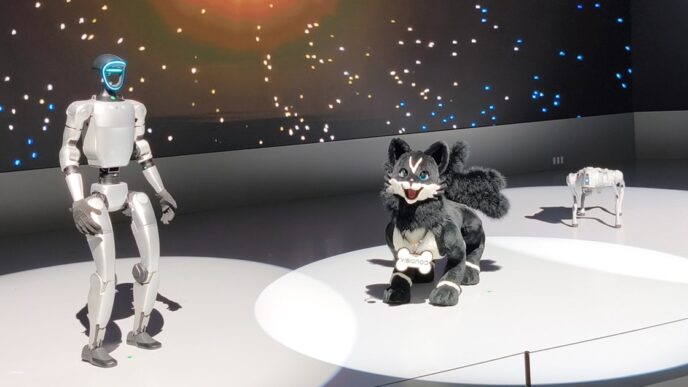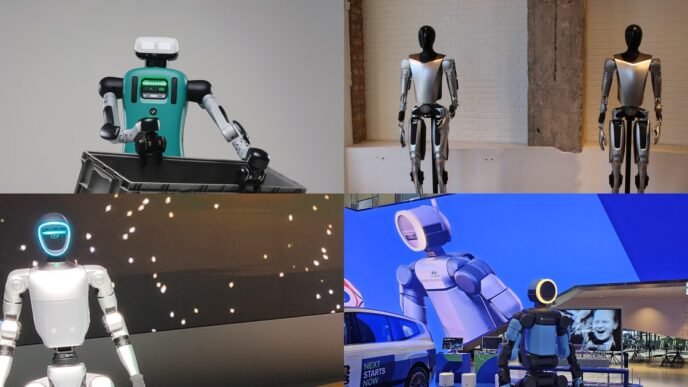
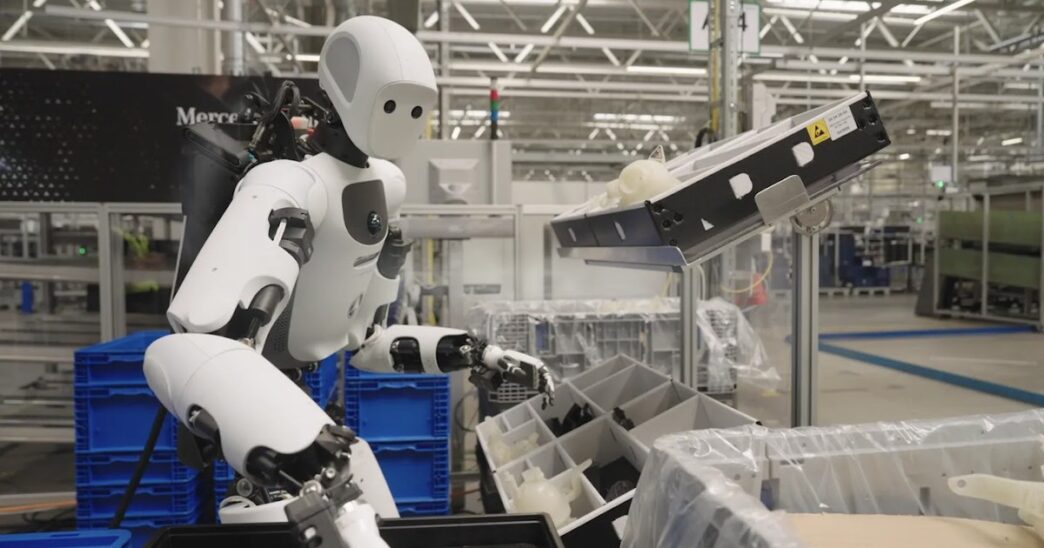
Google DeepMind says its newest robot model has done real work on a car assembly line. Gemini Robotics 2.5, announced on November 10, 2026, is a vision-language-action (VLA) model, the kind that turns camera images and instructions into arm and hand movements. In a proof of concept at two Mercedes-Benz plants, it ran Apptronik’s Apollo 2 humanoid through automotive kitting with what DeepMind calls a 96% success rate. The company also says the model succeeds 30% to 100% more often than its predecessor in the lab and finishes tasks 20% to 30% faster.
The 96% is the number everyone will quote. It’s also the least explained number in the announcement: DeepMind hasn’t said how many picks it covers, how long the robots ran, what counted as a failure, or how often a person stepped in. Here’s what Gemini Robotics 2.5 adds, what the factory pilot does and doesn’t show, and why the safety numbers in the same post don’t measure the same thing.
- What: Gemini Robotics 2.5, Google DeepMind’s new VLA robot model, announced November 10, 2026. It’s rolling out to DeepMind’s robotics partners only, with no public API or price.
- Lab claims (DeepMind’s tests): evaluated on more than 200 tasks; 30% to 100% higher success than the previous baseline depending on task type, and 20% to 30% faster.
- Factory pilot: Apptronik’s Apollo 2 humanoids sorted metal brackets into sequencing trays on Mercedes-Benz lines in Kecskemét, Hungary, and Sindelfingen, Germany, at a 96% success rate. DeepMind labels it a proof of concept.
- The catch: no trial count, run length, failure definition or intervention rate for the 96%; Mercedes-Benz is an Apptronik investor; and the 99.5% jailbreak score belongs to Gemini 4 Argon, not to the new robot model.
What Gemini Robotics 2.5 adds
Gemini Robotics 2.5 is the action half of DeepMind’s robot stack. A separate embodied-reasoning model, Gemini Robotics ER, plans the steps and tracks progress; the VLA moves the arms and hands. When DeepMind launched Gemini Robotics 2 on July 30, it shipped three models, and only the reasoning model, ER 2, was open to developers in preview (our Gemini Robotics 2 explainer). This time there’s one new model, and DeepMind says it is “rolling out to our robotics partners.” The post mentions no API, no pricing and no new ER or on-device version. Ars Technica reported that the 2.5 release still runs on cloud servers rather than on the robot.
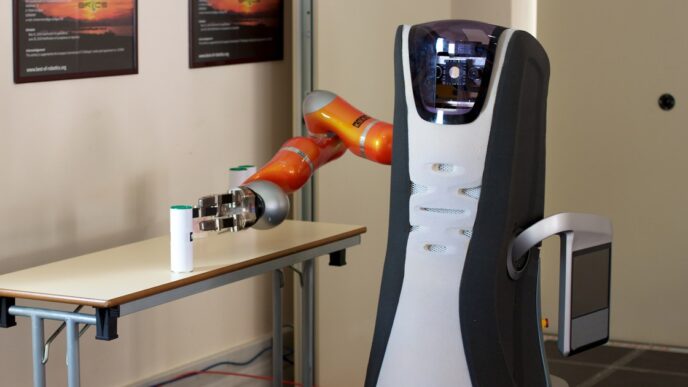
DeepMind says it tested the model on more than 200 distinct tasks, such as serving food with tongs, tying a bow on a gift box and pipetting liquid, on two kinds of hardware: Apollo 2 fitted with Sharpa’s five-finger, 22-degree-of-freedom SharpaWave hand, and a Franka Duo two-arm setup with parallel grippers. Its summary claim is a 30% to 100% higher success rate than “previous baselines,” depending on the type of task, and 20% to 30% faster completion.
The post’s charts compare individual tasks with Gemini Robotics 2. As reported by Humanoids Daily and TechTimes from those charts, most of the examples are tasks the older model couldn’t do at all:
| Task (DeepMind’s examples) | Gemini Robotics 2 | Gemini Robotics 2.5 |
|---|---|---|
| Pack pastries with tongs | 5% | 100% |
| Close a toolbox lid | 0% | 93% |
| Unhang a mug and place it on a table | 29% | 75% |
| Untie a ribbon bow | 0% | 70% |
| Hang a cardigan | 0% | 62% |
| Sweep trash into a dustpan | 0% | 52% |
| Pack a rice cooker | 0% | 40% |
| Fold pants | 0% | 40% |
Two things stand out. First, a jump from 0% can’t be expressed as a percentage gain at all, so the “30% to 100% higher” range must describe category averages, and DeepMind didn’t publish per-task figures for its pick-and-place or kitting and insertion categories. Second, the new model’s scores on these eight examples average 66.5% (our calculation), and half of them are at 62% or below. The factory kitting number, 96%, is far higher than the typical lab task in the same post. DeepMind doesn’t give the number of trials behind any of these percentages.
Inside the Mercedes-Benz kitting pilot
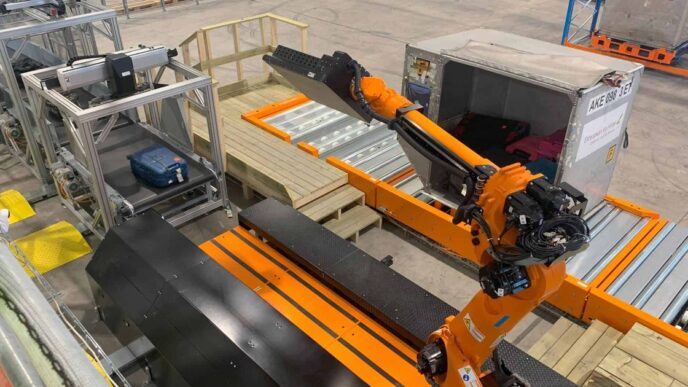
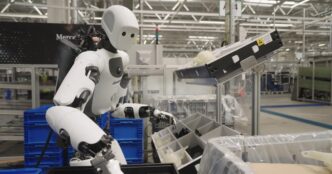
Kitting is a narrow, repetitive job: pull individual parts from bulk bins and lay them into trays or sequencing containers in the exact order the assembly line will use them. DeepMind says Apollo 2 robots did this “autonomously” on active production lines in Kecskemét and Sindelfingen, with the ER model keeping track of the workflow and Gemini Robotics 2.5 controlling the hands and arms, picking metal brackets and “correcting for any gaps.” It calls the 96% figure a pilot result and the project a proof of concept.
Apptronik CEO Jeff Cardenas, quoted in the post, says the models “improve[d] dramatically in just a few weeks of post-training” on Apollo 2 and carried over to Mercedes-Benz production “with very little drop-off.” That’s a claim from the company that builds the robot, about a partner that has invested in it. Mercedes-Benz backs Apptronik, as both Humanoids Daily and TechTimes note, and neither TechTimes nor we (in a search on November 11) found a Mercedes-Benz statement confirming the 96%. DeepMind director Kanishka Rao told Ars Technica that closing the last 4% will be a “steep road.”
Missing from the announcement, and worth asking for before treating 96% as a production number:
- The denominator. 24 of 25 and 960 of 1,000 are both 96%. They mean very different things.
- What a success is. One correct pick, one finished tray, or one shift without a stop.
- Interventions. How often a person reset a part, a tray or the robot.
- Speed. The video is labeled “Autonomous 2x,” so it plays at double speed. Ars reported the same. No cycle time is given.
- Part variety. How many bracket types and sequences the robots handled.
That’s the same gap we found in other car-plant humanoid trials this fall. Xiaomi reported an eight-hour shift sorting center-console covers, with earlier station results of 90.2% and then 98%, but no throughput or intervention numbers (our Xiaomi story). Audi’s parts-sequencing test with Agile Robots, which DeepMind also thanks in its acknowledgements, came with no success rate at all (our Audi story). And AgiBot published a 24-hour store trial in which two of six robots failed its own assessment (our AgiBot G2 story). DeepMind’s pilot has a better-sounding number than any of them and less detail than most.
The safety numbers measure different models
DeepMind’s safety section makes two claims, and they’re easy to blur together. The first is about Gemini Robotics 2.5 itself: “inference-time reasoning guidance” that steers the robot around hazards. DeepMind says it raised safe task completion by 33% around obstacles and 43% around nearby people. Those are relative gains on DeepMind’s own evaluations, with no baseline rates published.
The second claim is about a different model. DeepMind released ASIMOV-Jailbreak, an open benchmark of prompts that disguise unsafe requests, and says Gemini 4 Argon, its frontier model, resists 99.5% of them, up from 82% for Gemini Robotics ER 2. That score is for the planner that decides what to do, not the VLA that moves the hands. We covered Argon’s robotics debut in October, when Google showed it teaching Apollo a cornhole throw (our Argon story).
The benchmark’s numbers also don’t line up across sources yet. DeepMind’s post describes “hundreds of prompts” and gives 99.5% versus 82%. Ars Technica, writing the same day, reported 1,500 prompts and figures of 98.8% with Argon in the loop versus 73.5% for ER 2 alone. The Hugging Face release lists 845 multi-turn jailbreak episodes across 15 strategy groups, plus paired harmful and benign tabletop tasks. Those may be different configurations or a pre-launch draft, but until DeepMind publishes a breakdown, the exact jailbreak number is DeepMind’s claim, and anyone can now rerun it. The release is MIT-licensed.
For context, DeepMind’s safety report for Gemini Robotics 2 gave Apollo 2 “96% reliability in transitioning to a safe pose” in lab tests. Text prompts are also only one way to fool a robot. The camera is another, and that’s where independent testers have started looking.
Argon as a training engine
DeepMind credits much of the jump to Gemini 4 Argon. It says Argon can take one real camera scene, build a digital twin, and generate thousands of simulated practice runs that are mixed with real demonstrations, and that it helped researchers work out why tasks failed by reviewing video. Humanoids Daily reports DeepMind credits Argon for a four-month turnaround since Gemini Robotics 2.
That’s the same bet NVIDIA made a day earlier with GR00T 2, which leaned on simulated and human-video data and reported 71% one-shot and 95% five-shot success on 50 tasks (our GR00T 2 story). Anthropic, also on November 9, claimed Claude Fable 5.2 more than doubled GPT-6 Astra on a simulated robot-arm benchmark (our Fable 5.2 story). Frontier labs now want their general models to be part of how robots learn. DeepMind doesn’t say how much of 2.5’s gain came from Argon’s simulations and how much from more real-robot data or partner post-training.
What it means for buyers and rivals
For car makers, the pitch is generalization: one model that can be post-trained for a new station in weeks, rather than a cell programmed for one job. DeepMind’s robotics head, Carolina Parada, put the trade-off plainly to Ars: a team can be “very good at a particular application at the cost of generalization,” or push generality and “maybe not get to 99.9 in every application.” A plant manager will hear that as “not yet.”
For Apptronik, the pilot is the most concrete evidence yet that Apollo 2 does useful work outside its own Robot Park. For rivals, it raises the bar on disclosure in an odd way: DeepMind now owns the most quotable factory success rate in humanoids, while giving less detail behind it than Xiaomi or AgiBot did.
What to watch: a technical report or model card with trial counts; whether Mercedes-Benz says anything about moving from proof of concept to paid deployment; an on-robot version; and whether outside labs rerun ASIMOV-Jailbreak on other models now that it’s public.
Frequently asked questions
What is Gemini Robotics 2.5?
Gemini Robotics 2.5 is Google DeepMind’s vision-language-action model for controlling robots, announced on November 10, 2026. It turns camera images and instructions into arm and hand movements, and works alongside the Gemini Robotics ER reasoning model, which plans tasks.
Can developers use Gemini Robotics 2.5?
Not yet. DeepMind says it is rolling out to its robotics partners. The announcement gives no API access, pricing or public release date.
What did Apollo 2 do at Mercedes-Benz?
In a proof of concept at the Kecskemet and Sindelfingen plants, Apptronik’s Apollo 2 humanoids picked metal brackets from bulk bins and placed them into sequencing containers for the assembly line. DeepMind reports a 96% success rate but hasn’t published the number of trials or the intervention rate.
How much better is Gemini Robotics 2.5 than Gemini Robotics 2?
DeepMind says it succeeds 30% to 100% more often depending on the task type and finishes tasks 20% to 30% faster. Several example tasks went from 0% to between 40% and 93%. These are DeepMind’s own lab tests.
What is ASIMOV-Jailbreak?
ASIMOV-Jailbreak is an open benchmark from Google DeepMind, released on Hugging Face under the MIT license, that tests whether an AI model controlling a robot can be talked into unsafe actions. DeepMind says Gemini 4 Argon resists 99.5% of its jailbreak attempts, versus 82% for Gemini Robotics ER 2.
Sources
- Google DeepMind (Carolina Parada): “Gemini Robotics 2.5 accelerates real-world general dexterity,” November 10, 2026 (text, charts and the Apollo 2 at Mercedes-Benz video)
- Hugging Face: google/asimov_agentic dataset card, ASIMOV-Jailbreak section (MIT license, checked November 11, 2026)
- Ars Technica: “DeepMind reveals Gemini Robotics 2.5 and open safety benchmark ASIMOV-jailbreak,” November 10, 2026 (Rao and Parada quotes, cloud inference, 2x video, benchmark figures)
- Humanoids Daily: “Gemini Robotics 2.5 Puts Apollo 2 on Mercedes-Benz Lines as Argon Speeds Up Training,” November 10, 2026 (per-task chart values)
- TechTimes: “Gemini Robotics 2.5 Reports 96% Success Sorting Mercedes Car Parts but Publishes No Trial Count,” November 11, 2026
All sources accessed November 11, 2026.
Last updated: November 11, 2026. To report an error, see our corrections page. Articles are drafted with AI assistance and reviewed and edited by an editor; see our editorial policy.