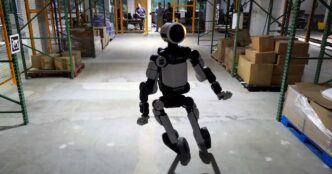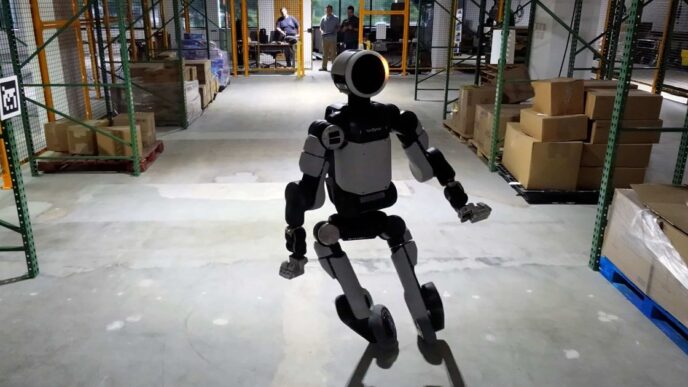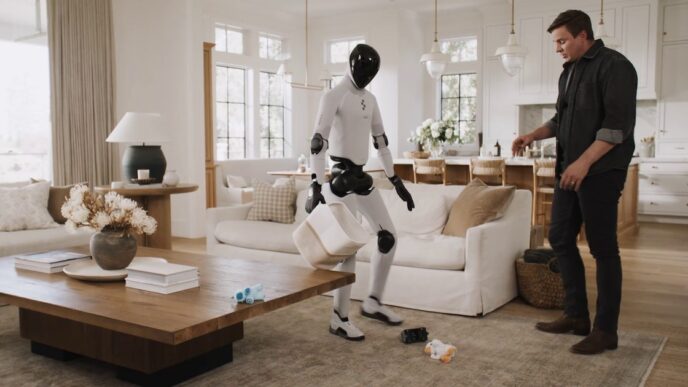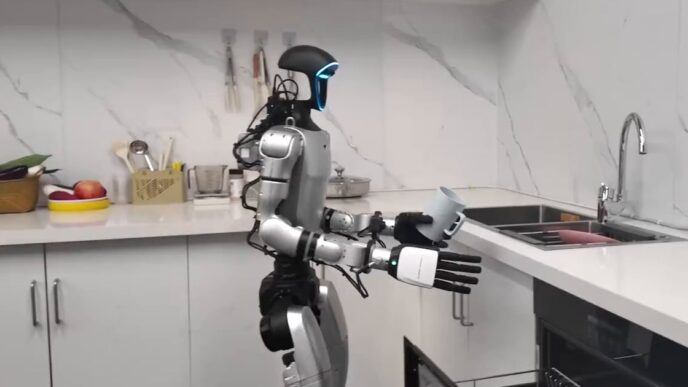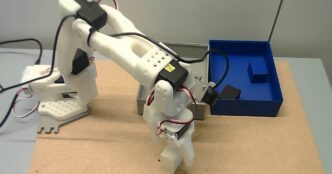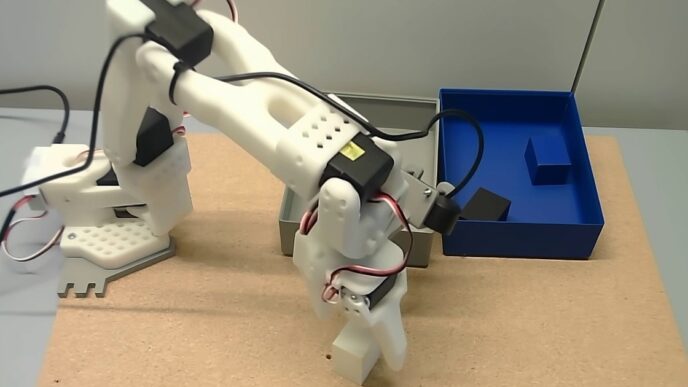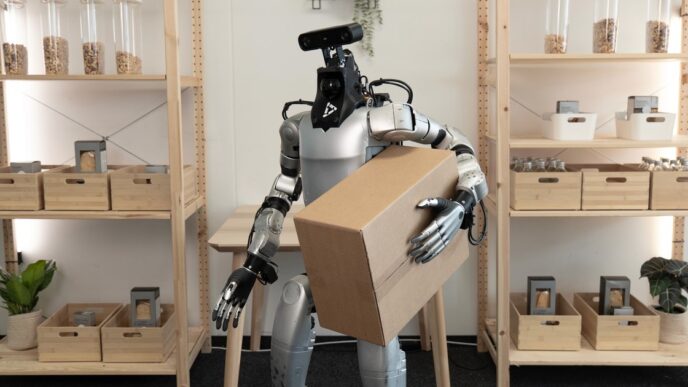
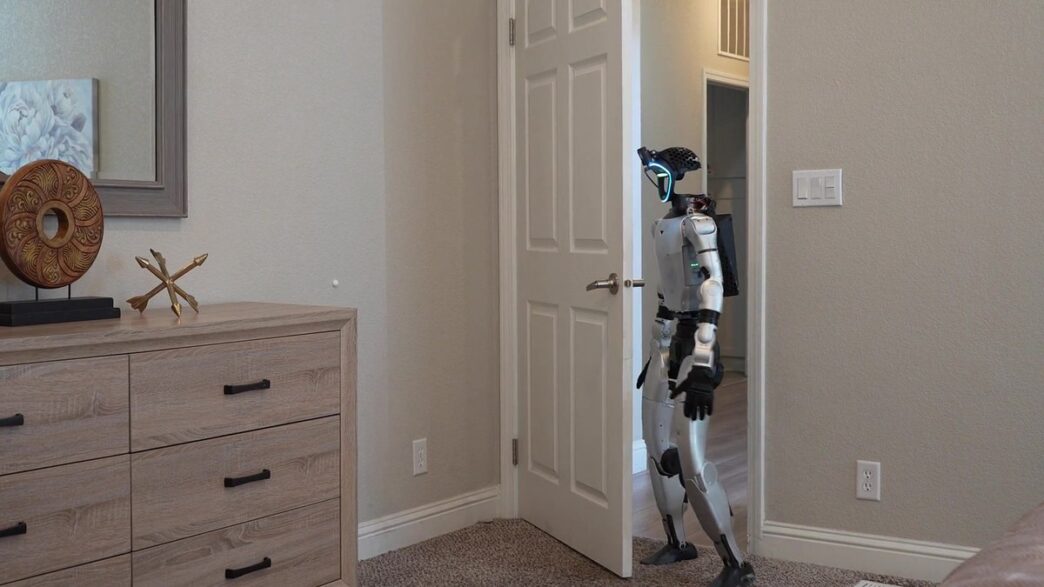
Apple’s machine learning researchers taught a Unitree G1 humanoid to sit on chairs, crawl under tables, sidestep through half-open doors and push boxes in houses it had never seen, and the robot never practiced in a real home first. Every training example came from 1,000 rooms that exist only in simulation. In 360 real-world trials across six homes nobody had scanned or mapped, the system Apple calls HALO succeeded 91% of the time, according to the paper the team posted to arXiv on November 4.
The Apple HALO humanoid work matters less for the tricks than for the bill. Most humanoid data today comes from people steering robots by remote control, and the paper puts the cost bluntly: an hour of that data takes at least an hour of human time. Apple’s pipeline swaps the people for GPUs. If that holds up beyond six skills, the bottleneck in humanoid learning shifts from operators to compute, which is a cost that falls every year. It also comes from a company that has never said it’s building a robot.
- What: HALO (“Humanoid Autonomy, Learned in simulation, running Onboard”), a research system from eight Apple researchers for the Unitree G1, posted on arXiv on November 4, 2026, with code on GitHub.
- Result: 91% success over 360 real trials of six skills in six unmapped rooms (10 trials per skill per room). Chained two- and three-step tasks averaged 70% in one real room.
- How: 296 hours of synthetic training episodes from 1,000 procedurally generated homes, made in 48 hours on 250 H100 GPUs, with no teleoperation. Everything runs on the robot, including a Mac mini M4 Pro in a backpack.
- The catch: it’s a research result with ten fixed instructions, people still recorded the keyframes for several skills, and no trained weights or dataset ship with the code.
Apple HALO’s training data came from 1,000 homes that don’t exist
The paper lists eight authors, all at Apple, led by Siyuan Hu, with Vladlen Koltun as the final author. Their pipeline builds a training episode in three steps. A motion model called Kimodo, which the repository downloads from NVIDIA’s Hugging Face account, generates a whole-body motion for a task such as “walk forward, turn around, sit on chair.” The procedural scene generator Infinigen builds a room around it. A simulator then renders what the robot’s head camera would see, using a virtual fisheye lens matched to the real one and randomized blur, noise, lighting and color to blunt the gap between simulated and real pixels.
The appendix gives the scale. The team generated 1,200 rooms, of which 1,178 finished (the furniture solver crashed on the other 22), and trained on 1,000 of them: 45% living rooms, 30% offices and 25% bedrooms, each 3.5 to 9.5 meters on a side with 20 to 80 objects. The finished corpus holds 162,698 episodes and 296.3 hours of data, which the abstract rounds to 300. Generating it took 48 hours across 250 NVIDIA H100 GPUs “without human intervention,” the paper says. The motion generator trained on 64 B200 GPUs and the low-level tracker on 4 H100s.
Quality control is automatic, too. Because Kimodo generates motion without physics, its output can slide a foot, sink into the floor or hop. For the sitting skill, Apple scores candidates against 33 geometric checks and keeps the best one. Of 50,000 sitting episodes generated, 77% passed all the hard checks, and 25,349 went into the corpus.
Three layers, and a Mac mini on its back
HALO runs entirely on the robot. Apple’s G1 carries two additions: a head mount with an OAK-1W wide-angle camera and a rear enclosure holding a Mac mini M4 Pro with 64 GB of memory, which brings the robot to 37.56 kg. The stack splits into three loops, per the paper and Apple’s project page:
- Orchestrator, about every 2 seconds: an off-the-shelf language model, by default Qwen3.6-35B-A3B in 4-bit form on the Mac mini, turns a spoken request into subtasks, checks the camera image to see whether each one worked and retries if it didn’t. It can optionally call a cloud model instead.
- Motion generator, about 3 times a second: a frozen Qwen3.5-2B vision-language encoder plus a diffusion transformer turns the camera image and the current subtask into a five-second whole-body plan of 150 frames. Apple measured about 152 ms per plan on the Mac mini.
- Tracker, 50 times a second: a reinforcement-learning policy on the G1’s built-in Jetson Orin NX follows that plan for all 29 joints, using depth from the robot’s own RealSense camera to place its feet and hands where the furniture actually is.
That last layer is the part the authors argue is new. Most systems that generate whole-body motion hand it to a “blind” tracker that only feels its own joints. HALO’s tracker sees. In Apple’s own ablation, taking depth away dropped sitting success in simulation from 84% to 74%.
What the 91% does and doesn’t measure
The single-task test is more rigorous than most humanoid demos. Each of six skills ran ten times in each of six real rooms that were never in the training data, 360 trials in all, and a run counted as a success only if the robot finished without falling or getting stuck. Apple’s numbers from Table II of the paper:
| Skill | Simulation (100 held-out rooms) | Real world (6 rooms) |
|---|---|---|
| Walk to a named object | 98% | 92% |
| Sit on a chair | 84% | 85% |
| Sidestep through a half-open door | 91% | 93% |
| Crouch under a table | 95% | 100% |
| Crawl under a table | 84% | 90% |
| Push a box | 93% | 88% |
| Chained tasks (3 sequences) | 69% | 70% |
The chained number is the one to read carefully. It comes from three multi-step sequences, ten trials each, in a single real room, so 30 runs. The hardest, crouch under a table, walk to a box, then push it, succeeded half the time. Apple’s own diagnosis is specific: in three of the five failed trials, the robot came out of the crouch facing away from the box, never got it into view and got distracted by other objects. The fix the authors suggest, basic search and turn-in-place behaviors, doesn’t exist in this version.
Ten trials per room is also a small sample for a reliability claim. NVIDIA’s GR00T 2 team made the same point about its own benchmarks this week, calculating that telling a 95% robot from a 99% robot takes about 285 trials per policy. HALO’s 91% is a strong research number. It isn’t a reliability rating for a robot in your living room.
“No teleoperation” isn’t the same as “no humans”
The headline claim is accurate: HALO’s corpus contains no teleoperation, no wearable capture suit and no scan of the test homes. But people are still in the loop, and the appendix says where. The crawl and crouch skills are guided by six keyframes taken from phone videos of a person going under a table, lifted into 3D and edited by hand. The push skill splices a generated walk onto a motion-capture recording of a person pushing a box. The sitting skill ends on a pose logged from a real G1, the door poses were hand-edited, and the tracker’s early training also used LAFAN1, a public library of human motion-capture clips.
The bigger limit is how the skill list grows. The paper says it plainly: adding a new task “still requires a human to write its prompt and author the keyframes of its motion sequence.” The whole corpus uses ten instructions, from “sit arm_chair” to “push box.” The orchestrator can understand a free-form request, but it can only translate it into one of those ten. There are no grasps, no doors opened by hand and no objects carried. The robot reaches the chair. It doesn’t make the coffee.
How HALO stacks up against other G1 brains
The Unitree G1 has become the default lab humanoid, and that makes comparisons possible. NVIDIA’s free Metatron policy also walks, sits and gets up on a G1, but the robot in NVIDIA’s videos was wired to a laptop with an RTX 5090. HALO is untethered. Berkeley’s SuperMimic trains a blind whole-body tracker in three hours on one GPU, but it’s tested on flat ground with motions it already knows, while HALO’s tracker uses depth to handle furniture it has never seen. Alibaba’s Lambda-0 uses the same Qwen3.5-2B backbone as HALO’s motion generator, but it learns from 500 hours of first-person human video instead of simulation.
The compute bill is modest by humanoid standards. HALO’s data generation works out to about 12,000 H100 GPU-hours (48 hours times 250 GPUs, our arithmetic), not counting training. That’s below the roughly 21,000 GPU-hours NVIDIA reported for its SONIC motion tracker on slower L40 GPUs, though the two jobs aren’t the same. Compare that with South Korea’s new humanoid data factory, where people teleoperate 12 robots to collect demonstrations by hand. Apple’s argument is that the second model doesn’t scale, and our guide to teleoperation and autonomy explains why buyers should care which one a demo used.
The hardware isn’t exotic either. Unitree’s store listed the base G1 at $13,500 when we checked its prices in October, before tax, shipping and the Mac mini and cameras Apple bolted on. Apple doesn’t say which G1 version it used.
What you can download, and what you can’t
Apple released the code on GitHub on November 4 under its own license, which allows use, modification and redistribution on Apple’s terms rather than a standard open-source license such as Apache 2.0. It covers the data generator, the motion generator, the tracker’s three-phase training, the orchestrator and launchers for simulation and the real robot. The repository’s own documents are clear about the gap: “No weights ship with the repository,” and no trained generator checkpoint or dataset is included. To reproduce HALO, you would regenerate the corpus and retrain both models yourself, on hardware on the scale the paper describes.
Apple hasn’t announced a robot product, and nothing in the paper points to one. AppleInsider’s coverage brought up leaks about a future Apple home device; that’s speculation, not an Apple statement. What the paper does show is an Apple research team that can make a $13,500 Chinese humanoid useful in strange rooms without a single teleoperated demonstration.
What to watch next
Three things would turn HALO from a strong paper into a platform. Trained weights would let other labs test the 91% on their own G1s. A skill that uses the hands, rather than pushing a box with them, would show whether simulation can teach manipulation as well as movement. And a longer chained test in more than one room would show how far the orchestrator can go before the robot loses sight of what it’s looking for.
Frequently asked questions
What is Apple HALO?
HALO is an Apple research system that lets a Unitree G1 humanoid follow spoken requests such as “sit on the chair” or “crawl under the table” in rooms it has never seen. Apple researchers trained it entirely on simulated data from 1,000 generated homes and described it in an arXiv paper posted on November 4, 2026.
Is Apple building a humanoid robot?
Apple hasn’t said so. HALO is a research paper that uses an off-the-shelf Unitree G1 with an added camera and a Mac mini, and Apple hasn’t announced any robot product.
Was the HALO robot teleoperated?
No. Apple says the real-robot runs were fully autonomous and that no teleoperation data was used for training. People did contribute some reference motions, such as phone videos of a person crawling under a table and a motion-capture clip of a box push.
How successful was HALO in real homes?
Across 360 single-skill trials in six real rooms, HALO succeeded 91% of the time, according to Apple’s paper. Chained tasks of two or three steps averaged 70% across 30 trials in one room.
Can I download Apple’s HALO model?
You can download the code from Apple’s ml-halo repository on GitHub, but no trained weights or dataset are included. You’d need to generate the training data and train the models yourself.
Sources
- Hu, Abuduweili, Meng, Liu, Leboutet, Chen, Müller and Koltun (Apple): “Perceptive Humanoid Motion from Simulation,” arXiv:2611.06908v1, submitted November 4, 2026 (Tables I-IV and IX, appendices A-G)
- HALO project page: stack description, gallery, training overview and overview video
- apple-aiml-research/ml-halo on GitHub: code, READMEs (“No weights ship with the repository”) and LICENSE, created November 4, 2026 (US Eastern)
- Humanoids Daily: “Apple’s HALO Teaches a Unitree G1 to Navigate Unseen Rooms With Simulation-Generated Data”
- AppleInsider: “M4 Pro Mac mini powers staggeringly capable robot,” November 9, 2026
- NVIDIA GEAR: GR00T 2 project page and whitepaper (trial-count estimate), November 2026
All sources accessed November 10, 2026.
Last updated: November 10, 2026. To report an error, see our corrections page. Articles are drafted with AI assistance and reviewed and edited by an editor; see our editorial policy.